Solar shading analysis software shows how trees, nearby buildings and roof parts block sunlight on a solar site. It estimates how much power that shade will cost. Aurora Solar ranks first at 83.3/100 for US home installers who want shade reports with no roof visit.
This page ranks 7 tools on shade analysis alone. It looks at how each tool captures shade and what its report proves. Some tools model shade from images, some simulate it for engineers, and some measure it on site.
For how the 3D model is built, see our 3D solar design software guide. For tools that spot roof obstacles for you, see our AI solar design software guide. For a ranking across every design job, see our best solar design software list.
Quick picks
Rank | Product | Best for | Starting price (company page, checked October 2026) | Shade method | Free plan / trial | Score /100 |
|---|---|---|---|---|---|---|
1 | Remote residential shade reports | ✓ USD 159 per user per month | Modelled (imagery, LIDAR on Premium) | None stated | 83.3 | |
2 | 3D shading plus simulation in Europe | ✓ EUR 845 per year plus VAT | Modelled (desktop 3D scene) | 30-day trial | 80.3 | |
3 | Shading losses in bankable yield reports | ✓ CHF 700 per year | Modelled (3D near-shading scene) | 30-day evaluation | 78.2 | |
4 | C&I shade and wiring losses | ✓ USD 159 per month | Modelled (LIDAR on Pro) | Free trial (length not stated) | 73.1 | |
5 | Pay-per-job residential design | ✓ GBP 4 per project | Modelled (imagery) | 5 free project credits | 72.3 | |
6 | Drone-based on-site shade | Quote only | Measured (drone) and remote | Demo only | 69.0 | |
7 | Shadow analysis in sales designs (India, US) | ✓ USD 159 per month (international list) | Modelled (3D) | Demo only | 67.5 |
✓ Verified on the company’s own pricing page. ◐ Published by the company outside its pricing page (help centre, store or press release). ? We could not read the company’s pricing page, so the figure is not confirmed. Prices checked October 2026.
Quote only means the company shows no public price. You ask it for a quote.
How the 7 tools scored
- Use-case fit 35%
- User reviews 20%
- Pricing 15%
- Ease of use 10%
- Support 10%
- Momentum 10%
Tool | Score chart | Score |
|---|---|---|
83.3 out of 100 | 83.3 | |
80.3 out of 100 | 80.3 | |
78.2 out of 100 | 78.2 | |
73.1 out of 100 | 73.1 | |
72.3 out of 100 | 72.3 | |
69 out of 100 | 69.0 | |
67.5 out of 100 | 67.5 |
Each bar shows the weighted score out of 100.
Sub-scores at a glance (0-10)
Product | Use-case fit | User reviews | Pricing | Ease of use | Support | Momentum | Total /100 |
|---|---|---|---|---|---|---|---|
9.4 | 7.9 | 8.0 | 7.5 | 7.5 | 7.5 | 83.3 | |
10.0 | 5.4 | 8.0 | 7.5 | 7.5 | 7.5 | 80.3 | |
8.9 | 6.3 | 8.0 | 5.0 | 7.5 | 10.0 | 78.2 | |
8.9 | 6.2 | 8.0 | 7.5 | 5.0 | 5.0 | 73.1 | |
5.6 | 6.7 | 8.0 | 7.5 | 10.0 | 10.0 | 72.3 | |
9.4 | 5.0 | 4.0 | 5.0 | 5.0 | 10.0 | 69.0 | |
6.7 | 6.3 | 6.0 | 7.5 | 10.0 | 5.0 | 67.5 |
A 5.0 on reviews, ease, support or momentum is our neutral value where public evidence is thin, not a judgement.
What is the difference between modelled and measured shade?
Shade tools fall into three groups.
- Remote, modelled from imagery or LIDAR (laser height data): Aurora Solar, HelioScope, Pylon and Arka 360, plus OpenSolar and Solargraf (also considered). They are fast enough for sales. How exact they are depends on the imagery and LIDAR in your area.
- Engineering simulation: PV*SOL premium and PVsyst, plus DNV SolarFarmer (also considered), model near shading in a 3D scene and turn it into yield losses (lost power output). They take in weather data from sources such as Meteonorm.
- Measured on site: Scanifly (drone models with on-site Viewshed shading). Solmetric SunEye-210 (fisheye camera) and Solar Pathfinder (optical dome) are under "Also considered".
One group cannot stand in for another. Aurora’s home shade report does not replace a PVsyst or SolarFarmer yield study for a utility plant.
How did we rank the best solar shading analysis software?
How the score is weighted
- Use-case fit 35%
- User reviews 20%
- Pricing 15%
- Ease of use 10%
- Support 10%
- Momentum 10%
We scored 13 products from 22 to 25 October 2026 and ranked the top 7. The other six are under "Also considered". One of them fell below our minimum match score (4 out of 10).
This was desk research from company docs, pricing pages and public reviews. We did not run shade studies or use the hardware. We used six weighted tests:
- Use-case fit (35%): How well it does this page’s job. The shading method and output in the docs come first. Then come yield, survey and imagery support.
- User reviews (20%): G2 and Capterra ratings. Ratings from only a few reviews count for less.
- Pricing (15%): Published prices beat quote-only. One-time hardware prices score a little below published software plans.
- Ease of use, support, momentum (10% each): Review sub-scores and dated releases. With no proof either way, a tool gets a middle score.
Products below the minimum score, and those outside the top 7, go to "Also considered". Scores are for this page only, so the same tool can score differently elsewhere. SurgePV is not part of this ranking. Full method: how we score software.
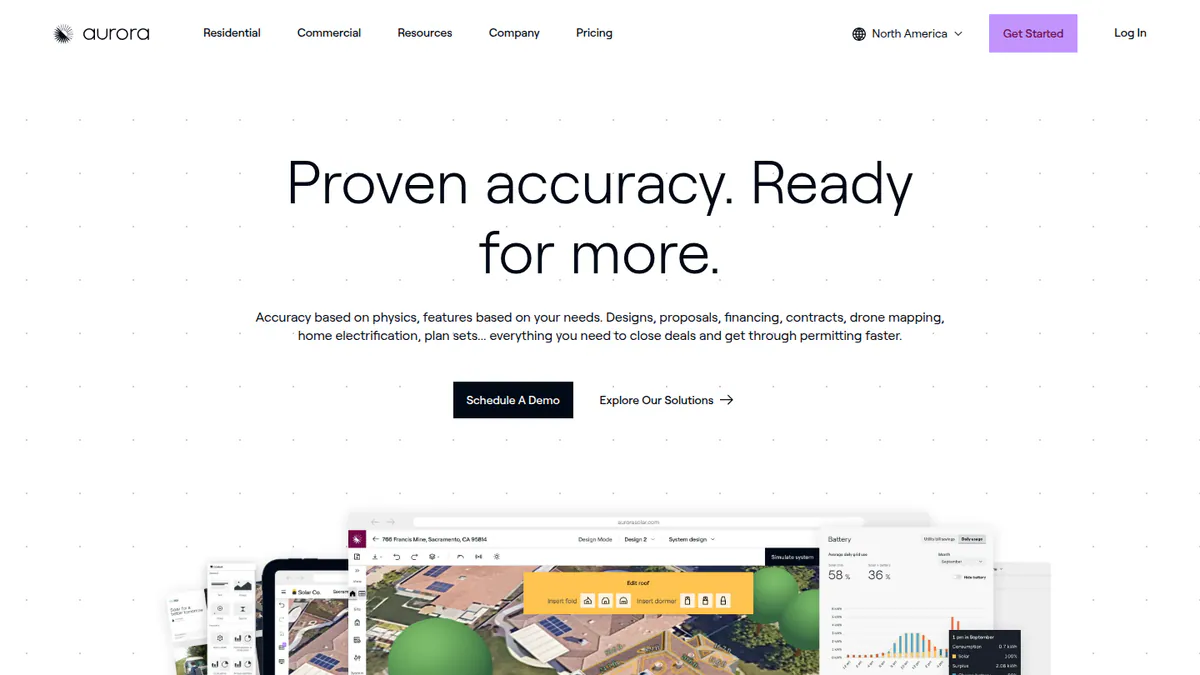
1. Aurora Solar: best for remote residential shade reports
Best for: US home installers who make shade reports with no roof visit. Score: 83.3/100.
What it is: Aurora Solar Inc. makes this cloud tool for design and proposals. Its main buyers are US home installers. Aurora sends large commercial and industrial (C&I) and utility work to HelioScope.
Why we picked it: It makes remote shade reports from LIDAR-assisted 3D models, so you can skip the roof visit. G2 users rate it 4.7/5 from 121 reviews.
Key features:
- Shade analysis on the 3D design.
- LIDAR-assisted modelling and bankable (lender-accepted) shade reports (Premium).
- Output modelling and battery modelling.
- Proposals with financing.
- AI site models and drone mapping (Enterprise).
Pricing: Basic costs USD 159 per user per month (USD 135 billed annually). Premium costs USD 259 (USD 220 annually). Enterprise is custom, per project. Checked October 2026 on the Aurora pricing page.
Pros (from user reviews):
- Shade reports and output estimates you can trust, and LIDAR shows roof obstacles (Capterra).
- Accurate designs and strong customer service (G2).
- New staff learn fast from its videos and knowledge base.
Cons (from user reviews):
- Heavy memory use slows weaker machines (2019 reviews).
- Proposal and finance features are thin for the cost.
- Few links to other software.
Reviews: G2 4.7/5 (121 reviews), Capterra 4.1/5 (7 reviews), checked October 2026.
Read our full Aurora Solar review or our Aurora Solar alternatives.
Want to see Aurora Solar working? Book a demo with the SolarSoftwares team.
Book a demoYour request goes by email to the SolarSoftwares team. A time is set only after we reply. It does not change any score or ranking.
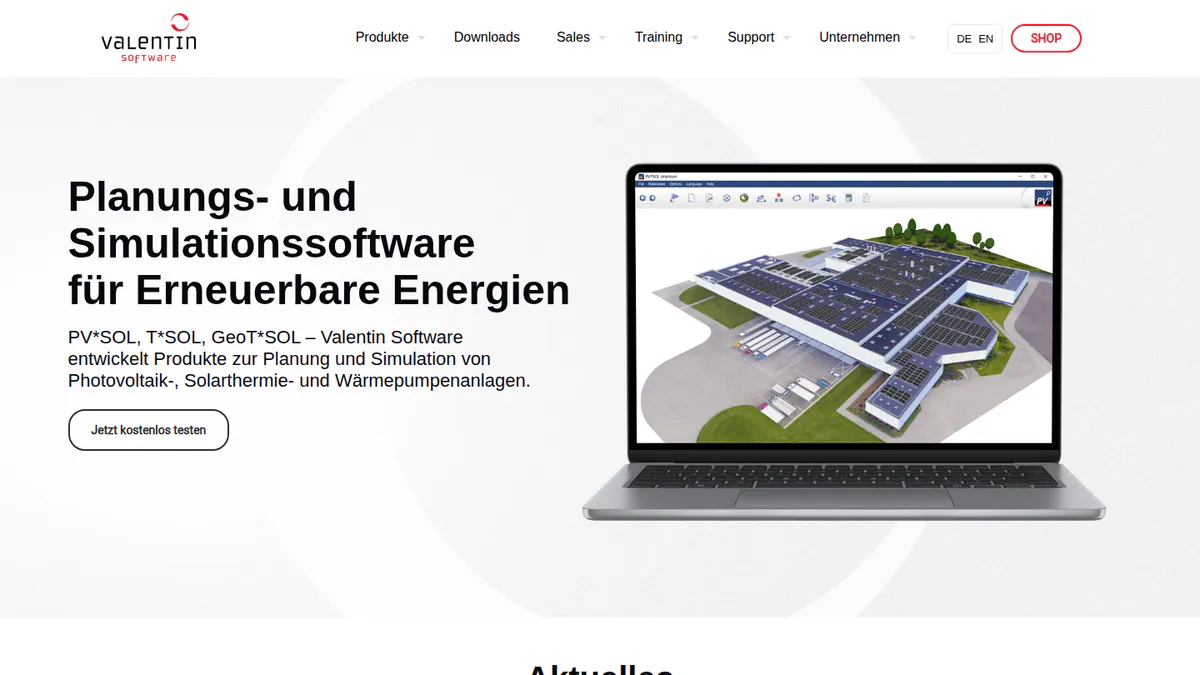
2. PV*SOL premium: best for 3D shading plus simulation in Europe
Best for: European planners who want shading, storage and load modelling in one desktop project. Score: 80.3/100.
What it is: Valentin Software’s desktop program does both design and yield modelling. Its main users are European planning offices doing home and C&I systems. The 2026 version came out on 24 November 2025.
Why we picked it: It models detailed shading on a 3D scene and feeds it straight into yield simulation. Prices are published, and G2 users rate it 4.2/5.
Key features:
- 3D PV design with detailed shading checks on the scene.
- Modelling that uses Meteonorm 9 climate data for weather.
- AC- and DC-coupled battery storage.
- Heat pump and EV loads per user.
- Export of customer slides (PDF/DOCX).
Pricing: EUR 845 per named user per year or EUR 285 for 3 months, plus VAT. Checked October 2026 in the Valentin shop.
Pros (from our research):
- You see shading losses and yield in one model, with no export step.
- Clear prices, and you can buy 3 months for a busy season.
- A major release every year keeps it current.
Cons (from our research):
- Desktop only, so there is no browser access in the field.
- Each licence covers one named user, so every planner needs a seat.
- Shade comes only from the 3D scene you build. We found no way to import site measurements.
Reviews: G2 4.2/5 (12 reviews), checked October 2026.
What we could not confirm: What users like or dislike, as G2 shows no review text for it.
Read our full PV*SOL premium review or our PV*SOL alternatives.
Want to see PV*SOL premium working? Book a demo with the SolarSoftwares team.
Book a demoYour request goes by email to the SolarSoftwares team. A time is set only after we reply. It does not change any score or ranking.
3. PVsyst: best for shading losses in bankable yield reports
Best for: Engineers who need shading inside P50/P90 (expected and conservative yield) reports. Score: 78.2/100.
What it is: Many engineers, EPCs (firms that engineer, buy and build solar projects) and consultants treat PVsyst as the standard lenders trust. It is Windows desktop modelling software from PVsyst SA in Switzerland. It is not a sales or proposal tool.
Why we picked it: Its 3D near-shading scene, with electrical mismatch, feeds the P50/P90 reports that lenders’ advisers expect. The price is published.
Key features:
- 3D near-shading scene with electrical mismatch losses.
- Detailed loss diagram and P50/P90 yield reports.
- Weather inputs such as Meteonorm 9, PVGIS, NSRDB and Solargis.
- Bifacial modules and trackers with backtracking.
- Battery and self-consumption plans.
- PVsystCLI to run many jobs in one go (CHF 3,000 per year).
Pricing: PVsyst 8 Professional costs CHF 700 per seat per year. Buying more seats cuts the price by up to 20%. Student costs CHF 25 per year. Checked October 2026 in the PVsyst shop.
Pros (from user reviews):
- Detailed, accurate yield results you can defend in a report.
- Thorough loss checks, so you see exactly what shade costs you.
- You can bring SketchUp models in to build 3D shading scenes.
Cons (from user reviews):
- Dated, complex screens (G2 ease of use 6.7/10).
- Steep learning curve.
- Setting up 3D scenes takes time.
Reviews: G2 4.5/5 (22 reviews), checked October 2026. Pros and cons are G2 reviewer themes from G2’s comparison page.
Read our full PVsyst review or our PVsyst alternatives.
Want to see PVsyst working? Book a demo with the SolarSoftwares team.
Book a demoYour request goes by email to the SolarSoftwares team. A time is set only after we reply. It does not change any score or ranking.
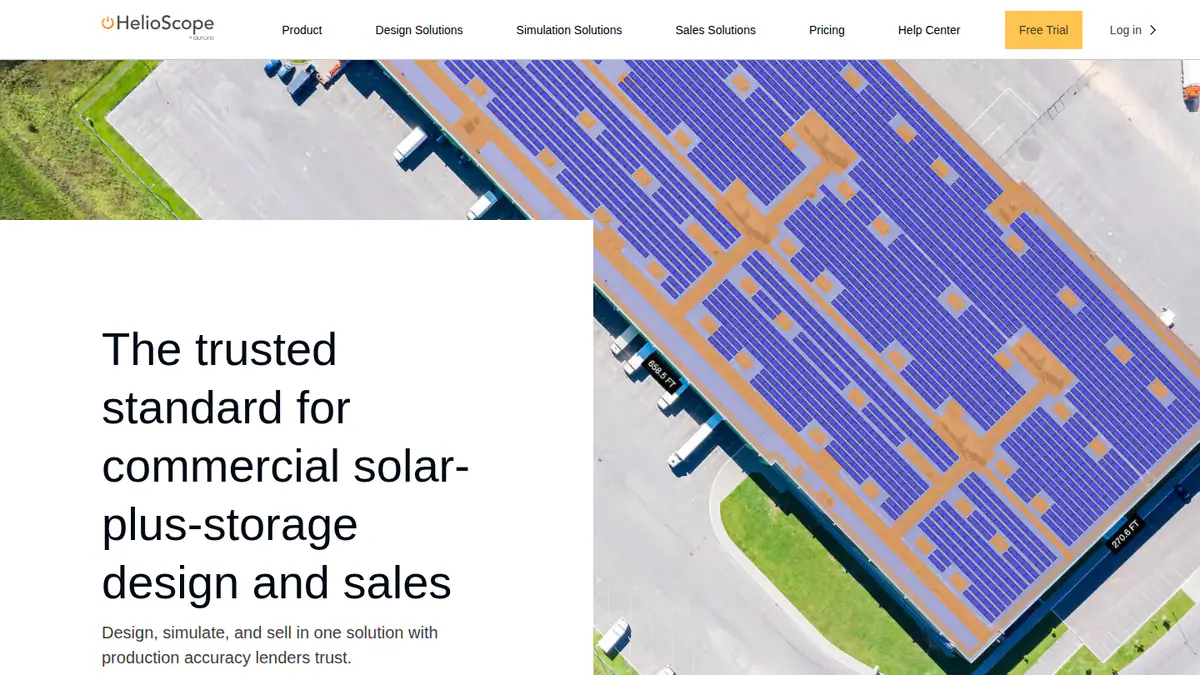
4. HelioScope: best for C&I shade and wiring losses
Best for: C&I rooftop and carport projects up to 30 MW DC. Score: 73.1/100.
What it is: HelioScope is a design and modelling tool for business jobs. Aurora Solar owns it and runs it as a separate product. It is built for C&I rooftop and carport designers, on projects up to 30 MW DC.
Why we picked it: It works out shading and wiring losses together, with LIDAR and P90/P95/P99 values on Pro. Prices are published, and G2 users rate it 4.5/5.
Key features:
- Shading and wiring-loss modelling.
- LIDAR, AI that spots roof obstacles, and P90/P95/P99 values (Pro).
- Rooftop, carport and ground-mount layout.
- Storage design.
- Trackers and PVsyst export (Enterprise).
Pricing: Basic costs USD 159 per month (USD 1,620 per year if billed yearly), up to 1.25 MW DC. Pro costs USD 259 per month (USD 2,640 per year if billed yearly), up to 5 MW DC. Enterprise is custom. Checked October 2026 on the HelioScope pricing page.
Pros (from user reviews):
- Fast, accurate shading and wiring-loss numbers.
- New users pick it up quickly.
- Quick reports to hand to the customer.
Cons (from user reviews):
- Costly if you only use it now and then.
- Project limits get in the way on large systems.
- Older reviews said it lacked battery and tracker support. Storage is now listed, but trackers need Enterprise.
Reviews: G2 4.5/5 (19 reviews), checked October 2026. Aurora says its output estimates are within 1% of PVsyst. We have not checked that claim.
Read our full HelioScope review or our HelioScope alternatives.
Want to see HelioScope working? Book a demo with the SolarSoftwares team.
Book a demoYour request goes by email to the SolarSoftwares team. A time is set only after we reply. It does not change any score or ranking.
5. Pylon: best for pay-per-job residential design with shading
Best for: Small installers in the UK, Australia and Ireland. Score: 72.3/100.
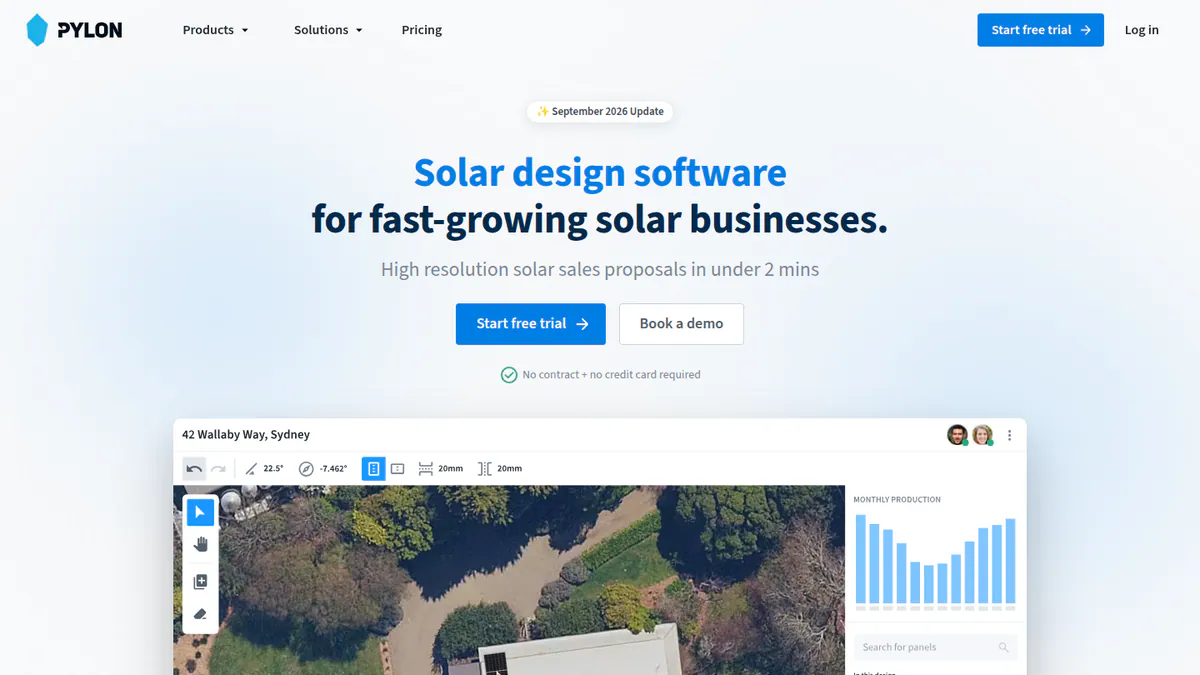
What it is: Pylon, based in Sydney, sells a design and proposal tool that you pay for per project. On shade analysis itself it is a weak fit.
Why we picked it: It earns its place on strong support, frequent updates and low per-job prices, not on shading. Capterra users rate its customer service 4.9/5.
Key features:
- Design on aerial photos, with cash-flow forecasts.
- MCS (UK installer certification) reports in the UK.
- STC and PDRS incentives (Australian schemes) in Australia.
- Web and PDF proposals with eSignature.
Pricing: GBP 4 per project up to 30 kW DC, or Pro at GBP 10 per project. Checked October 2026 on the Pylon UK pricing page. The Irish page lists the same plans at EUR 4 and EUR 10 per project. We could not confirm USD and AUD prices.
Pros (from user reviews):
- You only pay when you design a job, which suits small firms (Capterra).
- Detailed proposals that customers can follow (G2).
- Most reviewers find it friendly for beginners, though one says it takes time to pick up.
Cons (from reviews and our research):
- Aerial photo quality and age vary by area, which limits shade checks.
- Modelling a home’s power use is awkward.
- Pricing runs per project, so busy months cost more.
Reviews: Capterra 4.6/5 (25 reviews), G2 4.3/5 (2 reviews), checked October 2026.
What we could not confirm: Pylon’s shading method, or whether it gives a standalone shade report.
Read our full Pylon review or our Pylon alternatives.
Want to see Pylon working? Book a demo with the SolarSoftwares team.
Book a demoYour request goes by email to the SolarSoftwares team. A time is set only after we reply. It does not change any score or ranking.
6. Scanifly: best for drone-based on-site shade
Best for: US contractors who want to replace handheld shade tools with drone flights. Score: 69.0/100.
What it is: Scanifly combines remote design, drone 3D modelling and a mobile survey app. It is for US home and business contractors. It fits this job well, but quote-only prices and few reviews hold its score back.
Why we picked it: It is the only ranked tool that measures shade on site, using drone models and its Onsite Viewshed tool.
Key features:
- Onsite Viewshed shading from drone models. The company says several regulators and lenders accept it.
- Remote shading from satellite, Nearmap and LIDAR data.
- AI obstruction detection.
- iOS and Android field app that lets you mark up photos.
Pricing: Quote only and credit-based. Drone surveys and design services cost extra. Checked October 2026 on the Scanifly website.
Pros (from our research):
- Shade comes from real drone measurements, not just a model.
- You get remote and drone shading in one account.
- Frequent updates, with product posts through October 2026.
Cons (from our research):
- Quote only, so you cannot compare cost up front.
- Built for the US market.
- Only 3 user reviews, too few to judge it on user feedback.
Reviews: G2 4.7/5 (3 reviews, no visible text), checked October 2026.
Read our full Scanifly review or our Scanifly alternatives.
Want to see Scanifly working? Book a demo with the SolarSoftwares team.
Book a demoYour request goes by email to the SolarSoftwares team. A time is set only after we reply. It does not change any score or ranking.
7. Arka 360: best for shadow analysis in sales designs (India and US)
Best for: Residential and C&I sellers in India and the US. Score: 67.5/100.
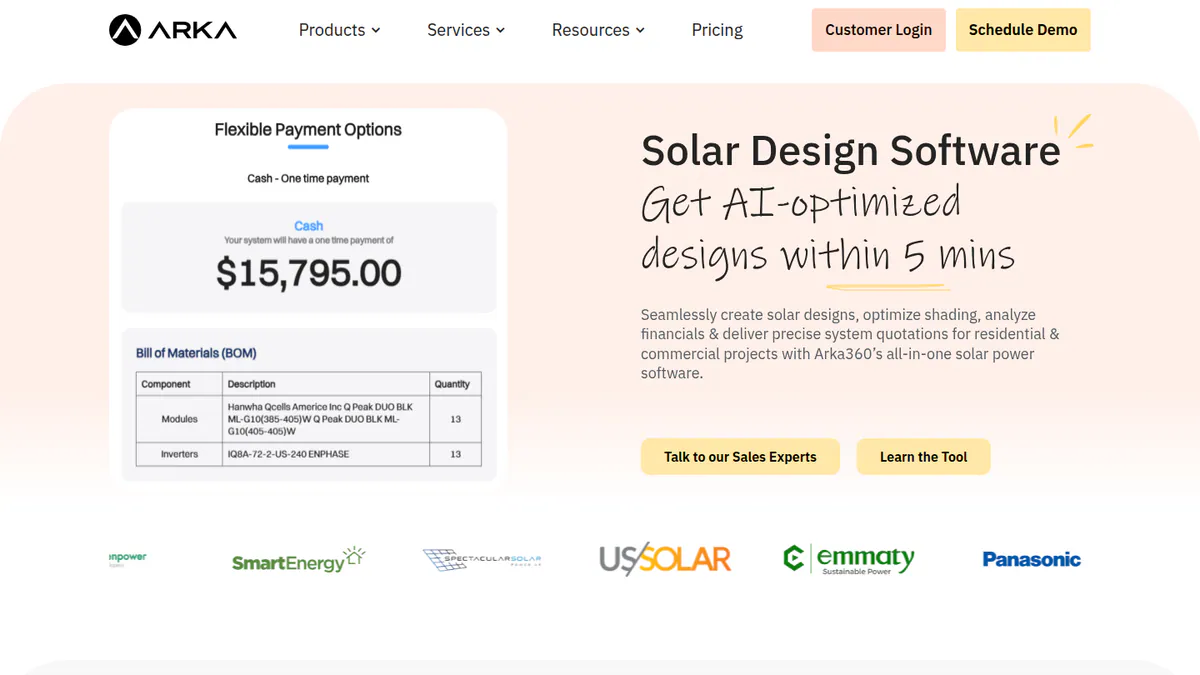
What it is: Arka 360, once called The Solar Labs, is a cloud tool for design, proposals and CRM (customer management). Its users sell home and C&I systems in India and the US.
Why we picked it: It has the largest review base on this page, with 137 G2 reviews at 4.3/5, and reviewers single out its shadow analysis. US prices are published.
Key features:
- Shading checks on the 3D design.
- 3D model export to PVsyst for deeper loss modelling (US Premium).
- Stringing (how panels wire into inverters), with optimisers.
- Generation reports in proposals.
Pricing: The international-list Basic costs USD 159 per month (USD 1,699 per year). Premium costs USD 199 per month. We left out Indian prices because the page shows two INR sets that disagree. Checked October 2026 on the Arka 360 pricing page.
Pros (from user reviews):
- Shadow analysis and project estimates help you show customers the numbers.
- Easy to use, with 14 G2 mentions.
- Caring support staff.
Cons (from user reviews):
- Lag on projects of 3 MWp and above.
- Some features are missing, and the setup is too rigid.
- Multi-user limits.
Reviews: G2 4.3/5 (137 reviews), checked October 2026.
Read our full Arka 360 review or our Arka 360 alternatives.
Want to see Arka 360 working? Book a demo with the SolarSoftwares team.
Book a demoYour request goes by email to the SolarSoftwares team. A time is set only after we reply. It does not change any score or ranking.
SurgePV (unscored): for readers comparing shading work tied to the 3D roof model. Check imagery and roof dimensions against a site survey. The numbered scores above do not include it.
Sources checked 27 October 2026: SurgePV product information · SolarSoftwares SurgePV review
Book a demo of SurgePV with the SolarSoftwares team.
Book a demoYour request goes by email to the SolarSoftwares team. A time is set only after we reply. It does not change any score or ranking.
How do the 7 shading tools compare?
This table compares the 7 ranked tools side by side.
Product | How shade is captured | Shade output | Electrical mismatch | Starting price |
|---|---|---|---|---|
Remote imagery. LIDAR (Premium) | Shade report. Bankable report (Premium) | Not documented | USD 159/user/mo | |
Desktop 3D scene | Shading in yield simulation | Not documented | EUR 845/yr | |
3D near-shading scene | Loss diagram, P50/P90 | Yes | CHF 700/yr | |
Remote. LIDAR (Pro) | Shading and wiring losses. P90/P95/P99 (Pro) | Wiring losses | USD 159/mo | |
Aerial imagery | Not confirmed | Not documented | GBP 4/project | |
Drone (Viewshed) and remote | Onsite shading | Not documented | Quote only | |
Remote 3D | Shadow analysis | Not documented | USD 159/mo |
Also considered
- OpenSolar (scored 67.4/100): A free design and proposal tool with shading. Hardware and finance partners pay for it. It missed the top 7 because the docs did not show us how the shading engine works. Its G2 rating rests on only 3 reviews.
- DNV SolarFarmer (scored 67.1/100): DNV’s utility-scale yield engine with 2D and 3D shading on real terrain. It missed the top 7 because it has no published price or user reviews. The desktop app is Windows only. It also suits utility teams, not most installers.
- Solargraf (scored 64.7/100): Enphase’s design, proposal and permit tool for North America, from USD 2,799 per year. It missed the top 7 because of low user ratings (Capterra 3.2/5 from 15 reviews). Users report crashes and long waits for support.
- Solar Pathfinder + Assistant (scored 52.5/100): A plain optical dome with no electronics. You use it on site to trace the skyline. From USD 299 plus software. It missed the top 7 because it is slow to set up (2012 forum posts) and has no G2 or Capterra reviews.
- Solmetric SunEye-210 (scored 52.5/100): A handheld fisheye camera that measures solar access, at USD 2,195 one-time. It missed the top 7 because it is out of stock with a 10-12 week lead time. We also found no new releases and no user reviews.
- HORIcatcher (below the minimum score): Meteotest’s horizon-mirror and camera kit, listed at CHF 1,400 on the legacy Meteonorm 8 site. That site says Meteonorm 8 is no longer available. We could not confirm current software support.
- Meteonorm, PVGIS and NSRDB: Sources of weather and sunlight data, not shading tools.
How do you choose solar shading analysis software?
- Do you sell US home jobs and want shade reports with no roof visit? Pick Aurora Solar Premium.
- Must shading hold up in a lender’s yield review? Use PVsyst. For utility terrain, also look at DNV SolarFarmer (also considered).
- Do you design C&I roofs and carports? Pick HelioScope.
- Do you plan in Europe with storage and heat-pump loads? Pick PV*SOL premium.
- Need measured shade? Choose Scanifly if you fly drones. For handheld readings, see SunEye-210 or, on a tight budget, Solar Pathfinder (both also considered).
- Is the budget zero? Start with OpenSolar (also considered), then see our free solar design software list.
For yield simulation beyond shading, see solar simulation software. For plant-scale design, see utility-scale solar design software.
Want more choices? Browse every tool we checked in our design and simulation category, or see our shading analysis feature guide.
Solar shading analysis software FAQs
Is a shading report required for solar permits or incentives?
It depends on your incentive scheme, utility or AHJ (local permitting authority). Check their current rules. Aurora sells bankable (lender-accepted) shade reports on Premium (USD 259 per user per month, checked October 2026). Scanifly says several regulators and lenders accept its Viewshed shading.
Which shading tools do lenders and utilities accept?
PVsyst P50/P90 reports are the usual standard for utility and C&I finance. DNV says SolarFarmer (also considered) is bankable in the US after six due-diligence projects (1,195 MW) in 2024. For home jobs, the claims that lenders accept a tool come from companies such as Scanifly and Aurora. Check with your lender.
How much does solar shading analysis software cost?
As of October 2026, PVsyst costs CHF 700 per seat per year. Aurora Premium costs USD 259 per user per month and HelioScope starts at USD 159 per month. OpenSolar is free (also considered). Hardware is a one-time cost, such as USD 2,195 for the SunEye-210.
Do I still need a Solmetric SunEye or Solar Pathfinder?
Only if you need measured, on-site shade readings. Both tools are under "Also considered". Remote LIDAR models and drone tools such as Scanifly are the other options. The SunEye-210 was out of stock in October 2026, with a 10-12 week lead time.
Can drone photogrammetry or LIDAR replace on-site shade measurement?
Drone photogrammetry can replace a handheld shade reader. LIDAR (Aurora Premium, HelioScope Pro) cannot, because it is still a remote model. Photogrammetry builds a 3D model from overlapping drone photos, so it captures the real site. We found no independent test of which is more exact (October 2026).
Is there free solar shadow analysis software?
Yes. OpenSolar’s core platform, including shading, is free as of October 2026. It sits under "Also considered" because we could not check how its shading engine works. PVsyst has a 30-day evaluation and PV*SOL premium a 30-day trial, but neither is free long term.
Sources
All checked 22 to 25 October 2026.
- Aurora Solar: pricing, G2, Capterra
- PV*SOL premium: shop, 2026 release, G2
- PVsyst: shop, product page, G2
- HelioScope: pricing, G2
- Pylon: pricing, Capterra
- Scanifly: website, G2
- Arka 360: pricing, G2
- OpenSolar: pricing, G2
- DNV SolarFarmer: product page, DNV news, September 2024
- Solargraf: pricing, Capterra
- Solar Pathfinder: store
- Solmetric SunEye-210: store
- HORIcatcher: product page
Last updated 28 October 2026. Next scheduled review: 23 January 2027.