Key takeaways
- Round robin gives every rep the same number of leads. It is simple and easy to defend, but it ignores skill, capacity and who is free.
- In the example, capped weighting by past conversion lifts expected contracts from 8.25 to 9.00 a week (100 leads, 4 reps). That is 9.1%, but the rates may be noise.
- In the example, reassigning an unanswered lead after 30 minutes (our modelling choice) lifts the example share contacted within 60 minutes from 75.5% to 85.1%.
- Of 5 tools checked in October 2026, 3 document round robin in their own help pages. They are HubSpot, Zoho CRM and Pipedrive.
To assign leads automatically in software, see the best CRM for solar sales teams.
Lead routing at a glance
Lead routing answers one question: who owns this lead, and what happens if they do not reply? It is the "assign" step of lead management.
| Item | Detail |
|---|---|
| Core question | Which rep gets this lead now, and who gets it next if there is no reply? |
| Methods | Round robin, weighted, territory, skill based and availability based. These can be combined. |
| Numbers to watch | Leads per rep, time to first contact, contact rate and contracts per lead, by rep. |
| Standard or rule | None. Each company sets its own rules. |
| In software | CRMs hold the assignment rules. See the software table. |
Why lead routing matters for installers
A lead that nobody owns is not answered. Routing gives every enquiry one owner on arrival. The speed of the first reply then depends on the rule, not on who sees the inbox. See speed to lead. It also shapes pay. Reps on commission watch who gets the better leads, so a visible rule avoids disputes (sales commission tracking).
How the five routing methods work
Each method asks a different question. Round robin asks whose turn it is. The others ask who is best placed, who is nearby or who is free.
- Round robin: leads go to reps in a fixed order, then the order repeats. Lead counts stay equal. The catch is that a rep who is away, full or weak still gets a turn.
- Weighted: each rep gets a share, set by past conversion, seniority or capacity. It sends more leads to reps who close more. Small samples make the weights noisy, as the example below shows.
- Territory based: the lead goes to the rep who covers its postcode, county or region. It cuts travel time. The risk is uneven demand. One territory can be flooded while another sits idle.
- Skill based: the lead goes to a rep matched on a fact such as language, roof type, commercial work or battery experience. Use it only where the match changes the outcome.
- Availability based: reps who are away, off shift or full are skipped. It is usually a filter on another method, not a method on its own.
Fairness has two meanings. Equal lead counts are fair on volume. They are not fair on value if some leads are worth more. Examples are a shared or exclusive lead or a commercial enquiry. If value differs, rotate within each lead type. Lead scoring can set the type.
Reassignment when a rep does not respond
A routing rule needs a timer. If the owner logs no contact attempt within a set time, the lead moves to another rep or a manager.
Define "responded" as a logged call, text or email, not a status change, or reps can stop the timer without calling. Set the timer to business hours so night leads do not bounce. Cap the number of moves so a lead does not circulate for ever. These are our suggestions, not company rules.
Worked example: round robin vs weighted routing
Take 100 new leads a week and 4 reps. Every number below is example. The example compares round robin with capped weighting only. Territory, skill and availability routing are not worked here. Past rate is past contracts divided by past leads handled. Contact shares are the example chance that a rep contacts a lead within 30 and 60 minutes.
| Rep (example) | Past leads / contracts / rate | Capacity per week | Contact in 30 min / 60 min |
|---|---|---|---|
| Rep A | 200 / 24 / 12% | 35 | 90% / 97% |
| Rep B | 200 / 18 / 9% | 30 | 75% / 90% |
| Rep C | 200 / 14 / 7% | 25 | 45% / 70% |
| Rep D | 100 / 5 / 5% | 25 | 25% / 45% |
Round robin gives each rep 25 leads. Weighted routing splits leads in proportion to past rate. Rep A’s share would be 36.4 leads, above the cap of 35. So Rep A gets 35, and the other 65 split by the rates 9%, 7% and 5%. Expected contracts are leads times past rate, assuming each rep keeps that rate at the new volume. Weighted figures are rounded for display.
| Rep (example) | Round robin leads | Weighted leads | Round robin contracts | Weighted contracts |
|---|---|---|---|---|
| Rep A | 25.0 | 35.0 | 3.00 | 4.20 |
| Rep B | 25.0 | 27.9 | 2.25 | 2.51 |
| Rep C | 25.0 | 21.7 | 1.75 | 1.52 |
| Rep D | 25.0 | 15.5 | 1.25 | 0.77 |
| All reps | 100 | 100 | 8.25 | 9.00 |
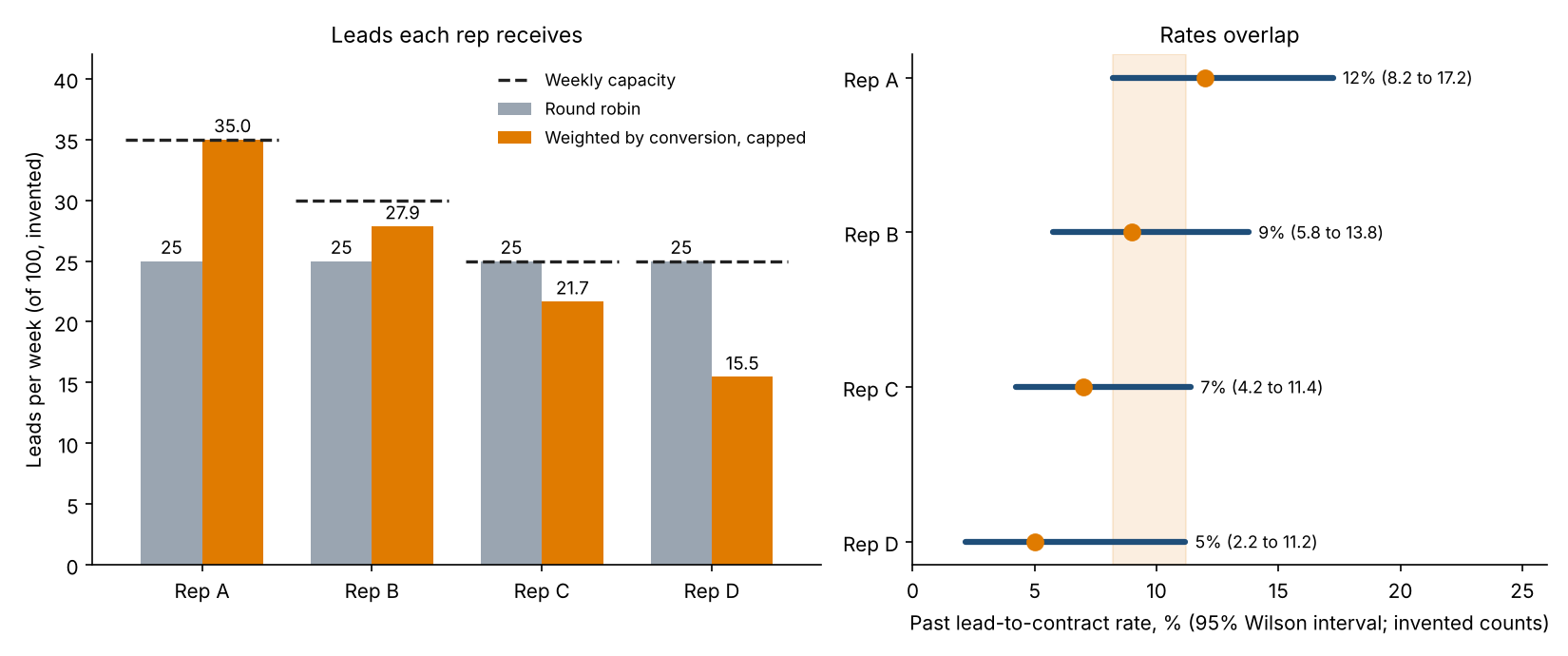
Figure 1. Weighting moves 10 leads a week to Rep A and adds 0.75 expected contracts. Yet the 95% intervals for example Rep A and Rep D overlap: Rep A’s lower bound is 8.2% and Rep D’s upper bound is 11.2%.
- Weighting: the gain is 9.1%, from 8.25 to 9.00 contracts. There is a side effect on speed. The example share contacted within 30 minutes rises from 58.8% to 66.0%, because faster reps get more leads.
- Reassignment: an unanswered lead moves at 30 minutes to a rep chosen evenly from the other three. The example share contacted within 60 minutes then rises from 75.5% to 85.1%.
- Assumptions: the second rep gets a full 30 minutes and answers independently. The first rep stops after 30 minutes. That lowers Reps A and B (97% to 94.8%, and 90% to 88.3%). If the first rep keeps trying, the figure is about 91.6%.
The data does not clearly show that Rep A beats Rep D. Rep A’s lower bound of 8.2% sits below Rep D’s upper bound of 11.2%. The intervals are Wilson 95% intervals on the example counts.
With these counts you cannot reliably tell Rep A from Rep D. A two-sided z test on 24 of 200 against 5 of 100 gives p about 0.05. Past rate also mixes skill with lead mix, so treat the weights as a nudge, not a verdict. The example ignores lead cost, rep pay and travel.
Round robin vs weighted routing calculator
Enter up to 4 reps with past leads, past contracts, weekly capacity and contact shares. It returns both allocations, expected contracts, intervals and the reassignment line.
Not showing? Open the round robin routing calculator on its own page. Enter shares as percentages (45, not 0.45). It reproduces the tables above and warns on blank, negative, out-of-range or ambiguous numbers such as 1.000.
How solar software handles lead routing
Three of the five tools document round robin, and none documents reassignment on no reply. Rows come from company pages read in October 2026.
| Software | Round robin or rotation | Availability, territory or fallback | Source and date |
|---|---|---|---|
| HubSpot Sales Hub | Yes | Partly | HubSpot knowledge base, assign and rotate record owners, last updated 23 September 2026 |
| Zoho CRM | Yes | Partly | Zoho CRM help, setting assignment rules, no date printed |
| Sunbase | Partly | Partly | Sunbase solar CRM page, no date printed (2026 copyright) |
| JobNimbus | Not stated | Not stated | JobNimbus help, new-lead automation page, no date printed (2025 copyright) |
| Pipedrive | Yes | Not stated | Pipedrive help, automatic assignment, last updated 3 September 2026. Marketplace listing, no date printed |
Not stated: the company page we cite does not say. Partly: the page describes some of it.
- HubSpot Sales Hub: The "Rotate record to owner" workflow action assigns records "equally within a selected team or between specified users". For leads and tickets the options are Load Balanced, Round Robin or Random (leads: beta, Sales Hub Professional or Enterprise). Availability, territory or fallback: "Assign to available users only" skips users set to Away for leads and tickets. If everyone is away, no owner is set. Reassignment on no reply is not documented on the page read.
- Zoho CRM: With several users selected, records are assigned in a round-robin pattern. Availability, territory or fallback: Availability can be checked by online status and shift timing. An unavailable or deactivated user sends the record to the default user. Rule entries can be reordered. With enough recent data an AI option can assign owners. Weights are not mentioned.
- Sunbase: The page says it can "Assign new leads or opportunities to the right representative". Round robin is not mentioned. Availability, territory or fallback: It lists teams and territories as configurable. Rules linking them to assignment are not described.
- JobNimbus: An automation creates a Task for the assignees chosen when the automation is built. No rotation is described. Availability, territory or fallback: Not stated.
- Pipedrive: Automatic assignment rules (Professional plan and above) use a round robin across team members for the Team assignee type. Availability, territory or fallback: Availability checks and reassignment on no reply are not described. A third-party marketplace app by Traffic Oxygen claims reassignment after a set number of minutes. That is the developer’s claim, not Pipedrive documentation.
HubSpot, Zoho CRM and Pipedrive are general CRMs, not solar tools. For the wider process, see lead management. For ranked options, see the best CRM for solar sales teams and the best solar lead management software.
Common mistakes with lead routing
FAQs
What is round robin lead assignment?
Round robin gives each new lead to the next rep in a fixed list, then starts again at the top. With 4 reps, each gets every fourth lead. It keeps lead counts equal but does not check skill, workload or availability.
Should I use round robin or weighted routing?
Use round robin when reps are similar and you want a rule everyone accepts. Use weighted routing when capacity or results differ clearly and you have enough leads per rep to trust the rates. In the example the gain was 9.1%, but the intervals overlapped.
What happens if a rep does not respond to a lead?
A good rule reassigns the lead after a set time to another rep or a manager. Of the pages read, HubSpot’s and Zoho’s describe skipping unavailable users. None of the five describes reassignment on no reply, so check your tool before you rely on it.
Is round robin fair?
It is fair on lead count, not on lead value. If lead types differ in value, rotate within each type. Report contracts per rep as well as leads per rep.
Related terms
- Speed to lead: how quickly a new enquiry gets its first reply.
- Lead scoring: ranking leads by how likely they are to buy.
- Appointment setting: booking the sales visit once a lead is contacted.
- Canvassing app: a phone app for door-to-door reps.
Next step: put your own reps’ past rates into the calculator, then see which CRM in the best CRM for solar sales teams list can apply the rule.
Sources
- HubSpot knowledge base: assign and rotate record owners using workflows, last updated 23 September 2026 (checked October 2026).
- Zoho CRM help: setting assignment rules, no date printed (checked October 2026).
- Sunbase: solar CRM software, no date printed (checked October 2026).
- JobNimbus help: automation to notify a sales rep of a new lead, no date printed (checked October 2026).
- Pipedrive help: automatic assignment, last updated 3 September 2026 (checked October 2026).
- Pipedrive Marketplace: Round robin your leads (third-party app), no date printed (checked October 2026).
Last updated 30 October 2026. Next scheduled review: 30 January 2027.