Key takeaways
- NIST’s definition is about who runs the software, not how it is priced. You use the company’s applications and do not manage the servers.
- The invented base case has 6 seats, 150 USD per seat per month, a 7% yearly rise and 1,500 USD onboarding. It costs 36,220.92 USD over 3 years, or 167.69 USD per seat per month.
- The yearly rise adds 2,320.92 USD, or 7.2% over a no-rise subscription before onboarding. Two more seats from year 2 add 7,973.64 USD.
- None of the 4 solar company pages read states an uptime percentage, though Aurora’s and JobNimbus’s full terms were not opened. HelioScope’s terms renew a subscription for a period equal to the initial term.
- Exit terms differ: HelioScope, OpenSolar and JobNimbus state them, while Aurora Solar does not. Read yours before you sign.
SaaS covers design, CRM and monitoring tools. Pick the job you are buying for: design, CRM or monitoring, then run the contract checks below on each shortlisted company.
SaaS at a glance: why it matters for installers
SaaS means you rent software that the company hosts and updates. So the contract and the price rise count as much as the features.
| Item | Detail |
|---|---|
| What you buy | The right to use the company’s hosted application for as long as you pay. |
| Cost formula | Cost = onboarding + the sum, over each year, of seats x price x 12 x (1 + rise) to the power (year - 1). |
| Standard or rule | NIST SP 800-145 is a definition, not a certification. No solar standard exists. |
| Where it matters | Renewal dates, price rises, uptime, and your data when you leave. |
| In software | Design, CRM, project, monitoring and forecasting tools. Each company words its terms differently. See the software table. |
A SaaS bill repeats every period, so small percentages compound. A missed notice date can renew you. If you stop paying, you may lose access, and your files may go with it. The cost of switching is on company lock-in.
What does SaaS mean, and how is it different from a desktop licence or a service?
NIST SP 800-145 (Mell and Grance, September 2011) describes SaaS as the capability "to use the provider’s applications running on a cloud infrastructure". The customer does not manage or control that infrastructure.
Hosting and pricing are separate questions. For the split between browser and installed, see cloud-based vs desktop software. This page covers the contract side.
| Item | SaaS | Perpetual desktop licence | Service |
|---|---|---|---|
| Who runs it | The company hosts it. | You install and run it. | The company’s staff do the work. |
| What you pay | Cisco’s page: the right to use it "as long as they pay the recurring subscription fee". | Cisco’s page: a licence giving "the right to use the software in perpetuity". | A fee per job or per package. |
| Updates | Cisco’s page says the recurring fee includes bug fixes and updates. | Cisco’s page says buyers pay separately for updates. | Not applicable. |
| Solar example | A design or CRM subscription. | A desktop tool bought once. | Aurora’s pricing page lists "Plan sets, including storage" and "Engineering stamps" as Enterprise add-ons. |
A company can sell both. NIST’s "measured service" characteristic lists active user accounts among the things a service may meter. So a seat count is a normal billing unit. The next section lists the common units.
How is SaaS priced?
Companies price SaaS by user, by project, by prepaid credit or by flat fee. Each unit changes what makes your bill grow.
- Per seat: cost rises with headcount.
- Per project: cost rises with sales volume.
- Credits: prepaid units that actions use up.
- Quote only: no public price. Compare quotes on all-in cost.
- Free plan or trial: check what happens when it ends.
What should a SaaS contract say? Eight checks
A SaaS contract should state the term, renewal, price changes, uptime, data ownership, exit and suspension. The order form can differ from the website, so the signed paper is what counts.
| Check | What to get in writing |
|---|---|
| 1. Term and billing | Monthly or annual, and any minimum commitment. |
| 2. Renewal | Does it renew itself, for how long, and how do you give notice? |
| 3. Price changes | When the company may raise fees, and whether there is a cap. |
| 4. Uptime and support | A monthly percentage, the exclusions, and the remedy for a miss. |
| 5. Data ownership | Who owns your records, and what licence the company takes. |
| 6. Exit | How long you can export, in what format, and when data is deleted. See data export. |
| 7. Suspension and company termination | On what grounds, and with how much notice. |
| 8. Cancelling | When your cancellation takes effect, and any refund. |
An uptime percentage is easy to misread. This table counts every minute as downtime, in an average month of 365.25 / 12 days. Real agreements leave out some events.
| Uptime promise | Downtime in an average month | Downtime in a year |
|---|---|---|
| 99% | 7.3 hours | 87.66 hours |
| 99.9% | 43.83 minutes | 8.77 hours |
| 99.99% | 4.38 minutes | 52.6 minutes |
Zoho CRM’s page states "99.9% monthly uptime" and excludes planned maintenance with at least 48 hours’ notice, external events and customer-side issues. Look for the same detail in any contract, and for a security report. See SOC 2 and data security.
Worked example: what does a subscription cost over 3 years?
The list price is a floor. Onboarding, yearly rises and seat growth sit on top of it. All inputs below are example, not company prices.
Base case (example): 6 seats at 150 USD per seat per month, billed yearly. It has a 7% rise at each renewal and 1,500 USD onboarding once. The rise applies to years 2 and 3. Each row changes one input.
| Case (example inputs) | Year 1 / Year 2 / Year 3 | Onboarding | 3-year total | Change vs base |
|---|---|---|---|---|
| Base: 7% rise | 10,800.00 / 11,556.00 / 12,364.92 | 1,500 | 36,220.92 | 0 |
| No rise (0%) | 10,800.00 / 10,800.00 / 10,800.00 | 1,500 | 33,900.00 | -2,320.92 (-6.4%) |
| 10% rise | 10,800.00 / 11,880.00 / 13,068.00 | 1,500 | 37,248.00 | +1,027.08 (+2.8%) |
| Onboarding 4,000 | 10,800.00 / 11,556.00 / 12,364.92 | 4,000 | 38,720.92 | +2,500.00 (+6.9%) |
| 2 more seats from year 2 | 10,800.00 / 15,408.00 / 16,486.56 | 1,500 | 44,194.56 | +7,973.64 (+22.0%) |
All amounts are in USD. The base case averages 1,006.14 USD a month, or 167.69 USD per seat per month with onboarding included.
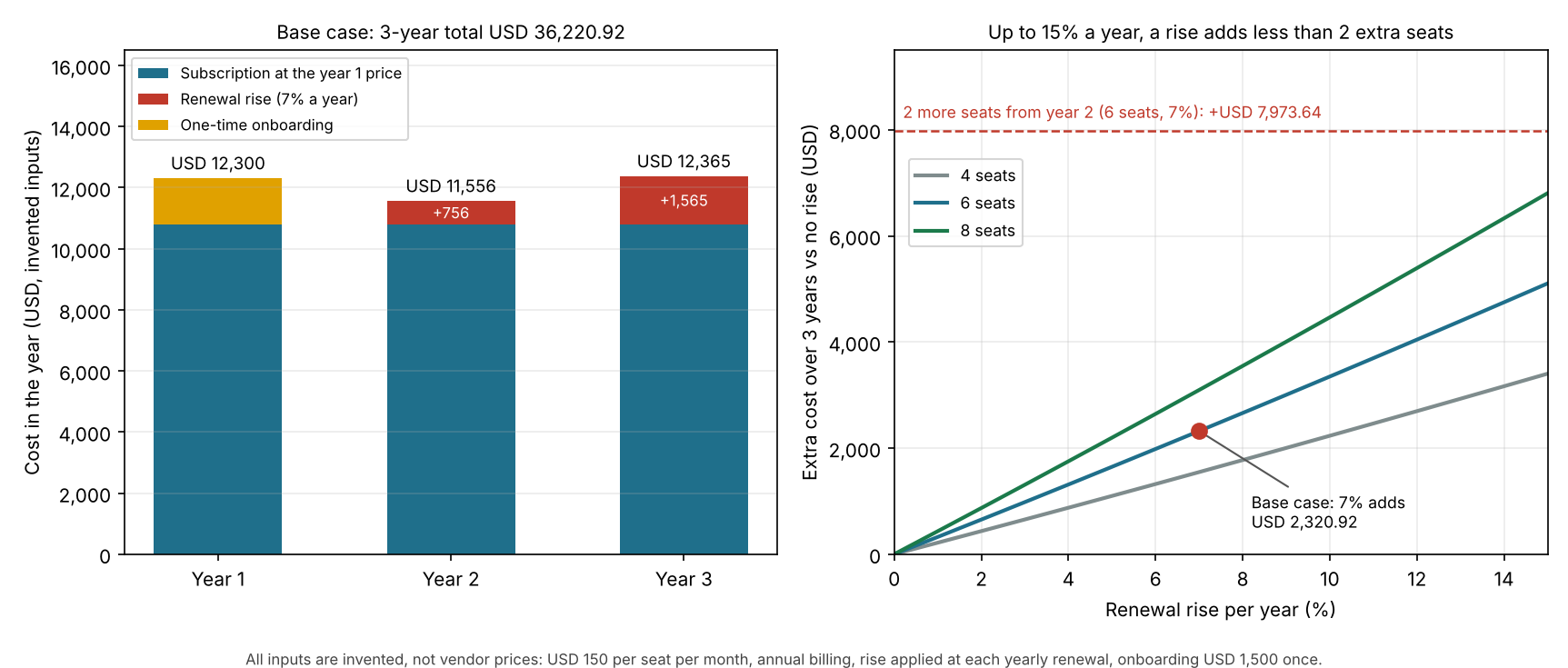
Figure 1. On example inputs, a yearly rise anywhere from 0 to 15% adds less over 3 years than 2 extra seats from year 2 do. The dashed line, 7,973.64 USD, is the extra cost of those 2 seats on the 6-seat base case.
A missed notice date has a price too. In the base case, one more year at the same rise would cost 13,230.46 USD. HelioScope’s terms renew for a period equal to the initial term. So a missed date on a 3-year deal commits you to another 3 years. To compare quotes with different pricing bases, see quote-only pricing. For the effort to go live, see onboarding and implementation.
Check your own subscription cost
Enter the seats, price, yearly rise and onboarding fee from a written quote. The calculator opens with the example base case.
If the calculator does not load, open the SaaS cost calculator on its own page.
How solar software handles SaaS contract terms
Only HelioScope’s terms state renewal, and only Zoho CRM states an uptime percentage. HelioScope, OpenSolar and JobNimbus state exit terms. The table records the wording, not a rating. Yes means the page states the term, and Not stated means the page we read does not say. The signed contract may say more than the page we read, and the Aurora row reflects its pricing page only. The bullets under the table give the wording. All pages were read in October 2026. On 30 October 2026 the HelioScope terms (June 2022) and OpenSolar terms (July 2023) were still the versions on their sites.
| Software | Term and cancelling | Renewal and price changes | Uptime percentage | Data on exit |
|---|---|---|---|---|
| Aurora Solar | Yes | Not stated | Not stated | Not stated |
| HelioScope | Yes | Yes | Not stated | Yes |
| OpenSolar | Yes | Not stated | Not stated | Yes |
| JobNimbus | Yes | Not stated | Not stated | Yes |
| Zoho CRM (general CRM) | Not stated | Not stated | Yes | Not stated |
- Aurora Solar: Basic and Premium: no minimum on monthly plans, a one-year commitment on annual plans. "Yes, you can cancel your purchase at any time". Monthly plans end "at the end of your monthly billing period" and annual plans "at the end of your annual billing period". Basic is 159 USD (monthly) or 135 USD (annual) per user per month. Premium 259 or 220. The pricing page states no renewal, uptime or data-exit terms.
- HelioScope, term and cancelling: Terms 7.1 say monthly or annual, as in the service order. The help article says an admin can cancel at any time and it ends at the end of the billing cycle.
- HelioScope, renewal and price: Terms 7.2 renew "for another Subscription Term of a period equal to your initial Subscription Term". Renewals are at "the then-current rates", and Terms 7.4 let fees change at the end of a term. Non-renewal notice goes through support.
- HelioScope, uptime and support: no uptime commitment. Terms 3.3 give support by email and chat, and Terms 13.4 give no warranty that use is "uninterrupted or error-free".
- HelioScope, data: Terms 5.1 say "You retain all right, title and interest in and to Your Data". Terms 12.3 give no access after expiry, allow deletion, and say "you should make sure to export Your Data" during the term.
- OpenSolar: Clause 13: "You may close your Account at any time." OpenSolar may close, suspend or limit access "at any time without reason". Clause 18: it may end the terms by "two days’ notice in writing, unless otherwise set out in a Service Agreement". Renewal and price changes: not stated anywhere on the terms page, which we read in full and which says it was last modified on 18 July 2023.
- OpenSolar, availability: Clause 18: "We are under no obligation to continue to operate or provide access."
- OpenSolar, assurance: Clause 4: "We provide no assurance, condition, warranty or other term in relation to the availability or ability to store any data".
- OpenSolar, data: Clause 8: "no responsibility or liability for the deletion or failure to store any User Content". You grant a "perpetual, irrevocable" licence in User Content. Deletion terms: see company lock-in.
- JobNimbus: Monthly or annual agreements, "depending on your plan and onboarding needs". "no required setup or onboarding fees". Cancel from the Subscription page, by a call or a form depending on plan. Failed payments are retried daily for three days. Then "the account will be suspended (not canceled)". "JobNimbus does not guarantee to hold data for canceled accounts" (accounts created before March 2026). Back up first.
- Zoho CRM: "Zoho’s availability SLA commitment is 99.9% monthly uptime." Excludes planned maintenance, external events and customer-side issues. No service credits are mentioned. Page read: uptime SLA page, "Last Updated: March 26, 2026".
Companies may state more in the contract you sign. For other jobs, see the best solar lead generation software, best fleet monitoring software, best forecasting software and best solar CRM in India.
Common mistakes with SaaS
FAQs
Is SaaS the same as cloud-based software?
Nearly. Cloud-based says where the software runs. SaaS also says the company runs it for you, usually on a subscription. See the cloud vs desktop page to see which tools run where.
Who owns my data in a SaaS tool?
The contract decides. HelioScope’s terms say you retain all right, title and interest in Your Data as submitted, and grant a licence to run the service. Put the same question to any company before you sign.
What uptime should a SaaS company promise?
A stated monthly percentage is the minimum, and the uptime table shows what it allows. Zoho CRM’s page states 99.9% monthly uptime. None of the 4 solar pages read states a percentage (Aurora’s and JobNimbus’s full terms were not opened). The exclusions and the remedy for a miss matter too.
Can a SaaS company raise the price?
Yes, if the contract allows it. HelioScope’s terms let it change fees at the end of a term and charge renewals at the then-current rates. A written cap is worth negotiating.
What happens to my data if I stop paying?
You may lose access, and the company may not keep your data. JobNimbus’s cancel article says it does not guarantee to hold data for cancelled accounts (those created before March 2026). After three daily retries, failed payments suspend an account. Export before you cancel.
Related terms
- Cloud-based vs desktop software: browser delivery against installed programs.
- Company lock-in: the cost of leaving a tool.
- Single sign-on: one login for many apps.
Next step: put your next written quote into the calculator, find its renewal and notice dates, then compare companies on the best solar design software list.
Sources
- NIST SP 800-145: The NIST Definition of Cloud Computing, Mell and Grance, September 2011 (checked October 2026).
- Cisco: perpetual licensing vs subscription licensing, page metadata 6 January 2023 (checked October 2026).
- HelioScope Terms of Use, printed "Last updated June 1st, 2022" (checked October 2026).
- HelioScope help: Cancel Subscription, updated 8 July 2025 (checked October 2026).
- OpenSolar user terms and privacy policy, last modified 18 July 2023 (checked October 2026).
- Aurora Solar pricing page, modified 29 September 2026 (checked October 2026).
- JobNimbus: how do I cancel my account, undated, applies to accounts created before March 2026 (checked October 2026).
- JobNimbus pricing page, undated, 2026 copyright (checked October 2026).
- Zoho CRM uptime SLA and availability, last updated 26 March 2026 (checked October 2026).
Last updated 30 October 2026. Next scheduled review: 30 January 2027.