Key takeaways
- The IRS FAQ (21 August 2025) says the residential clean energy credit "will not be allowed for any expenditures made after December 31, 2025".
- In this example’s 8 kW example, four incentives total 11,676 USD, which is 52.1% of the 22,400 USD price. Their present value at an example 6% discount rate is 9,945 USD.
- Only 1,000 USD (example) arrives at year 0, so you need 21,400 USD in cash up front, not the 10,724 USD net price.
- If the one cost-based incentive (example, capped at 4,400 USD) ends first, the net price rises by 19.6% of the price.
- Before an incentive goes into a proposal, confirm who pays, the basis, the timing and the end trigger.
To find proposal tools that apply caps, payee and end dates to a quote, see the best solar proposal software.
Solar incentives at a glance, and why they matter to installers
An incentive is a line in the price or cash-flow model. It has a payer, a rate type, a time and an end date. The rule belongs to the programme, not to the tool. This page covers the US federal position, with Australia and India examples.
Incentives change the net price, the cash needed up front and payback. A wrong default or end date sends a customer a mispriced quote. See payback period.
| Item | Detail |
|---|---|
| Formula | Net price = price before incentives minus each incentive received. Each incentive = rate × its basis, up to any cap. |
| Unit | USD, or the local currency. Rate types: fixed amount, per watt or kW, percent of cost, per kWh produced. |
| Where it matters | Proposal net price, cash needed up front, payback and the cash flow table. |
| Standard or rule | None shared. Each programme or tax law sets its own. Tools copy them by hand or from a database. |
| In software | An incentive list with rate types, auto-apply rules, caps and a customer display. See the software table. |
How do design and proposal tools model incentives?
They turn each incentive into a line with a rate type, a payment time and often a cap. The company pages use the same four rate types under different names.
| Rate type | Basis | Names in company pages |
|---|---|---|
| Fixed rebate | One amount | Fixed Amount (Pipe, Aurora), Fixed (OpenSolar) |
| Size-based | kW, watts or kWh of storage | System Size (Pipe), Size Based (OpenSolar), System Size and Storage System Size (Aurora) |
| Cost-based | Percent of price or cost | Cost-Based (Pipe, Aurora), Price Based (OpenSolar) |
| Per-kWh | Energy produced, over years | Production-Based (Pipe), Performance Based (OpenSolar), Performance-Based Incentives (Aurora) |
Timing is part of the model. Aurora’s types page applies cost-based incentives as a Year 1 tax credit. It sets per-kWh incentives as a rate with an escalation and a duration.
Per-kWh income is an expectation. Aurora’s SREC page says it calculates the total expected SREC savings by default and subtracts them from system cost. See renewable energy certificates and export tariffs. See net metering for bill credits.
What is the US federal position in October 2026?
For homeowners, the residential clean energy credit has an IRS-printed end date of 31 December 2025. For wind and solar under section 48E, Notice 2025-42 ends the credit when both tests are met. Construction must begin after 4 July 2026, and the facility must be placed in service after 31 December 2027.
| Credit | Rule in short | Source and date |
|---|---|---|
| Residential clean energy credit (homeowner) | No credit for expenditures made after 31 December 2025. | IRS FAQs, FS-2025-05, 21 August 2025 |
| Clean electricity investment credit, section 48E: rate | 6 percent base, up to 30% with wage and apprenticeship rules, plus two 10-point bonuses. | IRS 48E page, reviewed 5 January 2026 |
| Section 48E: wind and solar end | Ends when construction begins after 4 July 2026 and service starts after 31 December 2027. | IRS Notice 2025-42 (issued 15 August 2025 per Notice 2026-15, in a footnote, the PDF prints no date) |
| What counts as beginning construction | Physical work of a significant nature, or the five percent safe harbour. A federal court vacated Notice 2025-42 on 6 June 2026, so the safe harbour is back in use for now. | IRS Notice 2025-42, sections 3 and 6. Oregon Environmental Council v. IRS, D.D.C., 6 June 2026 |
The exact IRS wording, by row
- Residential credit, end: "The credit will not be allowed for any expenditures made after December 31, 2025."
- Residential credit, timing: an expenditure is "treated as made when the original installation of the item is completed."
- Section 48E rate: "The base amount ... is 6 percent of the qualified investment." Increased "up to 30%" for prevailing wage and apprenticeship, plus 10-point bonuses for domestic content and energy community.
- Section 48E end: the credit ends for wind and solar facilities "placed in service after December 31, 2027" with construction that "begins after July 4, 2026". Both apply.
- Beginning construction: construction begins when "physical work of a significant nature" begins.
- Safe harbour: a facility of 1.5 MW or less maximum net output may still use the five percent safe harbour.
- Safe harbour, update: a federal court vacated Notice 2025-42 in full on 6 June 2026, ruling the IRS acted arbitrarily and capriciously. The five percent safe harbour applies again for all taxpayers unless the ruling is reversed on appeal or replaced by new guidance.
The 48E page prints rates but not the wind and solar end dates, so read all three pages together.
Update, checked November 2026: a federal court vacated Notice 2025-42 in full on 6 June 2026, ruling the IRS had acted arbitrarily and capriciously in dropping the five percent safe harbour. The ruling covers all taxpayers, not only the people who sued. As of the sources checked, the government had not filed an appeal and the IRS had not issued new guidance, so the earlier five percent safe harbour is again a valid way to show construction began, alongside the physical work test. An appeal or new guidance could change this, so confirm the current position with a tax adviser or the IRS site before relying on it.
For a given project, ask the owner and a tax adviser whether construction began by 4 July 2026. A safe harbour is a way to show construction began, not a deadline. See investment tax credit, IRA tax credits and third-party ownership to find who claims a credit on a leased system.
Worked example: one 8 kW system, four example incentives
On our example inputs, the incentives total 11,676 USD nominal and 9,945 USD in present value. The net price is 10,724 USD nominal or 12,455 USD in present value.
Inputs: 8 kW at 2.80 USD per watt, so 22,400 USD. Incentive money arrives at year-end. The discount rate is an example 6% nominal. Output is an example 11,200 kWh in year 1, falling 0.5% a year. We model no tax effects.
| Incentive (example) | Type and rate | Paid | Nominal (USD) | Present value (USD) |
|---|---|---|---|---|
| Rebate | Fixed 1,000 | Year 0 | 1,000 | 1,000 |
| Size-based | 0.10 USD per watt × 8,000 W | Year 1 | 800 | 755 |
| Cost-based | 20% × 22,400 = 4,480, capped at 4,400 | Year 1 | 4,400 | 4,151 |
| Per-kWh | 0.05 USD per kWh, years 1 to 10 | Years 1 to 10 | 5,476 | 4,040 |
| Total | 11,676 | 9,945 |
Totals are worked out before rounding. The cost-based line uses a placeholder percentage, not any country’s credit.
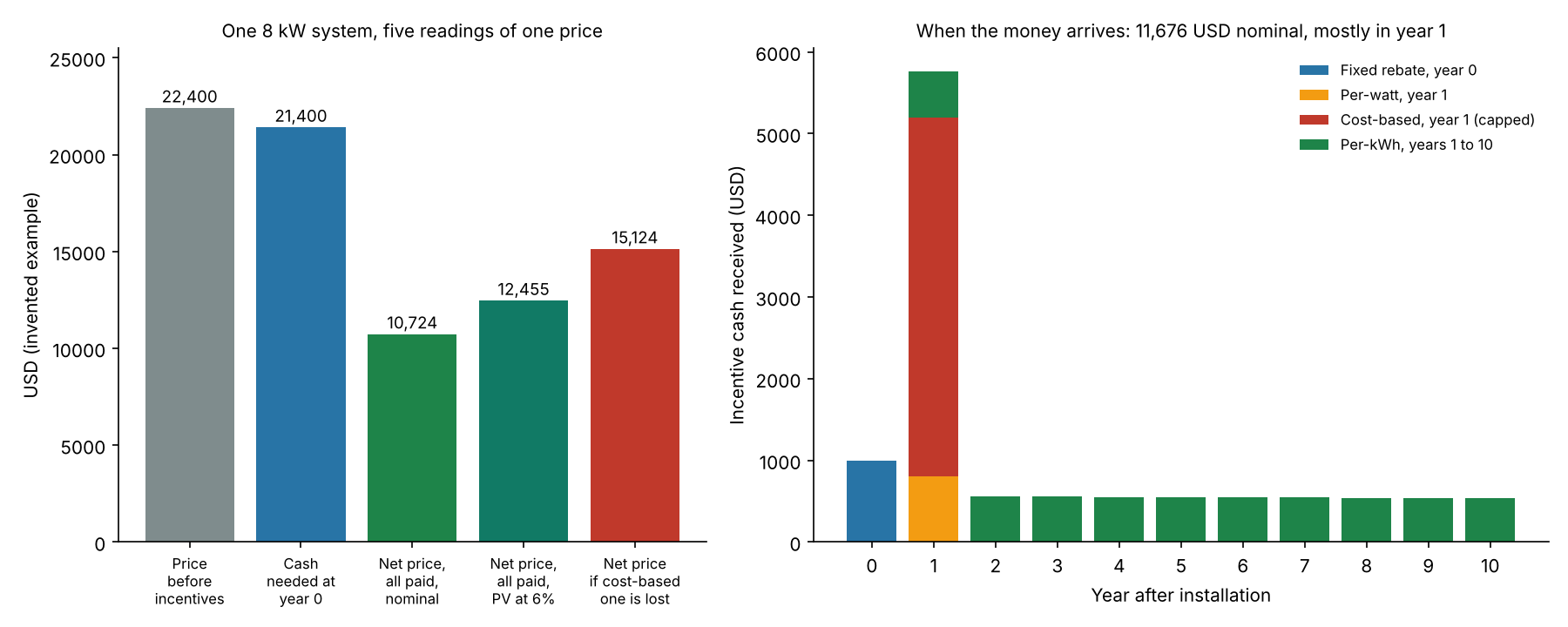
Figure 1. In our example, the headline net price is 10,724 USD. Year-0 cash is 21,400 USD and the present-value net price is 12,455 USD.
Three choices move the answer:
- Basis: if the 20% applies to the price less the 1,000 USD rebate, it is 4,280 USD, not 4,400. That is 120 USD less. OpenSolar’s page offers price bases including and excluding tax.
- End date: if the cost-based incentive ends first, incentives fall to 7,276 USD and the net price rises to 15,124 USD. That is 4,400 USD, or 19.6% of the price.
- Duration: a per-kWh term of 15 years, not 10, adds 2,637 USD. A wrong term is easy to miss.
Use these cash flows in cash flow analysis, NPV and payback period. See financial modelling for the wider model.
Solar incentive stack calculator
Enter size, price and four incentive types. It shows yearly cash, present value, the cap and net price.
Not showing? Open the incentive stack calculator on its own page. It gives the same numbers as the table above. It warns on blank, negative, out-of-range or ambiguous numbers such as 1.000.
What must an installer check before quoting an incentive?
Seven checks apply, each against the programme’s own page.
- Administrator: the tax authority, state agency, utility or regulator that runs it. DSIRE’s history page describes no update process, so treat a database as a pointer only.
- Who receives it: customer, installer or a financier. OpenSolar’s setup page has an "Incentive paid to" field for customer or installer.
- Rate type and basis: fixed, per watt, percent or per kWh, and what the percent applies to.
- Timing: point of sale, tax filing or yearly payments.
- End trigger: the IRS ties the residential credit to the date installation is completed. The Notice ties 48E to construction start and placed-in-service dates. Triggers differ by programme.
- Caps and stacking: caps, capacity limits and whether one incentive changes another’s basis.
- Customer display: show guaranteed items in the price. Show per-kWh income as an estimate.
How solar software handles incentives
All three tools we checked in October 2026 document incentives, and OpenSolar keeps per-kWh income out of its quotation table because it is not guaranteed. The details are in the list under the table.
| Software | Documents incentives? | Source and date |
|---|---|---|
| Aurora Solar | Yes | Aurora help, Incentives, types page and SRECs (no dates shown) |
| OpenSolar | Yes | OpenSolar support, Applying Incentives and How to set up Incentives (no dates shown) |
| Pipe Solar | Yes | Pipe help centre (written 10 November 2025) |
- Aurora Solar: Reps add incentives manually. Admins create custom ones. Types include cost-based, fixed, system size, storage size and performance-based, with caps. "Some incentives, like the Federal ITC, are applied to projects automatically."
- OpenSolar: Incentives are added in the Design tab. Some auto-apply by location and system criteria. Types are Fixed, Size Based, Price Based and Performance Based, with caps and an "Incentive paid to" setting for customer or installer. "PBIs are not guaranteed and do not appear in the quotation table to avoid misrepresenting savings." Reselect the federal ITC after overriding defaults.
- Pipe Solar: Four types: cost-based, production-based, system size and fixed amount. Incentive price and net system price update as incentives are chosen.
The table covers three tools only. The best solar proposal software list covers more proposal tools.
Solar incentive rules by country
Rules differ by country and change often. The three rows below are dated facts from government pages, not a full survey.
| Country | What the page prints | Source and date |
|---|---|---|
| US (federal) | See the table above. | IRS pages, 2025 and 2026 |
| Australia, home batteries | Eligible systems create small-scale technology certificates. For rooftop solar see STCs. | Clean Energy Regulator, page shows last updated 29 October 2026 |
| India, rooftop solar | A national subsidy scheme with subsidy amounts by system size band. See DISCOM approval. | Ministry of New and Renewable Energy via PIB, 12 February 2025 |
- Australia (home batteries, not rooftop solar): the STC factor is 8.4 for January to April 2026 and 6.8 for May to December 2026. Support is 100% for the first 14 kWh, 60% above 14 and up to 28 kWh, and 15% above 28 and up to 50 kWh. Only the first 50 kWh of usable capacity is eligible.
- India: the PM Surya Ghar release says the scheme "offers a subsidy of up to 40%". Its table gives INR 30,000 to 60,000 for 1 to 2 kW. It gives INR 60,000 to 78,000 for 2 to 3 kW, reaching INR 78,000 at 3 kW. The portal has current terms.
For the UK, see MCS certification, which says what the scheme asks of a design. UK grants and tax rates are not covered here.
Common mistakes with incentives
FAQs
Is there still a US federal tax credit for home solar?
No, not under the residential clean energy credit: the IRS FAQ of 21 August 2025 says the credit will not be allowed for expenditures made after 31 December 2025. It treats an expenditure as made when installation is completed. Other projects may fall under other credits, such as section 48E, so ask a tax adviser.
What is the difference between a rebate and a tax credit?
A rebate is a payment or point-of-sale discount, often fixed or per watt. A tax credit is claimed through a tax return, so cash arrives later.
Who receives the incentive, the customer or the installer?
Either can, set by the programme. OpenSolar lets you choose customer or installer. In the Australian battery programme, registered agents can give an upfront discount if the customer assigns the right to claim STCs.
Where can I find state incentives?
Use the state agency or utility that runs the programme as your source, and DSIRE as a pointer. DSIRE began in 1995 under a US Department of Energy contract to the North Carolina Solar Center. That centre is now the NC Clean Energy Technology Center. Check each entry at the source.
Related terms
- Investment tax credit: a cost-based credit claimed by the owner.
- Renewable energy certificates: certificates sold for the output of a system.
- Third-party ownership: leases and PPAs, where the owner is not the host.
- Domestic content bonus: an extra US federal credit tied to where equipment is made.
- Renewable portfolio standard: a state rule that sets a renewable share for utilities.
Next step: confirm the payer, basis, cap and end trigger on the programme’s own page, then enter them in the best solar proposal software.
Sources
- IRS: FAQs for modification of home energy credits under Public Law 119-21, FS-2025-05, 21 August 2025 (checked October 2026).
- IRS Notice 2025-42, issued 15 August 2025 per IRS Notice 2026-15, in a footnote. The PDF prints no date (checked 30 October 2026).
- EY Tax News: District court vacates IRS notice eliminating 5 percent safe harbor for clean energy projects, on the 6 June 2026 ruling in Oregon Environmental Council v. IRS (checked November 2026).
- IRS: Clean Electricity Investment Credit, page last reviewed 5 January 2026 (checked October 2026).
- Aurora help: Incentives, Aurora help: incentive types and Aurora help: SRECs. No dates shown (checked 30 October 2026).
- OpenSolar: Applying Incentives to a Project and How to set up Incentives. No dates shown (checked 30 October 2026).
- Pipe help centre: how to apply incentives to a solar proposal, written 10 November 2025 (checked October 2026).
- Clean Energy Regulator: Cheaper Home Batteries Program, last updated 29 October 2026 (checked 30 October 2026).
- PIB: PM Surya Ghar Muft Bijli Yojana, Ministry of New and Renewable Energy, 12 February 2025 (checked October 2026).
- DSIRE: history, undated (checked October 2026).
Last updated 3 November 2026. Next scheduled review: 30 January 2027.