Key takeaways
- Roof family sets the fixing method. Sloped roofs take flashed attachments. Standing-seam roofs rarely need holes. Flat roofs are commonly ballasted.
- A 2018 US lidar study ruled out planes facing northwest to northeast or steeper than 60 degrees. It also needed 80% of unshaded energy and 10 m2 of plane.
- The same US study modelled modules covering 0.98 of tilted roof area but 0.70 of flat roof area, or 28.6% less. Those are modelling ratios for a national estimate, not a rule for any one flat roof.
- In our invented 25-year example, three of the five roof coverings end before the array does.
- In October 2026, 6 tools were checked. Of these, 2 document a mount-type choice, 3 partly and 1 not on the company pages.
To model roof faces and mounts in software, see the best solar design software.
Rooftop solar at a glance
| Item | Detail |
|---|---|
| What it is | A PV array on a building roof. The other main place is the ground. See solar farm. |
| Roof families used here | Sloped (shingle), metal (standing seam, corrugated) and flat (membrane). This grouping is ours, not a standard. |
| How modules are fixed | Flashed attachments and rails on sloped roofs, seam clamps or through-fixings on metal, ballast on flat roofs. |
| Rule or standard | No single standard. The building code, the AHJ and the racking maker’s manual decide. |
| In software | Roof faces with pitch and azimuth, keep-outs, and a racking or mount choice. See best solar design software. |
Why does the roof matter for installers?
The roof decides the mount, the survey, the usable area and the work after the sale. A good roof on paper can still need a new covering before the array’s life is over.
This page adds how the roof family shapes each of those steps. The detail sits on the pages under Related terms.
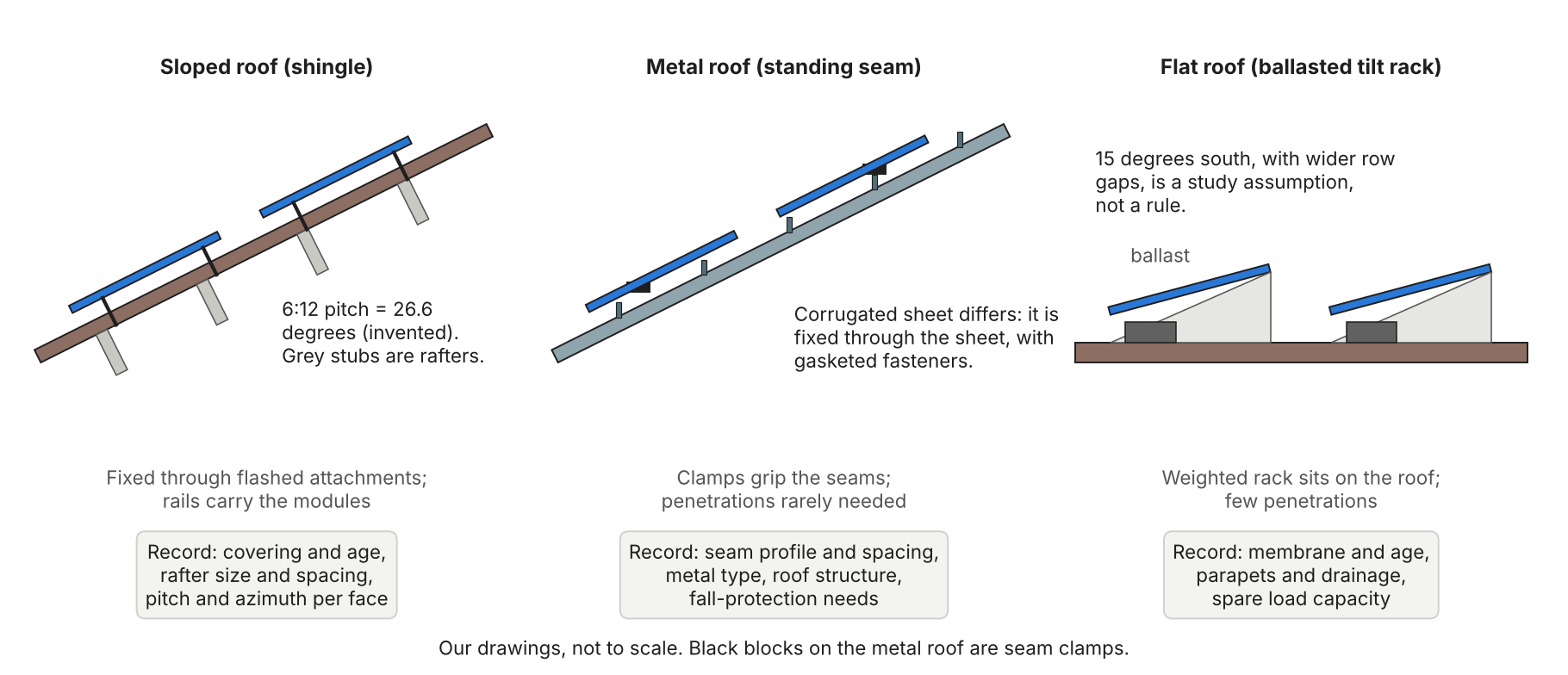
Figure 1. Each roof family changes how modules are fixed and what the survey must record. Flat roofs hold fewer modules per roof area.
Which roof families do installers design for, and how are modules fixed?
Installers group roofs into sloped, metal and flat. Each is fixed in its own way, so the survey asks different questions.
| Family | How modules are fixed (as published) | What to record (our checklist) |
|---|---|---|
| Sloped, shingle | Rails or rail-less hardware on fasteners through the covering. Flashing seals the holes. Metallic flashing means prying shingles up. | Covering and age, rafter size and spacing, pitch and azimuth per face. |
| Metal, standing seam | Mounts fix to the seams with angled fasteners. The article says "penetrations are rarely necessary". | Seam profile and spacing, metal type, fall protection, wire routing. |
| Metal, corrugated | Sheets are face-fixed with exposed fasteners. A lag bolt goes through the raised part, and some attachments use gasketed fasteners to seal each hole. | Sheet profile, purlin position, fastener condition, metal type. |
| Flat, membrane | Systems are "commonly ballasted with few penetrations". Lightweight polymer systems also exist. | Membrane and age, parapets, drainage, spare load capacity. |
The sources are trade articles, not codes. The mount articles date from 2017 and 2023. The classroom page behind the prying-shingles point has no date. Check every detail in the racking maker’s current manual.
Which roof factors decide whether a roof can take solar?
Orientation, tilt, shade, size and condition decide it. One US study turned the first four into hard cut-offs. Condition needs a person on site.
The 2018 study by NREL (now NLR) researchers used lidar to estimate US rooftop potential. It counted a roof plane as unsuitable if it faced northwest through northeast or tilted more than 60 degrees. It also left out planes where a PV system would make under 80% of the energy of an unshaded system. A roof needed one contiguous plane with a projected footprint of at least 10 m2. These are modelling rules for a national estimate, not installer limits.
The US Department of Energy’s consumer guide (4 August 2021) says an installer, roofing expert or structural engineer can judge a roof’s suitability. It also says it helps to know when the roof was installed or replaced. We use these checks:
- Covering age and life: compare life left with the array life, as in the example below.
- Framing: rafter or purlin size and spacing, for the structural check.
- Obstructions: vents, skylights and chimneys, drawn as keep-out zones.
- Fire pathways: the setbacks your AHJ prints.
- Shade: from trees and neighbours, tested in a shading analysis.
- Access and safety: how the crew reaches the roof and what fall protection it needs.
Worked example: will each covering outlast a 25-year array?
If a covering ends before the array, you need one re-roof, or one detach and reset, during the array’s life. All ages, lives and the 25-year array life below are example placeholders, not typical values. Get real lives from the covering’s maker or a roofer.
| Roof (example) | Age (years) | Expected life (years) | Life left now (years) | Life left after array (years) | Covering ends before array by (years) |
|---|---|---|---|---|---|
| A: sloped, covering 1 | 3 | 30 | 27 | 2 | 0 |
| B: sloped, covering 2 | 12 | 25 | 13 | -12 | 12 |
| C: standing-seam metal | 10 | 40 | 30 | 5 | 0 |
| D: flat, membrane | 18 | 20 | 2 | -23 | 23 |
| E: corrugated metal | 8 | 25 | 17 | -8 | 8 |
Roofs B, D and E fall short by 12, 23 and 8 years. Roof D has 2 years left, so a re-roof before install is the likely call. Roofs A and C outlast the array.
The same study’s area ratios show the flat-roof cost. Take 100 m2 of suitable roof and an example 1.8 m2 module. At 0.98, tilted roofs hold 98 m2 of modules, or 54 modules. At 0.70, flat roofs hold 70 m2, or 38 modules. That is 28.6% less module area on the same roof area.
Roof life against array life calculator
Enter the covering’s age, its expected life and the array life. You will see the years left and any gap. The presets match the table and use the example numbers above, so swap in your own.
How solar software handles roof type and mounting
Of the six tools, two company pages name a mount or roof-type choice, three name one in part and one names none. Each tool is rated on whether its own documentation names a mount or roof-type choice.
| Software | Documents a mount or roof-type input? | Method |
|---|---|---|
| HelioScope | Partly | Manual |
| IronRidge Design Assistant | Yes | Manufacturer tool |
| PVcase Roof Mount | Yes | Manual, with partner mounts |
| OpenSolar | Partly | Partner BOM calculator |
| SubcontractorHub | Partly | AI-assisted design |
| Aurora Solar | Not stated | Manual or AI roof model |
Not stated: the company page we cite does not say. Here that means the Aurora pages checked name no roof type or mount type. Partly: the page names a choice for some cases only. What each company page says, with the source checked in October 2026:
- HelioScope. "Racking: set to Flush Mount to design a tilted residential roof." The layout page says "Select Racking type" and names fixed tilt. Flush mount and fixed tilt are named. Ballasted flat roofs and roof covering are not, as on our racking page. Source: HelioScope help: Step by Step Residential Design. 3 Mechanical Layout. No date printed.
- IronRidge Design Assistant. Fixed Tilt Racking for flat-roof projects, and ballasted BX projects that are landscape only. Roof covering and rafter spacing are not mentioned, and attachment specs are entered by hand. Source: Design Assistant HelioScope user guide, version 1.10, copyright 2026.
- PVcase Roof Mount. Users "choose and adapt mounting systems", must select a rooftop material from a dropdown, and can use a mounting ballast calculator. Source: PVcase help: release notes 1.32 and 1.33. No date printed.
- OpenSolar. In one partner calculator you select Flat Roof as the mounting system type and select a roof type from a list of coverings. Other mount types are not described on that page. Source: OpenSolar support: Van Der Valk mounting BOM calculator. No date printed.
- SubcontractorHub. A "Flat" toggle draws a flat-roof facet and a "Ground Mount" toggle draws a ground facet. Facet settings name azimuth and shading only. Source: SubcontractorHub help: flat roof and ground mount layouts. No date printed.
- Aurora Solar. The roof face page lists azimuth, pitch, area, module count and percent area. The roof modelling page names SmartRoof and roof face options. Neither names a roof type or mount type. Source: Aurora help: roof face characteristics. 3 ways to model a roof. No date printed.
Aurora’s wider help may cover racking. See our racking page. More tools are compared in the best solar design software list.
Common mistakes with rooftop solar
FAQs
Can solar panels go on a flat roof?
Yes. Solar Power World says flat-roof systems are commonly ballasted with few penetrations. The 2018 study modelled flat-roof modules at 15 degrees south with wider spacing. That is its assumption. It also assumed they cover 0.70 of flat roof area. Check the load first. See structural loads.
Does rooftop solar always need holes in the roof?
No. Ballasted flat-roof systems have few penetrations. Solar Power World says standing-seam roofs rarely need them. Rail systems on sloped roofs are fixed through the covering, and flashing seals each hole.
How much roof area does rooftop solar need?
On 100 m2 of suitable roof with an example 1.8 m2 module, the 2018 study’s ratios give 54 modules tilted and 38 flat. Those ratios are modelling assumptions, so measure the real roof. See roof measurement for usable area.
Should I replace the roof before installing solar?
Compare the covering’s life left with the array life. In our example, roof D has 2 years left, so a re-roof before install is the likely call. Get real lives from the covering’s maker or a roofer.
Is rooftop solar the same as residential solar?
No. Rooftop describes where the array sits, and residential describes the customer. Shops and warehouses have roofs too, and some countries run home-focused rooftop programmes, such as India’s PM Surya Ghar. Metering terms such as behind-the-meter answer a different question.
Related terms
- Roof measurement: pitch, azimuth and area per plane.
- Racking and mounting design: rails and attachments.
- Structural loads: weight and wind.
- Solar panel layout: placing the modules.
- Distributed generation: small power plants connected near where the power is used.
- Net metering: how exports from a roof system are credited.
Next step: build the roof family and covering checks into your survey with the best solar site survey apps.
Sources
- Gagnon et al., Environmental Research Letters 13, 024027, published 13 February 2018 (checked 30 October 2026).
- Solar Power World, metal rooftops, 23 August 2023 (checked 30 October 2026).
- Solar Power World, mounting systems for roofs, 13 February 2017 (checked October 2026).
- Solar Power World, roof-mount systems classroom page, undated (checked October 2026).
- US Department of Energy, Walk Me Through It, 4 August 2021 (checked October 2026).
- HelioScope help, residential design and mechanical layout (checked October 2026).
- IronRidge Design Assistant HelioScope user guide, version 1.10 (checked October 2026).
- PVcase help, release notes 1.32 and 1.33 (checked October 2026).
- OpenSolar support, Van Der Valk mounting BOM calculator (checked October 2026).
- SubcontractorHub help, flat roof and ground mount layouts (checked October 2026).
- Aurora help, roof face characteristics and 3 ways to model a roof (checked October 2026).
Last updated 30 October 2026. Next scheduled review: 30 January 2027.