Key takeaways
- Lawrence Berkeley National Laboratory (LBNL) counted 27 states plus DC with a mandatory RPS in June 2026. Of those, 16 have a final target of at least 50% of retail sales, and 4 have a 100% RPS.
- The duty falls on retail suppliers, not on installers or customers. Suppliers usually retire one certificate per MWh. Many states let them pay an alternative compliance payment (ACP) instead.
- A solar carve-out is why SRECs exist. LBNL says carve-outs are typically 1-5% of retail sales and often limited to in-state resources.
- Rules move, and a proposal is not a rule. The body shows a New Jersey proposal that would cut its Class I share.
- In an example with 1,000,000 MWh of sales, covering the shortfall costs 2.73 USD per MWh sold.
If your state has a solar carve-out, price SREC income with the best solar proposal software and the best solar financial modeling software.
Renewable portfolio standard at a glance
An RPS turns a state’s renewable goal into a yearly buying duty for suppliers. The duty is a percentage of what they sell.
| Item | Detail |
|---|---|
| Who is bound | Retail suppliers, called load-serving entities (LSEs) by LBNL. EPA says rules cover "electric utilities and other retail electric providers". |
| Formula | Certificates required = obligated retail sales in MWh times the target percentage. One certificate is one MWh. |
| Typical range | LBNL says "Current RPS targets range from 10-40% of retail sales in most states, albeit with widely varying eligibility rules". |
| Solar carve-outs | Typically 1-5% of retail sales (LBNL). |
| Rule source | Each state’s law and regulator. EPA notes that "there is wide variation in RPS rules from state to state". |
| Where it matters | Certificate income, supplier demand for solar, and policy risk in proposals. |
| In software | Tools model certificate or per-kWh income, not RPS targets. See best solar financial modeling software. |
Why does an RPS matter to solar installers?
A solar carve-out is why SRECs exist: suppliers must buy a set share of solar certificates, so solar owners can sell them. Percentages change, so quote the statute year.
Who owns the certificates is a contract question. See renewable energy certificates, third-party ownership and power purchase agreements.
An RPS is not net metering or a tax credit. Net metering sets the bill credit for exports. Tax credits come from tax law (see investment tax credit). The RPS sets what suppliers must buy. A proposal can carry all three. See solar incentives and rebates.
Cost feeds the debate. LBNL’s 2024 edition reports its highest compliance costs in states with solar carve-outs and high SREC prices. They ran at 11-12% of retail bills (data through 2023, so dated).
How does an RPS work?
The law sets a yearly percentage. Each obligated supplier multiplies it by its sales. It then proves the result with certificates or, where allowed, pays an ACP.
- The state sets the target. LBNL writes targets as a percentage of retail sales by obligated LSEs. A target can be the sum of several tiers.
- Exempt load is removed. Some suppliers face lower percentages or are exempt.
- Each tier is multiplied by sales. A solar carve-out has its own percentage.
- Certificates are retired. Suppliers show compliance this way: "Compliance demonstrated through the retirement of RECs" (LBNL). They may bank surplus for later years.
- A shortfall is covered. LBNL notes that "Many states allow LSEs to submit alternative compliance payments (ACPs) in lieu of retiring RECs".
| Term | Meaning |
|---|---|
| Tier or class | A named share of the target with its own eligibility rules. New Jersey’s Table A has Class I and Class II. |
| Carve-out | A separate target for solar or DG, typically 1-5% of retail sales and often in-state only (LBNL). |
| REC or SREC | The certificate retired for one MWh. See renewable energy certificates. |
| ACP | A payment per MWh short, made instead of retiring a certificate where the state allows it. |
| Banking | Keeping surplus certificates for later years. LBNL says individual LSEs may do this. |
The ACP shapes prices. LBNL says spot prices depend on supply, demand and ACP rates. In New England it says pricing has been "hovering just below the current MA/CT ACP". For Maryland it says prices are "capped by low solar ACP", and gives that ACP as 55 USD per MWh in 2025 and 45 USD in 2026.
Worked example: one supplier’s obligation
In our example case the supplier is short 40,000 main-tier and 8,500 solar certificates. Covering them costs 2.73 USD per MWh of retail sales.
| Input (example) | Value |
|---|---|
| Retail sales and exempt share | 1,000,000 MWh a year. 5% exempt, so 950,000 MWh obligated |
| Targets | Main tier 20%. Solar carve-out 3%, as a separate tier |
| Certificates held, including banked | 150,000 main tier. 20,000 solar |
| Market price per certificate | 30 USD main tier. 180 USD solar |
| ACP per MWh short | 40 USD main tier. 250 USD solar. The supplier pays the cheaper of price and ACP |
| Solar yield | 1.3 MWh per kWdc a year |
The next table shows what each tier needs, what the supplier holds and what the gap costs.
| Tier | Required | Held | Shortfall | Cost (USD), with price per certificate |
|---|---|---|---|---|
| Main tier | 190,000 | 150,000 | 40,000 | 1,200,000 (30.00 each) |
| Solar carve-out | 28,500 | 20,000 | 8,500 | 1,530,000 (180.00 each) |
| Total | 218,500 | 170,000 | 48,500 | 2,730,000 |
The market price is below each ACP, so the price sets the cost. If the main-tier price rose to 60 USD, the 40 USD ACP would cap that cost at 1,600,000 USD. The shortfall cost is the total divided by sales: 2,730,000 / 1,000,000 = 2.73 USD per MWh.
The solar requirement of 28,500 certificates equals 21,923 kWdc at 1.3 MWh per kWdc. That is a one-year sizing guide, not a build target. Existing projects and banked certificates also count.
A rule change moves the same sum. New Jersey’s proposed Table A would cut the Class I share. Here are its percentages on the same example 1,000,000 MWh, with no exemption.
| Energy year | Class I now | Class I proposed | SREC share (unchanged) |
|---|---|---|---|
| EY2026 (1 Jun 2025 to 31 May 2026) | 38.0% | 35.0% | 4.50% |
| EY2027 (1 Jun 2026 to 31 May 2027) | 41.0% | 35.0% | 4.35% |
| EY2028 (1 Jun 2027 to 31 May 2028) | 44.0% | 40.0% | 3.74% |
| EY2029 (1 Jun 2028 to 31 May 2029) | 47.0% | 45.0% | 3.07% |
In certificates, the same percentages on the example sales look like this. All counts are in MWh.
| Energy year | Class I now | Class I proposed | Fewer Class I | SREC (unchanged) |
|---|---|---|---|---|
| EY2026 | 380,000 | 350,000 | 30,000 | 45,000 |
| EY2027 | 410,000 | 350,000 | 60,000 | 43,500 |
| EY2028 | 440,000 | 400,000 | 40,000 | 37,400 |
| EY2029 | 470,000 | 450,000 | 20,000 | 30,700 |
Across the four years the proposal removes 150,000 Class I certificates from this example supplier’s duty. For EY2026 and EY2029, that cut is still only proposed text, not an adopted rule. For EY2027 and EY2028, the Board already set the lower 35.0% and 40.0% Class I figures by Board Order on 21 May 2026, so this rulemaking mainly writes an already-operative value into the regulation text. EY2026 ended on 31 May 2026, before the proposal was published, so its row shows what the percentages would have meant for a year already over, not a live target. Table A lists Class II at 2.50% in every year. With 35.0% Class I, the Total column is then 37.50%. We read the proposal text itself: Table A’s Total column adds only Class I and Class II. SRECs, TRECs and SREC-IIs sit in their own columns and are not counted inside Class I or the Total.
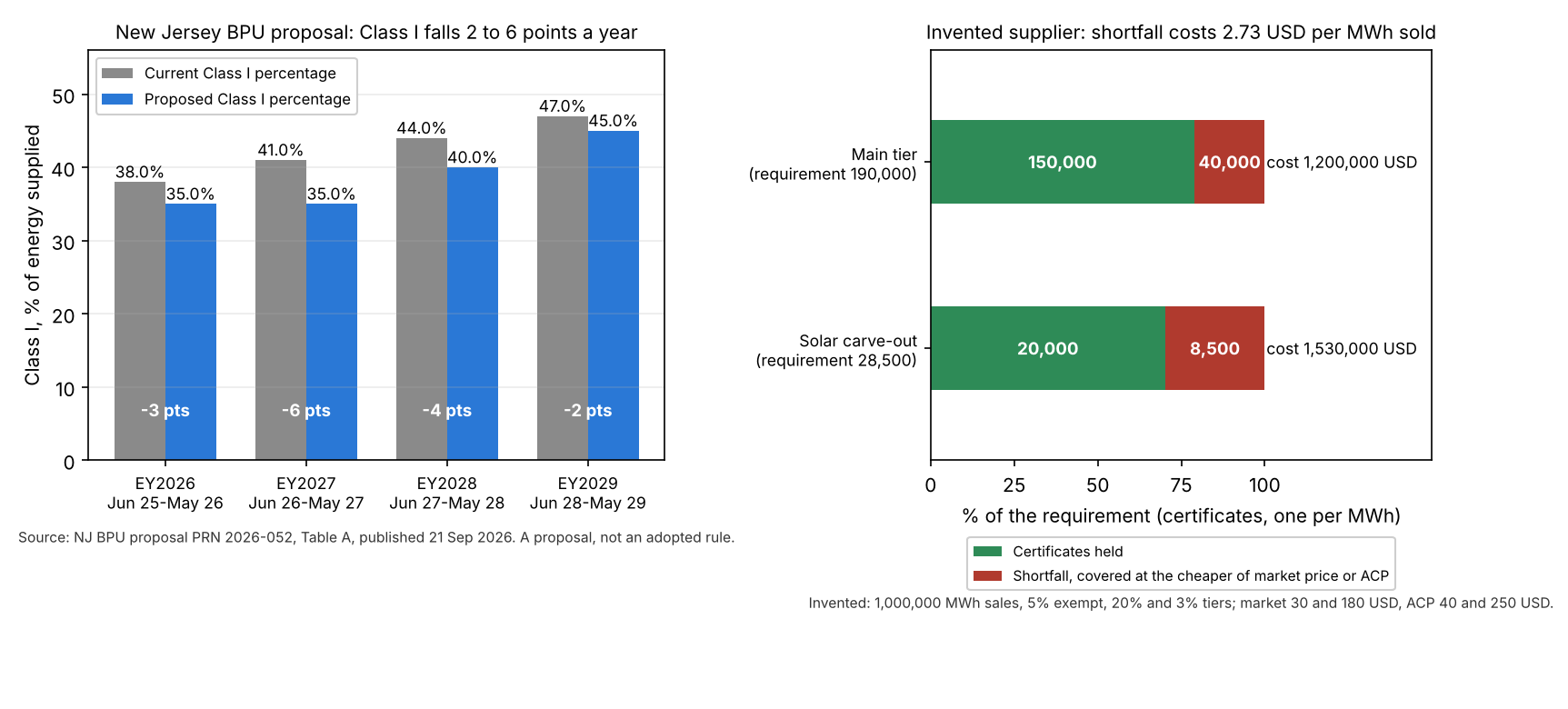
Figure 1. New Jersey’s proposal would cut the Class I share by 2 to 6 points in each of four energy years. In the example ledger, covering 48,500 missing certificates costs 2.73 USD per MWh sold.
Check your own obligation
Enter sales, targets, certificates held, prices and ACPs. The preset reproduces the example. Two buttons load New Jersey’s EY2027 percentages with example sales.
How do RPS rules differ and change by state?
Each state sets its own percentages, tiers, eligible resources and penalties. Lawmakers revise them. Read the current statute and regulator page, not a tracker alone. LBNL names New Hampshire, Pennsylvania and Virginia as having modest solar carve-outs. The sources cited here give no full list of carve-out states.
LBNL’s June 2026 update lists changes in six states. Its policy status runs to April 2026. These rows are LBNL’s wording, not our reading of each state’s law.
| State | Change listed by LBNL |
|---|---|
| Arizona | Repealed RPS. |
| Connecticut | Reduces Class I requirements, while removing LFG and certain biomass from eligibility. |
| Maine | Extends Class IA targets through 2040 and creates a new Class III. |
| North Carolina | Eliminates Duke Energy’s interim 2030 CES target, but retains the 2050 target. |
| New York | Eliminates economy-wide carbon reduction targets, which provide the basis for the RPS and CES. |
| Virginia | Increased the DG carve-out for Dominion from 1% to 5% of the total RPS target. |
New Jersey’s Board of Public Utilities published its proposal in the New Jersey Register on 21 September 2026 (58 N.J.R. 2155-2156). It leaves the SREC and Class II requirements unchanged.
The Justia copy of Massachusetts’ regulation 225 CMR 14.07 lists a Class I minimum standard that includes the solar carve-outs. After 2030 it says the standard rises 1% a year unless law modifies it. Justia is a secondary copy, current through Register 1550 (20 June 2025). The mass.gov drafts we opened were not the final text and showed different figures, so confirm the schedule on the regulator’s page.
- As listed there, the Class I minimum is 27.0% in 2025 and 30.0% in 2026.
- It is 33.0% in 2027, 36.0% in 2028 and 39.0% in 2029.
- It reaches 40.0% in 2030.
How solar software handles an RPS
Installer tools model the income an RPS creates, not the RPS itself. None of the three company pages states an RPS target or a supplier obligation.
| Software | Models SREC or per-kWh income? | Source |
|---|---|---|
| Aurora Solar | Yes | Aurora help, Solar Renewable Energy Credits (SRECs). No date shown on the page |
| Solargraf | Yes | Solargraf help, How to: Add an SREC. Published 10 December 2021 |
| OpenSolar | Partly | OpenSolar support, How to set up Incentives. No date shown on the page |
Partly: the page has per-kWh income inputs but does not name SRECs. What each company page says:
- Aurora Solar. Add an SREC programme through Add Incentive. By default Aurora subtracts the total expected SREC savings from system cost. The page says aggregators sell SRECs to utilities "to meet state RPS requirements". It does not say Aurora registers or sells them.
- Solargraf. An incentive can be marked "Is this an SREC?". It takes a DSIRE programme ID, a duration in years and a rate per kWh AC. The rate is fixed or varies by year. No RPS mention.
- OpenSolar. A Performance-Based incentive takes values by year, a number of years and an annual adjustment. The page does not mention SREC, REC or RPS.
Tools with incentive libraries and cash-flow models are compared in the best solar financial modeling software list.
Common mistakes with an RPS
FAQs
What is the difference between an RPS and a clean energy standard?
LBNL defines a CES as similar to an RPS, but with a broader set of eligible technologies, typically including nuclear. It counts 16 states with a CES. Most of them also have an RPS.
Does an RPS apply to installers or homeowners?
No. It binds retail suppliers. New Jersey’s rule text covers "Each supplier/provider" that sells electricity to retail customers in the state. A solar owner may earn certificates that suppliers buy. See renewable energy certificates.
What is an alternative compliance payment?
It is a payment made in place of retiring a certificate, where the state allows it. LBNL says many states do. It also says Maryland’s solar ACP was 55 USD per MWh in 2025 and 45 USD in 2026.
How many states have an RPS?
LBNL counts 27 states plus DC with a mandatory RPS in its June 2026 update, down from 29 plus DC in its 2024 edition. Of the 27, its slide 7 says 16 have final targets of at least 50% of retail sales and 4 have a 100% RPS. The 2026 update lists Arizona’s repeal among the changes since. LBNL leaves out voluntary and executive-order targets.
Related terms
- Renewable energy certificates: the tradable record of 1 MWh that suppliers retire.
- Net metering: bill credits for a customer’s own exports.
- Solar incentives and rebates: payments and credits that cut a system’s net cost.
Next step: find your state’s carve-out in the LBNL update in Sources, then test SREC income against bill savings in the best solar financial modeling software.
Sources
- LBNL, U.S. State Electricity Resource Standards: 2026 Data Update, Galen Barbose, June 2026. Policy status to April 2026.
- Berkeley Lab news, status update on state clean electricity standards, 13 August 2024.
- LBNL, U.S. State Renewables Portfolio and Clean Electricity Standards: 2024 Status Update, published 8 August 2024.
- EPA, Energy and Environment Guide to Action, Chapter 5: Renewable Portfolio Standards, published 23 June 2017, last updated 30 December 2025.
- New Jersey BPU, proposal PRN 2026-052, N.J.A.C. 14:8-2.3, 58 N.J.R. 2155-2156, 21 September 2026. Comments due 20 November 2026. Full text read 3 November 2026, including Table A and its Total-column footnotes.
- Justia, 225 CMR 14.07, secondary copy of the Massachusetts regulation, current through Register 1550, 20 June 2025.
- Aurora Solar help, SRECs, no date shown on the page.
- Solargraf help, How to: Add an SREC, published 10 December 2021.
- OpenSolar support, How to set up Incentives, no date shown on the page.
Last updated 3 November 2026. Next scheduled review: 3 February 2027.