Key takeaways
- Berkeley Lab’s Tracking the Sun (August 2024) reports 2023 TPO shares. Residential systems had 27%. Small and large non-residential systems had 13% and 33%.
- In this example’s 50 kWdc case (95,000 USD capex), ownership has the highest 20-year total at 149,656 USD. The lease gives 92,873 and the PPA 86,703.
- At a 7% host discount rate (our assumption), the order flips on NPV: lease 45,665, PPA 41,508, ownership 27,984 USD. Ownership and lease tie at 4.63%.
- If output falls 10% (example test), the lease saving drops 28.8%, the PPA saving 10.0% and ownership 17.9%. The PPA owner carries that output risk.
- Who claims tax benefits changes the price. Check the primary rule and its date before you quote a number.
To model a lease or PPA offer in software, see the best solar financial modeling software.
Third-party ownership at a glance
| Item | Detail |
|---|---|
| Forms | PPA (pay per kWh delivered) and lease (pay a fixed amount each month). EnergySage calls both forms of TPO. |
| Typical terms | DOE: PPAs generally 10 to 25 years. EnergySage: residential leases and PPAs usually 20 to 25 years. |
| Where it matters | Proposals for hosts that cannot use tax credits. Also for hosts who want no upfront cost. |
| Standard or rule | No single standard. State law, the contract and tax rules decide. |
| In software | Proposal and finance tools model lease or PPA payments. Inputs differ. |
Why does third-party ownership matter for installers?
TPO changes what you sell and what you must model. The host weighs a payment against a bill, not a price against a payback.
The risk changes too. The National Renewable Energy Laboratory (NREL) wrote the Module 4 training slides (undated). They list "No operating and maintenance responsibilities" as a PPA advantage. They warn that "PPA pricing may be sub-optimal (developer could receive most of the financial benefits)". Show both sides in your proposal, with assumptions beside every number.
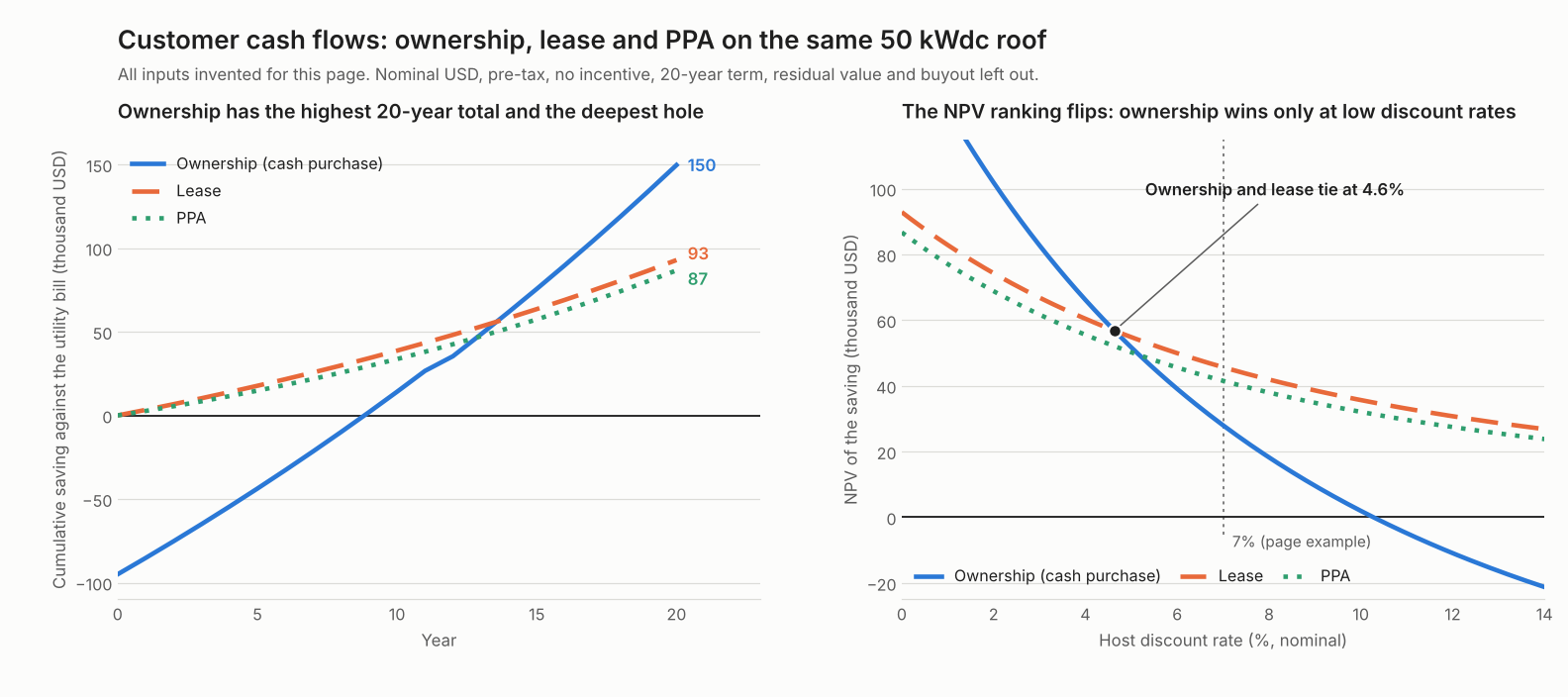
Figure 1. In this example’s 50 kWdc case, ownership has the highest 20-year saving. At 7%, the lease and PPA have the higher NPV.
How do a lease and a PPA differ?
Both put solar on the host’s site. The owner holds title. A lease charges a fixed monthly amount. A PPA charges for the electricity produced. Two other pages cover each in depth: solar lease and power purchase agreement.
| Item | Lease | PPA | Ownership (cash or loan) |
|---|---|---|---|
| Owner of the system | Third party | Third party | Host |
| Host pays | Fixed monthly amount | Price per kWh delivered | Purchase price or loan payments |
| Output risk | Host (payment does not move) | Owner (payment follows kWh) | Host |
| Escalator | Often | Often | None |
| Upfront cash | None. The owner funds the system | None | Full capex, or the loan down payment |
EnergySage says many leases and PPAs add annual rate increases, "typically 1-3% per year". The output risk row follows from how each payment is defined. Our example tests it below. For price, escalator and buyout detail, see the PPA page.
Who owns what in a TPO deal?
The owner holds the system. The owner usually gets the tax benefits too. DOE’s Better Buildings page (23 August 2023) says the developer and its investors own the equipment. They keep it for the PPA term. At the end, the customer "may be able to extend the term, purchase the system from the developer, or have the equipment removed".
The primary tax sources below are dated. Read each as a statement from its date.
- NREL (July 2014) says the lessor "receives any applicable federal, state, and local tax benefits and incentives". It may pass savings on through lower payments.
- NREL (October 2016) says lessors "often take advantage of federal tax incentives and depreciation benefits". Universities that own systems cannot, as most pay no federal tax.
- NREL’s Module 4 slides list this as a PPA advantage: "Ability for tax-exempt entity to benefit from savings passed on from federal tax incentives".
- DOE (2023) says tax credits and rebates exist at federal and state levels. They lower costs for developers and investors.
Rules changed in 2025, so quote a tax rule with its source and date, and ask a tax adviser how it applies.
- IRS Notice 2025-42, section 1, describes when the credit ends for an applicable solar facility. The text we read covers construction that begins after 4 July 2026 and service after 31 December 2027.
- The only lease mention we saw is in a retrofit cost test, which leaves out land cost including lease payments. The notice does not address lease structures. Section 7 applies it if construction did not begin before 2 September 2025.
- A CRS report (25 September 2025) quotes the residential credit law. It does not apply to "any expenditures made after December 31, 2025".
For more, see investment tax credit, IRA tax credits and solar incentives and rebates.
How do owners finance a TPO fleet?
Owners usually raise money from investors who can use tax benefits. NREL’s 2010 report says developers "typically work with tax equity partners". It describes a sale-leaseback between developer and tax-equity partnership. That report is old. Use it only to see the structure.
SAM’s financing overview names five models. Three structures matter here. A single owner "builds, owns, and operates" the system. A partnership flip is for "two-party projects that involve equity investments by a project developer and a third party tax investor". SAM lists versions with and without debt. A sale leaseback is "a tax investor purchasing 100% of the project from the developer and then leasing it back to the developer". See project finance model.
What must installers and software model?
Model each input below: the host’s payment, the bill it replaces, who pays for what, and what happens at the end. Miss one and the saving is wrong.
- Payment basis: USD per kWh for a PPA, USD per month for a lease. Aurora’s custom lease and PPA page lists four inputs. These are a per kWh rate, a monthly payment, an escalation rate and an upfront payment.
- Output: degraded kWh each year. A PPA payment follows it. A lease payment does not. See degradation rate.
- Bill avoided: the host’s tariff and escalation. Exports depend on net metering.
- Owner’s costs: who pays O&M and replacements. Our example gives them to the owner.
- Term end: extension, buyout or removal. The contract sets the price.
- Tax: whose it is, and whether the price includes it. Keep it out of the host’s cash flow. Add it only if the host claims it.
Then run the host’s cash flow analysis and NPV. Cost lines are in CAPEX and OPEX.
Worked example: ownership, lease and PPA on one roof
On a 50 kWdc commercial roof, the lease saves 92,873 USD over 20 years and the PPA 86,703. Ownership saves 149,656 USD after a 95,000 USD outlay.
| Input (example) | Value |
|---|---|
| System and energy | 50 kWdc. 1,400 kWh per kWdc in year 1 (70,000 kWh). 0.5% degradation a year. 20 years |
| Bill avoided | 0.150 USD per kWh in year 1, rising 3% a year. All output used on site |
| Ownership | 1.90 USD per W = 95,000 USD at year 0. O&M 15 USD per kWdc (750 USD) rising 2.5%. Inverter 0.08 USD per W (4,000 USD) in year 12. No incentive |
| Lease | 600 USD per month in year 1 (7,200 USD a year), rising 2% a year. Owner pays O&M |
| PPA | 0.112 USD per kWh in year 1 (7,840 USD), rising 2% a year. Owner pays O&M |
| Host discount rate | 7% nominal. Year-end flows, capex at year 0 |
| Left out | Tax, depreciation, incentives, residual value after year 20, buyout, removal, fees |
In year 1 the bill avoided is 10,500 USD. Saving equals bill avoided minus host payment.
| Result (example inputs) | Ownership | Lease | PPA |
|---|---|---|---|
| Cash at year 0 (USD) | -95,000 | 0 | 0 |
| Net saving in year 1 (USD) | 9,750 | 3,300 | 2,660 |
| 20-year total saving (USD) | 149,656 | 92,873 | 86,703 |
| NPV at 7% (USD) | 27,984 | 45,665 | 41,508 |
| NPV at 3% / 12% (USD) | 82,767 / -10,919 | 66,851 / 30,752 | 61,698 / 27,461 |
| Cumulative cash turns positive | 8.8 years | no outlay | no outlay |
Ownership wins on the total. It loses on NPV at 7% because its cash goes out first. The NPVs tie with the lease at 4.63% and with the PPA at 5.18%. Below those rates ownership wins. Ownership also leaves a system with years of life after year 20, which we did not value.
We changed one input at a time and kept the rest at base. The 20-year totals moved as follows.
| Input changed | Ownership | Lease | PPA |
|---|---|---|---|
| Both escalators 0% / 3% | 149,656 (unchanged) | 123,814 / 74,348 | 118,244 / 67,846 |
| Output 90% of expected | 122,874 | 66,092 | 78,033 |
| Output 80% of expected | 96,093 | 39,310 | 69,363 |
| Utility escalation 0% / 5% | 82,159 / 210,380 | 25,377 / 153,598 | 19,207 / 147,428 |
| Placeholder incentive, 20% of capex in year 1 | 168,656 | 92,873 (unchanged) | 86,703 (unchanged) |
With output at 80% the lease host saves 39,310 USD and the PPA host 69,363. The PPA owner carries the shortfall. It lifts the ownership NPV to 45,741 USD. That is almost level with the lease at 45,665. The test ranges differ in size, so this does not rank the inputs. A flat check drops escalators, degradation, O&M escalation and inverter replacement. It gives totals of 100,000 USD for ownership, 66,000 for the lease and 53,200 for the PPA.
Calculator: compare ownership, lease and PPA
Enter your own inputs. It reproduces the tables above. It warns on blank, negative, out-of-range or unclear values.
If the frame does not load, open the ownership, lease and PPA calculator on its own page.
How solar software handles third-party ownership
Aurora and HelioScope take lease or PPA inputs. SAM models the owner and its investors, not the host’s bill.
| Software | Models lease or PPA? | Source |
|---|---|---|
| Aurora Solar | Yes | Aurora help, Custom Leases/PPAs, updated 17 April 2026 |
| HelioScope | Partly | HelioScope Financial Modeling Glossary, updated 4 August 2026 |
| SAM | Yes, owner side | SAM help, financing overview, undated |
Partly: the page covers PPA inputs but not lease.
- Aurora Solar: Account admins can create custom leases and PPAs for reps to present in Sales Mode. Inputs listed: per kWh rate, monthly payment, escalation rate, upfront payment. No term or buyout input listed. No statement on who claims credits.
- HelioScope: PPA financing inputs: price per kWh, escalation rate, term in years. Lease is not covered on the page. PPA inputs also include a down payment and an end-of-term payment. Financing sections listed are cash, loan and PPA.
- SAM: Financial models for single owner, partnership flip (with and without debt), sale leaseback and merchant plant. These model the owner and investors, not the host’s bill saving.
To compare more tools, read the list of best solar financial modeling software and the list of best commercial solar proposal software.
Common mistakes with third-party ownership
Is third-party ownership allowed in every state?
No. DOE’s page (23 August 2023) says "Laws surrounding PPAs vary by state". Some states have laws that create barriers for PPAs or outlaw them entirely. It also cites DSIRE for PPAs being available in 26 states plus Washington, D.C. That count is from 2023. Check with the state regulator before you quote a structure.
FAQs
What is the difference between a solar lease and a PPA?
A lease charges a fixed monthly amount, and a PPA charges for the electricity the panels produce. In both, a third party owns the system. EnergySage describes the two forms this way.
Who claims the tax credit on a TPO system?
The lessor or PPA provider, because they own the system for tax purposes. NREL (2014) said the same thing, and the mechanism is still in force as of November 2026: the third-party owner claims the business credit under section 48E (the clean electricity investment credit), not the homeowner’s own residential clean energy credit, which only ever applied to a system the homeowner bought outright and in any case does not apply to spending after 31 December 2025. The lessor’s 48E claim sits under the same rules covered on the investment tax credit page: 30% if the project is under 1 MW AC or meets wage and apprenticeship rules, and a placed-in-service deadline tied to when construction began. Ask a tax adviser to confirm the current rate and deadline for a specific deal.
Is a solar lease or PPA cheaper than buying?
Not over 20 years in our example case, but yes on NPV at 7%. Ownership has the highest total saving at 149,656 USD, against 92,873 for the lease and 86,703 for the PPA. At 7%, the lease (45,665) and PPA (41,508) beat ownership (27,984).
Can the host buy the system?
Sometimes, if the contract allows it. DOE says the customer may be able to buy the system from the developer at the end of the term. EnergySage says some agreements allow a buyout during the term, "typically at fair market value or a price specified in your contract". The contract sets the price.
Is TPO falling or rising?
Residential TPO fell, then ticked up. Tracking the Sun (2024) says residential TPO has declined from a high of roughly 60% of systems installed in 2012. It "ticked up slightly to 27% in 2023". Its data cover about 78% of US distributed PV systems installed through 2023.
Related terms
- PPA: pricing per kWh delivered.
- Solar lease: fixed monthly payments.
- Financial modelling: the wider method.
- Domestic content bonus: an extra US federal credit tied to where equipment is made.
Next step: to put an offer in front of a host, use the best commercial solar proposal software or the best solar financial modeling software.
Sources
- DOE Better Buildings Solution Center: power purchase agreement, 23 August 2023 (re-read 30 October 2026).
- NREL: Non-PPA Options for Financing Solar Deployment at Universities, October 2016 (checked October 2026).
- NREL: Homeowners Guide to Leasing a Solar Electric System, July 2014 (checked October 2026).
- NREL: Solar PV Project Financing, Third-Party PPA System Owners, revised February 2010 (checked October 2026).
- NREL: Project Financing, Policy, and Incentives, Module 4, undated (checked October 2026).
- Berkeley Lab: Tracking the Sun 2024, executive summary, August 2024 (re-read 30 October 2026).
- CRS Insight IN12611: Expiration and Carryforward Rules for the Residential Clean Energy Credit, 25 September 2025 (checked October 2026).
- IRS Notice 2025-42, sections 1 and 7 re-read 30 October 2026. No issue date printed in the text read.
- EnergySage: solar leases vs PPAs, shows "Updated Oct 26, 2026" (checked October 2026).
- Aurora help: Custom Leases/PPAs, updated 17 April 2026 (checked October 2026).
- HelioScope: Financial Modeling Glossary, updated 4 August 2026 (checked October 2026).
- SAM help: financing overview, undated (checked October 2026).
Last updated 3 November 2026. Next scheduled review: 3 February 2027.