Key takeaways
- The IRS page (reviewed 5 January 2026) prints a 6 percent base rate, raised "5 times or up to 30%" when wage and apprenticeship rules are met.
- IRS Notice 2025-42 ends the 48E credit for solar only when both tests are met: construction begins after 4 July 2026 and service starts after 31 December 2027.
- On example inputs, 600,000 USD of eligible cost gives 180,000 USD of credit at a 30% rate you enter, or 36,000 USD at 6%.
- The 2025 Form 3468 instructions cut the basis of energy property by 50% of the credit. That line sits under section 48, so confirm it for your credit.
- The owner claims the credit on a tax return, so cash arrives after the install.
To model the credit in software, see the best solar financial modeling software.
ITC at a glance, and why it matters for installers
An ITC is a credit set against tax. You work it out as a rate times the cost that counts. It changes net cost and cash flow. A wrong rate or date misprices a quote.
| Item | Detail |
|---|---|
| Formula | Credit = rate × cost that counts for the credit. The owner’s tax adviser marks which costs count. |
| Unit | Percent of cost. The result is in USD. |
| Where it matters | Net price, owner cash flow, payback, and who can use the credit. |
| Standard or rule | US tax law, read through IRS pages and notices. Sections 48E and 48 are the two named below. |
| In software | An incentive line of the cost-based type, with a rate you set. See the software table or the best solar financial modeling software. |
In a quote, the credit lowers the owner’s net price but pays out later. It changes the payback period and the cash flow analysis.
Which tax credit do installers mean by "ITC"?
Usually the business credit under section 48E. That is the clean electricity investment credit. The older energy credit under section 48 is a separate rule. So is the homeowner’s residential clean energy credit.
The IRS 48E page calls it a credit that "replaces the Energy Investment Tax Credit". The 2025 Form 3468 instructions have a part for the clean electricity credit (Part V). They have another part for the energy credit under section 48 (Part VI).
The residential clean energy credit is different. IRS FAQ FS-2025-05 (21 August 2025) says: "The credit will not be allowed for any expenditures made after December 31, 2025."
See solar incentives and rebates and IRA tax credits.
What do the IRS pages print today?
The table lists what each IRS page says, with its date. The 48E page does not print the solar end dates, but the notice does.
| Topic | What the IRS page prints | Source and date |
|---|---|---|
| Who | "Taxpayers with a qualified facility and energy storage technology placed in service after Dec. 31, 2024". | IRS 48E page, reviewed 5 January 2026 |
| Rate | "The base amount of the Clean Electricity Investment Credit is 6 percent of the qualified investment." It is raised "5 times or up to 30%" for wage and apprenticeship rules, unless the project is under 1 MW AC output, which gets the full 30% without meeting those rules. Most residential and small commercial jobs fall under that 1 MW line. | IRS 48E page, reviewed 5 January 2026, and the Treasury rule on the 1 MW AC exception |
| End for solar | Ends "for applicable wind and solar facilities placed in service after December 31, 2027", for facilities "the construction of which begins after July 4, 2026". | IRS Notice 2025-42, section 1. Issued 15 August 2025 per Notice 2026-15, footnote 11 |
| Beginning of construction | Construction begins when "physical work of a significant nature" begins. A continuous program of construction is needed. | IRS Notice 2025-42, sections 3, 4, 6 and 7 |
| Foreign entities | The Form 3468 instructions bar the credit where "the taxpayer is a specified foreign entity". | Form 3468 instructions (2025), Part V |
| How to claim | The owner files Form 3468 "with the taxpayer’s annual return". "Taxpayers cannot claim both investment credit and production credit for the same facility." | IRS 48E page, reviewed 5 January 2026 |
| Refund or sale | Elective pay makes certain credits "effectively refundable" for tax-exempt and governmental entities. Transfer lets other entities sell a credit. | IRS elective pay and transferability page, reviewed 27 June 2026 |
| Recapture | A recapture event is disposing of the property "before the end of 5 full years after the property was placed in service". | Form 3468 instructions (2025) |
| Depreciable basis | Under Part VI: "You must reduce the basis of energy property by 50% of the energy credit determined." | Form 3468 instructions (2025, footer dated 25 August 2026) |
- Domestic content and energy community: the 48E page adds further increases for both. See domestic content bonus.
- Beginning of construction, more detail: The notice itself says the five percent safe harbour in earlier notices is not available, and Section 6 lets a low output solar facility (maximum net output not greater than 1.5 MW AC) use similar principles to show construction began before 5 July 2026. Section 7 covers facilities whose construction did not begin before 2 September 2025. Update, checked November 2026: a federal court vacated Notice 2025-42 in full on 6 June 2026 (Oregon Environmental Council v. IRS, D.D.C.), ruling the IRS had acted arbitrarily and capriciously in dropping the five percent safe harbour. The ruling covers all taxpayers. As of the sources checked, the government had not filed an appeal and the IRS had not issued new guidance, so the five percent safe harbour is again a valid way to show construction began, alongside the physical work test. An appeal or new guidance could change this, so confirm the current position with a tax adviser or the IRS site before relying on it.
- Foreign entities, more detail: Notice 2026-15 (released 12 February 2026 per Mayer Brown) "describes interim guidance regarding restrictions to certain energy credits". It covers sections 45Y, 48E and 45X.
- Refund or sale, more detail: elective pay "makes certain clean energy tax credits and the CHIPs manufacturing credit effectively refundable". Tax-exempt and governmental entities can use it. Transfer lets entities that cannot use elective pay but qualify for a credit sell it to a third-party buyer.
- Registration: an entity "must register with us before filing" to use elective pay or transfer.
The Form 3468 page (reviewed 10 September 2026) lists the 2025 form. It shows corrections dated 30 March and 3 September 2026. See MACRS depreciation for how basis feeds depreciation.
Worked example: one 650,000 USD commercial system
On example inputs, the credit is 36,000 USD at 6% and 180,000 USD at 30%. Sell the 30% credit at an example 92 cents per dollar. You get 165,600 USD.
The table compares four example cases of one system. A higher rate, a sale or a smaller cost that counts each changes the result.
Inputs (example): cost 650,000 USD. 50,000 USD does not count, so 600,000 USD counts. The rate is an input, not a forecast. Cash comes 1 year after install. Discount rate: 6%. The basis falls by 50% of the credit. That 50% is a section 48 rule. We apply it to every case only for illustration, because the form instructions we read show no matching Part V sentence.
| Case (example) | Cost that counts (USD) | Credit (USD) | Cash in year 1 (and present value) (USD) | Basis if the section 48 cut applied (USD) |
|---|---|---|---|---|
| A: claimed, rate 6% | 600,000 | 36,000 | 36,000 (present value 33,962) | 632,000 |
| B: claimed, rate 30% | 600,000 | 180,000 | 180,000 (present value 169,811) | 560,000 |
| C: sold at 92 cents, rate 30% | 600,000 | 180,000 | 165,600 (present value 156,226) | 560,000 |
| D: 100,000 less counts, rate 30% | 500,000 | 150,000 | 150,000 (present value 141,509) | 575,000 |
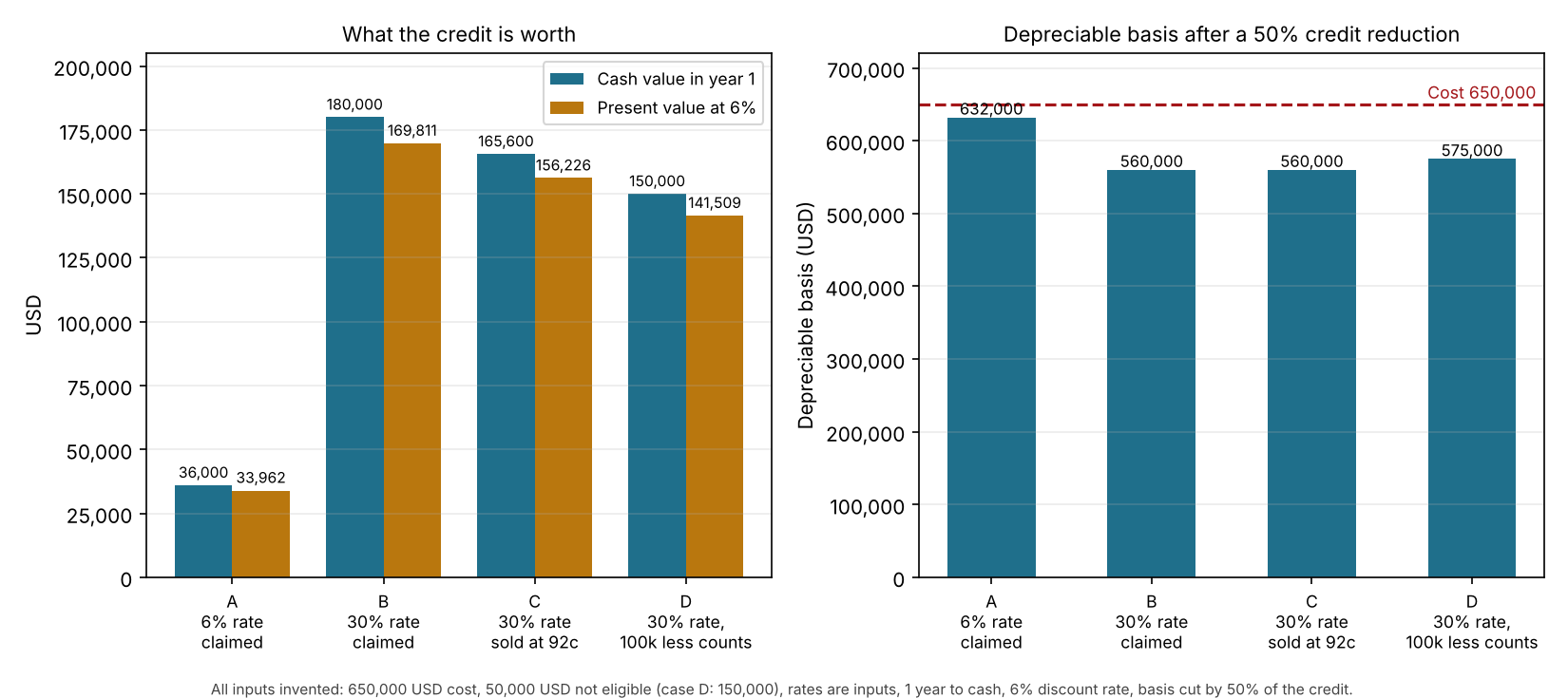
Figure 1. On example inputs, the 30% credit is five times the 6% credit. A sale at 92 cents turns 180,000 USD of credit into 165,600 USD of cash.
Several things move the answer. First, the rate: 600,000 × 30% is 180,000. Second, the cost that counts: 100,000 USD less at 30% removes 30,000 USD of credit. Third, timing: waiting 2 years, not 1, cuts the present value of case B from 169,811 to 160,199 USD.
Not showing? Open the investment tax credit calculator on its own page. It warns on blank, negative, out-of-range or unclear numbers such as 1.000.
What should installers ask the owner’s tax adviser to keep on file?
These items help the adviser back up the return. This list is a prompt, not a legal checklist.
- Cost split: contract and invoices by line, so the adviser can mark what counts.
- Placed-in-service date: dated proof of when the system went into service. The IRS rates and end dates tie to it.
- Construction-start evidence: records of physical work and a continuous program. Keep these if the project relies on the 4 July 2026 date.
- Wage and apprenticeship records: the Form 3468 instructions list the rules for the higher rate. The adviser can say which records to keep.
- Supplier certifications: Notice 2026-15, section 2.02(2), says you must keep certifications "for a period of not less than six years".
- Owner details: who owns the system. Add an elective pay registration number if the owner is a tax-exempt or government body.
How solar software handles the ITC
Of the five tools checked, three clearly handle the ITC, one handles it partly and one company page does not say. The pages were read in October 2026, and the Aurora and OpenSolar pages show no date.
| Software | Does it handle the ITC? | Page read |
|---|---|---|
| Aurora Solar | Yes | Aurora help, Incentives |
| OpenSolar | Yes | OpenSolar support, Applying Incentives to a Project |
| SAM (NLR, formerly NREL) | Yes | SAM help, Incentives. No date or version printed |
| HelioScope | Partly | HelioScope help, Customizing Financial Incentives. No date shown |
| Solo (GoSolo) | Not stated | Solo help. No other date shown |
Partly means the page describes a related feature but does not name the ITC. Not stated means the company page we read does not say.
- Aurora Solar: "Some incentives, like the Federal ITC, are applied to projects automatically." Cost-based incentives take a percentage of system cost. Aurora’s page calls the ITC "set at 30% until 2033". That differs from the IRS end rules above, so treat it as a tool default, not law.
- OpenSolar: "If your project qualifies for the Federal ITC, you must re-select it after clicking "Override Default Incentives"" because the override unchecks it.
- SAM: "SAM allows the ITC to be expressed either as a fixed amount or as a percentage of the project investment cost with a maximum limit."
- SAM, basis: ticking the box "reduces the depreciable basis by 50% of the ITC amount".
- HelioScope: the incentives page does not name the ITC. Its Reduced Basis section says "the tax credit would have to be deducted from the total system cost first".
- Solo (GoSolo): the page read is a resource list titled "Federal ITC and MACRS Informational Resources". It does not say the tool calculates the ITC. Its schedule is marked "(updated 2022)".
To see how tools model credits, tax and cash flow, read the best solar financial modeling software list. To see how they show incentives in a customer quote, read the best solar proposal software list.
Common mistakes with the ITC
FAQs
Is the solar ITC still available in 2026?
Yes, if construction began by 4 July 2026 or the project is placed in service by 31 December 2027, because the end rule needs both tests. Notice 2025-42 ends the 48E credit for solar that begins construction after 4 July 2026 and is placed in service after 31 December 2027. The rate is a separate question: a project under 1 MW AC gets the full 30% without meeting wage and apprenticeship rules, which covers almost every residential and small commercial job.
What is the difference between the ITC and the PTC?
An investment credit rests on the investment. A production credit rests on output over time. The IRS 48E page says taxpayers cannot claim both for the same facility.
Can the owner sell the credit?
Some entities can. The IRS elective pay and transferability page (27 June 2026) says transfer lets entities that cannot use elective pay sell a credit to a third-party buyer. They get cash.
Who claims the ITC on a leased or PPA system?
The IRS 48E page speaks of "taxpayers with a qualified facility". The Form 3468 energy credit text adds a property rule: "Acquired by the taxpayer if the original use of such property commences with the taxpayer."
The IRS pages we read do not name the lessor or the customer. On a lease or PPA, ask the owner’s adviser who the taxpayer is. See third-party ownership.
Does the ITC change depreciation?
Yes, under the energy credit part. The 2025 Form 3468 instructions say to reduce the basis of energy property by 50% of the energy credit. No matching sentence was seen for Part V, so the adviser confirms the figure for your credit.
Related terms
- Solar incentives and rebates: the types of benefit a tool models, with dated US rules.
- Domestic content bonus: the extra credit points the IRS 48E page ties to domestic content.
- MACRS depreciation: how a business deducts the cost of an asset over time.
Next step: test your own rate and timing in the best solar financial modeling software, then quote it with the best solar proposal software.
Sources
- IRS: Clean Electricity Investment Credit, page last reviewed 5 January 2026 (checked October 2026).
- IRS Notice 2025-42, issued 15 August 2025 per Notice 2026-15. The PDF prints no date (checked October 2026).
- EY Tax News: District court vacates IRS notice eliminating 5 percent safe harbor for clean energy projects, on the 6 June 2026 ruling in Oregon Environmental Council v. IRS (checked November 2026).
- IRS Notice 2026-15, released 12 February 2026 per Mayer Brown, 25 February 2026 (checked October 2026).
- IRS: Instructions for Form 3468 (2025), footer dated 25 August 2026 (checked October 2026).
- IRS: About Form 3468, reviewed 10 September 2026 (checked October 2026).
- IRS: Elective pay and transferability, reviewed 27 June 2026 (checked October 2026).
- IRS: FAQs on home energy credit changes, FS-2025-05, 21 August 2025 (checked October 2026).
- Aurora help: Incentives (checked October 2026).
- OpenSolar: Applying Incentives to a Project (checked October 2026).
- SAM help: Incentives. No date or version printed (checked October 2026).
- HelioScope help: Customizing Financial Incentives. No date shown (checked October 2026).
- Solo help: Federal ITC and MACRS Informational Resources. "(updated 2022)" on the page (checked October 2026).
Last updated 3 November 2026. Next scheduled review: 3 February 2027.