Solar CMMS software (computerised maintenance management system) is the work-order system for a solar plant’s upkeep. It holds repair tickets, planned upkeep schedules, spare parts and each asset’s service history. Fabrico ranks first on this list, at 80.4/100.
Fabrico ranks first because it has the best user reviews here. But it has no solar features, and its solar case rests on its own marketing.
An honest note on this category: It is thin. We checked nine tools, and only seven reached our minimum match score (4 out of 10). The two top scorers are general CMMS products, not solar software.
Most solar options are big suites where the CMMS is one part. None of them shows a price, and none has more than a few public reviews. We have not padded the list to reach ten.
Quick picks
Rank | Product | Best for | Starting price (company page, checked October 2026) | Pricing model | Free plan / trial | Score /100 |
|---|---|---|---|---|---|---|
1 | Preventive maintenance and spare parts across several plants | Quote only | Quoted per plant | Demo. Pilot site offered | 80.4 | |
2 | Starting free with a small O&M team | ✓ Free Lite. Pro USD 19 per user per month | Per user | Free forever (Lite) | 70.5 | |
3 | Remote, off-grid and microgrid sites | Quote only (no company price page found) | Not published | Not confirmed | 69.0 | |
4 | O&M providers running tickets, dispatch and asset finance in one system (status unconfirmed) | Quote only | Quote | Unknown | 61.0 | |
5 | Utility fleets wanting work orders inside a SCADA and APM suite | Quote only | Quote | Demo only | 59.3 | |
6 | Turning drone thermography findings into field tasks | Quote only | Subscription, quote | Demo only | 56.8 | |
7 | Carrying construction QA and punch lists into O&M | Quote only | Quote | Demo only | 52.3 |
✓ Verified on the company’s own pricing page. ◐ Published by the company outside its pricing page (help centre, store or press release). ? We could not read the company’s pricing page, so the figure is not confirmed. Prices checked October 2026.
Quote only means the company shows no public price. You ask it for a quote.
How the 7 tools scored
- Use-case fit 35%
- User reviews 20%
- Pricing 15%
- Ease of use 10%
- Support 10%
- Momentum 10%
Tool | Score chart | Score |
|---|---|---|
80.4 out of 100 | 80.4 | |
70.5 out of 100 | 70.5 | |
69 out of 100 | 69.0 | |
61 out of 100 | 61.0 | |
59.3 out of 100 | 59.3 | |
56.8 out of 100 | 56.8 | |
52.3 out of 100 | 52.3 |
Each bar shows the weighted score out of 100.
Sub-scores at a glance (0-10)
Product | Use-case fit | User reviews | Pricing | Ease of use | Support | Momentum | Total /100 |
|---|---|---|---|---|---|---|---|
10.0 | 7.2 | 4.0 | 10.0 | 10.0 | 5.0 | 80.4 | |
10.0 | 5.0 | 7.0 | 5.0 | 5.0 | 5.0 | 70.5 | |
10.0 | 5.0 | 4.0 | 5.0 | 7.5 | 5.5 | 69.0 | |
10.0 | 5.0 | 4.0 | 5.0 | 5.0 | 0.0 | 61.0 | |
6.7 | 5.0 | 4.0 | 5.0 | 5.0 | 10.0 | 59.3 | |
6.7 | 5.0 | 4.0 | 5.0 | 5.0 | 7.5 | 56.8 | |
6.7 | 5.0 | 4.0 | 5.0 | 5.0 | 3.0 | 52.3 |
A 5.0 on reviews, ease, support or momentum is our neutral value where public evidence is thin, not a judgement.
What is the difference between a CMMS, an O&M platform and a monitoring tool?
A CMMS (computerised maintenance management system) is the work-order layer. It holds PM schedules, repair tickets, tech tasks, checklists, spare parts and each asset’s service history.
A full O&M (operations and maintenance) or asset platform does more. It adds output analysis, contracts and investor reports. A monitoring or SCADA (plant control and data) system is different again. It spots the fault in the first place.
That split explains this ranking. The general CMMS tools handle work orders well, but they know nothing about strings (rows of panels wired together), inverters or PR (performance ratio). The solar suites know the plant but treat upkeep as one part among many.
If you need the wider platform, start with our solar O&M software and solar asset management software rankings. All these pages sit in our monitoring and asset management hub.
Picking the system that raises the alarms? See solar SCADA software. To find out why output is low before you send a crew, see solar performance analytics. For the full control room on a utility plant, see solar farm management software.
How did we rank these solar CMMS tools?
How the score is weighted
- Use-case fit 35%
- User reviews 20%
- Pricing 15%
- Ease of use 10%
- Support 10%
- Momentum 10%
We reviewed nine products by desk research between 22 and 25 October 2026. We read company docs, price pages, app-store listings, trade press and public user reviews. We did not test any of them hands-on.
We scored all nine and ranked seven, with the other two under Also considered. None was dropped for facts we could not check. We score each product on six points.
- Use-case fit (35%): How well it does this page’s job. We look for work orders, PM (preventive maintenance) schedules, spare parts, a mobile field app and tickets raised from alarms.
- User reviews (20%): G2, Capterra and app-store ratings. Ratings from only a few reviews count for less.
- Pricing (15%): Public prices score higher than prices you have to ask for.
- Ease of use, support and momentum (10% each): Review sub-scores, support on record and dated releases.
A point with fewer than eight reviews, or no proof, gets a middle score (5 out of 10), not a penalty. If we could not confirm a product’s core facts on the company’s own site, it loses two points. We show third-party ratings for context only and never use them in rating markup.
Scores are set per page. We weigh the job this page covers, so the same tool can score differently elsewhere.
Read the full method and how we verify pricing.
1. Fabrico (general CMMS): best for preventive maintenance and spare parts across several plants
Best for: O&M teams that want a well-reviewed, easy CMMS and can live without PV asset models. Score: 80.4/100.
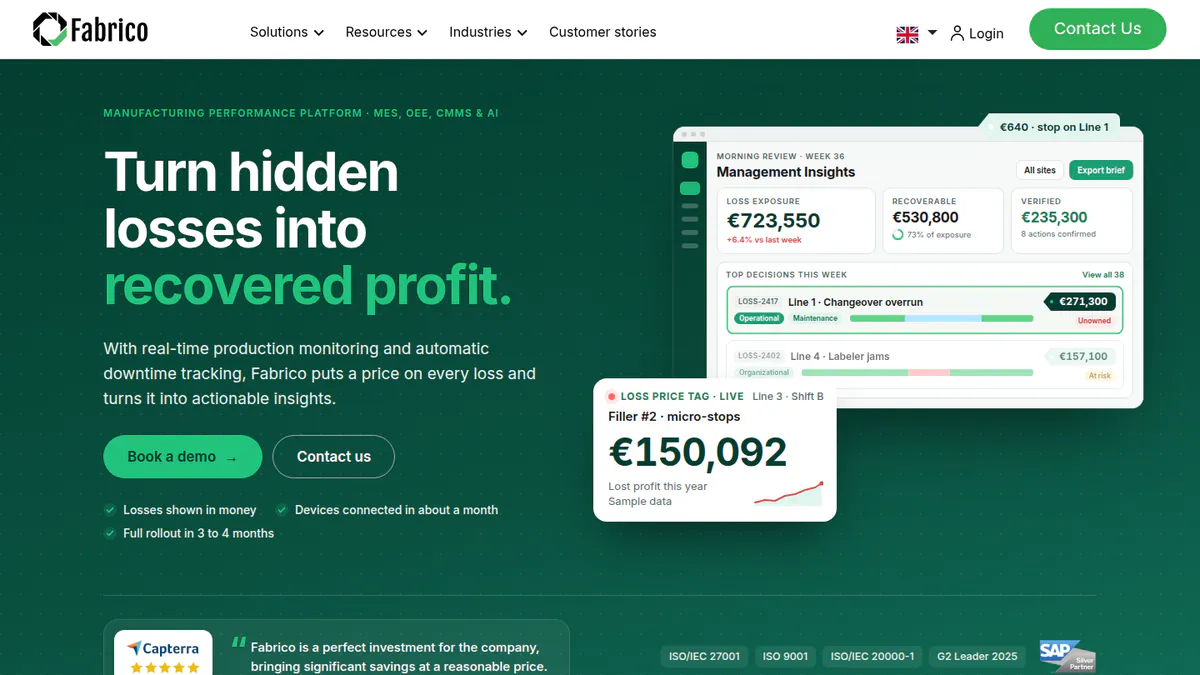
What it is: Fabrico is a maintenance and MES (factory execution system) tool built for factories. It tracks live OEE (equipment effectiveness) and downtime next to its work orders. Its own blog pitches it to solar O&M teams and ranks Fabrico first among CMMS for renewables.
Why we picked it: It has the best user reviews on this page. It covers the three core CMMS jobs: work orders, PM schedules and spare parts. You can also trial it on one pilot site first.
Key features:
- Work orders, preventive maintenance and work cards.
- Spare parts and inventory.
- Web plus iOS and Android apps with QR scanning.
- Multi-site KPIs (key performance indicators) and reports on cost impact.
- Machine links through PLCs (machine controllers) and IoT (connected) sensors, plus SAP links and AI helper add-ons.
Pricing: You have to ask the company for a price. There are three plans: Light for small plants, Full for medium and large plants, and Enterprise for groups and multi-site. Each is quoted per plant, by modules, lines and sites, and a pilot is on offer (Fabrico pricing, checked October 2026). Capterra lists a free tier and free trial that the company page does not show.
Pros (from user reviews):
- Very easy to use and to find your way around, say several reviewers from 2023-2025 (Capterra).
- PM jobs schedule themselves, so you spend less time planning.
- Smooth onboarding and a usable mobile app.
Cons (from reviews and our research):
- Loading the first asset data takes time (Capterra).
- Not widely known yet, so you have fewer peers to ask (Capterra).
- No offline mode for remote sites, by the company’s own admission (Fabrico blog).
Reviews: Capterra 4.9/5 from 19 reviews, with ease of use 4.9/5 and customer service 5.0/5 (checked October 2026). We found no solar O&M users among the reviews we read.
What we could not confirm: its blog says it turns SCADA alarms into work orders. Its pricing page does not mention SCADA or name any monitoring company.
Want to see Fabrico (general CMMS) working? Book a demo with the SolarSoftwares team.
Book a demoYour request goes by email to the SolarSoftwares team. A time is set only after we reply. It does not change any score or ranking.
2. Oxmaint (general CMMS): best for starting free with a small O&M team
Best for: Small O&M contractors testing a CMMS before they spend money. Score: 70.5/100.
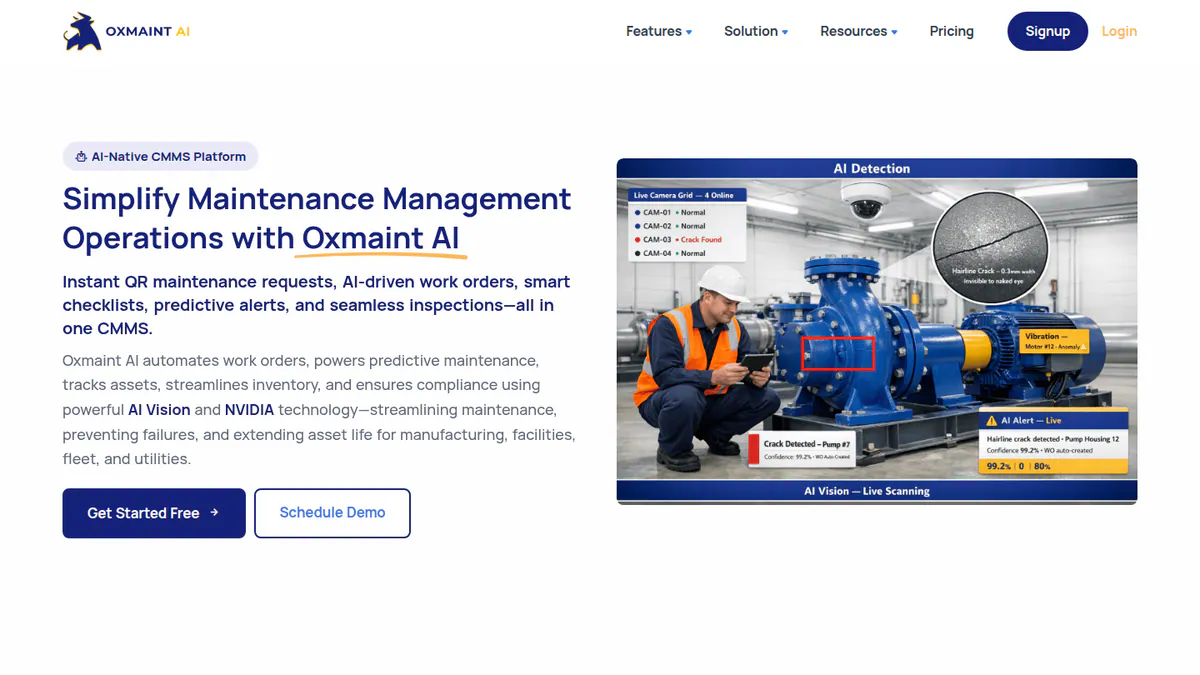
What it is: Oxmaint is a general CMMS with AI help, sold to factories, buildings, fleets and power plants. Solar shows up in its marketing, but there is no solar module.
Why we picked it: It is the only tool here with published prices and a free plan. You can test a CMMS at no cost. Its Pro plan adds API access (a way for apps to connect) for pulling in alarms from other systems.
Key features:
- Work orders with preventive and predictive maintenance.
- Asset list with QR codes.
- Parts, inventory and purchasing.
- Inspections and safety checks.
- AI agents for scheduling and routing (Agentic plan).
- iOS and Android apps, plus an API.
Pricing: Four plans, checked October 2026 (Oxmaint pricing).
- Lite: Free forever. You get 3 work orders a month, 1 schedule, limited assets and reporting, unlimited members, the mobile app and community support.
- Pro: USD 19 per user per month or USD 190 per user per year. It adds all modules, unlimited assets and work orders, API access and multi-location.
- Agentic: USD 49 per user per month or USD 490 per year. It adds AI scheduling, work-order routing and predictive insights.
- Enterprise: Quoted, with an on-premises option and 24/7 phone support.
Capterra quotes a different starting price, which conflicts with the company page.
Pros (from our research):
- You can start free, with unlimited members.
- You see the per-user price before any sales call, which is rare here.
- You can pick a support level, from community help to 24/7 phone.
Cons (from our research):
- Lite’s 3 work orders a month will not cover a real portfolio.
- No solar module on the pricing page.
- No user reviews to judge it by.
Reviews: No usable ratings as of October 2026. The Capterra listing has 0 reviews, and we could not read a rating on the G2 listing.
Want to see Oxmaint (general CMMS) working? Book a demo with the SolarSoftwares team.
Book a demoYour request goes by email to the SolarSoftwares team. A time is set only after we reply. It does not change any score or ranking.
3. 60Hertz: best for remote, off-grid and microgrid sites
Best for: O&M teams and owners keeping solar, battery and diesel assets running where signal is weak. Score: 69.0/100.
What it is: 60Hertz, based in Anchorage, Alaska, makes a mobile-first CMMS for energy assets. It targets rural power, microgrids, mining, military, telecom and backup power. Note: we could not check its own website, so these facts come from Capterra and the App Store.
Why we picked it: It is built for energy assets on remote sites, and its field app works offline. It also has more user reviews than any other ranked energy tool, though still only 7.
Key features:
- Work orders completed on mobile, with photos, notes and data validation.
- Preventive maintenance scheduling and service history.
- Field app that works offline.
- No-code checklist and workflow designer in the web portal.
- Multi-site asset lists, tech management and reports.
- An iOS release (v3.22.0) dated 9 October added redesigned controls, dark mode and in-form diagrams (App Store).
Pricing: You have to ask the company for a price, as we found no company pricing page. Capterra lists a starting price of USD 20 per month and a free trial (Capterra listing, checked October 2026). We could not confirm either with the company.
Pros (from user reviews): From Capterra reviews.
- Strong reports, with graphs, filters and a report builder.
- Easy to manage many assets across several sites.
- Responsive, knowledgeable staff.
Cons (from user reviews):
- Steep admin learning curve, mainly when building checklists.
- The mobile app’s look needs updating. Mobile access is its lowest-rated feature at 3.3/5.
- Linking to some third-party controllers is hard.
Reviews: Capterra 4.1/5 from 7 reviews, with ease of use 3.1/5 and customer service 4.0/5 (checked October 2026). That is too few to rely on.

Want to see 60Hertz working? Book a demo with the SolarSoftwares team.
Book a demoYour request goes by email to the SolarSoftwares team. A time is set only after we reply. It does not change any score or ranking.
4. ACTIS ERP: best for O&M providers running tickets, dispatch and asset finance in one system
Best for: O&M providers, asset managers and investors with C&I (commercial and industrial) and utility portfolios. Score: 61.0/100.
What it is: ACTIS ERP is a renewables ERP (business system) from Alectris, a solar asset-care and O&M firm. It joins tickets, work orders, field dispatch, spare parts, monitoring alerts and asset records. It sits above SCADA rather than replacing it. We could not reach the company site, so these facts come from 2020-2021 trade press, and its status today is unconfirmed.
Why we picked it: An O&M operator built it to put alarms, tickets, dispatch and spare parts on one record. That is the closest fit to a solar CMMS among the solar suites, if it is still on sale.
Key features:
- One hub for monitoring alerts, tickets and asset data.
- Work orders with mobile checklists, photos and spare-parts tracking.
- Live planning and tracking of field crews, with location and routes.
- Offline mobile logging through the Resco connection (June 2020).
- Technical and financial asset records.
Pricing: You have to ask the company for a price, with no public prices. Alectris has sold it directly and through resellers such as Profergy in Australia since March 2020 (pv magazine Australia, checked October 2026).
Pros (from our research):
- An O&M operator built it for O&M operators.
- Per 2020-2021 press, alarm, ticket and spare part sit on one record.
- It ran Alectris’s 24/7 global control centre (January 2021).
Cons (from our research):
- No dated product news after January 2021.
- No user reviews to judge it by.
- No published price or trial.
Reviews: No user reviews found. There are no listings on G2, Capterra or Trustpilot as of October 2026.
Read our full ACTIS ERP review.
Want to see ACTIS ERP working? Book a demo with the SolarSoftwares team.
Book a demoYour request goes by email to the SolarSoftwares team. A time is set only after we reply. It does not change any score or ranking.
5. Power Factors Unity: best for utility fleets wanting work orders inside a SCADA and APM suite
Best for: IPPs (independent power producers), asset owners and large O&M providers running utility-scale solar, wind and storage. Score: 59.3/100.
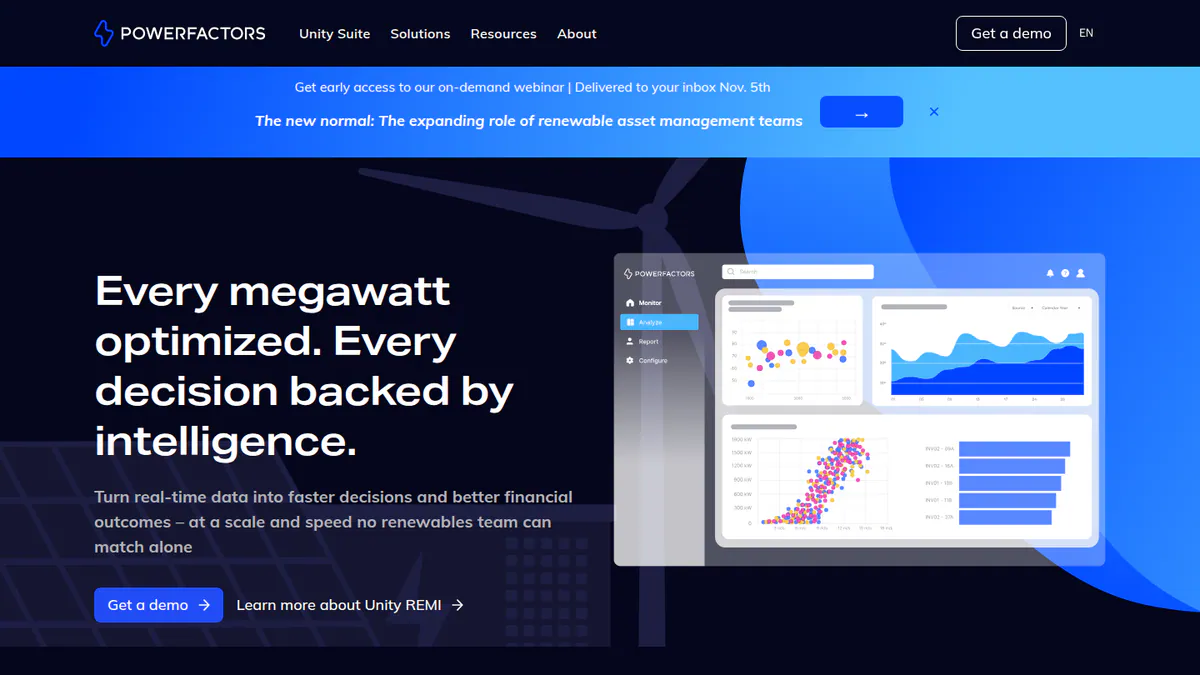
What it is: Power Factors Unity merges the former Drive, Greenbyte and BluePoint products into one renewables suite. It covers SCADA, plant control, APM (asset performance management), field service and commercial asset work. Maintenance is one part of that suite, so it fits this job less well than the CMMS tools.
Why we picked it: No other tool here puts work orders and SCADA in one suite from one company. Its 2026 releases also show the product is moving.
Key features:
- Field service: work orders, scheduling, stock and maintenance KPIs.
- Local and central SCADA, power plant controller and EMS (energy management system).
- APM with Advanced Insights.
- Unity REMI AI, launched 29 April 2026, with forecasts, plain-English questions and AI agent workflows.
- An iOS app to triage events by energy or revenue loss.
Pricing: You have to ask the company for a price. The site lists a demo (Power Factors, checked October 2026).
Pros (from our research):
- You get work orders and SCADA from one company.
- Its REMI AI is trained on 310+ GW of operational data. Unity is active across 30+ GW (April 2026, per Solar Power World).
- Active 2026 releases, including iOS app updates in May and July.
Cons (from our research):
- You have to ask the company for a price, so you cannot compare cost before a sales call.
- No free trial. You see it through a demo only.
- Almost no user reviews to judge it by.
Reviews: App Store 5.0/5 from 1 rating. The legacy Greenbyte Capterra listing has 0 reviews (checked October 2026).
What we could not confirm: which systems it links to, as Power Factors does not publish a connections list.
Read our full Power Factors Unity review.
Want to see Power Factors Unity working? Book a demo with the SolarSoftwares team.
Book a demoYour request goes by email to the SolarSoftwares team. A time is set only after we reply. It does not change any score or ranking.
6. Raptor Maps: best for turning drone thermography findings into field tasks
Best for: Utility-scale owners, IPPs and O&M firms whose upkeep starts from inspection findings. Score: 56.8/100.
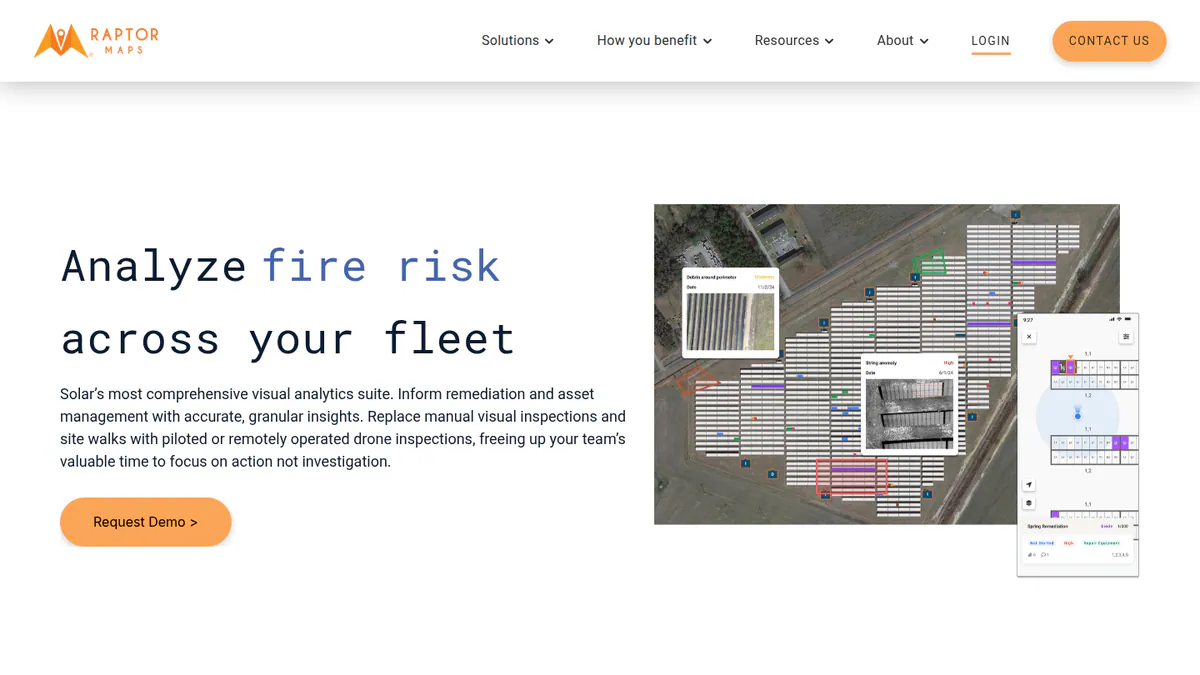
What it is: Raptor Maps, based in Boston, builds a digital twin (a virtual model) of each plant from drone, aircraft, satellite and sensor data. It puts a power and money figure on each fault, and its field app sends techs to them with checklist tasks. It is an inspection tool with CMMS-style tasks, not a full maintenance system.
Why we picked it: On big plants, much repair work starts from an inspection finding. Raptor Maps turns those findings into field tasks with a loss figure attached.
Key features:
- Drone thermal scans that find faults and size the loss.
- Raptor Solar Sentry docked drones that fly scheduled, on-demand or SCADA-alert-triggered missions.
- Mobile app that works offline, with GPS routes to faults.
- STC-normalised (standard test conditions) thermography for OEM warranty claims.
- Module barcode scanning and serial checks.
- API and SCADA/DAS (data acquisition system) data connection.
Pricing: You have to ask the company for a price, sold as a subscription. A 2021 Solar Builder article says the subscription includes unlimited inspection reports (Raptor Maps, checked October 2026).
Pros (from our research):
- Each finding carries a power and money loss figure, which helps you rank tickets.
- The offline field app suits large sites.
- Drone capture works with any drone hardware.
Cons (from our research):
- No PM scheduling or spare-parts module on record.
- You have to ask the company for a price.
- Few reviews to judge it by: five App Store ratings and no written reviews.
Reviews: App Store 4.8/5 from 5 ratings. The G2 listing has 0 reviews (checked October 2026).
Read our full Raptor Maps review.
Want to see Raptor Maps working? Book a demo with the SolarSoftwares team.
Book a demoYour request goes by email to the SolarSoftwares team. A time is set only after we reply. It does not change any score or ranking.
7. SenseHawk: best for carrying construction QA and punch lists into O&M
Best for: Utility-scale developers and EPCs that want one digital twin from construction to operations. Score: 52.3/100.
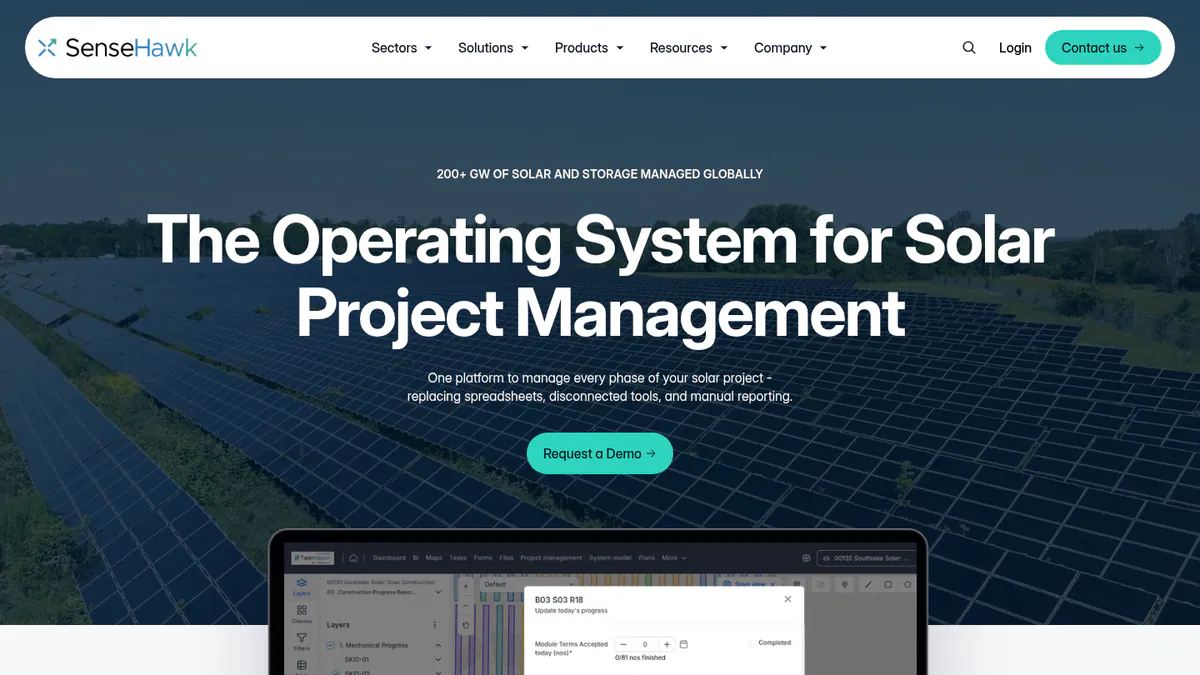
What it is: SenseHawk pairs TaskMapper with Therm. TaskMapper handles build progress, quality checks, punch lists, stock and field tasks on a GIS (digital map) view. Therm handles drone visual and thermal scans. Reliance Industries announced on 6 September 2022 that it was buying a 79.4% stake for USD 32 million. Note: we could not open SenseHawk’s own site, so its features come from company text on G2 and SoftwareOne.
Why we picked it: It is the only tool here that carries construction QA records and punch lists into O&M on the same map. That suits an EPC handing a plant to its own O&M crew.
Key features:
- Web and mobile tasks, checklists and schedules.
- No-code forms, defect tracking and punch lists.
- Stock and logistics by barcode scanning.
- Drone thermal scans with defect locations.
- ISO 27001 certification (an information security standard).
Pricing: You have to ask the company for a price (SoftwareOne listing, checked October 2026).
Pros (from our research):
- Construction defects and O&M tasks live on the same map.
- A wide user base: it reported 140+ customers in 15 countries and 100+ GW at the 2022 deal.
- Barcode stock records carry over from construction.
Cons (from our research):
- Built mainly for construction, not routine upkeep.
- You have to ask the company for a price.
- We found no 2025-2026 news, so recent progress is unclear.
Reviews: G2 4.8/5 from 2 reviews (TaskMapper) and 4.5/5 from 2 reviews (SenseHawk), checked October 2026. That is too few to rely on.
Want to see SenseHawk working? Book a demo with the SolarSoftwares team.
Book a demoYour request goes by email to the SolarSoftwares team. A time is set only after we reply. It does not change any score or ranking.
What does each tool do for maintenance?
Product | Solar-specific? | Work orders and PM | Spare parts | Offline field app | Alarm to work order | Public reviews (October 2026) | Price |
|---|---|---|---|---|---|---|---|
No (general CMMS) | Yes | Yes | No (company blog) | Claimed in company blog only | Capterra 4.9 (19) | Quote per plant | |
No (general CMMS) | Yes | Yes | Not documented | Not documented | None | Free. USD 19/user/mo | |
Energy assets, remote sites | Yes | Not documented | Yes | Not documented | Capterra 4.1 (7) | Quote only | |
Yes | Yes (2020-2021 press) | Yes | Via Resco (2020) | Alerts and tickets in one hub (press) | None | Quote only | |
Yes (renewables) | Yes (field service module) | Inventory listed | Not documented | SCADA in the same suite | App Store 5.0 (1) | Quote only | |
Yes | Field tasks only | Not documented | Yes | SCADA alerts can trigger drone missions | App Store 4.8 (5) | Quote only | |
Yes | Tasks, checklists, schedules | Inventory by barcode | Not documented | Not documented | G2 4.8 (2) | Quote only |
Also considered
- Bluence (Isotrol): A SCADA, plant control and APM suite that the company says runs 190 GW. Predictive upkeep sits inside its APM. We could not confirm a separate work-order module, so it fell below the minimum score. See solar SCADA software.
- PowerTrack: AlsoEnergy’s monitoring platform, now part of Stem. It makes work orders from alerts and passes tickets to other CMMS tools, but it is not a CMMS itself. That put it below the minimum score. Its App Store rating is 3.1/5 from 42 ratings (October 2026). See solar monitoring software.
- Other general CMMS (Limble, UpKeep, MaintainX, IBM Maximo, Fiix, eMaint): We did not research these for this edition, so they are not scored. We will add any that show solar O&M use at the next review.
How do you choose solar CMMS software?
- Small O&M firm wanting to try a CMMS with no contract? Start on Oxmaint Lite. Move to Pro at USD 19 per user per month once you pass three work orders a month.
- For the best-reviewed work-order tool on sites with signal, shortlist Fabrico. Ask in the demo how it models strings and inverters.
- Remote, off-grid and microgrid sites suit 60Hertz, thanks to its offline field app and checklist builder.
- Already running Power Factors SCADA or APM across a utility fleet? Use the Unity field service module rather than adding a separate CMMS.
- When most of your repair work starts from thermal inspections, pair Raptor Maps with a CMMS. You can also use its field app alone for anomaly tasks.
- EPCs handing plants to their own O&M team should look at SenseHawk, which keeps construction QA records attached to the assets.
- Need dispatch and scheduling for residential service crews rather than plant maintenance? See our solar field service management software ranking instead.
Want more choices? Browse every tool we checked in our monitoring and asset management category.
Solar CMMS software FAQs
What is a CMMS for solar farms?
A CMMS plans and records upkeep on a PV plant. It covers preventive maintenance schedules, plus repair tickets, spare parts and asset history. As of October 2026, all the solar options we found need a price request: ACTIS ERP, Power Factors Unity, Raptor Maps, SenseHawk and 60Hertz.
Is a general-purpose CMMS good enough for solar O&M?
Often yes, for work orders, preventive maintenance and spare parts. Fabrico (Capterra 4.9/5 from 19 reviews, October 2026) and Oxmaint document all three. They lack a model of strings and inverters, so alarms need a link to another system. Otherwise choose a solar suite such as Power Factors Unity.
How does a CMMS get alarms from SCADA?
Either the CMMS sits in the same suite as the SCADA, or you add an API link. Power Factors Unity keeps both in one suite. Oxmaint has API access from its Pro plan (USD 19 per user per month, October 2026). Fabrico’s blog claims alarm-to-work-order, which we could not confirm.
What is the best CMMS for renewable energy?
On our October 2026 scores, Fabrico ranks highest at 80.4/100 as a general CMMS. Among energy tools, 60Hertz scores highest at 69.0/100. For utility fleets that also need SCADA, Power Factors Unity covers wind, solar and storage in one suite.
Do small solar O&M contractors need a CMMS?
Once you track repeat inspections across several sites, a shared work-order system beats spreadsheets. It gives you audit trails and backs warranty claims. Oxmaint’s free Lite plan is a low-cost way to find out. It allows 3 work orders a month with unlimited members (checked October 2026).
Sources
All checked 22 to 25 October 2026.
- Fabrico: pricing, company blog (December 2025), Capterra
- Oxmaint: pricing, product site
- 60Hertz: Capterra, App Store
- ACTIS ERP: pv magazine Australia, Solar Power World, June 2020, Renewable Energy Magazine, January 2021
- Power Factors Unity: company site, Solar Power World, April 2026, App Store
- Raptor Maps: company site, digital twin docs, Solar Builder, App Store
- SenseHawk: SoftwareOne listing, G2 TaskMapper, G2 SenseHawk, pv magazine USA, September 2022
- Bluence: Isotrol. PowerTrack: AlsoEnergy, App Store
Last updated 28 October 2026. Next scheduled review: 23 January 2027.