Solar farm management software helps a control room run a large solar plant. It covers SCADA (the plant control and data system), alarms and field work. Power Factors Unity ranks first on this list, at 67.7/100, as the only suite with plant control, alarms and field work. GreenPowerMonitor is second at 60.2/100.
We considered 15 products, scored 12 and ranked the top 7 from 22 to 25 October 2026.
What does solar farm management software do?
Running a solar farm is a daily cycle. The control room watches each inverter and tracker. It keeps the plant inside its grid-code limits (the rules for feeding power to the grid). It sorts alarms and sends techs out with the right parts. It also plans site checks and logs uptime for the owner.
We ranked tools on how much of that day they cover for large plants. We scored SCADA and plant control, turning alarms into work orders, monitoring and asset data.
Search results for this term mix in build tools. If you build the plant as an EPC (engineering, procurement and construction firm), see our EPC project management ranking instead.
The same companies show up on pages for narrower jobs. See O&M software (operations and maintenance) for upkeep and asset management for contracts and revenue. To find lost output, see performance analytics. All four sit in our monitoring and asset management category.
Quick picks
Rank | Product | Best for | Starting price (company page, checked October 2026) | Free plan / trial | Score /100 |
|---|---|---|---|---|---|
1 | Control, monitoring and field work in one suite | Quote only | Demo only | 67.7 | |
2 | On-site SCADA with logbook, forecasting and planning | Quote only (Core, Pro, Elite) | Demo only | 60.2 | |
3 | Multi-technology fleets with plant control | Quote only | Demo only | 56.0 | |
4 | Alarm-to-work-order with an offline field app | Quote only | Demo only | 54.3 | |
5 | Autonomous drone inspections triggered by SCADA | Quote only | Demo only | 53.5 | |
6 | Deciding which faults justify a site visit | Quote only | Demo only | 51.0 | |
7 | Smaller ground-mount plants on per-kWp pricing | ✓ EUR 0.02 per kWp per month (above 200 kWp) | Free demo access | 49.7 |
✓ Verified on the company’s own pricing page. ◐ Published by the company outside its pricing page (help centre, store or press release). ? We could not read the company’s pricing page, so the figure is not confirmed. Prices checked October 2026.
Quote only means the company shows no public price. You ask it for a quote.
How the 7 tools scored
- Use-case fit 35%
- User reviews 20%
- Pricing 15%
- Ease of use 10%
- Support 10%
- Momentum 10%
Tool | Score chart | Score |
|---|---|---|
67.7 out of 100 | 67.7 | |
60.2 out of 100 | 60.2 | |
56 out of 100 | 56.0 | |
54.3 out of 100 | 54.3 | |
53.5 out of 100 | 53.5 | |
51 out of 100 | 51.0 | |
49.7 out of 100 | 49.7 |
Each bar shows the weighted score out of 100.
Sub-scores at a glance (0-10)
Product | Use-case fit | User reviews | Pricing | Ease of use | Support | Momentum | Total /100 |
|---|---|---|---|---|---|---|---|
9.1 | 5.0 | 4.0 | 5.0 | 5.0 | 10.0 | 67.7 | |
7.6 | 5.0 | 4.0 | 5.0 | 5.0 | 7.5 | 60.2 | |
7.1 | 5.0 | 4.0 | 5.0 | 5.0 | 5.0 | 56.0 | |
6.7 | 5.0 | 4.0 | 5.0 | 5.0 | 5.0 | 54.3 | |
5.7 | 5.0 | 4.0 | 5.0 | 5.0 | 7.5 | 53.5 | |
5.7 | 5.0 | 4.0 | 5.0 | 5.0 | 5.0 | 51.0 | |
4.8 | 5.0 | 7.0 | 5.0 | 5.0 | 2.5 | 49.7 |
A 5.0 on reviews, ease, support or momentum is our neutral score. We use it when public evidence is thin. It is not a judgement.
How did we rank these solar farm management tools?
How the score is weighted
- Use-case fit 35%
- User reviews 20%
- Pricing 15%
- Ease of use 10%
- Support 10%
- Momentum 10%
We considered 15 products and scored 12 from 22 to 25 October 2026. We ranked the top 7 and list the other 5 under "Also considered". This was desk research from company docs, pricing pages, trade press and public user reviews. We did not run any plant with these tools.
The six criteria:
- Use-case fit (35%): How well it does this page’s job. Asset management, O&M (operations and maintenance) work tracking and monitoring count equally, then SCADA. The product must also serve large plants.
- User reviews (20%): Ratings from only a few reviews count for less, and no reviews means a middle score. Hardly any large-plant tool has enough public reviews to move this.
- Pricing (15%): Published pricing scores higher than quote-only.
- Ease of use, support and momentum (10% each): Review sub-scores and dated product updates. Each gets a middle score when we find no proof.
Products below our minimum match score (4 out of 10) go to "Also considered", as do products ranked below 7th. That is why Sitemark sits there. It scored 60.2 on strong reviews but is a weak match for running a plant. Scores are for this page’s job, so a tool can score differently elsewhere. Read the full method: how we score software.
What does a solar farm software stack hold?
- Control layer: Plant SCADA and a power plant controller to meet grid code. Power Factors, GreenPowerMonitor and BaxEnergy show this.
- Monitoring and analytics: Fleet dashboards, alarms and loss analysis. Each ranked product covers some of this.
- Work management: Tickets, work orders, crews and spare parts. Power Factors and VCOM Cloud (CMMS, or maintenance software, module) do this best. ACTIS ERP (business management software), in Also considered, covers it too.
- Inspection: Drone thermal scans and guiding techs to faults. Raptor Maps leads here.
Few teams buy all four from one company. Pick the layer that holds your main record, then check how the others link to it.
1. Power Factors Unity: best for control, monitoring and field work in one suite
Best for: IPPs (independent power producers) and contract O&M firms running large solar, wind and BESS (battery storage) fleets. Score: 67.7/100.
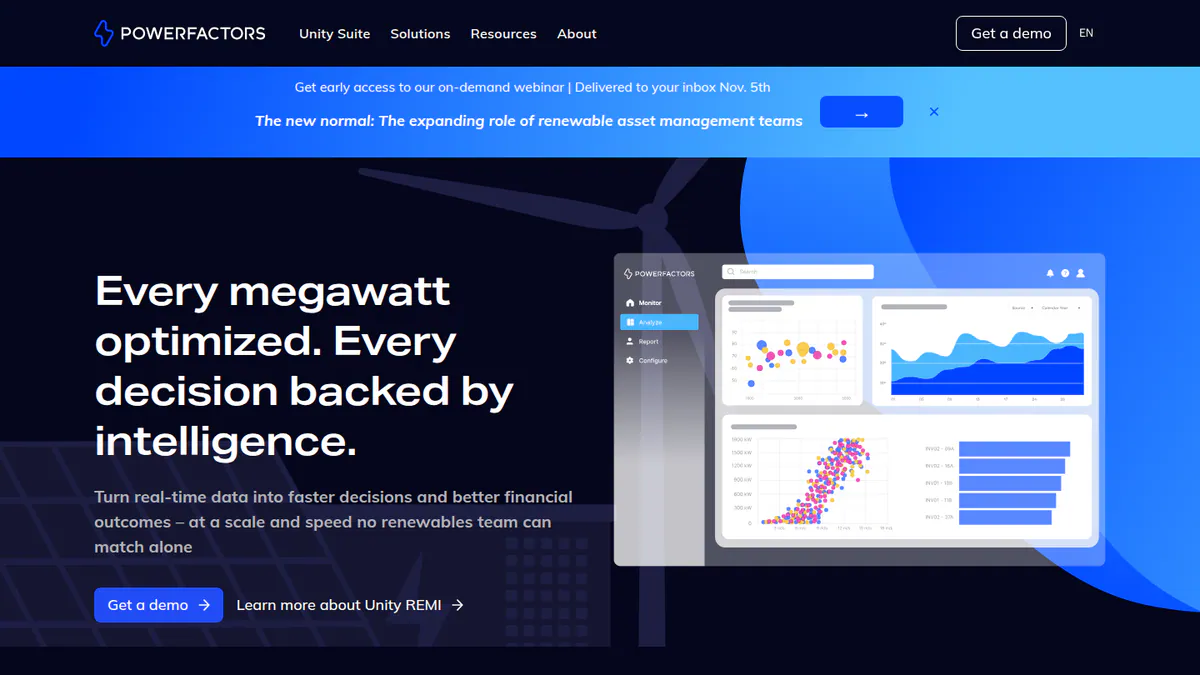
What it is: Unity is a suite for running renewable plants, from Power Factors, LLC. It merges the firm’s Drive, Greenbyte and BluePoint products. IPPs, asset managers and O&M firms use it on solar, wind and BESS fleets.
Why we picked it: It covers the control, monitoring and work layers of a solar farm in one suite, which no other ranked product does. It also runs solar, wind and BESS fleets side by side.
Key features:
- Local and central SCADA, a power plant controller and EMS (energy management system) at the control layer.
- Asset performance tracking above the control layer.
- Field service with work orders, scheduling, spare-parts stock and upkeep KPIs (key performance indicators).
- An iOS app, released in May 2026 and updated in July. A duty engineer can drill from fleet to device and sort events by lost energy and revenue.
- REMI AI, launched on 29 April 2026. Support for SCADA and EMS is listed as coming soon.
- Solar, wind, BESS and hybrid plants.
Pricing: Quote only, and the site has a demo. Checked October 2026 on the Power Factors website.
Pros (from our research):
- You deal with one company from plant control to job close-out.
- It is proven at scale: trade press put Unity across 30+ GW in April 2026.
- It is moving fastest here, with an iOS app and REMI AI both released in 2026.
Cons (from our research):
- Pricing is quote only.
- No G2 or Capterra reviews of Unity exist to judge it by.
- REMI support for SCADA and EMS is still listed as coming soon.
Reviews: App Store 5.0/5 (1 rating), checked October 2026.
What we could not confirm: which systems Unity integrates with. Power Factors publishes no list, which matters if you keep another SCADA.
Read our full Power Factors Unity review.
Want to see Power Factors Unity working? Book a demo with the SolarSoftwares team.
Book a demoYour request goes by email to the SolarSoftwares team. A time is set only after we reply. It does not change any score or ranking.
2. GreenPowerMonitor (DNV): best for on-site SCADA with logbook, forecasting and planning
Best for: Owners who run their own plants, and O&M firms, at utility and C&I (commercial and industrial) sites. Score: 60.2/100.
What it is: GreenPowerMonitor is a Spanish monitoring and SCADA company, owned by DNV since 2016. It pairs on-site GPM SCADA with the GPM Horizon cloud. It runs a 24/7 monitoring centre in Bangalore and names Navisun and Equinor as clients.
Why we picked it: It is one of only three ranked products with its own SCADA. Tickets, a logbook and forecasts sit on top, so the control room can stay in one product.
Key features:
- On-site GPM SCADA.
- Alarms on Core, and tickets and analysis on Pro.
- Logbook, KPIs, forecast, planning and a mobile app on Elite.
- Gemini AI to predict faults (Elite).
- Horizon Storage, which added BESS in October 2025.
Pricing: Quote only for all three tiers. Checked October 2026 on the GPM Horizon page.
Pros (from our research):
- Your control room gets a logbook and forecasts in the same product.
- Three tiers let you start small and add features later.
- The company runs a 24/7 monitoring centre you can lean on.
Cons (from our research):
- Most operations features need the top Elite tier.
- It has tickets only, with no full work-order or spare-parts system.
- No user reviews exist to judge it by.
Reviews: No user reviews on G2, Capterra or SourceForge as of October 2026.
What we could not confirm: its integrations or API (a way for other software to connect), which the product page does not state.

Want to see GreenPowerMonitor (DNV) working? Book a demo with the SolarSoftwares team.
Book a demoYour request goes by email to the SolarSoftwares team. A time is set only after we reply. It does not change any score or ranking.
3. BaxEnergy: best for multi-technology fleets with plant control
Best for: Power firms and IPPs running solar next to wind, storage, hydrogen or hybrid plants. Score: 56.0/100.
What it is: BaxEnergy is based in Hannover, with a site in Acireale, Italy. Yokogawa Electric bought it (announced 5 June 2024). It is now sold as Asset Performance Management by BaxEnergy. The company claims 120 GW+ in 40+ countries. These facts come from Yokogawa’s pages, not baxenergy.com.
Why we picked it: It monitors any brand across solar, wind, BESS and hydrogen and adds a power plant controller. Yokogawa ownership brings its own SCADA and RTUs if you need them.
Key features:
- Any-brand monitoring across wind, solar, BESS, hydrogen and hybrids.
- Power plant controller to smooth ramps and shift energy.
- KPI dashboards, alarms and GIS (mapping) views, plus loss analysis, auto reports and predictive analytics.
- Works with other SCADA and OEM (equipment maker) kit, and with Yokogawa’s FAST/TOOLS SCADA and STARDOM RTUs (remote terminal units).
- Mobile access to KPIs and alarms.
Pricing: Quote only, with large-account sales via Yokogawa. Checked October 2026 on the Yokogawa solar page.
Pros (from our research):
- It covers the widest mix of plant types on this page.
- A big automation group backs it, with its own SCADA and RTUs.
- You can keep the SCADA you already have.
Cons (from our research):
- We found no work-order or field-service module, so techs need a separate tool.
- Pricing is quote only, through Yokogawa’s large-account sales.
- One G2 review with no text is too little to judge it by.
Reviews: G2 4.5/5 (1 review, no visible text), checked October 2026.
What we could not confirm: how its forecasts work, and how the "AssetStack" product named on G2 links to the Yokogawa offer.

Want to see BaxEnergy working? Book a demo with the SolarSoftwares team.
Book a demoYour request goes by email to the SolarSoftwares team. A time is set only after we reply. It does not change any score or ranking.
4. VCOM Cloud: best for alarm-to-work-order with an offline field app
Best for: Owners of plants that use meteocontrol blue’Log dataloggers. Score: 54.3/100.
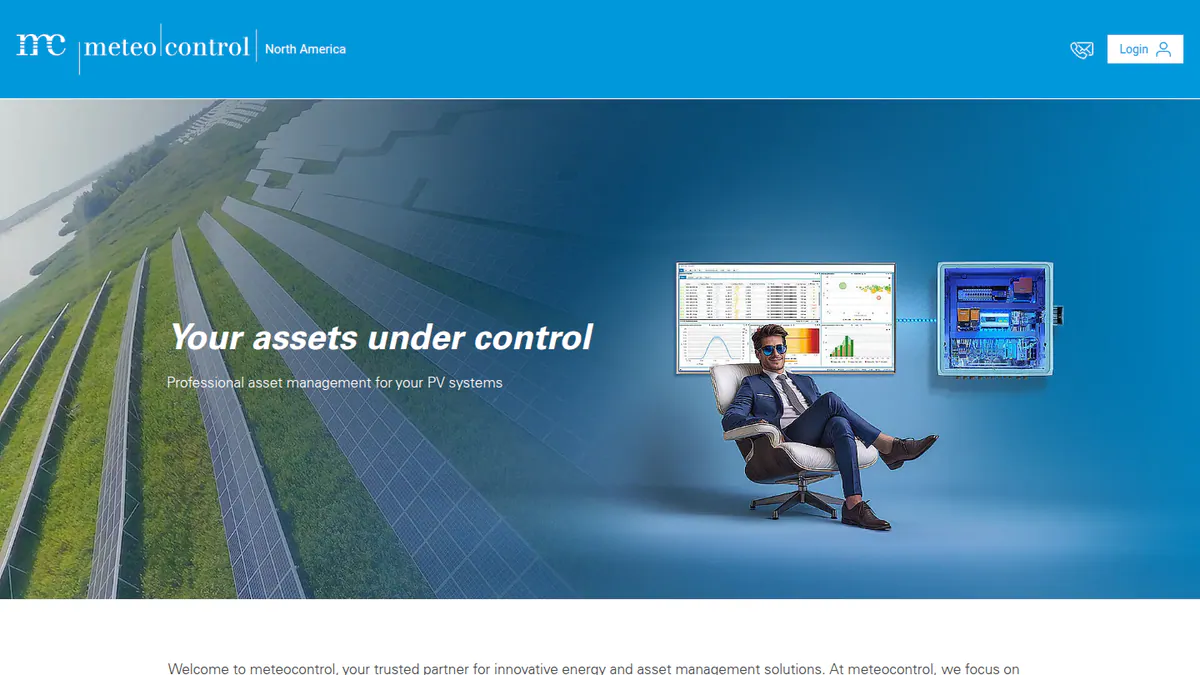
What it is: VCOM Cloud is a PV monitoring cloud from meteocontrol GmbH in Augsburg, Germany. It shows the clearest alarm-to-job loop on this page. meteocontrol reported 50,000 systems and about 18 GWp monitored as of December 2020.
Why we picked it: It joins alarms, tickets, work orders and an offline field app in one product. That covers the field side of the day well, even though it has no SCADA.
Key features:
- Alarms and automations open tickets automatically.
- A licensed CMMS module turns tickets into digital work orders for teams or techs.
- The offline VCOM O&M app records forms, photos, check-in and check-out, and time on site.
- VCOM API.
Pricing: Quote only, and the CMMS is licensed separately. Checked October 2026 on the VCOM O&M app page.
Pros (from our research):
- Alarms become tickets and work orders on their own, as the help centre shows.
- The offline app suits sites with poor coverage.
- The VCOM API lets you pull data into other tools.
Cons (from our research):
- It has no SCADA or power plant controller.
- The CMMS module costs extra, as it is licensed separately.
- It collects data mainly through meteocontrol’s own loggers.
Reviews: No user reviews on G2 or Capterra as of October 2026.
What we could not confirm: planned upkeep and spare-parts features, which the CMMS help page does not describe.
Read our full VCOM Cloud review.
Want to see VCOM Cloud working? Book a demo with the SolarSoftwares team.
Book a demoYour request goes by email to the SolarSoftwares team. A time is set only after we reply. It does not change any score or ranking.
5. Raptor Maps: best for autonomous drone inspections triggered by SCADA
Best for: Large-plant owners who inspect often and want techs sent to the exact module. Score: 53.5/100.
What it is: Raptor Maps, Inc. makes an inspection and analytics tool, not a control system. Its clients are large-plant owners, asset managers and O&M teams. The company raised a USD 35 million Series C.
Why we picked it: It brings the inspection layer: drones that SCADA alarms can trigger, and GPS guidance to the faulty module. It works beside your control system rather than replacing it.
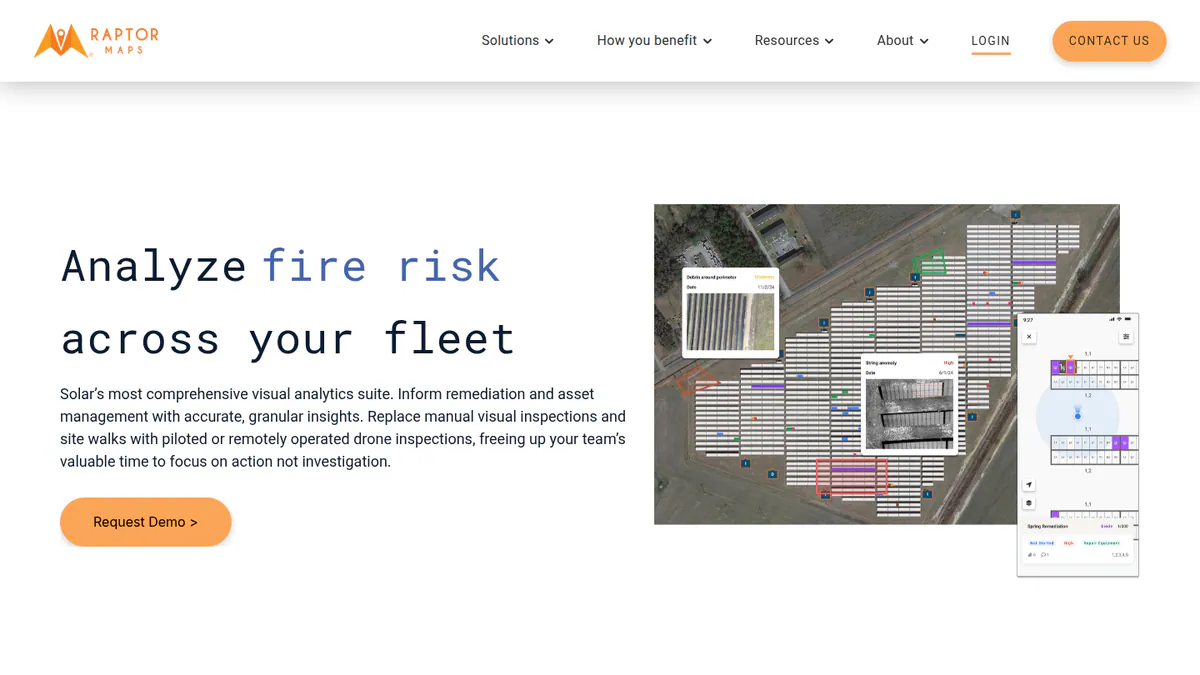
Key features:
- Raptor Solar Sentry: docked drones that fly on a schedule, on demand or when SCADA raises an alert.
- Findings on a plant digital twin, with lost power and money.
- An offline app that guides techs by GPS to each fault, with checklist tasks.
- SCADA and DAS (data logger) data via API.
Pricing: Quote only. 2021 trade press described a subscription with unlimited inspection reports. Checked October 2026 on the Raptor Maps website.
Pros (from our research):
- A SCADA alarm can send a drone, so you see the array fast.
- Techs find the right module without paper maps.
- You can capture with any drone or hardware.
Cons (from our research):
- It has no SCADA, plant control or full CMMS.
- Pricing is quote only.
- Five App Store ratings and no G2 or Capterra reviews are too few to judge it by.
Reviews: App Store 4.8/5 (5 ratings), checked October 2026.
Read our full Raptor Maps review.
Want to see Raptor Maps working? Book a demo with the SolarSoftwares team.
Book a demoYour request goes by email to the SolarSoftwares team. A time is set only after we reply. It does not change any score or ranking.
6. 3E SynaptiQ: best for deciding which faults justify a site visit
Best for: Owners and asset managers of utility and C&I fleets in Europe. Score: 51.0/100.
What it is: Brussels firm 3E makes SynaptiQ, a monitoring and analytics tool that works with any hardware. Owners, asset managers and O&M firms run it across PV, wind and storage. BESS performance tracking and wind analytics are built in.
Why we picked it: Its ROI ranking of fixes, plus expected yield (how much power the panels make) from satellite data, gives a duty engineer a clear reason to send a crew or not.
Key features:
- The Asset Operations app sends live fault alerts and makes tasks for site work.
- A tool ranks fixes by ROI (return on investment). That helps a duty engineer decide what is worth a truck roll today.
- Expected yield from satellite sun data, so plants without working pyranometers (sun sensors) still get a baseline.
- Customer portals and API.
Pricing: Quote only. Checked October 2026 via a 3E case study page.
Pros (from our research):
- It ranks site visits by value, so trucks go where they pay.
- It works across inverter and logger brands.
- One tool covers solar, wind and BESS.
Cons (from our research):
- It has no SCADA or plant control.
- It makes tasks, but we found no full CMMS or ticketing, so crews need another tool.
- Pricing is quote only, and no user reviews exist to judge it by.
Reviews: No user reviews on G2 or Capterra as of October 2026.
Want to see 3E SynaptiQ working? Book a demo with the SolarSoftwares team.
Book a demoYour request goes by email to the SolarSoftwares team. A time is set only after we reply. It does not change any score or ranking.
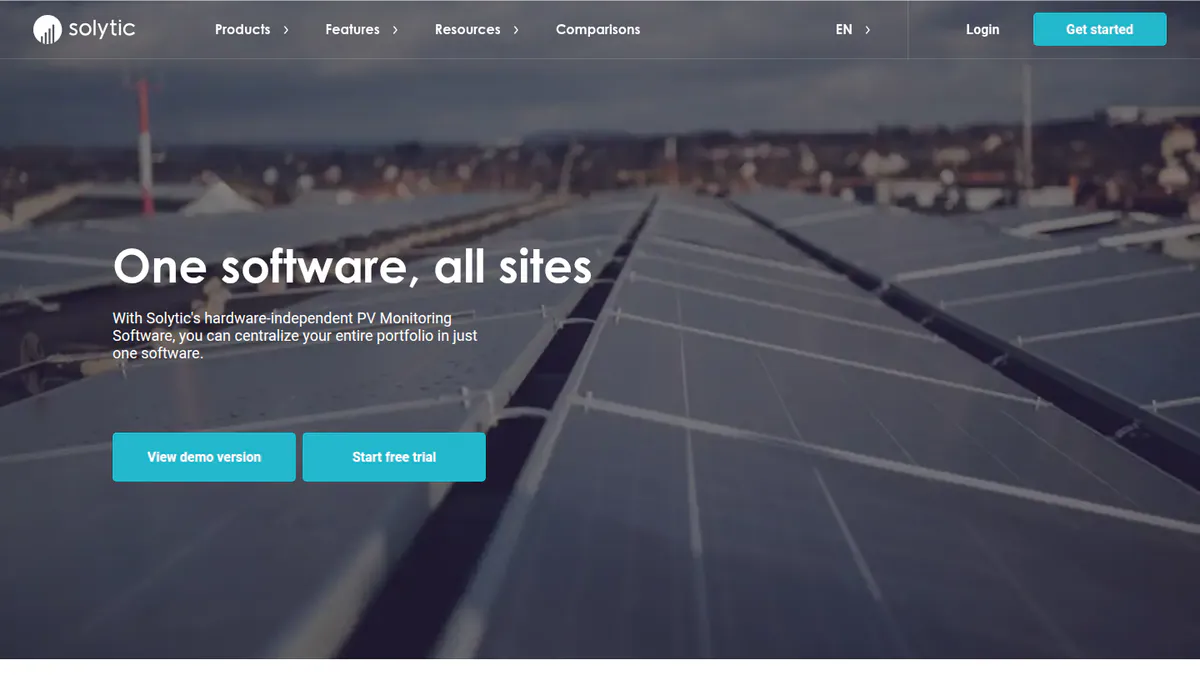
7. Solytic: best for smaller ground-mount plants on per-kWp pricing
Best for: Owners in Europe with ground-mount plants of a few megawatts and no SCADA budget. Score: 49.7/100.
What it is: Solytic is a monitoring tool from Solytic GmbH in Berlin that works with any hardware. S.E.E. (PV Secure) bought it in October 2024. It sells only to firms such as installers, O&M firms, utilities and asset owners.
Why we picked it: It gives smaller plants any-brand monitoring, root-cause alerts and automated tickets at a price you can see upfront.
Key features:
- Root-cause alerts and automated tickets.
- Task records.
- Report templates.
- 40+ inverter and logger brands, with no extra hardware.
Pricing: EUR 0.02 per kWp (kilowatts peak) per month above 200 kWp (EUR 0.50 per kWp setup). EUR 5 per site per month up to 200 kWp (EUR 60 setup). White-label licence EUR 500 per month, one-year minimum. Corporate clients only. Checked October 2026 on the Solytic pricing page. For example, a 5 MWp plant costs EUR 100 per month after a one-off setup of EUR 2,500.
Pros (from our research):
- It is the only product here with a public price for larger plants, so budgets are easy.
- You need no extra hardware.
- You can try it with free demo access.
Cons (from our research):
- It has no SCADA, plant control or full CMMS, so it fits plants that need monitoring and alerts, not a control room.
- The latest dated product update we found is from February 2021.
- No user reviews exist to judge it by.
Reviews: No user reviews on G2 or Capterra as of October 2026.
What we could not confirm: a mobile app.
Want to see Solytic working? Book a demo with the SolarSoftwares team.
Book a demoYour request goes by email to the SolarSoftwares team. A time is set only after we reply. It does not change any score or ranking.
How do the 7 solar farm management tools compare?
Product | SCADA / plant control | Alarm to ticket or work order | Field app | Forecast or planning | Technologies |
|---|---|---|---|---|---|
SCADA, PPC, EMS | Work orders, scheduling, inventory | iOS | REMI predictive | Solar, wind, BESS | |
GPM SCADA | Tickets | Mobile app (Elite) | Forecast and planning (Elite) | Solar, wind, BESS | |
PPC. Yokogawa SCADA and RTU | Alarms (no work orders documented) | Mobile KPIs and alarms | Predictive analytics | Solar, wind, BESS, hydrogen | |
No | Automatic tickets, CMMS work orders | Offline O&M app | Not documented | Solar | |
No (reads SCADA alerts) | Anomaly to task | Offline, GPS to anomaly | Scheduled drone missions | Solar | |
No | Fault to task | Not documented | Expected yield | Solar, wind, BESS | |
No | Automatic tickets | Not confirmed | Not documented | Solar |
Also considered
- ACTIS ERP (scored 49.3/100, would rank 8th): a renewables ERP from Alectris. It tracks crews, work orders and spare parts above SCADA. It misses the top 7 because its status is unconfirmed. We could not reach the company’s site and found no dated product news after January 2021.
- PowerTrack (scored 48.2/100, would rank 9th): AlsoEnergy’s monitoring tool, now moving to the Stem PowerTrack name. It makes work orders from alerts and hands tickets to outside CMMS systems. It misses the top 7 on weak reviews: App Store 3.1/5 from 42 ratings, checked October 2026. It also has no dispatch or scheduling.
- Sitemark (below the minimum score): a drone inspection platform with ticketing. Its reviews are excellent (G2 4.9/5 from 30 reviews, checked October 2026). It has no monitoring or control layer for running a plant. See our drone inspection ranking.
- SenseHawk (TaskMapper / Therm) (below the minimum score): built mainly for construction progress and handover, with drone thermal analytics. Facts come from third-party listings.
- PowerHub (below the minimum score, status unconfirmed): a commercial asset-management layer for invoicing and contracts. We found no product activity after May 2023. It is covered on our asset management page.
- Bluence (Isotrol): A SCADA and control-room suite that was not on this page’s candidate list. It is scored on our O&M and asset management pages.
- Generic CMMS (MaintainX, UpKeep, Limble, IBM Maximo): not solar-specific and not scored. See our solar CMMS page.
How do you choose solar farm management software?
- For SCADA, plant control, analytics and work orders from one company, pick Power Factors Unity.
- Want on-site SCADA plus a logbook and output forecasts, and can pay for the Elite tier? Pick GreenPowerMonitor.
- If your fleet mixes solar with wind, storage or hydrogen, or you already run Yokogawa control systems, shortlist BaxEnergy.
- Already have SCADA and need alarms to become work orders for techs? Add VCOM Cloud’s CMMS (on meteocontrol loggers) or a dedicated CMMS.
- When site checks drive your upkeep plan, add Raptor Maps for drone flights that SCADA alerts can trigger.
- For a few smaller ground-mount plants with no grid-code control duties, Solytic’s per-kWp price is the easiest to budget.
- If your control layer is in place and you need plant forecasts to plan, see our solar forecasting ranking.
For the control layer on its own, see solar SCADA software. For the full developer stack, see our guide to software for utility-scale developers.
Want more choices? Browse every tool we checked in our monitoring and asset management category.
Solar farm management software FAQs
What software is used to manage a solar farm?
Most often a stack of tools. SCADA and a power plant controller handle control. A platform handles monitoring and analytics, and an upkeep system holds work orders. As of October 2026, Power Factors Unity is the only product we scored that shows all three in one suite.
What is the difference between solar monitoring, SCADA and asset management software?
SCADA watches and controls the plant in real time, often with a power plant controller to meet grid code. Monitoring records and checks output. Asset management adds business views such as uptime, revenue and contracts. GreenPowerMonitor sells SCADA and monitoring, with revenue modules on its Pro tier (October 2026).
Does a solar farm need a separate CMMS?
Not always. A CMMS (maintenance software) records work orders and spare parts. It can sit inside the main platform. Power Factors includes work orders and inventory in Unity, and VCOM Cloud sells a CMMS module (October 2026). See our solar CMMS page for standalone options.
How does a control room spot underperformance across a solar farm?
It compares each plant’s output with an expected value and raises an alarm when the gap grows. As of October 2026, GreenPowerMonitor’s Elite tier adds Gemini predictive fault detection. BaxEnergy has loss analysis with auto reports. To work out why a plant is short, see our performance analytics ranking.
Can one platform manage solar farms with mixed inverter brands?
Yes. BaxEnergy describes monitoring that works across OEMs, and 3E SynaptiQ works with any maker. Solytic connects to 40+ inverter and logger makers without extra hardware (October 2026). VCOM Cloud collects data mainly through meteocontrol’s own loggers, so check that yours fit first.
Sources
All checked 22 to 25 October 2026.
- Power Factors: website, Solar Power World, April 2026, App Store
- GreenPowerMonitor: GPM Horizon, DNV news, 2025
- BaxEnergy: Yokogawa solar page, Yokogawa press release, June 2024, G2
- VCOM Cloud: CMMS help, ticket system help, O&M app
- Raptor Maps: website, docs, App Store
- 3E SynaptiQ: case study, Insaver story
- Solytic: pricing, product update
- ACTIS ERP: pv magazine Australia, Solar Power World, June 2020, Renewable Energy Magazine, January 2021
- PowerTrack: AlsoEnergy, what’s new, App Store
- Also considered: Sitemark on G2, SenseHawk listing, PowerHub, May 2023
Last updated 28 October 2026. Next scheduled review: 23 January 2027.