Solar O&M software helps a team look after solar plants. O&M means operations and maintenance. The software turns an alarm into a ticket, then a work order, then a closed job on a phone app. Power Factors Unity ranks first on this list, at 63.2/100.
What does solar O&M software do in the maintenance loop?
Solar O&M software earns its keep in one loop. An alarm or a site finding becomes a ticket. The ticket becomes a work order with parts and a technician.
The technician closes the job on a phone app. That record then feeds warranty claims and contract reports.
We ranked tools on how much of that loop they show. Single jobs have their own pages:
- Monitoring alone: solar monitoring.
- Analytics alone: performance analytics.
- Drone inspection alone: drone inspection.
- The commercial and contract side: asset management.
- The whole control-room day on a utility plant: solar farm management.
This page sits in our monitoring and asset management group.
Quick picks
Rank | Product | Best for | Starting price (company page, checked October 2026) | Free plan / trial | Score /100 |
|---|---|---|---|---|---|
1 | Utility-scale fleets wanting SCADA to work order in one suite | Quote only | Demo only | 63.2 | |
2 | Remote, off-grid and microgrid maintenance | Quote only (Capterra lists from USD 20 per month) | Not confirmed | 59.3 | |
3 | Monitoring with alarm-driven tickets and a CMMS module | Quote only | Demo only | 56.3 | |
4 | O&M providers wanting an ERP above SCADA (status unconfirmed) | Quote only | Unknown | 51.3 | |
5 | Installers running install and service crews in one system | Quote only | Demo only | 51.0 | |
6 | Control-room operators wanting predictive maintenance on SCADA | Quote only | Demo only | 51.0 | |
7 | Mixed-brand C&I fleets on published pricing | ✓ EUR 5 per site per month (up to 200 kWp) | Free demo access | 50.5 |
✓ Verified on the company’s own pricing page. ◐ Published by the company outside its pricing page (help centre, store or press release). ? We could not read the company’s pricing page, so the figure is not confirmed. Prices checked October 2026.
Quote only means the company shows no public price. You ask it for a quote.
How the 7 tools scored
- Use-case fit 35%
- User reviews 20%
- Pricing 15%
- Ease of use 10%
- Support 10%
- Momentum 10%
Tool | Score chart | Score |
|---|---|---|
63.2 out of 100 | 63.2 | |
59.3 out of 100 | 59.3 | |
56.3 out of 100 | 56.3 | |
51.3 out of 100 | 51.3 | |
51 out of 100 | 51.0 | |
51 out of 100 | 51.0 | |
50.5 out of 100 | 50.5 |
Each bar shows the weighted score out of 100.
Sub-scores at a glance (0-10)
Product | Use-case fit | User reviews | Pricing | Ease of use | Support | Momentum | Total /100 |
|---|---|---|---|---|---|---|---|
7.8 | 5.0 | 4.0 | 5.0 | 5.0 | 10.0 | 63.2 | |
7.2 | 5.0 | 4.0 | 5.0 | 7.5 | 5.5 | 59.3 | |
7.2 | 5.0 | 4.0 | 5.0 | 5.0 | 5.0 | 56.3 | |
7.2 | 5.0 | 4.0 | 5.0 | 5.0 | 0.0 | 51.3 | |
5.0 | 5.0 | 4.0 | 5.0 | 5.0 | 7.5 | 51.0 | |
5.0 | 5.0 | 4.0 | 5.0 | 5.0 | 7.5 | 51.0 | |
5.0 | 5.0 | 7.0 | 5.0 | 5.0 | 2.5 | 50.5 |
A 5.0 on reviews, ease, support or momentum is our neutral value where public evidence is thin, not a judgement.
How did we rank these solar O&M tools?
How the score is weighted
- Use-case fit 35%
- User reviews 20%
- Pricing 15%
- Ease of use 10%
- Support 10%
- Momentum 10%
We looked at 13 products from 22 to 24 October 2026. We scored 12 and ranked the top 7. The other 5 sit in "Also considered". Sitemark fell below our minimum fit score (4 out of 10).
We used company docs, help pages, price pages, trade press and public user reviews. This was desk research, so we did not run any plant in any tool. Each product gets a score on six points.
- Use-case fit (35%): How well it does this page’s job. Shown O&M steps count most: tickets, work orders, planned upkeep, spare parts and close-out on a phone. Plant data that feeds them comes next.
- User reviews (20%): G2 and Capterra ratings. A few reviews count for less, and no reviews scores neutral.
- Pricing (15%): Public prices score higher than prices you have to ask for.
- Ease of use, support and momentum (10% each): Review sub-scores and dated product news, or neutral with no proof.
Scores belong to this page, so the same tool can score differently elsewhere. Products whose core facts we could not check on the company’s own site lose 2 points. Full method: how we score software.
Which kind of O&M software do you need?
- Utility-scale and large C&I fleets (IPPs, owners, third-party O&M): Power Factors Unity, Bluence, VCOM Cloud and ACTIS ERP. These start from plant data and SCADA (the system that controls a plant and logs its data). Utility-scale means very large solar farms, and C&I means businesses and factories.
- Remote, off-grid and microgrid sites: 60Hertz, built for upkeep where the signal is poor.
- Installers who also run rooftop and small C&I fleets: Scoop Solar for crews and service calls. Solytic gives mixed-brand monitoring with tickets.
- Drone-led or construction-led work: see Raptor Maps and SenseHawk under "Also considered". They are inspection and build tools first.
1. Power Factors Unity: best for utility-scale fleets wanting SCADA to work order in one suite
Best for: IPPs (independent power producers), asset managers and large O&M firms running solar, wind and BESS (battery storage) fleets. Score: 63.2/100.
What it is: Power Factors merged its Drive, Greenbyte and BluePoint products into the Unity suite. It spans plant control (SCADA, power plant controller and EMS, an energy management system), plant performance, field service and the commercial side. So a fault, its work order and the invoice can sit in one place.
Why we picked it: It shows more of the maintenance loop than any other tool here, from SCADA alarms to work orders, stock and invoices. That makes it the strongest fit for large fleets that want one company.
Key features:
- Field service: work orders, scheduling, stock and upkeep KPIs (key performance figures).
- SCADA, power plant controller and EMS.
- iOS app (2026) to sort events by lost energy and revenue.
- Commercial asset management with invoice handling.
- Unity REMI AI engine (launched 29 April 2026) for predictions and plain-English questions. Trade press says it is trained on 310+ GW of plant data, with 30+ GW live in Unity.
Pricing: You have to ask the company for a price, with a demo on the site. Checked October 2026 on the Power Factors website.
Pros (from our research):
- One suite covers the full loop, from plant data to work order and spare parts.
- Your team works the costliest faults first, because events are ranked by lost energy and revenue.
- The product is moving fast, with REMI in April 2026 and iOS app releases in May and July.
Cons (from our research):
- You have to ask the company for a price, with a demo but no trial.
- There are no G2 or Capterra reviews, so you cannot check other users’ experience.
- REMI support for SCADA and EMS was still "coming soon" in April 2026.
Reviews: App Store 5.0/5 (1 rating), checked October 2026. No G2 or Capterra reviews.
What we could not confirm: a public list of connections, and whether the iOS app works offline.
Read our full Power Factors Unity review.
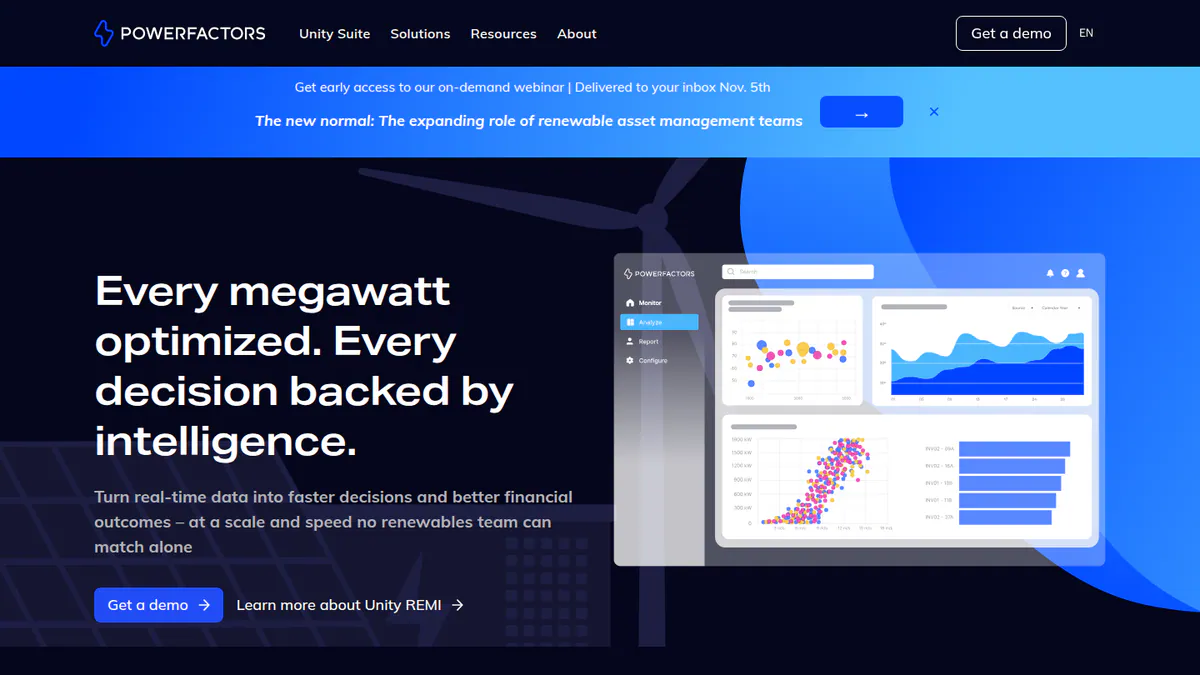
Want to see Power Factors Unity working? Book a demo with the SolarSoftwares team.
Book a demoYour request goes by email to the SolarSoftwares team. A time is set only after we reply. It does not change any score or ranking.
2. 60Hertz: best for remote, off-grid and microgrid maintenance
Best for: O&M teams that look after solar, diesel and battery kit at remote sites. Score: 59.3/100.
What it is: 60Hertz, based in Anchorage, Alaska, makes a mobile-first maintenance tool. It serves rural power, microgrids, mining, the military, telecom and backup power. Note: we could not reach the company’s site, so these facts come from its Capterra and App Store pages.
Why we picked it: It is built for upkeep at remote, off-grid sites, with an offline field app and a form builder that needs no coding. It is also the only ranked tool with a user review base, though a small one.
Key features:
- Work orders closed out on a phone.
- Planned upkeep schedules and service history.
- A field app that works offline, with data checks, photos and notes.
- A builder for forms, checklists and workflows that needs no coding.
- Asset lists and reports across many sites.
Pricing: We found no company price page, so treat the price as on request. Capterra lists a starting price of USD 20 per month, which we could not confirm with the company. Checked October 2026 on Capterra.
Pros (from user reviews):
- Reporting is strong, with graphs and filters.
- You can track lots of assets across many sites without losing the thread.
- Staff reply fast and know their stuff.
Cons (from user reviews):
- Admins face a steep learning curve, mainly when they build checklists.
- The phone app looks dated. Mobile access is its lowest-rated feature (3.3/5).
- Linking to some third-party controllers is hard.
Reviews: Capterra 4.1/5 (7 reviews, some incentivised), checked October 2026.
Want to see 60Hertz working? Book a demo with the SolarSoftwares team.
Book a demoYour request goes by email to the SolarSoftwares team. A time is set only after we reply. It does not change any score or ranking.
3. VCOM Cloud: best for monitoring with alarm-driven tickets and a CMMS module
Best for: C&I and utility owners and O&M firms already on meteocontrol monitoring. Score: 56.3/100.
What it is: meteocontrol, from Augsburg in Germany, runs VCOM Cloud as its monitoring and fleet tool. Its ticket system makes tickets from alarms. A CMMS (maintenance management system) module, sold under its own licence, turns them into work orders. meteocontrol reported 50,000 systems and about 18 GWp monitored as of December 2020.
Why we picked it: Its help pages show the clearest path on this page from alarm to ticket to work order. That makes it an easy add-on for teams already on meteocontrol monitoring.
Key features:
- Tickets made for you from alarms and set rules.
- CMMS work orders linked to tickets and given to teams or technicians.
- An offline O&M app with forms, photos, check-in and check-out, and time tracking.
- Custom form and report templates.
- VCOM API.
Pricing: You have to ask the company for a price. The CMMS is a VCOM module with its own licence. Checked October 2026 on the VCOM O&M app page.
Pros (from our research):
- Alarms flow to tickets and then work orders, and the help pages show how.
- Monitoring and upkeep share one login, so no fault gets lost between systems.
- Technicians log time in a field app that works offline.
Cons (from our research):
- The CMMS costs extra on top of monitoring.
- You have to ask the company for a price, with a demo but no trial.
- There are no user reviews to judge it by.
Reviews: No user reviews on G2 or Capterra as of October 2026.
What we could not confirm: planned upkeep or spare parts, which the help pages do not cover.
Read our full VCOM Cloud review.
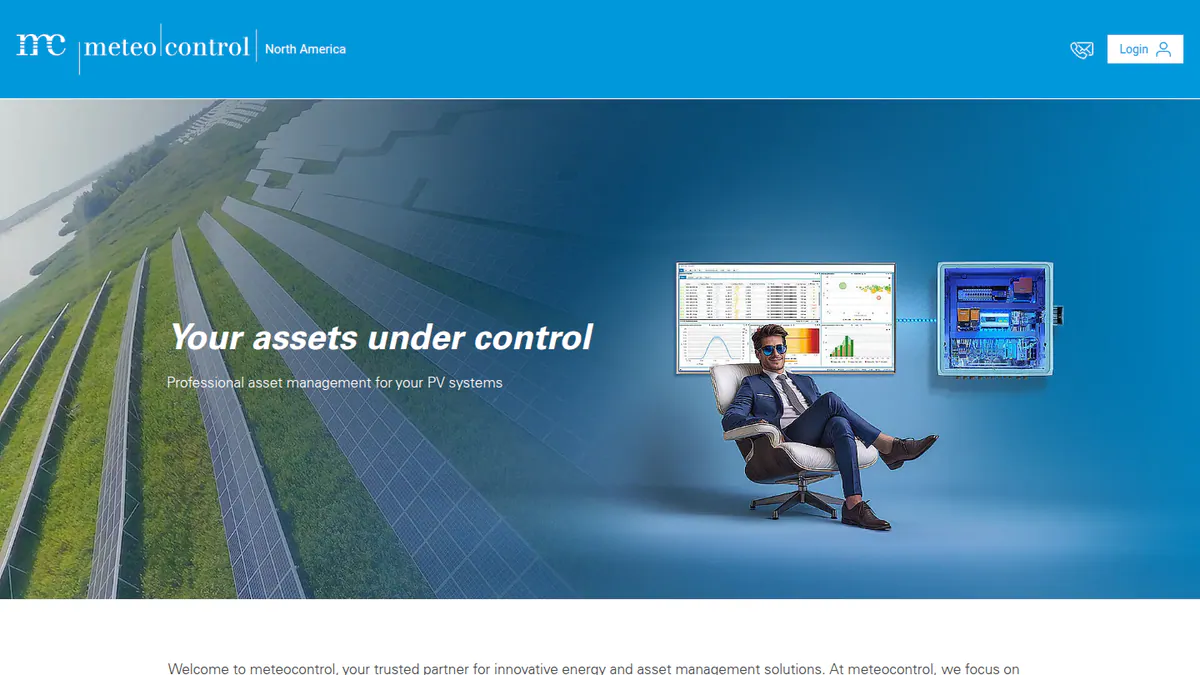
Want to see VCOM Cloud working? Book a demo with the SolarSoftwares team.
Book a demoYour request goes by email to the SolarSoftwares team. A time is set only after we reply. It does not change any score or ranking.
4. ACTIS ERP: best for O&M providers wanting an ERP above SCADA
Best for: O&M firms, asset managers and investors with large solar fleets. Score: 51.3/100.
What it is: ACTIS is a renewables ERP (business system) from Alectris, an O&M and asset-care firm. It joins monitoring alerts, tickets, work orders, crew dispatch, spare parts, and the tech and money side of each asset. It sits above SCADA and does not replace it. Note: we could not reach the company’s site, so its sale status is unconfirmed, and the features below come from 2020-2021 trade press, partly from the company.
Why we picked it: On paper it covers most of the loop: alerts, tickets, work orders, crew dispatch and spare parts. It ranks on that fit, even though its sale status is unconfirmed.
Key features:
- One hub for monitoring alerts, tickets and asset data.
- Work orders with phone checklists, photos and spare-parts tracking.
- Live planning and tracking of field crews.
- Offline phone logging through Resco’s mobile software.
- Technical and financial asset management.
Pricing: No public pricing. It is sold direct and through resellers such as Profergy in Australia. Checked October 2026 via pv magazine Australia.
Pros (from our research):
- An O&M firm built it and ran its own 24/7 global control centre on it (January 2021).
- The tech and money sides of each asset sit in one system.
- Spare parts and crew tracking sit next to work orders.
Cons (from our research):
- You have to ask the company for a price, sold direct or through resellers.
- We found no dated product news after January 2021, so the roadmap is unclear.
- There are no user reviews to judge it by.
Reviews: No user reviews found as of October 2026.
Read our full ACTIS ERP review.
Want to see ACTIS ERP working? Book a demo with the SolarSoftwares team.
Book a demoYour request goes by email to the SolarSoftwares team. A time is set only after we reply. It does not change any score or ranking.
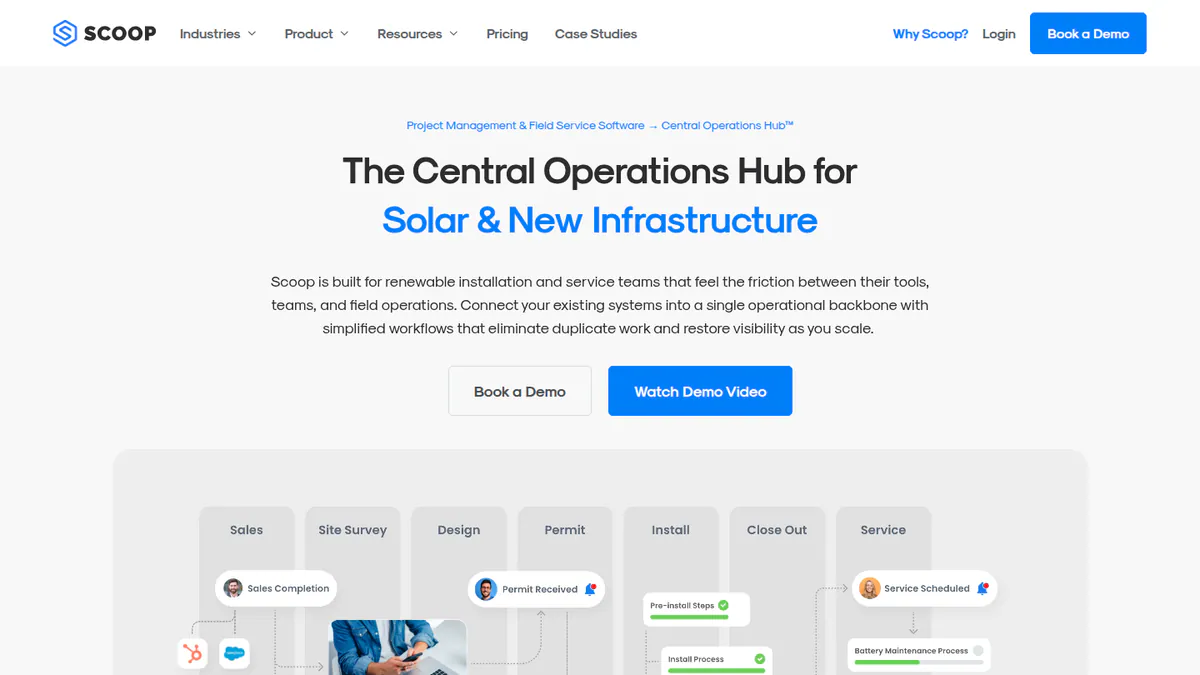
5. Scoop Solar: best for installers running install and service crews in one system
Best for: Installers and service firms, from home systems to utility scale. Score: 51.0/100.
What it is: Scoop, built in Vancouver, is a field service and ops hub for solar, storage, EV charging and wind. For O&M it shows planned upkeep, asset history and SLA (service-level agreement) records next to dispatch and service calls. It has no monitoring, so alarms must come from another system.
Why we picked it: It covers the crew side of O&M well, with dispatch, planned upkeep and SLA records in one place. That suits installers who also run a service team.
Key features:
- Planned upkeep, asset history and SLA records.
- Crew scheduling, dispatch and service calls.
- An offline field app with geotagged photos and required forms.
- Stock and price book.
- A subcontractor portal with scoped permissions.
Pricing: You have to ask the company for a price, priced by modules, workflows and install or service volume. Every plan has unlimited users, storage and devices. Checked October 2026 on the Scoop pricing page.
Pros (from our research):
- Every plan has unlimited users, so a big technician team costs no more per head.
- One system covers install and long-term service, so asset history stays in one place.
- It keeps adding tools, such as an AI scheduling helper announced in June 2025.
Cons (from our research):
- It has no monitoring, so alarms cannot raise tickets until you link another system.
- You have to ask the company for a price, with a demo but no trial.
- There are no G2 or Capterra reviews to judge it by.
Reviews: No G2 or Capterra listing found as of October 2026.
Read our full Scoop Solar review.
Want to see Scoop Solar working? Book a demo with the SolarSoftwares team.
Book a demoYour request goes by email to the SolarSoftwares team. A time is set only after we reply. It does not change any score or ranking.
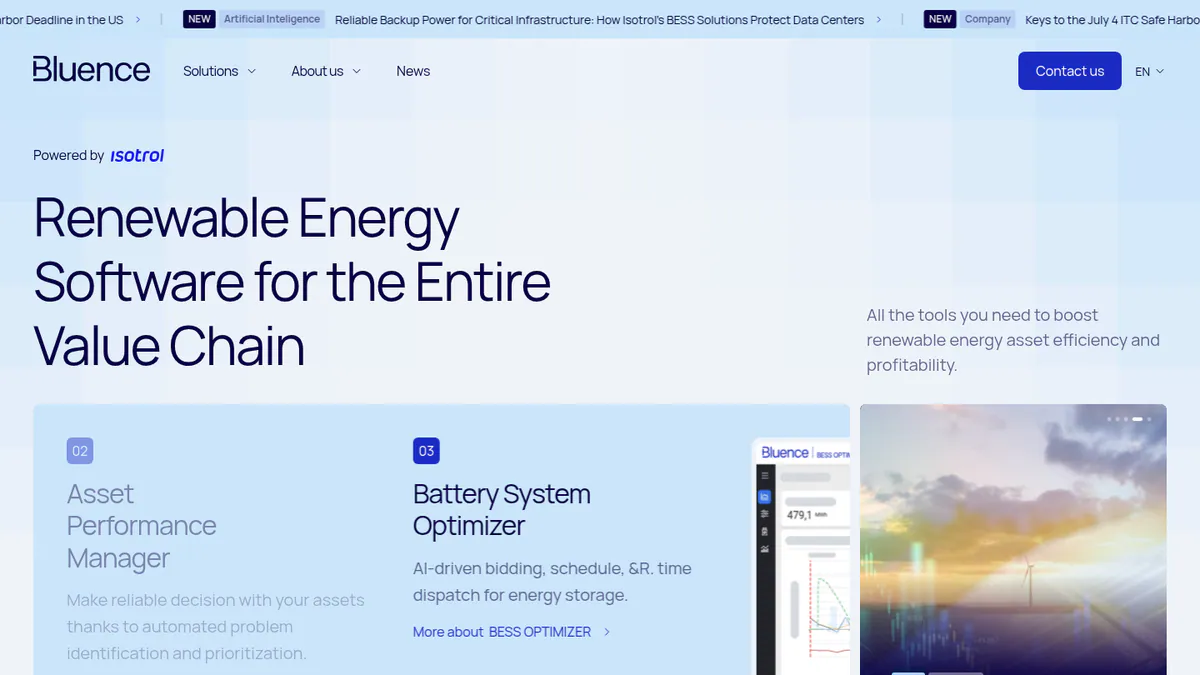
6. Bluence (Isotrol): best for control-room operators wanting predictive maintenance on SCADA
Best for: IPPs, utilities and O&M firms that run utility-scale solar, wind and storage from a central control room. Score: 51.0/100.
What it is: Isotrol sells Bluence as a suite for plant SCADA, plant control and a central control room. It also covers APM (asset performance management). Isotrol is based in Seville, with a US head office in Denver, and cites 190 GW managed.
Why we picked it: It earned its place on predictive maintenance built into the control layer, so alarms and analysis start in one suite. It suits control rooms that want maintenance insight without a second system.
Key features:
- Plant and central SCADA for fleets of many sites.
- APM with predictive maintenance and performance data.
- A power plant controller to meet grid-code rules (the utility’s technical rules).
- BESS optimiser (launched November 2025).
- Power market bidding and automated energy trading.
Pricing: You have to ask the company for a price. Checked October 2026 on the Isotrol website.
Pros (from our research):
- It owns the control layer, so alarms start in the same suite.
- Predictive maintenance in APM helps you fix kit before it fails.
- With offices in Seville and Denver, European and US buyers can deal with a local team.
Cons (from our research):
- You have to ask the company for a price, with a demo but no trial.
- It is a full SCADA and control suite, so it is a big buy if you only need maintenance tools.
- There are no user reviews to judge it by.
Reviews: No user reviews on G2 or Capterra as of October 2026.
What we could not confirm: a separate work-order or CMMS module, which makes it a weaker match for the full loop.
Want to see Bluence (Isotrol) working? Book a demo with the SolarSoftwares team.
Book a demoYour request goes by email to the SolarSoftwares team. A time is set only after we reply. It does not change any score or ranking.
7. Solytic: best for mixed-brand C&I fleets on published pricing
Best for: Installers and O&M firms in Germany and Europe that watch many small and mid-sized systems. Score: 50.5/100.
What it is: S.E.E. (PV Secure) bought Berlin-based Solytic in October 2024. Its monitoring tool works across 40+ hardware makers with no extra kit. Its tickets are lighter than a full CMMS.
Why we picked it: It is the only ranked tool with prices on the company site, and it raises tickets from alerts across 40+ hardware makers. That makes it an easy start to budget for on European rooftop fleets.
Key features:
- Real-time alerts you can set, with root-cause details.
- Automatic tickets and task records.
- Automatic reports from templates.
- A white-label portal for your customers.
- GraphQL API (a data feed for other software).
Pricing: Sites up to 200 kWp cost EUR 5 per site per month, with EUR 60 setup per site. Above 200 kWp, the price is EUR 0.02 per kWp per month, with EUR 0.50 per kWp setup. A white-label licence costs EUR 500 per month, with a one-year minimum. Solytic sells to business clients only. Checked October 2026 on the Solytic pricing page.
Pros (from our research):
- You can budget up front, because prices per site and per kWp are public.
- One login covers mixed inverter brands.
- Installers who also run fleets can offer the portal under their own brand.
Cons (from our research):
- Setup fees (EUR 60 per small site) add up when you bring an old fleet across.
- White label ties you to EUR 500 a month for at least a year.
- There are no user reviews to judge it by, and the latest product update we found is from February 2021.
Reviews: No user reviews on G2 or Capterra as of October 2026.
What we could not confirm: a full CMMS with planned upkeep or spare parts, or a phone app.
Want to see Solytic working? Book a demo with the SolarSoftwares team.
Book a demoYour request goes by email to the SolarSoftwares team. A time is set only after we reply. It does not change any score or ranking.
How do the 7 solar O&M tools compare?
Product | Alarm or finding to ticket | Work orders | Offline field app | Preventive maintenance | Spare parts | Monitoring or SCADA included |
|---|---|---|---|---|---|---|
Event triage by loss | Yes | iOS app (offline not stated) | Maintenance KPIs | Yes | Yes, SCADA | |
Not documented | Yes | Yes | Yes | Not documented | No | |
Yes, automatic | Yes (CMMS module) | Yes | Not documented | Not documented | Yes | |
Yes (2020-21 sources) | Yes | Yes, via Resco | Not documented | Yes | Sits above SCADA | |
Not documented | Yes, service calls | Yes | Yes | Inventory module | No | |
Within SCADA/APM | Not confirmed | Not documented | Predictive (APM) | Not documented | Yes, SCADA | |
Yes, automatic | Task documentation | Not confirmed | Not documented | Not documented | Yes |
Also considered
- Raptor Maps: scored 49.0/100. A drone inspection and analytics tool that ranks repairs by lost energy and helps with OEM (equipment maker) warranty claims. It sits outside the top 7 because its work tools stop at tasks, with no full CMMS shown.
- 3E SynaptiQ: scored 48.5/100. A monitoring and analytics tool that turns faults into site tasks and ranks fixes by ROI (return on investment). We found no full CMMS or ticket module, no pricing and no reviews.
- SenseHawk: scored 44.5/100. A digital twin (a computer copy of the plant) built mainly for construction, with field tasks and drone thermal checks. It helps most if you built the plant, and we could not reach its own site.
- PowerTrack: scored 44.4/100. AlsoEnergy’s monitoring tool raises work orders from alerts and passes tickets to other CMMS tools. It has no dispatch or scheduling of its own, and App Store users rate it 3.1/5 (42 ratings).
- Sitemark: a drone inspection tool with forms and tickets (G2 4.9/5 from 30 reviews, checked October 2026). Strong reviews give it a higher overall score than some ranked tools. But it is a weak match for O&M work, so it falls below the minimum fit score. See our drone inspection guide.
- Omnidian: a performance-assurance service (output guarantee, monitoring and its own technicians), not software you run. So we do not rank it against software.
- Generic CMMS (MaintainX, UpKeep, Limble, IBM Maximo): not built for solar and not scored. They have no plant data, so alarms must be linked in. Our solar CMMS guide covers that side.
How do you choose solar O&M software?
- Do you run utility-scale fleets and want SCADA, data, work orders and parts from one company? Pick Power Factors Unity.
- For remote, off-grid or microgrid sites with a weak signal, pick 60Hertz.
- Already on meteocontrol loggers? Add the VCOM CMMS module before you buy a second system.
- Installers with a service team who need dispatch, planned upkeep and SLAs should pick Scoop Solar and link their monitoring.
- Run mixed-brand rooftop fleets in Europe on a tight budget? Start with Solytic’s public per-site prices.
- Is your SCADA from Isotrol? Check what Bluence covers for work orders before you add a CMMS.
- If drone findings drive your plan, look at Raptor Maps under "Also considered".
For crews and dispatch across install as well as service, see our solar field service management ranking. For the control layer, see solar SCADA software.
Want more choices? Browse every tool we checked in our monitoring and asset management category.
Solar O&M software FAQs
How is solar O&M software different from a generic CMMS?
Solar O&M software links to plant data, so alarms can raise tickets with no typing. As of October 2026, VCOM Cloud shows alarm-to-ticket flows. PowerTrack, under "Also considered", raises work orders from alerts. A generic CMMS such as MaintainX, UpKeep or Limble needs a connection to see inverter faults.
Can solar O&M software integrate with SCADA and monitoring to create work orders automatically?
Yes. As of October 2026, VCOM Cloud makes tickets from alarms on its own and links them to CMMS work orders. Power Factors Unity has its own SCADA and field service modules. Raptor Maps, also considered, can launch drone flights from SCADA alerts.
What size of solar portfolio needs dedicated O&M software?
There is no fixed size, but the products show their market. Solytic prices per site from EUR 5 a month for systems up to 200 kWp (October 2026), which suits fleets of small systems. Power Factors, Bluence and ACTIS are built for utility-scale fleets.
Does O&M software support warranty and PPA availability reporting?
Power Factors Unity has commercial asset management with invoice handling (October 2026). Raptor Maps, also considered, makes STC-normalised (standard test conditions) thermal images for OEM warranty claims. No product we checked confirms built-in PPA (power purchase agreement) uptime maths, so ask companies to show it against your contract.
What should an O&M contractor look for in solar O&M software?
Look for tickets from alarms, work orders with parts and photos, an offline field app, planned upkeep schedules and reports your clients accept. In our October 2026 review, no product shows all five. Power Factors Unity comes closest, then ACTIS ERP, whose status we could not confirm.
Sources
All checked 22 to 24 October 2026.
- Power Factors: website, Solar Power World, April 2026, App Store
- 60Hertz: Capterra, App Store
- VCOM Cloud: CMMS help, ticket system help, O&M app
- ACTIS ERP: pv magazine Australia, Solar Power World, June 2020, Renewable Energy Magazine, January 2021
- Scoop Solar: pricing, product comparison, Field Technologies
- Bluence: Isotrol
- Solytic: pricing, product update, Solarserver, October 2024
- Raptor Maps: website, docs, App Store
- 3E SynaptiQ: case study, Insaver story
- SenseHawk: SoftwareOne listing, G2, pv magazine USA, September 2022
- PowerTrack: AlsoEnergy, what’s new, App Store
- Sitemark: G2. Omnidian: dealers page
Last updated 28 October 2026. Next scheduled review: 23 January 2027.