Solar asset management software shows a plant owner what each solar plant earned, how often it ran and which losses cost money.
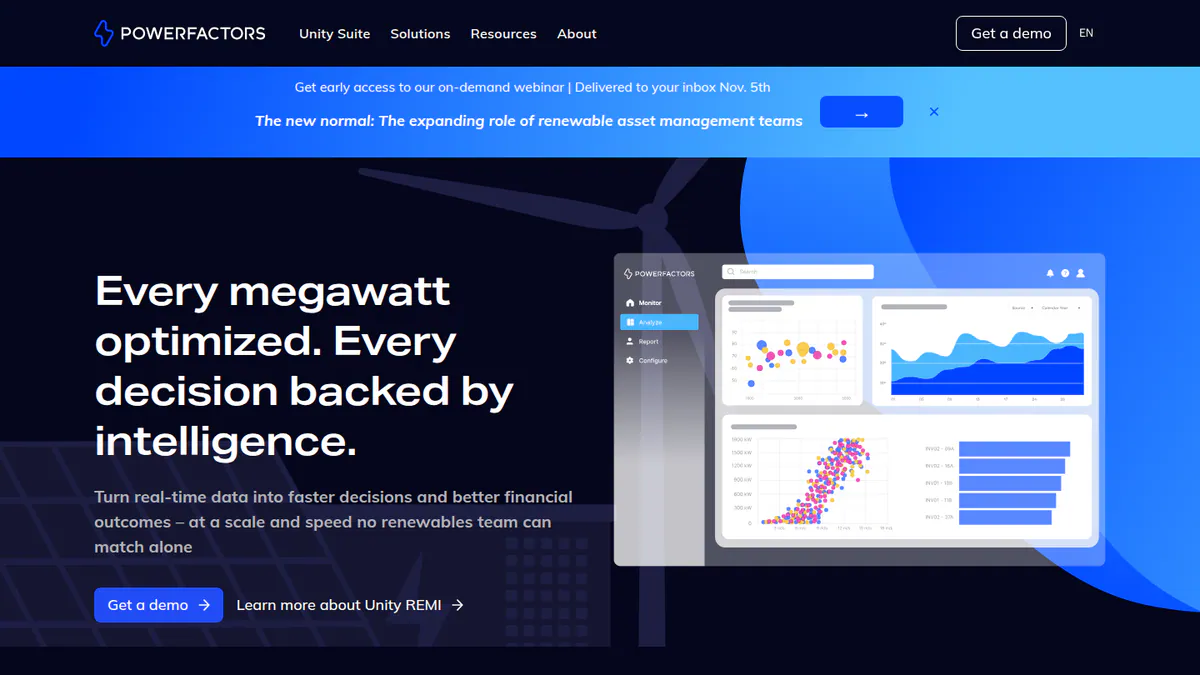
Power Factors Unity ranks first (71.0/100) of the 13 tools we scored. It ties invoice handling to the same data as its SCADA (plant control and data), plant performance and field service. It suits IPPs (independent power producers) and asset managers with utility-scale (very large solar farms) and large C&I (business and factory) fleets.
What does solar asset management software show an owner?
Asset management software answers the owner’s monthly questions. Did each plant earn what the budget said? Was it up as often as the PPA asks? Which losses cost money? Can the lender and offtaker (the buyer of the power) get a report without a week in spreadsheets?
We ranked tools on how much of that money-and-fleet layer they show. This is a C&I and utility-scale group.
The same companies show up on other pages, scored for other jobs:
- Alarms that become work orders: solar O&M software (operations and maintenance).
- The upkeep system alone: solar CMMS software.
- Why a plant falls short: solar performance analytics.
- Running a utility-scale plant day to day: solar farm management software.
All of these pages sit in our monitoring and asset management group.
Quick picks
Rank | Product | Best for | Starting price (company page, checked October 2026) | Free plan / trial | Score /100 |
|---|---|---|---|---|---|
1 | IPPs wanting operations and commercial asset management in one suite | Quote only | Demo only | 71.0 | |
2 | PPA availability, budgets and revenue tracking | Quote only (Core, Pro, Elite tiers) | Demo only | 68.5 | |
3 | Owners whose asset data comes from drone inspections | Quote only | Demo only | 66.3 | |
4 | Putting a financial value on module-level defects | Quote only | Demo only | 60.7 | |
5 | Ranking corrective actions by ROI across European fleets | Quote only | Demo only | 60.2 | |
6 | Owners trading energy and optimising BESS revenue | Quote only | Demo only | 58.8 | |
7 | Owners already on meteocontrol loggers | Quote only | Demo only | 56.3 |
✓ Verified on the company’s own pricing page. ◐ Published by the company outside its pricing page (help centre, store or press release). ? We could not read the company’s pricing page, so the figure is not confirmed. Prices checked October 2026.
Quote only means the company shows no public price. You ask it for a quote.
How the 7 tools scored
- Use-case fit 35%
- User reviews 20%
- Pricing 15%
- Ease of use 10%
- Support 10%
- Momentum 10%
Tool | Score chart | Score |
|---|---|---|
71 out of 100 | 71.0 | |
68.5 out of 100 | 68.5 | |
66.3 out of 100 | 66.3 | |
60.7 out of 100 | 60.7 | |
60.2 out of 100 | 60.2 | |
58.8 out of 100 | 58.8 | |
56.3 out of 100 | 56.3 |
Each bar shows the weighted score out of 100.
Sub-scores at a glance (0-10)
Product | Use-case fit | User reviews | Pricing | Ease of use | Support | Momentum | Total /100 |
|---|---|---|---|---|---|---|---|
10.0 | 5.0 | 4.0 | 5.0 | 5.0 | 10.0 | 71.0 | |
10.0 | 5.0 | 4.0 | 5.0 | 5.0 | 7.5 | 68.5 | |
5.6 | 7.9 | 4.0 | 10.0 | 10.0 | 5.0 | 66.3 | |
7.8 | 5.0 | 4.0 | 5.0 | 5.0 | 7.5 | 60.7 | |
8.3 | 5.0 | 4.0 | 5.0 | 5.0 | 5.0 | 60.2 | |
7.2 | 5.0 | 4.0 | 5.0 | 5.0 | 7.5 | 58.8 | |
7.2 | 5.0 | 4.0 | 5.0 | 5.0 | 5.0 | 56.3 |
A 5.0 on reviews, ease, support or momentum is our neutral value where public evidence is thin, not a judgement.
How did we rank these asset management tools?
How the score is weighted
- Use-case fit 35%
- User reviews 20%
- Pricing 15%
- Ease of use 10%
- Support 10%
- Momentum 10%
We looked at 15 products from 22 to 24 October 2026. We scored 13 and ranked the top 7. The other 6 sit in "Also considered". kWh Analytics HelioStats fell below our minimum fit score (4 out of 10). We did not score Bazefield or QOS Energy, because we could not confirm their status or domain.
We used company docs, price pages, trade press and user reviews. This was desk research, so we did not load a fleet into any tool. Each product gets a score on six points.
- Use-case fit (35%): How well it does this page’s job. Shown asset-management features count most: fleet KPIs (key performance figures), contracts, and revenue and money reports. Performance data comes next, then monitoring.
- User reviews (20%): Ratings from only a few reviews count for less, and most tools here have few or none. Those score neutral and lose no points.
- Pricing (15%): Public prices score higher than prices you have to ask for.
- Ease of use, support and momentum (10% each): Review sub-scores and dated product news, or neutral with no proof.
Scores are set for this page’s job, so the same tool can score differently elsewhere. Because reviews are scarce, a tool with real review data can beat a deeper suite, as Sitemark does at number 3. Full method: how we score software.
What are the three kinds of asset management tool?
- Suites with their own SCADA: Power Factors Unity, GreenPowerMonitor and Bluence.
- Monitoring-first tools with fleet reports: 3E SynaptiQ and VCOM Cloud. PowerTrack and Solytic sit in "Also considered".
- Drone-led asset records: Sitemark and Raptor Maps, which value defects by lost output or money. Zeitview sits in "Also considered".
PowerHub and ACTIS ERP were built as money layers above monitoring. But we could not confirm that either is still in active work, so both sit in "Also considered".
1. Power Factors Unity: best for IPPs wanting operations and commercial asset management in one suite
Best for: IPPs and asset managers with fleets that mix solar, wind and storage. Score: 71.0/100.
What it is: Power Factors folded its Drive, Greenbyte and BluePoint products into the Unity suite. For an owner, the key parts are asset performance management and a commercial module for asset oversight and invoices. These share data with SCADA and field service, so a lost-energy event and its revenue hit sit in one place.
Why we picked it: It scored highest on fit because commercial asset management, performance data, SCADA and field service share one data set. That suits IPPs who report to investors and run the plants too.
Key features:
- Commercial asset management: asset oversight and invoice handling.
- Asset performance management with Advanced Insights.
- An iOS app that ranks events by lost energy and revenue.
- SCADA, power plant controller and EMS (energy management system).
- Unity REMI AI engine, launched 29 April 2026. Trade press says it is trained on 310+ GW of plant data and live across 30+ GW in Unity.
Pricing: You have to ask the company for a price, with a demo on the site. Checked October 2026 on the Power Factors website.
Pros (from our research):
- You can trace each revenue loss to the plant event behind it.
- One suite covers wind and storage sites next to your solar.
- It keeps moving: REMI came in April 2026, the iOS app v1.0 in May and v1.1.3 in July.
Cons (from our research):
- You have to ask the company for a price, so you cannot compare cost before a sales call.
- No free trial. You see it through a demo only.
- Almost no user reviews to judge it by.
Reviews: App Store 5.0/5 (1 rating), checked October 2026. No G2 or Capterra reviews.
What we could not confirm: a public list of connections, and how deep the money module goes beyond invoices.
Read our full Power Factors Unity review.
Want to see Power Factors Unity working? Book a demo with the SolarSoftwares team.
Book a demoYour request goes by email to the SolarSoftwares team. A time is set only after we reply. It does not change any score or ranking.
2. GreenPowerMonitor (DNV): best for PPA availability, budgets and revenue tracking
Best for: Owners who report contract uptime and budget gaps. Score: 68.5/100.
What it is: GreenPowerMonitor is a Spanish firm, owned by DNV since 2016. It sells the GPM Horizon platform for monitoring, SCADA and asset performance across solar, wind and BESS (battery storage) fleets.
Why we picked it: It is the only product here that names contract (PPA) availability tracking. Its tier list also shows where budgets and revenues sit, the core of an owner’s monthly report.
Key features:
- PPA and contract availability tracking with lost-revenue figures.
- Core tier: monitoring, alarms and a data studio.
- Pro tier: adds analysis, budgets, reports, revenues and tickets.
- Elite tier: adds KPIs, forecast, planning, Gemini predictive fault spotting and a phone app.
- On-site GPM SCADA, plus Horizon Storage for BESS (October 2025).
Pricing: You have to ask the company for a price for all three tiers. Checked October 2026 on the GPM Horizon page.
Pros (from our research):
- You can see which tier holds budgets, revenues and reports before you talk to sales.
- DNV backs it, with a 24/7 monitoring centre in Bangalore.
- One platform runs your solar, wind and storage sites.
Cons (from our research):
- Revenue and budget features need Pro or above.
- You have to ask the company for a price for all three tiers.
- No user reviews to judge it by.
Reviews: No user reviews on G2, Capterra or SourceForge as of October 2026.
What we could not confirm: which connections or API it offers, as the product page does not say.

Want to see GreenPowerMonitor (DNV) working? Book a demo with the SolarSoftwares team.
Book a demoYour request goes by email to the SolarSoftwares team. A time is set only after we reply. It does not change any score or ranking.
3. Sitemark: best for owners whose asset data comes from drone inspections
Best for: Owners who manage assets around site findings. Score: 66.3/100.
What it is: Sitemark (Leuven, Belgium) builds a drone inspection tool for EPCs (engineering, procurement and construction firms), O&M firms and owners. Its AI ranks faults by severity and likely lost output, with tickets, trend tracking and reports. It ranks third on its review record, not on asset-management depth, and it shows no PPA, budget or invoice features.
Why we picked it: It has the largest review record on this page, with 30 G2 and 5 Capterra reviews, and users praise its ease of use and support. Its fault ranking by likely lost output also feeds owner spending choices.
Key features:
- Thermal and visual checks: MC4s (standard panel connectors), soiling, trackers, cracks, plants, storm damage and serial numbers.
- Faults ranked by likely lost output.
- Trend tracking and reports for each stakeholder.
- Forms and tickets to manage work.
- Bring your own drones, or use Sitemark’s partner network.
Pricing: You have to ask the company for a price, with packages based on the number of sites. Checked October 2026 on the Sitemark pricing page.
Pros (from user reviews): From Capterra reviews.
- Easy to use for both technicians and managers.
- A quick, helpful support team.
- Covers build through operations, with thermal checks.
Cons (from user reviews):
- You cannot download thermal orthomosaic images (stitched aerial maps).
- The minimum package must be used within a year.
- A bit pricey for firms just starting out.
Reviews: G2 4.9/5 (30 reviews) and Capterra 5.0/5 (5 reviews), checked October 2026.

Want to see Sitemark working? Book a demo with the SolarSoftwares team.
Book a demoYour request goes by email to the SolarSoftwares team. A time is set only after we reply. It does not change any score or ranking.
4. Raptor Maps: best for putting a financial value on module-level defects
Best for: Utility-scale owners who need defect costs and warranty proof. Score: 60.7/100.
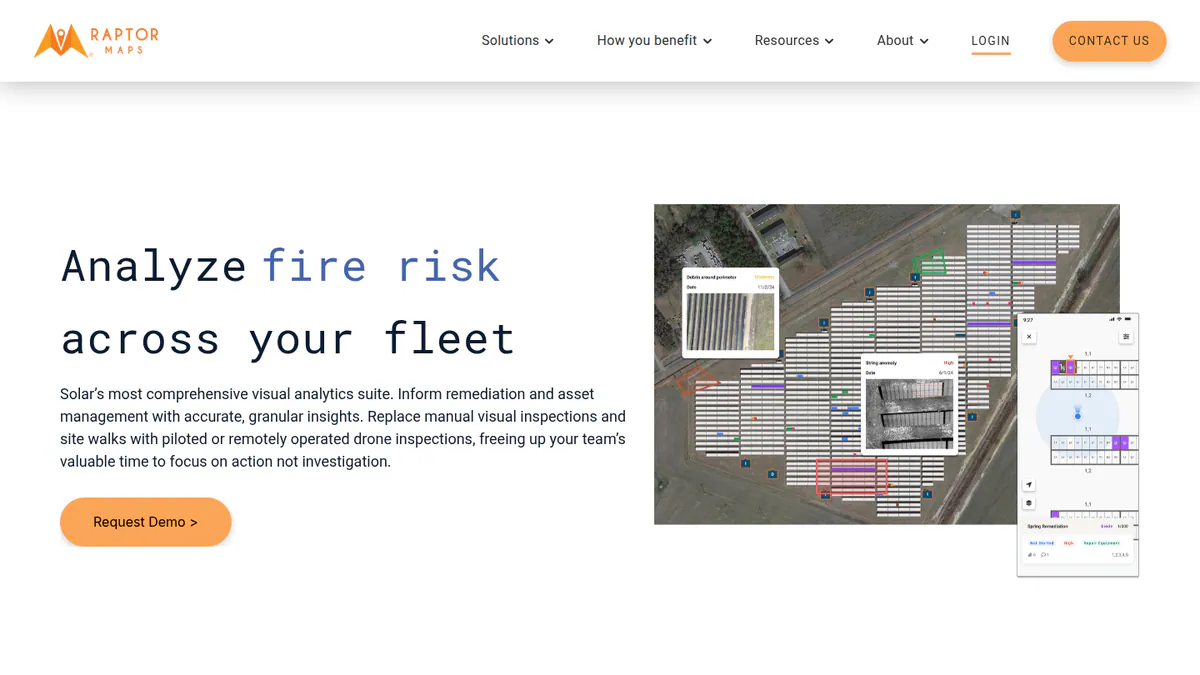
What it is: Raptor Maps, based in Boston, builds a digital twin (a computer copy) of each plant from drone, aircraft, satellite and sensor data. It puts a power and money loss on each fault. For owners, the key parts are warranty-claim thermal data and serial-number records.
Why we picked it: It puts a money figure on each fault and supplies thermal data for warranty claims. Both feed straight into an owner’s spending choices.
Key features:
- Money lost per fault.
- STC-normalised (standard test conditions) thermal data for OEM (equipment maker) warranty claims.
- Serial-number checks for as-built and safe-harbour records (proof of eligibility for US tax credits).
- Benchmarks and wear-over-time trends.
Pricing: You have to ask the company for a price. 2021 trade press described it as a subscription with unlimited inspection reports. Checked October 2026 on the Raptor Maps website.
Pros (from our research):
- You can rank repairs by money lost, not by alarm counts.
- Serial-level records back up your as-built and safe-harbour files.
- You can use any drone or capture hardware.
Cons (from our research):
- No budget, PPA or invoice features shown.
- You have to ask the company for a price.
- Few reviews to judge it by: five App Store ratings and none on G2 or Capterra.
Reviews: App Store 4.8/5 (5 ratings), checked October 2026.
Read our full Raptor Maps review.
Want to see Raptor Maps working? Book a demo with the SolarSoftwares team.
Book a demoYour request goes by email to the SolarSoftwares team. A time is set only after we reply. It does not change any score or ranking.
5. 3E SynaptiQ: best for ranking corrective actions by ROI across European fleets
Best for: European asset managers who must justify spend. Score: 60.2/100.
What it is: Brussels firm 3E makes SynaptiQ, a monitoring and analytics tool that works with any hardware. A distributor listing puts its linked capacity at roughly 20 GW. We cover its loss model on our performance analytics page.
Why we picked it: It works with any hardware brand and turns faults into fixes ranked by return. Its FlexiReport reports and customer portals suit managers who answer to clients.
Key features:
- A tool that ranks fixes by ROI.
- FlexiReport reports and customer portals for client and investor reports.
- Expected power output from satellite sunlight data, with no on-site sensors.
- BESS asset performance management and wind analytics.
- Real-time fault alerts that create tasks for site visits.
Pricing: You have to ask the company for a price. Checked October 2026 via a 3E case study page.
Pros (from our research):
- Every fix comes with a return on spend, which helps you justify budgets.
- You can track rooftop fleets that have no sunlight sensors.
- Benelux fleet owners use it, such as Insaver with 70 rooftop plants.
Cons (from our research):
- No contract, PPA or invoice features shown.
- You have to ask the company for a price.
- No user reviews to judge it by.
Reviews: No user reviews on G2 or Capterra as of October 2026.
Want to see 3E SynaptiQ working? Book a demo with the SolarSoftwares team.
Book a demoYour request goes by email to the SolarSoftwares team. A time is set only after we reply. It does not change any score or ranking.
6. Bluence (Isotrol): best for owners trading energy and optimising BESS revenue
Best for: IPPs that sell into power markets. Score: 58.8/100.
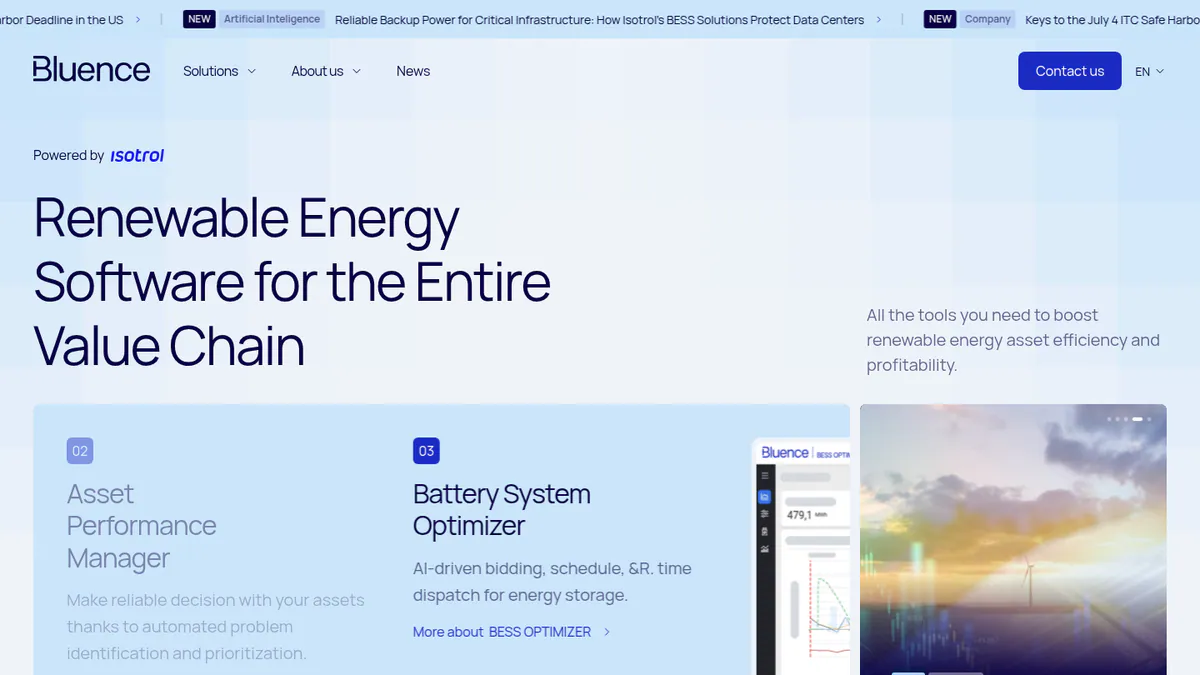
What it is: Isotrol, based in Seville with a US head office in Denver, sells the Bluence suite. It covers SCADA, plant control and APM (asset performance management), plus market tools. Isotrol cites 190 GW managed (undated).
Why we picked it: It is the only product here that shows power market bidding and automated energy trading. That lets owners judge each plant on market revenue, not just energy.
Key features:
- Power market bidding and automated trading.
- A multimarket BESS optimiser that uses market and output forecasts (launched November 2025).
- APM with predictive maintenance and performance data.
- Plant and central SCADA for fleets of many sites.
Pricing: You have to ask the company for a price. Checked October 2026 on the Isotrol website.
Pros (from our research):
- You see asset performance in market revenue, not just energy.
- SCADA and plant control sit in the same suite as APM.
- Predictive maintenance comes built into APM.
Cons (from our research):
- No contract or invoice module shown.
- You have to ask the company for a price.
- No user reviews to judge it by.
Reviews: No user reviews on G2 or Capterra as of October 2026.
What we could not confirm: anything on bluence.com itself. Our facts come from isotrol.com.
Want to see Bluence (Isotrol) working? Book a demo with the SolarSoftwares team.
Book a demoYour request goes by email to the SolarSoftwares team. A time is set only after we reply. It does not change any score or ranking.
7. VCOM Cloud: best for owners already on meteocontrol loggers
Best for: Owners with meteocontrol blue’Log dataloggers. Score: 56.3/100.
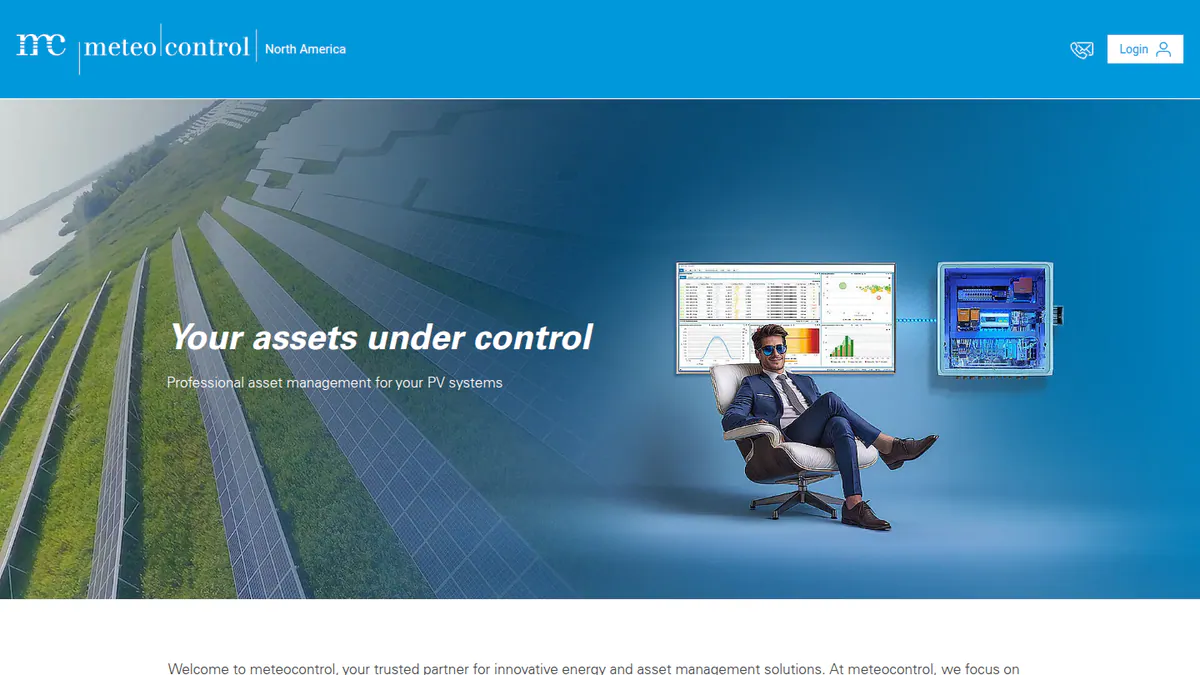
What it is: meteocontrol, from Augsburg in Germany, runs VCOM Cloud as its monitoring and fleet tool. It is now moving to an mc Cloud login. meteocontrol reported 50,000 systems and about 18 GWp monitored as of December 2020.
Why we picked it: For owners already on meteocontrol loggers, it adds report templates and automatic tickets with no new data link. It made the top 7 on that fit, though it shows no money features.
Key features:
- Fleet monitoring and data hosting.
- Custom form and report templates.
- VCOM API.
- Tickets made for you from alarms.
- A CMMS (maintenance management system) module, sold under its own licence, that adds work orders.
Pricing: You have to ask the company for a price, and the CMMS has its own licence. Checked October 2026 on the VCOM O&M app page.
Pros (from our research):
- A long track record, with 50,000 systems monitored by December 2020.
- Report templates speed up the owner’s monthly reports.
- Alarms raise tickets on their own, so faults are not missed.
Cons (from our research):
- No budget, revenue or contract features shown.
- Data comes mainly through meteocontrol loggers.
- No user reviews to judge it by.
Reviews: No user reviews on G2 or Capterra as of October 2026.
Read our full VCOM Cloud review.
Want to see VCOM Cloud working? Book a demo with the SolarSoftwares team.
Book a demoYour request goes by email to the SolarSoftwares team. A time is set only after we reply. It does not change any score or ranking.
How do the 7 solar asset management tools compare?
Product | Commercial features documented | Portfolio reporting | Where the data comes from | Starting price |
|---|---|---|---|---|
Invoice management, asset oversight | Yes, plus REMI queries | Own SCADA plus third-party | Quote only | |
PPA availability, revenues, budgets (Pro+) | Drag-and-drop reports | Own SCADA and monitoring | Quote only | |
Not documented | Stakeholder reports | Drone inspections | Quote only | |
Financial loss per defect, warranty claims | Trends and benchmarking | Drones, aircraft, satellites, SCADA | Quote only | |
ROI-ranked actions | FlexiReport, customer portals | Multi-brand monitoring | Quote only | |
Energy trading, BESS revenue | Not detailed | Own SCADA | Quote only | |
Not documented | Report templates | Mainly meteocontrol loggers | Quote only |
Also considered
- PowerTrack: scored 54.1/100. Stem’s monitoring tool, built by AlsoEnergy, tracks actual against modelled output and stores each site’s warranties and manuals. It shows no revenue, budget or PPA reports, and App Store users rate it 3.1/5 (42 ratings).
- PowerHub: scored 53.7/100. On paper the most money-focused tool here, with PPA and offtaker invoicing and community solar billing. BayWa r.e. bought it in September 2019, but we found no product news after May 2023, so it may be dormant.
- Solytic: scored 52.5/100. The only public price on this page: EUR 5 per site per month up to 200 kWp, plus EUR 60 setup per site. It has no money, budget or contract features.
- ACTIS ERP: scored 49.3/100. Alectris’s renewables ERP (business system) names financial asset management next to technical. Its status is unconfirmed, with no product news after January 2021.
- Zeitview: scored 46.5/100. An aerial inspection service with Asset Insights defect maps. You buy it as a service, and Trustpilot rates it 2.6/5 (4 reviews).
- kWh Analytics HelioStats: a benchmark and risk database for lenders and insurers. kWh Analytics now works mainly as an insurance underwriter, and we found no current HelioStats product page. It falls below the minimum fit score.
- Bazefield and QOS Energy: not scored. We could not confirm Bazefield’s status or reach QOS Energy’s company domain in October 2026.
- Energy Toolbase: its ETB Monitor is a monitoring product, not a fleet asset-management tool.
- General ERP and accounting systems: not built for solar and not scored. See our solar financial modelling page for pre-build models.
How do you choose solar asset management software?
- Do you own utility-scale solar, wind and storage and want plant and money data in one suite? Pick Power Factors Unity.
- If your monthly pain is PPA uptime, budget gaps and lost revenue, shortlist GreenPowerMonitor at the Pro tier or above.
- Selling into power markets or running batteries for revenue? Look at Bluence’s trading and BESS optimiser.
- For C&I rooftop fleets in Europe, pick 3E SynaptiQ. It ranks fixes by ROI and has stronger reports than Solytic, which we list under "Also considered".
- If drone checks drive your spending choices, pick Sitemark for in-house flights. Raptor Maps is better for money lost and warranty proof.
- Already on meteocontrol loggers? Start with VCOM Cloud’s report templates.
- Need offtaker invoicing or community solar billing? Ask PowerHub and Alectris (ACTIS), both also considered, for proof of active work first.
Want more choices? Browse every tool we checked in our monitoring and asset management category.
Solar asset management software FAQs
What is solar asset management software?
It is software that turns plant data into the owner’s view: uptime, revenue against budget, contract duties and investor reports. As of October 2026, GreenPowerMonitor sells this as Pro-tier modules (budgets, revenues, reports) on top of monitoring. Power Factors has a commercial asset management module in its Unity suite.
How do solar asset management tools connect inverter and meter data to portfolio KPIs?
Through on-site SCADA or dataloggers (small devices that collect inverter data). As of October 2026, Power Factors, GreenPowerMonitor and Bluence use their own SCADA. VCOM Cloud relies mainly on meteocontrol’s blue’Log loggers. Solytic, also considered, reads 40+ inverter and logger makers. Ask each company which of your models it reads.
What is the difference between solar monitoring and solar asset management?
Monitoring shows output and faults. Asset management adds what the loss cost, whether contract uptime was met and how the fleet did against budget. As of October 2026, only GreenPowerMonitor, Power Factors, PowerHub and ACTIS show contract, invoice or money features (see our solar monitoring page).
Which solar asset management platforms handle contracts, PPAs and financial reporting?
GreenPowerMonitor tracks PPA and contract uptime and lost revenue. Power Factors Unity has invoice handling (both checked October 2026). PowerHub shows PPA invoicing and contract tools, and ACTIS shows financial asset management. But both of those are also considered, rely on 2019-2023 sources, and have unconfirmed status.
Sources
All checked 22 to 24 October 2026.
- Power Factors: website, Solar Power World, April 2026, App Store
- GreenPowerMonitor: GPM Horizon, DNV news, 2025
- Sitemark: pricing, solar inspections, G2, Capterra
- Raptor Maps: website, Solar Builder, 2021, App Store
- 3E SynaptiQ: case study, distributor listing, Insaver story
- Bluence: Isotrol, RE+ debut
- VCOM Cloud: O&M app, ticket system help
- PowerTrack: AlsoEnergy, what’s new, App Store
- PowerHub: pvBuzz, community solar (May 2023), PV Tech, 2019
- Solytic: pricing, product update, Solarserver, October 2024
- ACTIS ERP: pv magazine Australia, Renewable Energy Magazine, January 2021
- Zeitview: solar page, news, Trustpilot
- kWh Analytics: US DOE success story
Last updated 28 October 2026. Next scheduled review: 23 January 2027.