Key takeaways
- C-rate is current divided by Ah. So 1C is a one-hour rate and 0.5C is a two-hour rate.
- Installers usually meet it as kW divided by kWh. That matches only while voltage stays near nominal.
- The capacity basis changes the number. The same 3.84 kW is 0.80C on nominal kWh and 0.84C on usable kWh (our arithmetic).
- The inverter can cap the rate. From two Pylontech modules, a 5.00 kW AC rating sets the power, at 0.52C.
- A kVA rating is not kW. Enphase’s 3.84 kVA on 5.0 kWh usable gives a ratio of 0.77, which is not a C-rate.
To check a battery against inverter limits in software, see the best solar battery storage design software.
C-rate at a glance
C-rate is a ratio. It says how hard a battery works relative to its size. It means nothing without a stated capacity basis.
| Item | Detail |
|---|---|
| Formula | C-rate = current (A) ÷ capacity (Ah). In power terms, kW ÷ kWh while voltage stays near nominal. Ideal full-discharge time in hours = 1 ÷ C-rate. |
| Unit and range | You write it as 1C, 0.5C or C/2. Battery University lists 1C as one hour, 0.5C (C/2) as two hours and 0.2C (C/5) as five hours. Continuous home-battery rates printed on this page run from 0.24C (Tesla, nominal kWh) to 1.05C (Pylontech, usable kWh). Short peaks run from a 1.23 kVA ratio (Enphase, not a true C-rate) to 2.00C (Pylontech). |
| Where it matters | Run time at a given kW, matching a battery to an inverter’s DC current, and reading capacity or cycle ratings tied to a test rate. |
| In software | PVsyst, HOMER Pro and OpenSolar describe charge or discharge limits. See the software table. |
Why does C-rate matter for installers?
It shows if a battery and inverter can deliver the kW a customer expects. It also shows for how long. A low C-rate gives a long run time. A high one empties the usable energy fast.
Ratings also move with rate. CSIRO’s Batteries for Homes (2021) says that, in general, the faster a battery is charged and discharged, the lower its cycle number. Cycle totals tie to specific C-rates. See battery cycle life for how cycles are counted, and depth of discharge for usable kWh.
How do you calculate C-rate?
Divide the current by the Ah rating, or the power by the energy. Both give the same C-rate while voltage stays at its nominal value.
- Read the capacity the maker uses, in Ah or kWh. Note whether it is nominal or usable.
- Read the rate in amps or kW. A kVA figure is not kW.
- C-rate = amps ÷ Ah, or kW ÷ kWh on the same basis.
- Convert with the nominal voltage. Ah = kWh × 1,000 ÷ V. Amps = kW × 1,000 ÷ V.
- Ideal time to deliver the capacity = 1 ÷ C-rate hours. Losses and voltage change it.
Voltage matters. A constant power draws more current as voltage falls. Take an invented 100 Ah, 48 V nominal battery at 3.84 kW. The current is 80.0 A at 48 V and 87.3 A at an example 44 V. That is 0.80C against 0.87C, or 9.1% higher.
Capacity also depends on rate. PVsyst’s help reports a ratio of about 40% between C10 and C100 capacity for lead-acid. For lithium-ion it reports a capacity increase of about 4% at C100.
Does the capacity basis change the C-rate?
Yes. Nominal and usable kWh differ, so one power gives two C-rates. A datasheet also quotes its capacity at a stated rate. So read the footnote.
Each row shows one printed rating and the C-rate it works out to.
Rates printed in four datasheets, with our arithmetic:
- Pylontech US5000 (file id PY21SDRE01-12-3, 48 V): 4,800 Wh nominal and 4,560 Wh usable. Current rows: 80 A "(Recommend)" and 100 A "(Max. Continuous)", at cell temperatures of 10 to 40°C. Ah is not printed. 4,800 ÷ 48 = 100 Ah. 80 A is 3.84 kW, 0.80C nominal and 0.84C usable. 100 A is 4.80 kW, 1.00C and 1.05C.
- Tesla Powerwall 3, North America, 2024: "Nominal Battery Energy 13.5 kWh AC". Footnote: 25°C, beginning of life, 3.3 kW charge or discharge power. Maximum continuous charge power is 5 kW. So 3.3 ÷ 13.5 = 0.24C and 5 ÷ 13.5 = 0.37C.
- Tesla Powerwall 3, 230 V sheet listing G98 and G99, 2026: "Usable Battery Energy (AC) 13.5 kWh". It is a minimum guaranteed at beginning of life, 25°C and 5 kW charge or discharge power. So 5 ÷ 13.5 = 0.37C. The kWh is the same, but the test rate and the label differ.
- Enphase IQ Battery 5P, US, May 2024: "Usable capacity 5.0 kWh". Rated (continuous) output 3.84 kVA. Peak 7.68 kVA (3 seconds) and 6.14 kVA (10 seconds). So 3.84 ÷ 5.0 = 0.77, and the peak ratios are 1.54 and 1.23. These are AC kVA over kWh, not kW over kWh.
The Pylontech sheet also prints a peak of 121 to 200 A for 15 seconds (200 A is 2.00C) and 101 to 120 A for 15 minutes.
The Tesla North America sheet also prints 11.5 kW AC maximum continuous discharge power. That rates the whole unit, which has solar inputs too. So we do not read 11.5 ÷ 13.5 as a battery rate. For lithium-ion, PVsyst’s help says some datasheets give a current near C2 that "probably correspond better to ‘nominal’ currents".
Worked example: which limit sets the power?
The lowest of three limits sets the power. They are the battery’s current limit, the inverter’s DC current limit and its AC rating. The C-rate then follows from the kWh you fitted.
Sunsynk’s page for its 5 kW single-phase SG04LP1-SM2 compact inverter prints a battery range of "40Vd.c ~ 60Vd.c". It lists a maximum charging and discharging current of "120Ad.c" and a rated power of "5000W". At 48 V nominal, 120 A is 5.76 kW. We pair it, hypothetically, with Pylontech modules at the 80 A recommended row. No compatibility is claimed. We ignore losses and voltage sag. We assume currents add across parallel modules.
One module is held back by the battery. From two modules, the inverter sets the power.
Table 1. One to four modules against a 5.76 kW inverter DC limit and a 5.00 kW AC rating.
| Modules | Nominal and usable kWh | Battery alone, 80 A each (kW) | Power used (kW), set by | C-rate (nominal, usable). Hours |
|---|---|---|---|---|
| 1 | 4.80 and 4.56 | 3.84 | 3.84, battery | 0.80C and 0.84C. 1.19 hours |
| 2 | 9.60 and 9.12 | 7.68 | 5.00, inverter AC rating | 0.52C and 0.55C. 1.82 hours |
| 3 | 14.40 and 13.68 | 11.52 | 5.00, inverter AC rating | 0.35C and 0.37C. 2.74 hours |
| 4 | 19.20 and 18.24 | 15.36 | 5.00, inverter AC rating | 0.26C and 0.27C. 3.65 hours |
On the 100 A "Max. Continuous" row, one module gives 4.80 kW (1.00C), still below both inverter limits. The inverter accepts up to 120 A. So on that row the battery’s 100 A limit (4.80 kW) is the lowest limit. Victron’s Cerbo GX manual lists charge and discharge current limits. A managed battery sends them to the inverter. See the battery management system page and hybrid inverter.
Inverter limits also move. Victron’s Multi RS manual gives a maximum total battery charging current of 100 A, reduced above 60 V. It gives 88 A at 230 V AC input, 57.6 V and 25°C. An installer can set a lower value in VictronConnect.
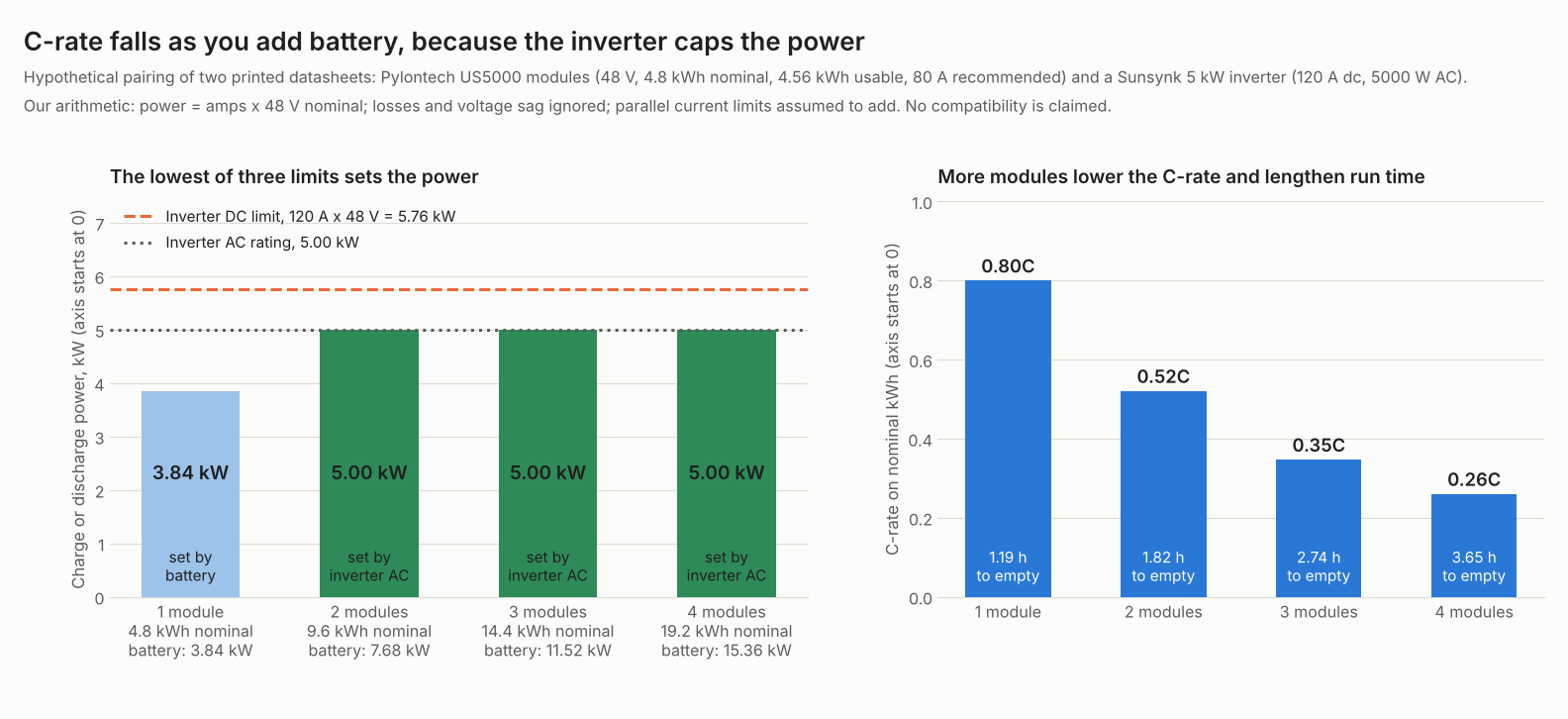
Figure 1. In a hypothetical pairing, the battery holds one 4.8 kWh module to 0.80C. From two modules, the inverter’s 5.00 kW AC rating holds it to 0.52C or less.
C-rate calculator
Enter a power and capacity to get the C-rate on both bases. Or enter modules and limits to see what sets the power. The example button reproduces Table 1.
How solar software handles C-rate
All three tools apply a charge or discharge limit, but in different ways. PVsyst uses it for design-time warnings, HOMER Pro caps charge power by the least of three values, and OpenSolar takes the limit from the battery specification. "Yes" means the company’s page says the tool applies one.
| Software | Applies a charge or discharge limit? | Notes |
|---|---|---|
| PVsyst | Yes (design-time warning). Modelled, hourly. | PVsyst help, undated. Its nominal capacity is defined at C10. |
| HOMER Pro | Yes. Modelled. | HOMER Pro 3.16 manual, no date. Charge power only. The company pages do not state discharge. |
| OpenSolar | Yes. Modelled. | OpenSolar support page, no date in the text read. It does not mention C-rate. |
What each page says:
- PVsyst: operating limits page. For lead-acid, "PVsyst will check that the charging / discharging rates are reasonable". The limits can be changed: charging in 2.5 hours and discharging in 2 hours. For lithium-ion, it lists maximum charging and discharging current, which "is not used in the simulation, only for warnings at design time".
- HOMER Pro: maximum storage charge power is "the least of" three values. They are the kinetic battery model, the maximum charge rate and the maximum charge current. The rate is in A per Ah of unfilled capacity, not a C-rate.
- OpenSolar: battery specifications determine "things like the maximum charge/discharge rate". The page lists "The maximum charging and discharging rate of the battery" as a specification.
For tools whose battery inputs set charge and discharge limits, see the best solar battery storage design software.
Common mistakes with C-rate
FAQs
What is a good C-rate for a solar battery?
Pick a rate that covers the customer’s peak kW on usable kWh. Printed home-battery sheets here run from 0.24C (Tesla, 3.3 kW, nominal kWh) to 1.05C (Pylontech, max continuous, usable kWh). A lower C-rate gives a longer run time at the same power. Capacity is quoted at a stated rate, so read the maker’s rate, basis and temperature range.
Is kW divided by kWh the same as C-rate?
Only roughly. It matches while voltage is near nominal and the kWh uses the same basis as the Ah rating. At an example 44 V instead of 48 V, 3.84 kW needs 87.3 A. That is 0.87C instead of 0.80C.
Does a higher C-rate shorten battery life?
In general, yes. CSIRO’s 2021 guide says faster charging and discharging gives a lower cycle number. It does not put a number on the effect. Compare cycle ratings only at the same rate and conditions.
How long does a battery last at a given C-rate?
The ideal time is 1 ÷ C-rate hours. So 0.80C gives 1.25 hours on nominal energy. Using 4.56 kWh usable at 3.84 kW gives 1.19 hours. Battery University says losses at fast discharges cut the discharge time.
Related terms
- Battery cycle life: how cycles are counted and how warranties cap them.
- Depth of discharge: usable kWh and throughput caps.
- State of charge: the battery’s level at one moment.
- Battery management system: the unit that sets current limits.
- Battery storage design: sizing steps for usable kWh and power.
Next step: enter the battery kWh, its max charge kW and the inverter limit in the calculator above. Then test the pairing in the best solar battery storage design software or the best battery energy storage software.
Sources
All pages were checked in October 2026.
- Battery University, BU-402: What Is C-rate?. Last updated 25 October 2021.
- CSIRO, Batteries for Homes. Building Technology Resource, 2021.
- PVsyst help: battery operating limits and capacity as a function of the discharge rate, both undated. The "probably correspond better to ‘nominal’ currents" quote is from the operating limits page.
- Pylontech US5000 datasheet. File id PY21SDRE01-12-3, no date. A retailer’s CDN hosts the copy.
- Tesla, Powerwall 3 datasheets: North America (2024 footers) and 230 V, UK English (2026 footers).
- Enphase, IQ Battery 5P datasheet. Document number IQB-5P-DSH-00010-6.0-EN-US-2024-05-28 as printed in the file (its file name says 2.0-EN-US-2023-07-26). A distributor hosts the copy.
- Sunsynk, Single Phase 5kW SG04LP1-SM2 Compact Datasheet. Support page, no year shown.
- Victron Energy, Multi RS manual: general description. No date shown.
- HOMER Pro 3.16 manual: battery maximum charge rate and how HOMER calculates the maximum battery charge power, no date shown.
- OpenSolar, How OpenSolar Models Battery Energy Storage, support page.
Last updated 30 October 2026. Next scheduled review: 30 January 2027.