Key takeaways
- A BMS has 4 main jobs in our grouping: monitor, protect, balance and send limits to the inverter.
- Passive balancing is slow. Ionworks says its current is typically 50-200 mA.
- In an example 100 Ah cell, a 5 Ah gap takes 50 hours at 100 mA, or 25 days at 2 balancing hours a day.
- The inverter follows the BMS. Victron says chargers then follow the battery’s instructions.
- The Sunsynk L3.0 sheet gives CAN2.0, RS485 and a 30 A recommended current that depends on temperature and SOC.
To check battery limits against an inverter in software, see the best solar battery storage design software.
Battery management system at a glance
A BMS decides what the battery may do right now. Its limits reach the inverter as numbers.
| Item | Detail |
|---|---|
| What it is | Electronics that watch the cells and set safe limits. Microchip says the BMS "prevents overcharging, over-discharging, and overheating". |
| Four jobs | Monitoring, protection, balancing, communication. Charge and health estimates sit under monitoring. See state of charge. |
| Unit / typical range | No single number. Ionworks gives passive balancing current as "typically low (50-200 mA)". |
| Standard or rule | A March 2019 CSA Group deck names UL 1973 and UL 9540 as referencing a BMS. The deck names them but does not quote them. |
| In software | Some monitoring portals show BMS alarms. See the software table. |
Why does a battery management system matter for installers?
The BMS sets how much current a battery will take and give. That limits real kW. It decides inverter fit. It also raises the alarms you get called out for.
A datasheet kWh figure says little about this. The live limit comes from the BMS. It can change with temperature and charge level. See battery storage design, hybrid inverter, solar-plus-storage and alerts and alarms.
What does a battery management system do?
It does 4 main jobs. They are monitor, protect, balance and communicate. Sources group them in different ways.
- Monitor. Microchip says monitoring means measuring the pack. Readings include voltage, current, temperature, charge and health.
- Protect. Ionworks says the BMS "Ensures the battery never operates outside safe limits for voltage, current, and temperature". Sandia’s slides list high and low voltage. They list extreme heat or cold. They also list overcurrent and reverse current.
- Balance. Ionworks says it "Keeps cells at similar states of charge to maximize pack capacity".
- Communicate. Microchip says the BMS can give pack information "to the user or system controller". Ionworks describes big packs. A master unit there talks to slave boards over a bus such as CAN.
How does cell balancing work, and how long does it take?
Balancing evens out cell charge, so the weakest cell does not set pack capacity. Passive balancing bleeds the fullest cells. Active balancing moves energy between cells.
Analog Devices (ADI) says passive balancing lets the stack "look like every cell has the same capacity as the weakest cell". A switch and a bleed resistor sit across each cell. They drain high cells while the pack charges. ADI adds that this "wastes energy in the process due to the discharge resistor".
Ionworks says active balancing "Uses DC-DC converters to transfer energy from higher-SoC cells to lower-SoC cells". It says passive balancing "Only works during charge".
The time to balance is the Ah gap divided by the bleed current in amps. Ionworks gives 50-200 mA as typical ("typically low (50-200 mA)"), and we found no second source for that range. Table 1 tests it.
Table 1. Hours of bleeding for a 100 Ah cell, by gap and bleed current (example cell, fixed gap, no charging current).
| Gap (% of capacity) | Gap (Ah) | 50 mA | 100 mA | 200 mA |
|---|---|---|---|---|
| 1% | 1 | 20 | 10 | 5 |
| 2% | 2 | 40 | 20 | 10 |
| 5% | 5 | 100 | 50 | 25 |
| 10% | 10 | 200 | 100 | 50 |
At 100 mA and an assumed 3.4 V, the resistor dissipates 0.34 W. A 5 Ah gap sheds about 17.0 Wh as heat (5 Ah × 3.4 V). Hours of bleeding are not calendar days. Suppose balancing runs only during charge. Then the hours it can run each day set the real time.
Table 2. Days to clear a 5 Ah gap at 100 mA (50 hours of bleeding), by balancing hours a day.
| Balancing hours a day | Days |
|---|---|
| 1 | 50.00 |
| 2 | 25.00 |
| 4 | 12.50 |
| 6 | 8.33 |
| 8 | 6.25 |
| 24 | 2.08 |
A pack that balances for 2 hours a day needs 25 days. Real gaps also drift while you wait.
How does the BMS talk to the inverter?
Over a data link, often CAN or RS485, the BMS sends limits. The inverter obeys. Victron’s Cerbo GX manual lists 3 limits. They are charge voltage limit (CVL), charge current limit (CCL) and discharge current limit (DCL).
The manual says these go to inverter/chargers and solar chargers. They then "disable their own charging algorithms and follow the battery’s instructions directly". The manual says to enable this control only if your battery type is listed. It must show as supported. It does not say what a lost link does, so the maker is the one to ask.
A maker can make the link a condition of cover. For its S48-100LFP STACK-LV, Rolls says closed loop communication is "essential for long-term performance". It calls it "a requirement of product registration" and of the extended warranty. Its list covers inverters "capable of reading battery data over CAN bus or RS-485". The same article says inverters with proper voltage and current setpoints "may be used". That is one maker’s rule. Read each battery’s warranty.
What do battery datasheets print about the BMS?
The two sheets we read print the link type and the temperature ranges, and little else about the BMS. On this page, "Not stated" means the source we cite does not print or say it.
Table 3. What two battery datasheets print about the BMS.
| Item | Sunsynk L3.0, v.7 (10/24/23) | RoyPow PowerHome 5.1 kWh sheet |
|---|---|---|
| Communication | "CAN2.0, RS485" | "CAN, RS485" |
| Current | Charge/Discharge Current: 30 A recommended, 60 A max, 75 A peak (2 min, 25°C). Footnote: "The current is affected by temperature and SOC." | A table of nominal and maximum current by pack size, from 50 A to 400 A. |
| Temperature | Charge 0°C to +55°C (optional heating, -20°C to +55°C). Discharge -20°C to +55°C. | Charge 0 to 55°C. Discharge -20 to 55°C. |
| BMS wording | Not stated | "Intelligent BMS & Built-in Fire Extinguishing System". |
| Balancing method, trip points | Not stated | Not stated |
The sheets also leave out the messages and do not say which part enforces a temperature range. The maker’s protocol document and cold-weather charging rules fill that gap.
Our sums turn the Sunsynk sheet current rows into power at its 51.2 V nominal. Units share current equally. The sheet gives 43.2 to 57.6 V. So one unit at 30 A spans 1.30 to 1.73 kW. The inverter limit is example. More units raise the sheet limit until the inverter limit takes over.
Table 4. Charge power set by the sheet current rows and by a 5.00 kW inverter limit.
| Units | 30 A sheet row × 51.2 V (kW) | Allowed (kW), limited by | 60 A sheet row × 51.2 V (kW) | Allowed (kW), limited by |
|---|---|---|---|---|
| 1 | 1.54 | 1.54, sheet current | 3.07 | 3.07, sheet current |
| 2 | 3.07 | 3.07, sheet current | 6.14 | 5.00, inverter |
| 3 | 4.61 | 4.61, sheet current | 9.22 | 5.00, inverter |
| 4 | 6.14 | 5.00, inverter | 12.29 | 5.00, inverter |
These are datasheet ceilings. The live BMS limit can be lower.
With a 5 kW inverter and 30 A per unit, you need 4 units before the inverter limit binds. At 60 A per unit, 2 units are enough.
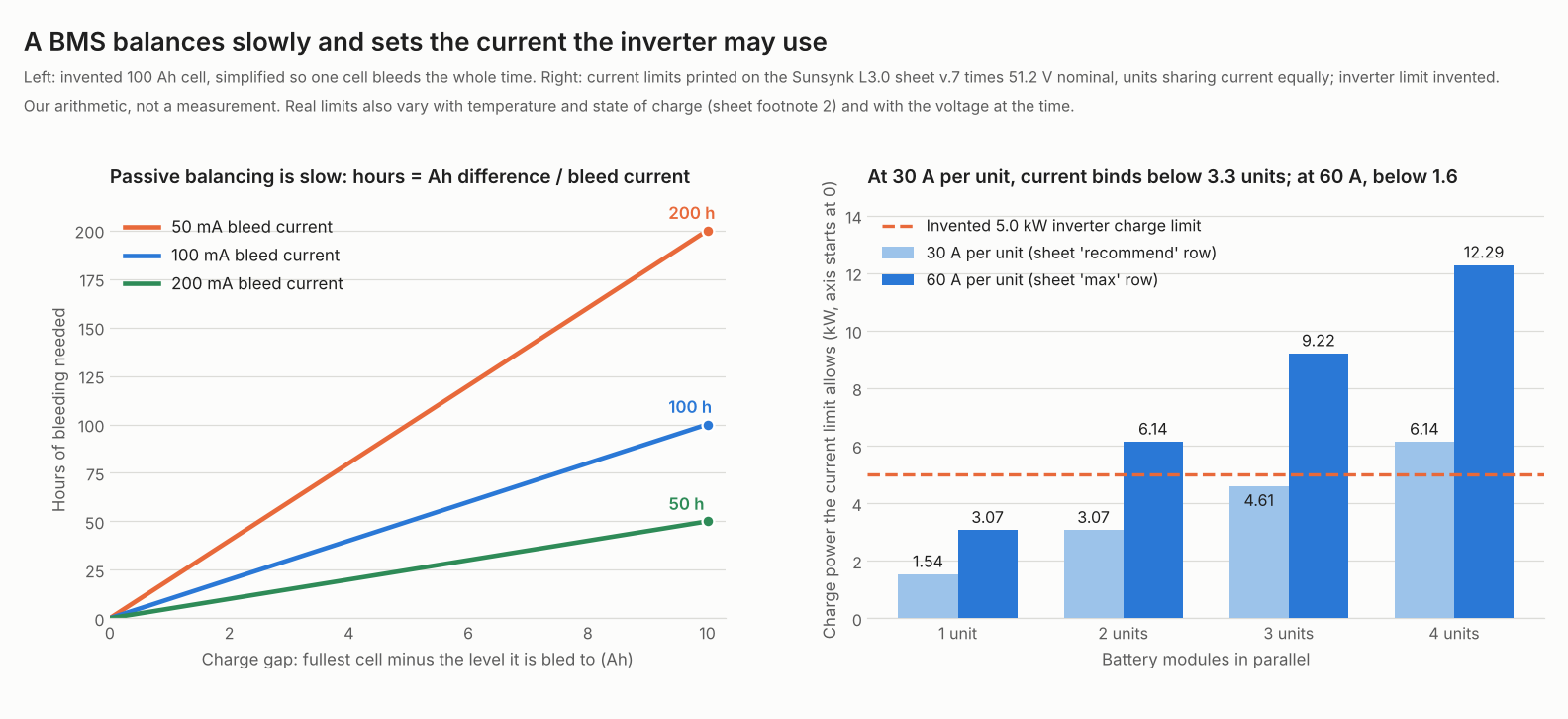
Figure 1. A 10 Ah gap takes 50 to 200 hours to bleed at 200 to 50 mA, and at 30 A per unit the sheet current, not the inverter, sets charge power below about 3.3 units.
Battery management system calculator
Enter a cell gap and bleed current for hours to balance, or units and sheet current for charge power.
How solar software handles battery management system data
Of the 4 portals we checked, only Victron VRM is documented as showing BMS alarms. "Yes" means that page says the portal shows BMS alarms or error codes. For wider comparisons, read the best solar battery storage design software and best solar monitoring software lists.
| Software | Does it show or use BMS data? | Method |
|---|---|---|
| Victron VRM | Yes | On-site monitoring |
| Fronius Solar.web | Partly | On-site monitoring |
| Enphase App | Not stated | On-site monitoring |
| Sungrow iSolarCloud | Not stated | On-site monitoring |
Partly means the page names a battery management module but does not say the portal shows its alarms. Details by company:
- Victron VRM. The alarms section lists a "Cell imbalance alarm" among alarms for batteries, and "Error code" and "Error" for the Lynx Ion BMS. Source: VRM Portal manual, alarms and monitoring, sections 6.3.2 and 6.3.3. No date printed. Control of chargers by BMS limits is in the Cerbo GX manual.
- Fronius Solar.web. The manual lists a "Battery management module" in the Fronius Solar Battery and says the operating state shows on the monitoring website or in Solar.web. Source: Fronius Energy Package operating instructions 028-17072025. The contents list an error-messages section for the battery management module. Whether Solar.web shows them is not stated.
- Enphase App. The owner’s guide has no BMS, battery management or balancing wording. Its LED table has a status "Not operating due to high temperature". Source: Owner’s guide USG-00018-4.0, July 2025.
- Sungrow iSolarCloud. An installer FAQ title names an "EC714 BMS communication fault". The answer text is not shown, and the page does not say the portal displays it. Source: Sungrow installer FAQ list, undated (2026 footer).
Common mistakes with battery management systems
FAQs
Is the BMS part of the battery or the inverter?
The BMS is part of the battery pack, and the inverter only reads its limits over CAN or RS485. Fronius lists a "Battery management module" in its battery. RoyPow’s battery sheet names an "Intelligent BMS".
Does every battery need to talk to the inverter?
Not always. The maker decides. For one model, Rolls makes closed loop communication a condition of cover. It also says inverters with proper setpoints may be used. Victron says to enable its battery control only if the battery is listed. Read the battery’s own manual.
What is the difference between passive and active balancing?
Passive balancing bleeds the fullest cells as heat. Active balancing moves energy to other cells with converters. ADI says passive balancing does not improve run-time. Ionworks says active balancing is more complex and costly.
What does a BMS do when a cell is too hot or too cold?
Ionworks says it can command cooling, derate power or limit charging at low temperatures. Both sheets in Table 3 print a charge range that starts at 0°C. They print a discharge range that starts at -20°C. They do not say which part enforces them.
Related terms
- State of charge: stored energy as a percentage of a stated capacity.
- Depth of discharge: the share of capacity used, with usable capacity and warranty limits.
- Hybrid inverter: the unit whose battery range and power limits the BMS must meet.
- Solar-plus-storage: battery operating modes and coupling.
- Battery cycle life: cycle counts and warranty wording.
- Charge controller: the part that manages charging between array and battery.
Next step: compare the battery’s continuous charge current with your inverter’s DC limit, using the best solar battery storage design software. For BMS alarms in the field, see the best solar monitoring software.
Sources
- Microchip, Fundamental Understanding of Battery Management System. Page last modified 19 January 2024. Checked Oct 2026.
- Ionworks documentation, Battery management systems. Undated. Checked Oct 2026.
- Analog Devices, Passive Battery Cell Balancing. 18 August 2016. Checked Oct 2026.
- Sandia National Laboratories, Battery Management (SAND2020-7243PE). No date printed. Checked Oct 2026.
- CSA Group (J. Leber), Battery Management Systems: Crucial ESS Consideration. 6 March 2019. Checked Oct 2026.
- Victron Energy, Cerbo GX manual, DVCC. Undated. Checked Oct 2026.
- Victron Energy, VRM Portal manual, alarms and monitoring. Undated. Checked Oct 2026.
- Rolls Battery, S48-100LFP STACK-LV Inverter Compatibility. Undated. Checked Oct 2026.
- Sunsynk L3.0 datasheet v.7 (10/24/23), distributor copy. Checked Oct 2026.
- RoyPow PowerHome 5.1 kWh battery sheet. Undated. Checked Oct 2026.
- Fronius Energy Package operating instructions 028-17072025. Checked Oct 2026.
- Enphase IQ Battery 5P owner’s guide USG-00018-4.0. July 2025. Checked Oct 2026.
- Sungrow installer FAQs. Undated. Checked Oct 2026.
Last updated 30 October 2026. Next scheduled review: 30 January 2027.