Battery energy storage software helps you test, size and run a battery paired with solar. It models savings, tariffs and dispatch (when the battery charges and discharges) so you can see the payback. Aurora Solar ranks first on this list, at 64.8/100, for US residential solar-plus-battery savings proposals.
Xendee ranks second, at 64.2/100, for C&I (commercial and industrial) and utility microgrid optimisation and control. A microgrid is a small local power grid. We scored 10 tools and ranked the top 7. Aurora leads on reviews and a public price more than storage depth.
What does battery energy storage software do?
Storage software does three jobs. Design tools place the battery, inverter and wires. Money tools run dispatch against a tariff (the power price schedule), a load profile and demand charges (fees set by your peak power use) to test payback. Control tools run the battery once it is in and set when it charges.
This page ranks tools for the second and third jobs. Need layout, stringing (how panels wire together) and battery placement? Go to our solar battery storage design software ranking. It covers 14 design tools, such as Pylon, PVsyst and Solargraf. Here we judge shared products on savings, tariffs and dispatch.
We did not score utility-scale BESS (battery energy storage system) control platforms. These are sold to asset owners and utilities. The control products below are ones that installers and C&I firms can buy with their modelling tool.
Quick picks
Rank | Product | Best for | Starting price (company page, checked October 2026) | Pricing model | Free plan / trial | Score /100 |
|---|---|---|---|---|---|---|
1 | US residential solar-plus-battery savings proposals | ✓ USD 159 per user per month (battery modelling from Premium, USD 259) | Per user, monthly or annual | None stated | 64.8 | |
2 | C&I and utility microgrid optimisation and control | ✓ 440 per user per month, billed annually (USD assumed) | Per user, annual. Controls by quote | 30-day paid demo. No free trial | 64.2 | |
3 | US C&I storage economics linked to a controller | Quote only | Quote, by team size | Demo only | 63.1 | |
4 | Off-grid and hybrid least-cost sizing | ✓ 1,575 per year, Base (USD assumed) | Annual or monthly licence | Free trial (length not stated) | 63.0 | |
5 | European self-consumption with heat pumps and EVs | ✓ EUR 845 per year plus VAT | Per named user | 30-day trial | 62.8 | |
6 | Utility-scale PV plus BESS and standalone storage feasibility | Quote only | Three tiers, quote | Demo only | 62.3 | |
7 | C&I demand-charge reduction and arbitrage | ✓ 4,200 per year (USD assumed) | Annual, or 665 monthly | Free trial (length not stated) | 59.2 |
✓ Verified on the company’s own pricing page. ◐ Published by the company outside its pricing page (help centre, store or press release). ? We could not read the company’s pricing page, so the figure is not confirmed. Prices checked October 2026.
Quote only means the company shows no public price. You ask it for a quote.
How the 7 tools scored
- Use-case fit 35%
- User reviews 20%
- Pricing 15%
- Ease of use 10%
- Support 10%
- Momentum 10%
Tool | Score chart | Score |
|---|---|---|
64.8 out of 100 | 64.8 | |
64.2 out of 100 | 64.2 | |
63.1 out of 100 | 63.1 | |
63 out of 100 | 63.0 | |
62.8 out of 100 | 62.8 | |
62.3 out of 100 | 62.3 | |
59.2 out of 100 | 59.2 |
Each bar shows the weighted score out of 100.
Sub-scores at a glance (0-10)
Product | Use-case fit | User reviews | Pricing | Ease of use | Support | Momentum | Total /100 |
|---|---|---|---|---|---|---|---|
5.0 | 7.9 | 6.0 | 7.5 | 7.5 | 7.5 | 64.8 | |
7.5 | 5.0 | 7.0 | 5.0 | 7.5 | 5.0 | 64.2 | |
9.2 | 5.0 | 4.0 | 5.0 | 5.0 | 5.0 | 63.1 | |
7.5 | 5.6 | 7.0 | 5.0 | 7.5 | 2.5 | 63.0 | |
5.0 | 5.4 | 8.0 | 7.5 | 7.5 | 7.5 | 62.8 | |
5.0 | 6.9 | 4.0 | 7.5 | 7.5 | 10.0 | 62.3 | |
7.5 | 5.0 | 7.0 | 5.0 | 5.0 | 2.5 | 59.2 |
A 5.0 on reviews, ease, support or momentum is our neutral score. We use it when public evidence is thin. It is not a judgement.
How did we rank these battery energy storage tools?
How the score is weighted
- Use-case fit 35%
- User reviews 20%
- Pricing 15%
- Ease of use 10%
- Support 10%
- Momentum 10%
We scored 10 products from 22 to 24 October 2026, using company docs, price pages, release notes and public user reviews. We did not run storage models in any tool. Each product gets a score on six points.
- Use-case fit (35%): How well it does this page’s job. We look for storage models, tariff and demand-charge maths, dispatch runs and money outputs. Control or monitoring products earn a bonus.
- User reviews (20%): G2 and Capterra ratings. A rating from only a few reviews counts for less. Tools with no public reviews get a middle score, not a penalty.
- Pricing transparency (15%): Published prices score above quote-only or unconfirmed prices.
- Ease of use, support and product momentum (10% each): Review sub-scores, support channels and dated releases. Each gets a middle score when we find no proof.
Eight products reached our minimum match score (4 out of 10). We rank the top 7 and list the other 3 under "Also considered". Scores are for this page’s job, so a tool can score differently on another page. Read the full method: how we score software.
What are the three kinds of storage money work?
- Behind-the-meter savings: Home and C&I batteries that pay through self-use, time-of-use shifting, demand-charge cuts and incentives. Tools: Aurora, PV*SOL premium, Energy Toolbase and HOMER Grid.
- Microgrids and hybrids: The least-cost mix of PV, storage, generators and other sources, with power in outages. Tools: HOMER Pro and Xendee.
- Utility-scale and standalone BESS: Plant-level feasibility, CAPEX (upfront build cost) and LCOE (lifetime cost per unit of power) for PV plus storage or storage-only sites. Tool: RatedPower.
See also our storage and microgrid category.
1. Aurora Solar: best for US residential solar-plus-battery savings proposals
Best for: US home installers who sell batteries on backup and bill savings in one proposal. Score: 64.8/100.
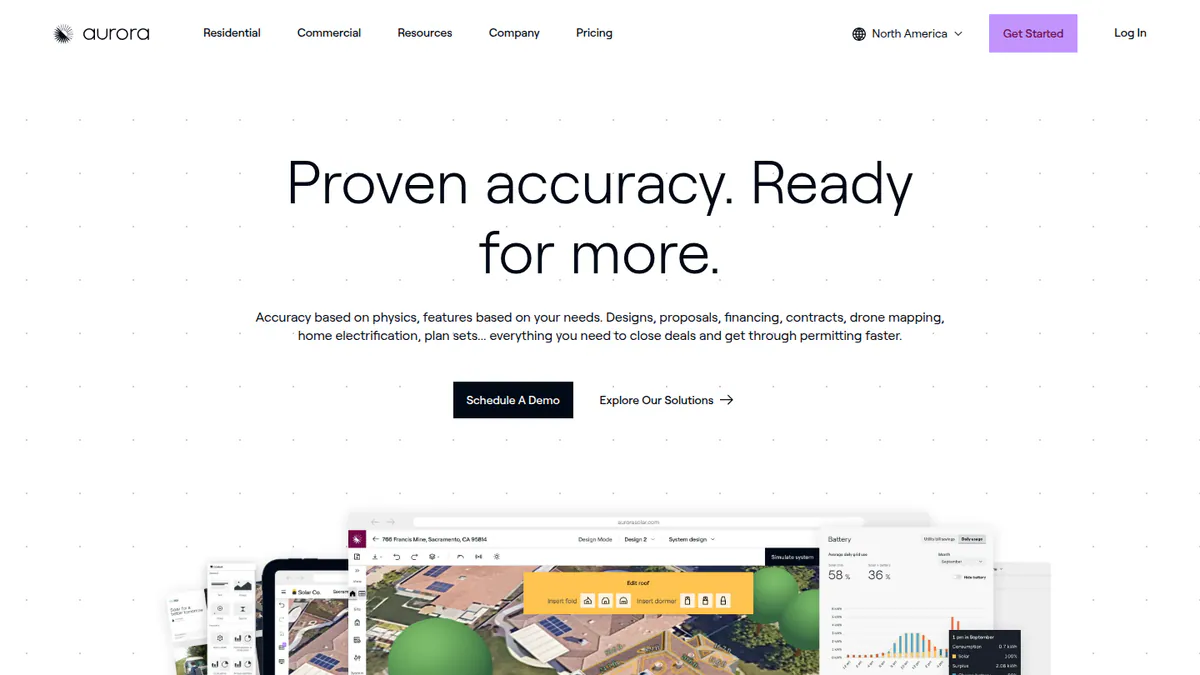
What it is: Aurora is a cloud 3D design and sales tool from Aurora Solar Inc. US home and light-commercial installers use it to design and sell systems. Four other tools here are a closer match for storage maths.
Why we picked it: It has 128 user reviews across G2 and Capterra and a public per-user price. US home installers can put battery savings and backup in the proposal they already send.
Key features:
- Battery models for backup, self-use and arbitrage (charge when power is cheap, use it when it costs more) on Premium.
- Sales proposals with tax-credit estimates (US credit rules change, check current law) and TPO (third-party ownership) finance options.
- Output simulation and shade analysis.
- Design API, plus plan sets and engineering stamps on Enterprise.
Pricing: Basic USD 159 per user per month (USD 135 billed annually). Premium USD 259 (USD 220 billed annually) adds battery modelling, modelling with LIDAR (laser height data) and bankable (fit for lenders) shade reports. Enterprise is custom, per project. No free trial is stated. Checked October 2026 on the Aurora pricing page.
Pros (from Capterra and G2 user reviews):
- Shade reports and output estimates are accurate, so customers can trust the savings.
- Designs come out accurate, and customer service is strong.
- Videos and a help library make it easy to learn.
Cons (from reviews and our research):
- Reviewers find the proposal and finance tools thin for the cost.
- Its docs show no demand-charge, value-stacking or controller products.
- Battery models need Premium, USD 100 more per user per month than Basic.
Reviews: G2 4.7/5 (121 reviews) and Capterra 4.1/5 (7 reviews), checked October 2026.
Read our full Aurora Solar review or our Aurora Solar alternatives.
Want to see Aurora Solar working? Book a demo with the SolarSoftwares team.
Book a demoYour request goes by email to the SolarSoftwares team. A time is set only after we reply. It does not change any score or ranking.
2. Xendee: best for C&I and utility microgrid optimisation and control
Best for: Microgrid developers, engineering firms and EPCs (engineering and build firms) that want one company for planning and live control. Score: 64.2/100.
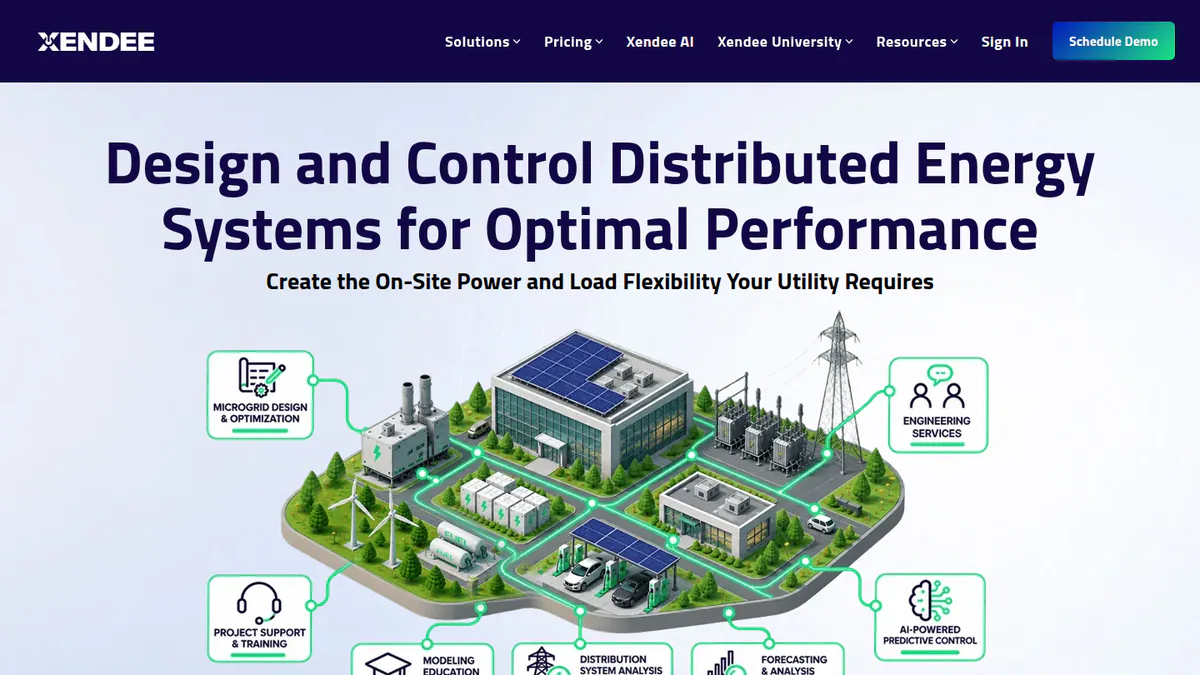
What it is: Xendee is a cloud microgrid platform from San Diego. It has three parts: DESIGN to optimise, DISCOVER to screen sites by API, and OPERATE, an AI model-predictive controller. Eaton led its Series B in September 2025, with a joint push on AI-powered microgrid controls.
Why we picked it: Its optimiser weighs storage against 25+ other energy sources, tariffs and outage needs. That is the core maths of a microgrid deal.
Key features:
- Optimisation across 25+ distributed-energy types, with cost-versus-carbon and multi-year runs.
- Tariff, NEM 3.0 (California net metering), grant and incentive models, plus outage ride-through.
- One-line diagram and power-flow models that size cables and transformers for you.
- DISCOVER API for multi-site screening (Platinum and Enterprise).
- OPERATE model-predictive control, priced on savings, capacity or a joint project, plus Eaton microgrid hardware.
Pricing: DESIGN Gold costs 440 and Platinum 540 per user per month. Both are billed annually only, with no monthly option. Platinum includes 3 free custom tariffs a year. Enterprise (four Platinum licences, model support for eight projects a year) and OPERATE are quote only. Custom tariffs cost 200 each on Gold. The page shows a dollar sign but no currency, so we assume USD. There is a 30-day paid demo, not a free trial. Checked October 2026 on the Xendee pricing page.
Pros (from our research):
- You get planning, multi-site screening and live control from one company, which no other tool here offers.
- You can budget from public per-user prices, which is rare for a tool of this class.
- Platinum includes 3 hours of modelling services a year.
Cons (from our research):
- Gold, at 440 a month billed annually (USD assumed), costs over three times HOMER Pro’s Base annual licence.
- No public user reviews exist to test the company’s claims.
- There is no free trial, only a 30-day paid demo.
Reviews: G2 lists Xendee with no reviews, and we found no Capterra listing. Checked October 2026.
What we could not confirm: how often Xendee ships updates, as we found no dated release notes.
Want to see Xendee working? Book a demo with the SolarSoftwares team.
Book a demoYour request goes by email to the SolarSoftwares team. A time is set only after we reply. It does not change any score or ranking.
3. Energy Toolbase (ETB Developer): best for US C&I storage economics linked to a controller
Best for: US commercial solar-plus-storage developers whose deals hang on demand charges, NEM (net energy metering) rules and grid-services income. Score: 63.1/100.
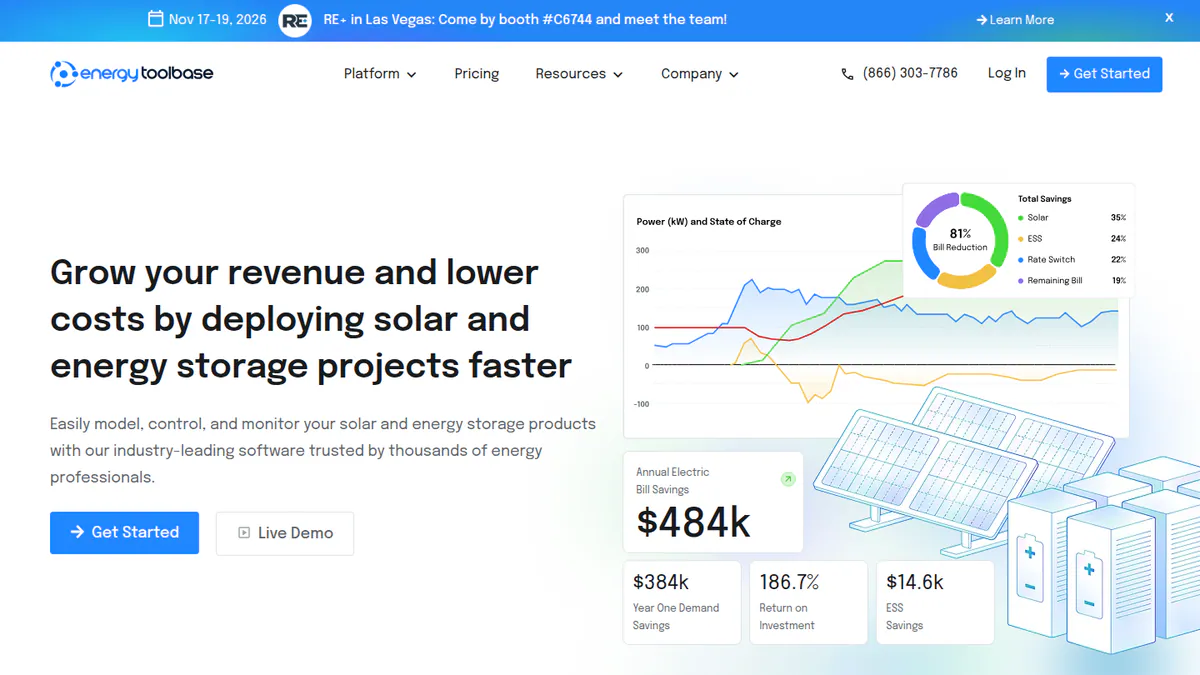
What it is: ETB Developer is a solar and storage savings model and proposal tool from Energy Toolbase Software Inc. Its buyers are US C&I and home developers and installers. The firm also sells ETB Controller and ETB Monitor, so its own EMS (energy management system) can run the modelled dispatch on site.
Why we picked it: On paper it fits this job best, with deep tariff and demand-charge models. It ranks third only because it has no public reviews or modelling price.
Key features:
- 120,000+ tracked utility tariffs, kept up by an in-house rates team.
- Demand-charge cuts, value stacking (earning from several services at once), NEM, virtual NEM (VNEM), NEM aggregation (NEMA) and time-of-use models.
- Demand response and grid services such as California’s DSGS (Demand Side Grid Support) programme (added March 2024).
- Storage runs with a digital twin of ETB’s own EMS dispatch. ETB Controller packages are sized from 100 to 5,000 kWh.
- Incentive maths, PV and battery degradation inputs, and side-by-side money results for each scenario.
- Unlimited white-label proposals with view tracking. Named hardware partners: Tesla, Socomec, Sungrow, Generac, Sol-Ark.
Pricing: ETB Developer is quote only. The price is set on a 30-minute call, based on team size. ETB Monitor packages are listed "as low as" 4,700, with a one-year subscription. ETB Controller packages start from 12,400 or 34,000. The page shows a dollar sign but no currency. Setup and support packages are also sold. Checked October 2026 on the Energy Toolbase pricing page.
Pros (from our research):
- Its docs show the deepest tariff and demand-charge models of any tool here.
- The dispatch you model matches the controller that runs the site.
- You can show grid-services income next to bill savings.
Cons (from our research):
- The modelling software has no public price.
- It covers US tariffs only, with California programmes the most prominent.
- No G2 or Capterra listing exists, so there are no user reviews to judge it by.
Reviews: No user reviews found as of October 2026.
Read our full Energy Toolbase review or our Energy Toolbase alternatives.
Want to see Energy Toolbase (ETB Developer) working? Book a demo with the SolarSoftwares team.
Book a demoYour request goes by email to the SolarSoftwares team. A time is set only after we reply. It does not change any score or ranking.
4. HOMER Pro: best for off-grid and hybrid least-cost sizing
Best for: Engineers and consultants sizing remote, islanded or hybrid systems where storage competes with diesel, wind or hydro. Score: 63.0/100.
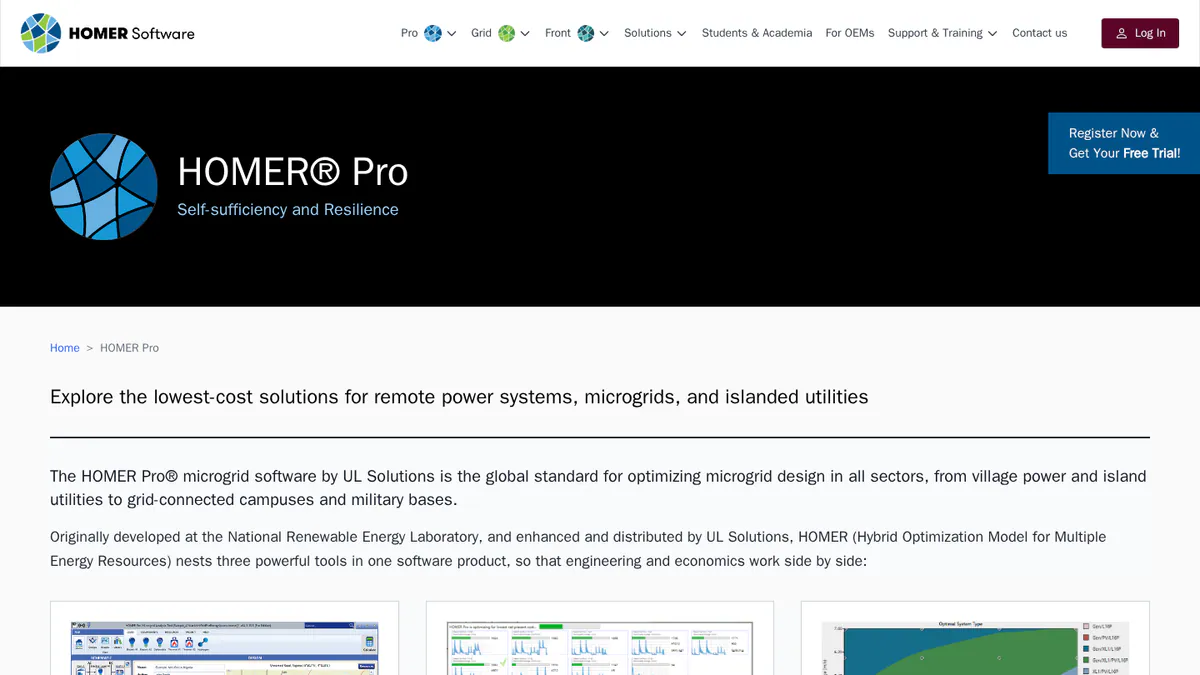
What it is: UL Solutions now sells HOMER Pro. It runs many system setups and ranks them by NPC (net present cost). Solar is one input. It is not a PV layout tool.
Why we picked it: It ranks each mix of PV, storage, generators and other sources by lifetime cost, the key test for off-grid and hybrid sites. Its prices are public and engineers rate it 4.4/5 on Capterra.
Key features:
- Least-cost runs across PV, wind, diesel, hydro, biomass, CHP (combined heat and power), hydrogen and storage.
- Sensitivity and multi-year runs, with NPC and LCOE outputs.
- Storage degradation tables and battery augmentation, added in version 3.18.5 (28 August 2026).
- MATLAB link for custom dispatch on the Expert plan.
- NASA solar resource data import.
- Advanced grid, load and storage modules (any four on Professional, all on Expert).
Pricing: Base 1,575 per year or 187.50 per month, with no modules. Professional 3,100 per year or 373.50 per month, with any 4 modules and 6 hours of training. Expert 4,650 per year or 568.50 per month, with all modules. You get 25% off four or more licences. The page shows a dollar sign only, so we assume USD. Checked October 2026 on the HOMER Pro pricing page.
Pros (from Capterra reviews):
- Hybrid and microgrid runs show tech and money results together.
- You can mix many energy sources in one model.
- The built-in data library is good, and MATLAB export is easy.
Cons (from Capterra reviews):
- Complex screens are the most common complaint.
- It is pricey next to other optimisation tools.
- Built-in data is not updated often, and rural data needed manual updates.
Reviews: Capterra 4.4/5 (9 reviews), checked October 2026. G2 shows no reviews. Reviews date from 2019 to 2023, mostly from engineers and academics.
Read our full HOMER Pro review.
Want to see HOMER Pro working? Book a demo with the SolarSoftwares team.
Book a demoYour request goes by email to the SolarSoftwares team. A time is set only after we reply. It does not change any score or ranking.
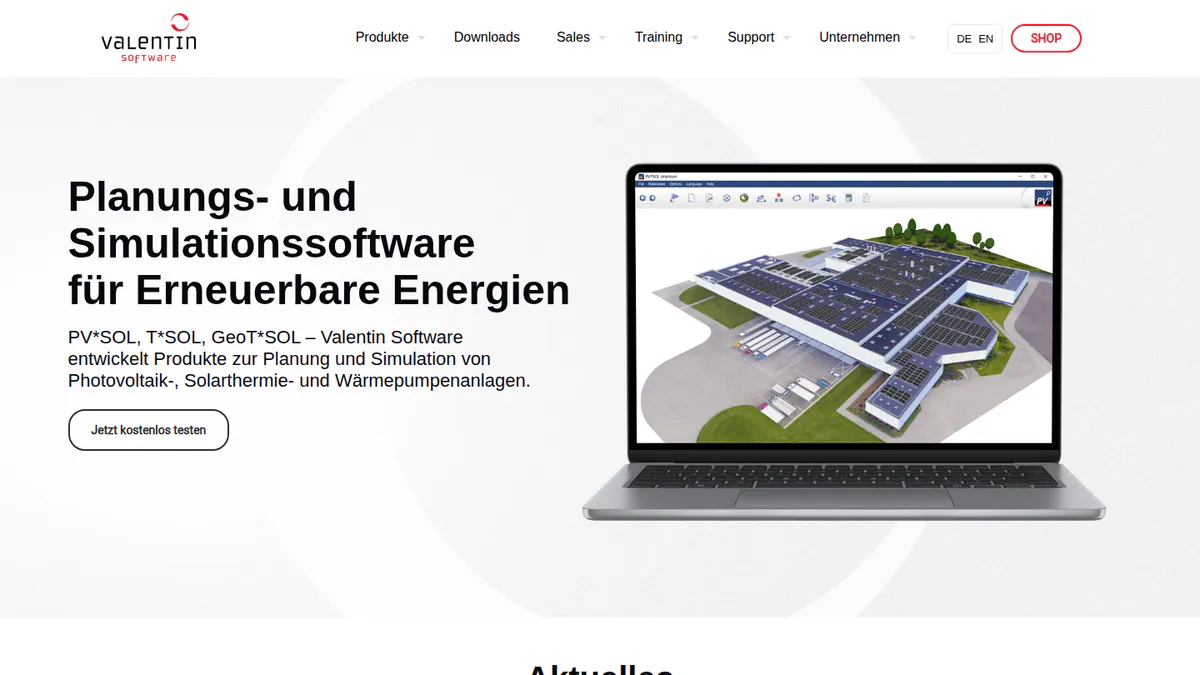
5. PV*SOL premium: best for European self-consumption with heat pumps and EVs
Best for: European installers and planners who sell batteries on self-use, where heat pumps and EV charging shape the load. Score: 62.8/100.
What it is: PV*SOL premium is a desktop 3D design and simulation tool from Valentin Software GmbH in Germany. It suits home and C&I systems. The 2026 version came out on 24 November 2025.
Why we picked it: It sizes batteries against heat pump and EV loads, which shape many European home loads now. Prices are public in euros, with a short-term option.
Key features:
- AC- and DC-coupled battery storage (two ways to wire a battery to solar).
- Heat pump and immersion heater links, with per-consumer tariffs for EVs and heat pumps and a load profile library.
- Yield runs with Meteonorm 9 climate data and 3D shade analysis.
- Customer report export (PDF, DOCX).
- JSON export of project and results for CRM or ERP.
Pricing: PV*SOL premium costs EUR 845 per year per named user, or EUR 285 for three months. The shop lists a licence extension at EUR 802.75. The 2D PV*SOL (not premium) costs EUR 585 per year. All prices are plus VAT. There is a 30-day trial. Checked October 2026 in the Valentin Software shop.
Pros (from reviews and our research):
- You can model battery, heat pump and EV loads in one run.
- You can buy three months for a busy season, at a public price.
- G2 users rate ease of use 8.2/10 (10 reviews).
Cons (from our research):
- It is desktop software, with no cloud teamwork in its docs.
- Its docs show no demand-charge, value-stacking or grid-services models.
- Each named user needs their own licence.
Reviews: G2 4.2/5 (12 reviews), checked October 2026.
Read our full PV*SOL premium review or our PV*SOL alternatives.
Want to see PV*SOL premium working? Book a demo with the SolarSoftwares team.
Book a demoYour request goes by email to the SolarSoftwares team. A time is set only after we reply. It does not change any score or ranking.
6. RatedPower: best for utility-scale PV plus BESS and standalone storage feasibility
Best for: Developers, EPCs and IPPs (independent power producers) testing utility-scale hybrid or storage-only projects. Score: 62.3/100.
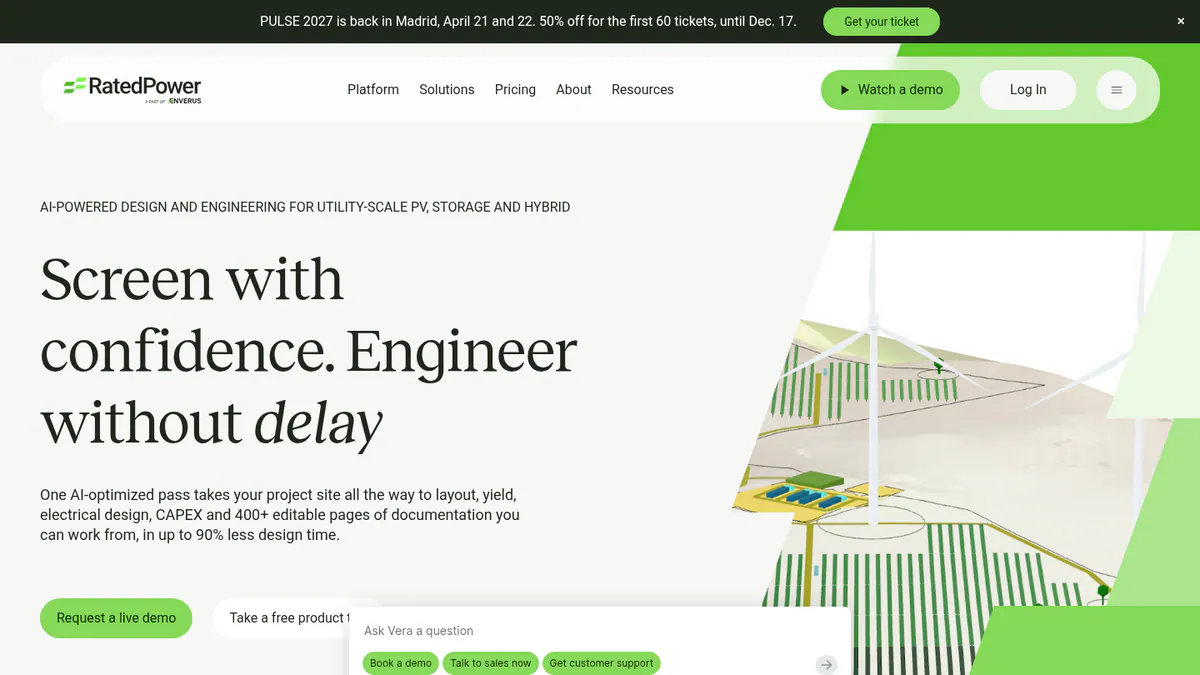
What it is: RatedPower, an Enverus company, makes a cloud tool for siting, layout, yield and electrical design of utility-scale plants.
Why we picked it: Hybrid and standalone storage come on every tier, at plant scale. It also has the largest review base on this page.
Key features:
- Hybrid and standalone storage on every tier, with BESS and hybrid design and dispatch runs.
- CAPEX and LCOE outputs.
- Power Analyst AI agent (an add-on) that builds design matrices and tunes KPIs (key performance indicators).
- Interconnection (grid hook-up) design and MV/LV (medium and low voltage) single-line diagrams.
- 400+ editable documents, such as BoQ (bill of quantities) and reports.
- DWG (AutoCAD drawing file) round-trip to AutoCAD, PVsyst-reconciled yield, and site screening in selected regions (Enterprise).
Pricing: Quote only, with Basic, Advanced and Enterprise tiers. Demo only. Checked October 2026 on the RatedPower pricing page.
Pros (from G2 review themes):
- Ease of use is the most cited strength (22 mentions).
- It saves time on feasibility layouts (18 mentions).
- Customer support gets praise (11 mentions).
Cons (from G2 review themes):
- Layout issues are the top complaint (14 mentions), though 11 reviewers praise the clear layout design.
- Some features are missing (8 mentions), such as some BESS-PCS (power conversion system) pairings.
- You get limited room to customise drawings.
Reviews: G2 4.4/5 (305 reviews), checked October 2026.
Read our full RatedPower review or our RatedPower alternatives.
Want to see RatedPower working? Book a demo with the SolarSoftwares team.
Book a demoYour request goes by email to the SolarSoftwares team. A time is set only after we reply. It does not change any score or ranking.
7. HOMER Grid: best for C&I demand-charge reduction and arbitrage
Best for: C&I developers and consultants proving a battery’s payback on demand charges, tariffs and EV charging loads. Score: 59.2/100.
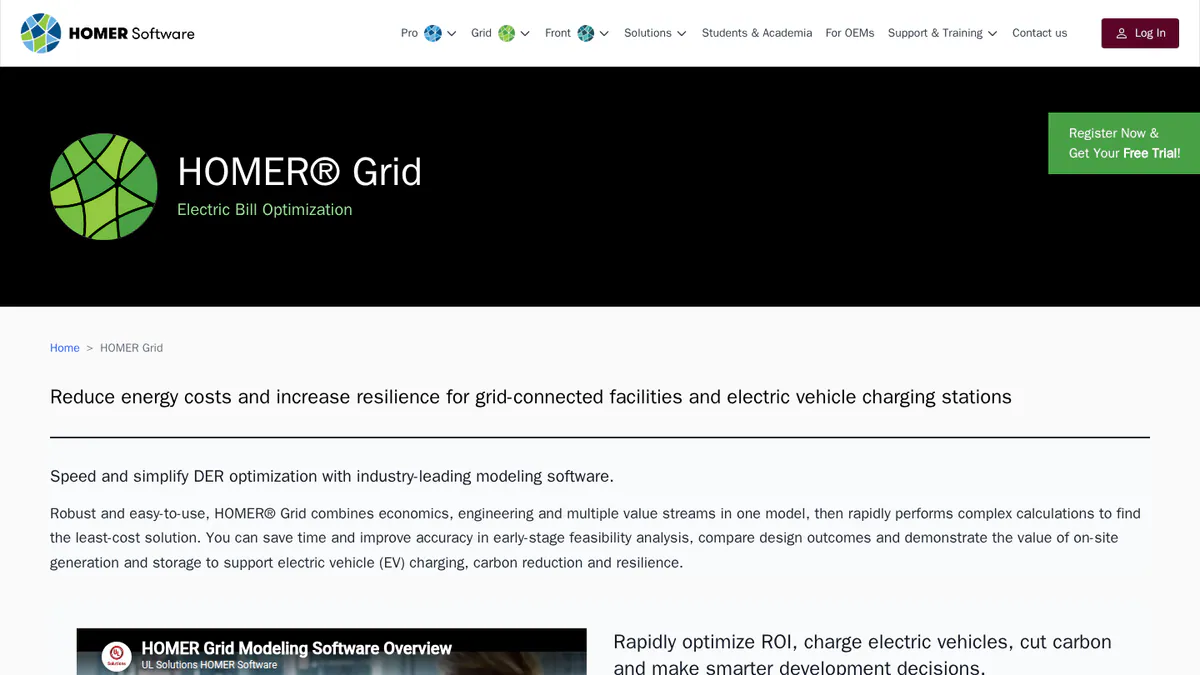
What it is: HOMER Grid is the behind-the-meter sibling of HOMER Pro, also from UL Solutions. It is built around grid-tied tariffs, not off-grid supply.
Why we picked it: Demand charges and tariffs are what most C&I battery deals turn on, and this tool is built for that maths. You can see the price and try it before you buy.
Key features:
- Storage and solar sizing to cut demand charges.
- Utility tariff models, with future tariff change scenarios.
- Arbitrage and peak-shaving dispatch.
- Runs many setups to find the least-cost one, with EV charging, outage backup and CHP.
- Custom client sales report.
- Network licences on Enterprise.
Pricing: Standard Annual costs 4,200 per year (350 per month), with 6 hours of live training. Standard Monthly costs 665 per month, and training costs 500. Enterprise is quote only. The page shows a dollar sign only, so we assume USD. Checked October 2026 on the HOMER Grid pricing page.
Pros (from our research):
- It sizes storage and solar to cut demand charges.
- A free trial lets you test it on a live deal first.
- It covers EV charging and outage backup in the same model.
Cons (from our research):
- No public user reviews exist to judge it by, and the only write-up we found is from 2019.
- Monthly billing costs 7,980 a year (USD assumed), nearly double the annual plan.
- On the monthly plan, training costs 500 extra.
Reviews: G2 lists HOMER Grid with no reviews, and we found no Capterra listing. Checked October 2026.
What we could not confirm: how often HOMER Grid ships updates, as we found no dated release notes for it.
Want to see HOMER Grid working? Book a demo with the SolarSoftwares team.
Book a demoYour request goes by email to the SolarSoftwares team. A time is set only after we reply. It does not change any score or ranking.
SurgePV (unscored): for readers comparing solar-plus-storage sizing and project economics. It is not a fleet dispatch or energy-trading platform. The numbered scores above do not include it.
Sources checked 27 October 2026: SurgePV product information · SolarSoftwares SurgePV review
Book a demo of SurgePV with the SolarSoftwares team.
Book a demoYour request goes by email to the SolarSoftwares team. A time is set only after we reply. It does not change any score or ranking.
How do the 7 battery storage tools compare?
Product | Main storage job | Tariff and demand charges | Dispatch modelling | Live control or monitoring | Segment | Starting price |
|---|---|---|---|---|---|---|
Residential savings proposals | Not documented beyond arbitrage | Backup, self-consumption, arbitrage | Not documented | Residential, light C&I | USD 159/user/mo | |
Microgrid optimisation | Tariffs, NEM 3.0, incentives | Multi-objective, multi-year | OPERATE controller (quote) | C&I, utility | 440/user/mo, annual (USD assumed) | |
C&I storage economics | 120,000+ tariffs, demand charges, NEM | Digital twin of ETB EMS | ETB Controller and Monitor | C&I, residential (US) | Quote only | |
Off-grid and hybrid sizing | Not the focus | Custom dispatch via MATLAB (Expert) | Not documented | C&I, utility, remote | 1,575/yr (USD assumed) | |
Self-consumption (Europe) | Per-consumer tariffs | AC/DC-coupled storage | Not documented | Residential, C&I | EUR 845/yr | |
Utility hybrid and standalone BESS | Not documented | BESS dispatch simulation | Not documented | Utility | Quote only | |
C&I demand charges | Tariffs incl. future changes | Peak shaving, arbitrage | Not documented | C&I | 4,200/yr (USD assumed) |
Also considered
- EG4 System Design Tools (scored 49.5/100): web-based sizing tools from battery and inverter maker EG4, such as a String Sizer for EG4 inverters. Not in the top 7 because they work only with EG4 hardware and show no tariff, savings or dispatch maths. We could not reach the tools site to confirm the suite or price.
- OpenSolar (below the minimum score): a free home design and proposal tool. Its storage features appear on sales pages only, with no tariff or dispatch maths. It is ranked on our storage design page.
- SolarEdge Designer (below the minimum score): a design and simulation tool built around SolarEdge gear. All we know comes from a 2018 press release and a 2020 trade article. We could not confirm its current storage features.
- Utility-scale BESS control platforms: Energy management and fleet analytics sold to asset owners and utilities. We did not research or score them for this installer page.
- Consumer battery calculators and sizing sheets: Left out because they do not model savings for a proposal.
How do you choose battery energy storage software?
- Selling US home batteries on backup and bill savings? Pick Aurora Premium.
- Building US commercial storage where the deal turns on demand charges, NEM or grid services? Shortlist Energy Toolbase and HOMER Grid. Pick Energy Toolbase if you also want a controller to run the modelled dispatch.
- For a microgrid that must island, compare Xendee (planning plus control) with HOMER Pro (cheaper, desktop, suits generator-heavy hybrids).
- In Europe, with heat pump or EV loads? Pick PV*SOL premium.
- For utility-scale PV plus storage or standalone BESS, pick RatedPower.
- Only install EG4 gear and need string checks? Use EG4’s own tools (also considered), and pair them with one of the above for savings.
- If you need battery placement, wiring and layout, use our storage design ranking and the battery design feature guide. For off-grid layout, see off-grid solar design software.
- To enrol customer batteries in grid programmes after install, see our VPP software for solar installers. For project-finance models beyond storage, see solar financial modelling software.
Want more choices? Browse every tool we checked in our storage and microgrid category.
Battery energy storage software FAQs
What software is used to design a solar + battery system?
You use a PV design tool for layout and wiring. Our storage design ranking covers 14 of them. For savings, Aurora’s Premium plan (USD 259 per user per month, checked October 2026) models backup, self-use and arbitrage. PV*SOL premium models AC- and DC-coupled batteries.
How do you size a battery for a solar system?
Size a battery from the site’s load data, the tariff and your goal. Then run several sizes and compare payback. HOMER Grid and HOMER Pro run many setups for you and rank them by cost. HOMER Pro 3.18.5 (August 2026) also models battery wear.
What is the difference between a BESS energy management system and battery design software?
An energy management system decides, live, when a battery charges and discharges. Design and savings software tests that behaviour before the sale. Energy Toolbase links the two. ETB Developer models the dispatch, and ETB Controller packages (100 to 5,000 kWh, checked October 2026) run it on site.
Can solar design software model battery storage and backup?
Yes, many can. Aurora models backup, self-use and arbitrage on Premium. PV*SOL premium handles AC- and DC-coupled storage. RatedPower covers hybrid and standalone storage at utility scale. As of October 2026, none of these shows demand-charge value stacking the way Energy Toolbase and HOMER Grid do.
How do you model battery savings under time-of-use tariffs?
Load the right tariff, run dispatch hour by hour against the customer’s load, then compare bills with and without storage. Energy Toolbase tracks 120,000+ utility tariffs with NEM and TOU (time-of-use) models. HOMER Grid can model future tariff changes, and Xendee has NEM 3.0 (all checked October 2026).
Does battery storage software model degradation?
Yes, some do. HOMER Pro added storage degradation tables and battery augmentation in version 3.18.5 (28 August 2026). Energy Toolbase takes PV and battery degradation inputs. We found no degradation docs for the other tools on this page.
Sources
All checked 22 to 24 October 2026.
- Aurora Solar: pricing, G2, Capterra
- Xendee: pricing, product overview, Eaton release, September 2025, G2
- Energy Toolbase: pricing, ETB Developer, grid services release
- HOMER Pro: pricing, releases, Capterra
- PV*SOL premium: shop, 2026 release, G2
- RatedPower: pricing, feature comparison, G2
- HOMER Grid: pricing, demand charges, G2
- EG4: String Sizer article, third-party help page
- OpenSolar: features. SolarEdge Designer: 2018 press release, 2020 trade article
Last updated 28 October 2026. Next scheduled review: 23 January 2027.