Key takeaways
- DoD means two things: how deep one cycle goes, and the most a battery may be discharged.
- A Sunsynk L3.0 datasheet lists 3.07 kWh, a recommended DoD of 90% and 2.76 kWh usable. The math is 3.07 × 0.90 = 2.76 kWh.
- Only Sunsynk’s sheet gives a DoD, so use each sheet’s usable kWh.
- Throughput caps and cycle counts are different promises, so compare them in kWh.
- In our example, one 9.0 kWh cycle a day hits the 10-year term before the 35 MWh cap. Two a day hit the cap in 5.33 years.
To size a battery from usable kWh in software, see the best solar battery storage design software.
Depth of discharge at a glance
DoD is a percentage of capacity. A sheet may use it for a cycle’s depth or for a limit, so the basis matters.
| Item | Detail |
|---|---|
| Formulas | DoD of a cycle = energy discharged ÷ capacity. Usable kWh = nominal kWh × DoD limit. OpenSolar’s help page states the second one. |
| Unit and range | Percent. Limits found: 90% (Sunsynk L3.0), "usually" 90% to 95% for lithium-ion (SolarQuotes) and "Typically 80 or 90%" (Easy-PV help). |
| Where it matters | Quoted kWh, backup hours, cycle-life claims and warranty checks. |
| Standard or rule | No standard text is cited. The Sandia and PNNL protocol defines the time between state-of-charge limits. The part cited here does not define DoD. |
| In software | Storage models that apply a DoD limit or use depth to model wear. See the software table. |
Why does depth of discharge matter for installers?
It sets how many of the quoted kWh a customer can draw. It can also change how long a warranty lasts.
A proposal that quotes nominal kWh as delivered kWh overstates the battery. Size from usable kWh. The steps are on the battery storage design page. Conversion losses come on top, under round-trip efficiency. The limit sits in the battery pack. To see where the inverter fits, read solar-plus-storage and hybrid inverters. A lower limit needs more nominal kWh. A throughput cap can end cover early for heavy users.
What is the difference between DoD, usable capacity and nominal capacity?
Nominal capacity is the rated kWh. Usable capacity is the part you may draw. The DoD limit links them: usable = nominal × limit.
- Depth of a cycle: Energy Toolbase’s glossary says it is "The percentage of a battery’s capacity that has been used relative to its full capacity". The NLR (formerly NREL) SAM webinar Q&A says "A full cycle is not necessarily a full 100% DOD, but depends on the range of the cycle".
- A limit: SolarQuotes defines DoD as "how much of the total capacity of a battery, expressed as a percentage, is useable". OpenSolar says "A battery can never discharge more than its maximum DOD". Easy-PV’s help says "Usable capacity may be less if there is a max permitted discharge depth".
- Not state of charge: that is the level at one moment. A cycle from 100% to 40% is 60% DoD by our math, if both use one capacity base.
Table 1. Capacity figures in four documents, with our math.
| Document | What it prints | DoD stated? | Our math |
|---|---|---|---|
| Sunsynk L3.0 datasheet, v.7 | Energy 3.07 kWh. "Usable Energy [1] 2.76 kWh", DC, tested at 90% DoD and 0.5C at 25°C. | Yes: "Recommend Depth of Discharge 90%" | 3.07 × 0.90 = 2.763 kWh, which rounds to the printed 2.76. |
| RoyPow PowerHome 5.1 kWh sheet | Nominal 5.12 kWh, usable 4.79 kWh. The same ratio holds for all eight pack sizes. | No | 4.79 ÷ 5.12 = 93.6% usable share. |
| Enphase IQ Battery 5P, Australian store page | "total usable energy capacity of 5.0 kWh". | No | No nominal figure on the page, so no share. |
| Tesla Powerwall Limited Warranty (USA), Rev. 1.0 | "energy capacity of 13.5 kWh", expressed as rated capacity. | No, and usable is not mentioned | Not stated |
Not stated means the document or page we cite does not say. Sunsynk’s usable figure is DC energy at one test point and may vary with setup.
How do DoD, cycle life and throughput warranties connect?
Deeper cycles are linked to a shorter life, so makers quote cycle life at a stated depth. A warranty may add a kWh cap. These are separate promises, so compare them in kWh.
PVsyst’s ageing page says "Datasheets usually specify a maximum number of cycles, for a specified depth of discharge (DOD)". It adds "a higher depth of discharge reduces the battery lifetime". The NLR (formerly NREL) SAM webinar Q&A says "You can limit the depth-of-discharge (DoD) to prolong battery life". The NLR (formerly NREL) BLAST page lists "Cycle depth and frequency" among lifetime factors. None gives an effect size for all products, so use the maker’s cycle table.
Table 2. What four documents promise, and throughput divided by the capacity each prints. Tesla and FranklinWH print rated capacity. Sunsynk prints usable.
| Document | Term and retention | Throughput ÷ printed capacity | DoD in the document? |
|---|---|---|---|
| Tesla Powerwall Limited Warranty (USA), Rev. 1.0 (Powerwall 2, Powerwall+ and Powerwall 3) | 10 years. 70% of 13.5 kWh at 10 years. | 37,800 ÷ 13.5 = 2,800 | No |
| FranklinWH limited warranty, aPower 2 | 15 years. Not less than 70% of 15 kWh, rated at 77°F and 3 kW. | 60,000 ÷ 15 = 4,000 | No |
| Enphase IQ Battery 5P, Australian store page | "15-year limited warranty up to 6,000 cycles". Full terms are on a linked page. | Not stated | No |
| Sunsynk L3.0 datasheet, v.7 | Years not stated on the sheet. 70% end of life. | 10,000 ÷ 2.76 = 3,623 (usable, not nominal) | Yes: 90% in the cycle test |
Tesla’s cap is measured at the AC output, while Sunsynk’s usable figure is DC, so the ratios are not like for like. The cycle or throughput limit in each document is listed below.
- Tesla: "Unlimited cycles" for solar self-consumption, time-based control and backup. "37.8 MWh of aggregate throughput" for other uses, "Measured at the battery AC output."
- FranklinWH: "the aggregate energy throughput reached 60 MWh, whichever comes first".
- Enphase: Cycle count only. No cycle definition on the page.
- Sunsynk: "Cycle Life ≥6000 (25±2ºC, 90%DOD, 0.5C/0.5C, 70%EOL)". Warranty energy "10MWh@70%EOL", whichever comes first.
Tesla’s cap applies to uses its table does not list. Sunsynk’s rows differ: 6,000 cycles × 2.76 kWh is 16,560 kWh, and 10,000 kWh is 60.4% of that. The sheet does not say which one rules, so ask the maker.
Cycle counts vary. PVsyst’s page says "A cycle is always defined as a complete charge and discharge of the battery", and gives a formula based on capacity. SAM counts cycles with a rainflow algorithm when one DoD is given. Read the warranty’s own definition.
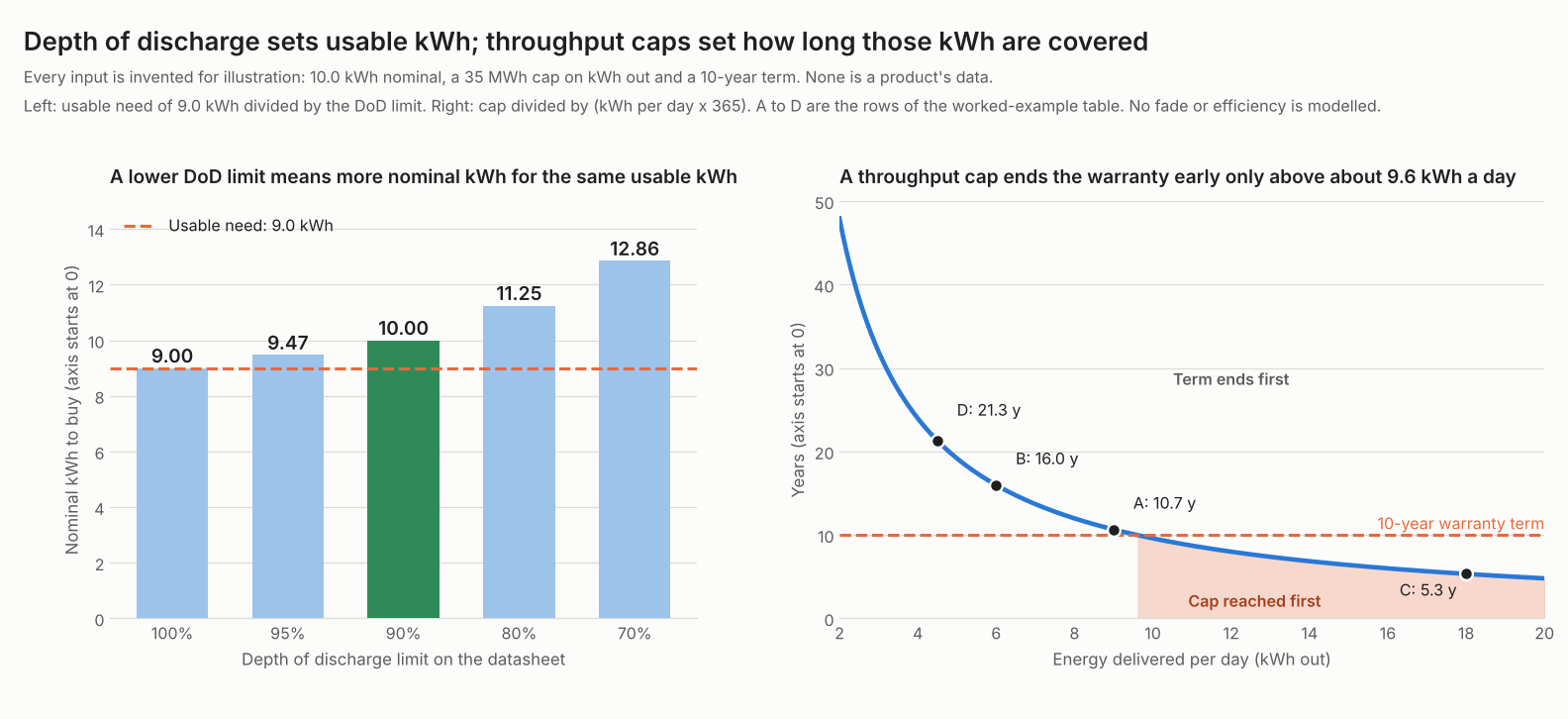
Figure 1. In an example, a 90% limit needs 10.00 kWh nominal for 9.0 kWh usable. A 35 MWh cap binds only above about 9.6 kWh a day.
How to calculate usable kWh and warranty years
Apply the limit, then compare each cap with the term. The smallest number of years runs out first.
- Read nominal kWh, the DoD limit (or usable kWh) and the basis: AC or DC, and test conditions.
- Usable kWh = nominal kWh × DoD limit. If the sheet gives usable kWh, the share is usable ÷ nominal.
- To size, nominal kWh needed = usable kWh needed ÷ DoD limit. Round up to whole modules.
- Energy out per year = daily kWh out × 365.
- Years to a throughput cap = cap in kWh ÷ energy out per year. Years to a cycle cap = cycles ÷ (daily kWh out ÷ usable kWh × 365).
- Compare with the warranty term. Check how it counts a cycle and where it measures kWh.
Worked example: a 10 kWh battery, four daily patterns
All inputs are example. The battery is 10.0 kWh nominal with a 90% DoD limit, so 9.0 kWh is usable. The warranty is 10 years or 35 MWh of energy out, whichever comes first. The model has no fade, efficiency or reserve.
Table 3. Years until the cap, by daily pattern. Rows run from least to most kWh out a day. The letters are labels only.
| Pattern | Cycles × depth of nominal | kWh out a day and a year | Years to 35 MWh | Reached first, and kWh out by then |
|---|---|---|---|---|
| D | 1 × 45% | 4.5 and 1,642.5 | 21.31 | 10-year term, 16,425 |
| B | 1 × 60% | 6.0 and 2,190.0 | 15.98 | 10-year term, 21,900 |
| A | 1 × 90% | 9.0 and 3,285.0 | 10.65 | 10-year term, 32,850 |
| C | 2 × 90% | 18.0 and 6,570.0 | 5.33 | 35 MWh cap, 35,000 |
Pattern A stops 2,150 kWh short of the cap, 6.1% headroom. The cap binds above 35,000 ÷ (10 × 365) = 9.59 kWh a day.
Here are the same sums on two real caps, as full-capacity daily use (our math, not typical use). A Powerwall that delivers 13.5 kWh a day reaches 37.8 MWh in 7.67 years, if the cap applied. An aPower 2 that delivers 15 kWh a day reaches 60 MWh in 10.96 years, inside its 15-year term.
Depth of discharge calculator
Enter nominal kWh, a DoD limit, daily kWh out and any caps.
How solar software handles depth of discharge
Of the six tools we checked, three say they apply a DoD limit or model wear from depth. Two do so in part, and Aurora’s page never mentions DoD. "Yes" means the company’s page says the tool does it.
| Software | Does it use DoD in usable capacity or battery wear? | Method |
|---|---|---|
| SAM | Yes | Modelled |
| PVsyst | Yes (ageing) | Modelled, hourly |
| OpenSolar | Yes | Modelled |
| Energy Toolbase | Partly | Modelled |
| Aurora Solar | Not stated | Modelled |
| Easy-PV | Partly | Modelled |
Partly means the page names the input but does not explain its effect.
What each page says, with notes:
- SAM: Battery Life page: with several DOD values, "SAM uses bilinear interpolation to consider both the average depth-of-discharge and cycle number". SAM help, Battery Life, undated. No usable-capacity input on this page.
- PVsyst: Battery ageing page: cycling ageing depends on "the number of charge/discharge cycles and the depth of discharge in each cycle". PVsyst help, undated (names version 8.1.4). Covers ageing, not a DoD limit.
- OpenSolar: Usable capacity "is given by the total capacity of the battery multiplied by its maximum depth of discharge (DOD)". OpenSolar support page, updated May 07, 2026 as printed.
- Energy Toolbase: The Storage Capacity Optimizer page lists "Max Depth of Discharge" among variables each simulation references, with "Discharge Efficiency". The effect is not explained. ETB help, undated.
- Aurora Solar: Backup Duration Calculations lists "The storage design’s battery usable capacity" as an input and stops at the "minimum state of charge". The page never mentions DoD. Aurora help, undated. Rated for DoD only. Other pages rate Aurora on storage modelling.
- Easy-PV: Custom battery page: "Max Discharge: maximum depth to which the manufacturer recommends that this battery is discharged. Typically 80 or 90%". Easy-PV help, Revision #2, undated. Describes the input, not its effect.
The best solar battery storage design software list covers storage sizing and modelling tools.
Common mistakes with depth of discharge
FAQs
What DoD does a solar battery have?
It varies by product: SolarQuotes says a lithium-ion DoD is usually 90% to 95%, and Easy-PV’s help says "Typically 80 or 90%". Sunsynk’s L3.0 sheet lists 90%, so read the datasheet.
Does discharging deeper shorten battery life?
Yes, in the sources listed. PVsyst and the SAM webinar answer both say so. The size depends on the product. A lower limit also costs usable kWh. In example Figure 1, 80% needs 11.25 kWh nominal against 10.00 kWh at 90%.
How do you work out usable kWh?
Multiply nominal kWh by the DoD limit, or read usable kWh from the datasheet. To size a battery, divide the usable kWh you need by the DoD limit and round up to whole modules. Check whether the figure is AC or DC.
Is depth of discharge the same as state of charge?
No. State of charge is the level at one moment, and DoD is how much has been used. See state of charge for how the level is found.
Related terms
- State of charge: the battery’s level at one moment, as a percentage.
- Battery cycle life: the number of cycles a battery is rated for.
- C-rate: charge or discharge power relative to capacity.
- Battery storage design: choosing kWh and kW for a stated goal.
- LFP battery: a lithium-ion cell with an iron-phosphate electrode.
Next step: size your next battery on usable kWh using the best solar battery storage design software. For dispatch, see the best battery energy storage software.
Sources
All pages were checked in October 2026. The SolarQuotes and Easy-PV quotes were re-opened on 30 October 2026. Dates are as printed.
- Energy Toolbase: depth of discharge glossary, last modified 31 December 2025 (page metadata).
- SolarQuotes: battery capacity jargon, 28 July 2025.
- OpenSolar: How OpenSolar Models Battery Energy Storage, updated 7 May 2026.
- Easy-PV help: custom battery, Revision #2, undated.
- SAM help: Battery Life, undated.
- NLR (formerly NREL) SAM webinar: behind-the-meter battery Q&A, 3 September 2020.
- NLR (formerly NREL): BLAST battery lifetime tool suite, undated (checked November 2026).
- PVsyst help: battery ageing, undated.
- Energy Toolbase help: Storage Capacity Optimizer, undated.
- Aurora help: Backup Duration Calculations, undated.
- Sandia and PNNL protocol, SAND2013-7084, August 2013.
- Tesla: Powerwall Limited Warranty (USA), Rev. 1.0, effective 21 August 2023.
- FranklinWH: limited warranty for end users, no effective date or version is printed. The page showed the viewing date (28 October 2026).
- Enphase Australia: IQ Battery 5P store page, undated.
- Sunsynk L3.0 datasheet v.7, 10/24/23, copy hosted by Bimble Solar.
- RoyPow: RBmax5.1L/L2 datasheet, no version or date (checked November 2026, URL updated after the old link stopped resolving).
Last updated 3 November 2026. Next scheduled review: 3 February 2027.