Key takeaways
- "Cycle" is not one rule. Sonnen’s warranty adds partial charges and discharges up to a full cycle. TBB’s counts discharge of nominal capacity. Enphase’s Australian warranty says "discharged cycles" and does not define them.
- A cycle limit becomes years only with a daily rate. Sonnen’s 10,000 cycles in 10 years is 2.74 cycles a day. Enphase’s 6,000 in 15 years is 1.10 a day.
- Two datasheets read (BSL and EPEVER) print their cycle count at a stated depth, rate and temperature. Neither prints an end-of-life level on the page read.
- On one example day, the three simple counts give 0.81 to 1.00 cycles, so a 6,000-cycle cap would last 16.4 to 20.3 years. That is an example, not a real range.
- Counting every swing (rainflow cycles, or each discharge period) would cut that to 5.5 years. No document read uses those two rules. They are bounds.
To see how storage design tools age a battery, see best solar battery storage design software.
Battery cycle life at a glance
Cycle life is a count with conditions attached. Read the end-of-life level, depth, current rate and temperature with it.
| Item | Detail |
|---|---|
| Formula | Years to a cycle cap = cap ÷ (cycles per day × 365). Cycles per day = energy out per day ÷ the capacity the rule uses. |
| Unit and range | Cycles. CSIRO’s Table 3 lists 3,000 to 6,000 cycles for lithium iron phosphate. |
| Standard or rule | No standard text is cited here. Each maker states its own end-of-life level and counting rule. |
| In software | Storage models count cycles or throughput to age the battery. See the software table. |
Why does battery cycle life matter for installers?
It decides when a warranty can end early. A proposal that quotes only "10 years" can hide a cycle or kWh cap. Convert the cap to cycles a day and compare it with the customer’s load. Usable kWh and kWh caps sit on the depth of discharge page. This page covers how a cycle is defined and counted. See also peak shaving.
What counts as one cycle, or an equivalent full cycle?
There is no single rule. A cycle may be a full charge and discharge, partial swings added up, or a count of swings by depth.
twaice’s battery encyclopedia says the equivalent full cycle (EFC) classifies "any cycle or any charge or discharge in terms of the charge throughput of a full cycle". Its example: 50% to 100% state of charge and back to 50% is 0.5 EFC. Rainflow counting is a different method. Shi et al. (2017) say it takes a state-of-charge series and finds "the depth of all cycles contained in this series". SAM and HOMER Pro document it.
Table 1. How five documents define or count a cycle.
| Document | What it says | Capacity basis and partial cycles |
|---|---|---|
| Sonnen Australia warranty, May 2022, clause 1.1(b) | A "Complete Recharge Cycle" is a full charge and a full discharge, or "partial charges and partial discharges" that together "constitute a full charge and a full discharge". | Basis not stated. Partial swings are added up. |
| TBB warranty V1.2, section 3.2 | "A full cycle is defined as the discharge of the nominal capacity of a fully charged battery followed by a full recharge." "Micro cycles aggregate into full cycles based on the amount of energy charged and discharged." | Nominal capacity. Partial swings are added up. |
| Enphase Australian warranty, effective 25 June 2024 | Cover ends at the earlier of 15 years or "6,000 discharged cycles". The document does not define the term. | Not stated. |
| PVsyst help, battery ageing | "A cycle is always defined as a complete charge and discharge of the battery". | Reference capacity times state of health. |
| HOMER Pro 3.16 manual | Throughput is "the change in energy level of the storage bank, measured after charging losses" and before discharging losses. It sets life "regardless of the depth of the individual charge-discharge cycles". | Energy, not cycles, in that mode. |
Sonnen and Enphase print no capacity basis, so "full" could mean nominal or usable. TBB says nominal. With 10.0 kWh nominal and 9.0 kWh usable (example), 8.1 kWh out is 0.81 cycles on one basis and 0.90 on the other.
How do datasheets and warranties state cycle limits?
Datasheets give a test result at a stated depth, rate and temperature. Warranties give a cap. In the Sonnen and Enphase warranties, cover ends at the earlier of a term and a cycle cap. SolarEdge and TBB differ.
Table 2a. Warranty comparison, part 1: two cycle-capped warranties, with our arithmetic. Cycles per day is the rate at which the cap and the term meet.
| Document | Term and limit | End of life | Our arithmetic |
|---|---|---|---|
| Sonnen Australia warranty, May 2022 | 10 years or "10,000 Complete Recharge Cycles", whichever is first. | Not below 80% of nominal capacity. | 10,000 ÷ (10 × 365) = 2.74 cycles a day. |
| Enphase Australian warranty, IQ Battery 5P, effective 25 June 2024 | Earlier of 15 years or 6,000 discharged cycles. | At least 70% of nameplate at 10 years and 60% at 15 years. | 6,000 ÷ (15 × 365) = 1.10 cycles a day. |
Sonnen’s cap binds only above 2.74 cycles a day. A home cycling once a day reaches the term first. Enphase’s binds above 1.10. End-of-life levels differ: Sonnen 80%, Enphase 70% at 10 years, TBB 75%.
Table 2b. Warranty comparison, part 2: two warranties with no simple cycle cap.
| Document | Term and limit | End of life | Our arithmetic |
|---|---|---|---|
| SolarEdge Home Battery 400V warranty, North America, May 2025 | 10 years. "Unlimited cycles" for standard solar use. For third-party management, "a maximum energy throughput of 26MWh". | 70% at the end of the term. | None shown: battery kWh not printed. |
| TBB warranty V1.2, orders from 1 October 2023 | 7 years, or 10 if registered within six months and kept online. Covers "1 full cycle per day". | At least 75% of nominal energy. | 15,800 ÷ 5.04 = 3,135 full cycles, against 3,650 for one a day over 10 years. |
Not stated means the document or page we cite does not say. SolarEdge prints neither the battery’s kWh nor how throughput is measured, so we show no arithmetic for it. TBB’s Section 4.1 has a "Minimum Energy Through Output" column (text: "Minimum Through Output Energy"): 15.8 MWh for 5.04 kWh modules, 31.6 MWh for 10.08 kWh.
Table 2c. Datasheets for comparison: two test results, with our arithmetic.
| Document | Test result | End of life | Our arithmetic |
|---|---|---|---|
| BSL ECO 10.0 Plus datasheet, undated | At least 6,000 cycles at 80% depth of discharge, 0.5C, 25°C. Warranty 10 years. 10.24 kWh nominal. | Not stated | 10.24 × 0.80 × 6,000 = 49,152 kWh, if 80% applies to nominal. |
| EPEVER LFP3.84KWH25.6V-P65L2 datasheet, undated | More than 6,000 cycles at 80% depth of discharge, 25°C, 0.5C. 3.84 kWh. No warranty on the page. | Not stated | 3.84 × 0.80 × 6,000 = 18,432 kWh, on the same assumption. |
TBB’s table gives 15.8 MWh for a 5.04 kWh module, which is 3,135 full cycles. One cycle a day for ten years is 3,650. The text read does not link the two.
Conditions matter. CSIRO’s Batteries for Homes (2021) says total cycles are referenced to specific C-rates. See C-rate and LFP batteries.
How do you turn a cycle limit into years?
Divide the cap by cycles used per year, then compare with the term. The smaller number of years ends cover first.
- Read the cap, the term and the end-of-life level.
- Find the capacity the maker’s cycle uses: nominal, usable or reference.
- Cycles per day = energy out per day ÷ that capacity.
- Years to the cap = cap ÷ (cycles per day × 365).
- The cap and term meet at cap ÷ (term × 365) cycles a day.
- If the document does not define a cycle, ask the maker before you promise years.
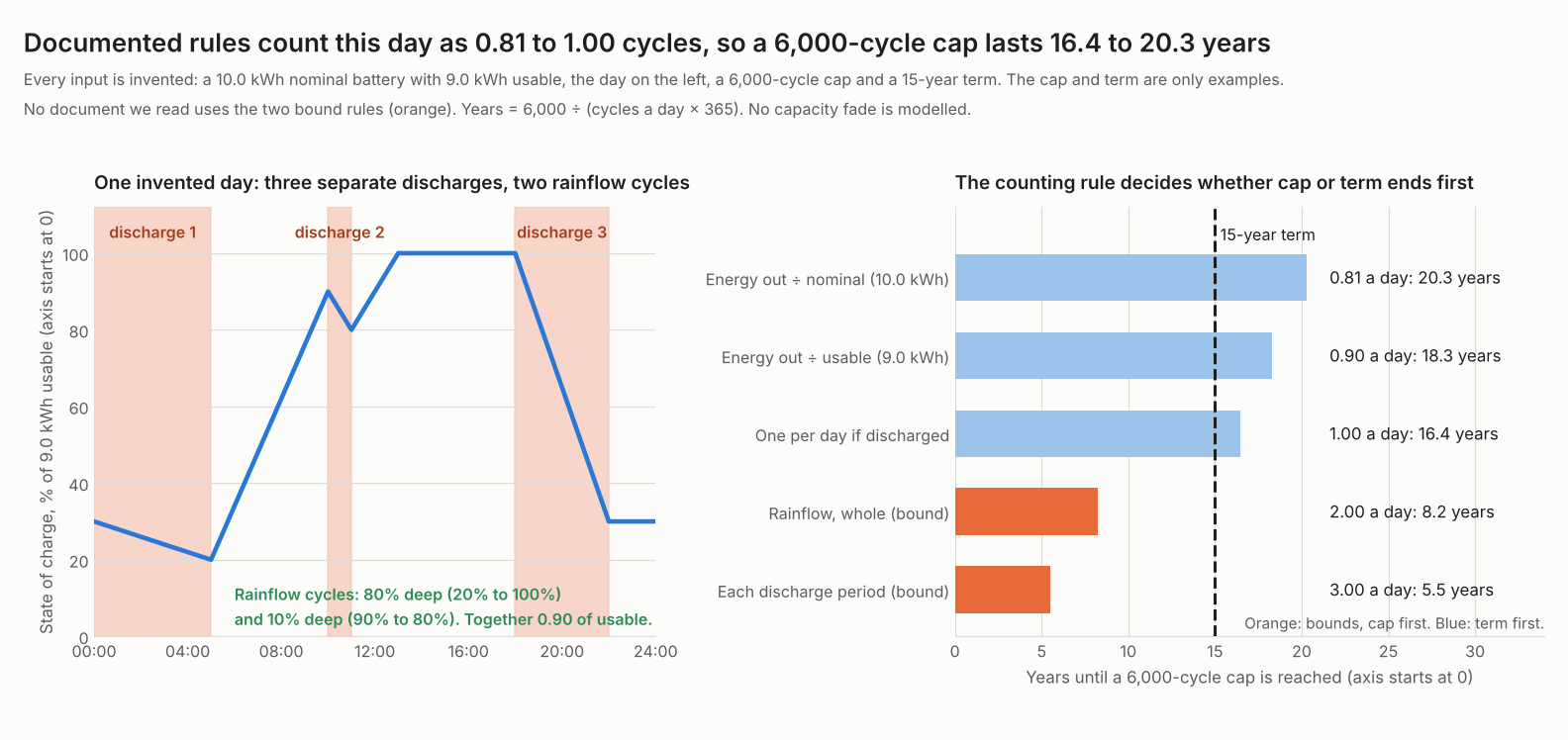
Figure 1. On one example day, the three simple counts give 0.81 to 1.00 cycles, so a 6,000-cycle cap lasts 16.4 to 20.3 years. The 2.00 and 3.00 counts are bounds.
Worked example: one example day, five counts
All inputs are example. The battery is 10.0 kWh nominal with 9.0 kWh usable. State of charge is read hourly as a percentage of usable energy and repeats each day. The cap is 6,000 cycles and the term is 15 years. These are Enphase’s Australian figures used as an example, not its counting rule. No fade or efficiency is modelled.
The battery discharges 8.1 kWh in three periods: 30% to 20% overnight, 90% to 80% at midday, and 100% to 30% at night.
Table 3. The same day under five rules, against a 6,000-cycle cap and a 15-year term.
| Rule | Cycles a day | Cycles a year | Years to 6,000 | Reached first |
|---|---|---|---|---|
| Energy out ÷ nominal (10.0 kWh), as in TBB’s wording | 0.81 | 295.65 | 20.29 | 15-year term |
| Energy out ÷ usable (9.0 kWh) | 0.90 | 328.50 | 18.26 | 15-year term |
| One per day if discharged (simple count, no document read) | 1.00 | 365.00 | 16.44 | 15-year term |
| Rainflow cycles, 80% and 10% deep, counted whole | 2.00 | 730.00 | 8.22 | Cycle cap |
| Each separate discharge period | 3.00 | 1,095.00 | 5.48 | Cycle cap |
No document read uses the rainflow or discharge-period rows. They are bounds. Rainflow finds an 80% cycle (20% to 100%) and a 10% cycle (90% to 80%). Weighted by depth they add to 0.90 of usable, the same energy as row two. A 6,000-cycle cap meets a 15-year term at 1.10 cycles a day.
Battery cycle life calculator
Convert a cap to years, or paste a day of readings to count it four ways. Start the list where the battery is not discharging.
How solar software handles battery cycle life
"Yes" means the company’s page says the tool counts cycles or throughput. SAM and PVsyst count cycles. HOMER Pro counts throughput and equivalent cycles. OpenSolar counts throughput, not cycles. Energy Toolbase lists a degradation rate only.
| Software | Counts cycles or throughput to age the battery? | Method | Notes |
|---|---|---|---|
| SAM | Yes | Modelled | SAM help, undated. Calendar degradation is also described. |
| PVsyst | Yes | Modelled, hourly | PVsyst help, undated. |
| HOMER Pro | Yes | Modelled | HOMER Pro 3.16 manual, no date printed. |
| OpenSolar | Yes (throughput, not cycles) | Modelled | OpenSolar support page, updated 7 May 2026 as printed. It does not mention cycles. |
| Energy Toolbase | Not stated | Modelled | ETB help, undated. |
What each page says:
- SAM. Battery Life page: "SAM only considers the cycle number in the capacity fade calculation using a rainflow counting algorithm" when one depth value is given.
- PVsyst. Battery ageing page: "A cycle is always defined as a complete charge and discharge of the battery". Calendar ageing is a separate effect.
- HOMER Pro. Lifetime throughput page: storage is replaced after "a fixed amount of energy cycles through the storage". Storage outputs list "Equivalent Cycles" computed with rainflow counting, for the Modified Kinetic Battery model only.
- OpenSolar. "OpenSolar keeps track of the kWh throughput of the battery, which is used for calculating the degradation of the battery."
- Energy Toolbase. The Storage Capacity Optimizer page lists "Battery Degradation Rate" among variables. It does not mention cycles or throughput.
Ranked options are in best solar battery storage design software.
Common mistakes with battery cycle life
FAQs
How many cycles does a solar battery last?
About 3,000 to 6,000 cycles for lithium iron phosphate at a stated depth and rate, according to CSIRO’s 2021 table. Two datasheets give about 6,000 at 80% depth of discharge. Two Australian warranties cap cycles at 6,000 (Enphase) and 10,000 (Sonnen).
Does a half discharge count as one cycle?
No. Sonnen and TBB add partial swings until they total one full cycle. twaice’s example counts 50% to 100% and back as 0.5 equivalent full cycle. Enphase’s Australian warranty does not define the term.
Is cycle life the same as battery lifespan?
No. Cycle life counts use. Lifespan also includes age. Sonnen and Enphase end cover at the earlier of a term or a cycle cap. PVsyst triggers replacement at a maximum calendar lifetime.
Do C-rate and temperature change cycle life?
Yes. Cycle ratings are quoted at a stated rate and temperature. An example is about 6,000 cycles at 80% depth of discharge, 0.5C and 25°C on the BSL and EPEVER sheets. CSIRO says faster charging and discharging lowers the cycle number, and high temperatures shorten life. Compare cycles only on the same basis.
Related terms
- Depth of discharge: the share of capacity used, with usable kWh and throughput caps.
- State of charge: the battery’s level at one moment.
- C-rate: charge or discharge power relative to capacity.
- Solar-plus-storage: battery operating modes and what each does to cycling.
- Battery management system, BESS, battery storage design and round-trip efficiency: related storage terms.
Next step: convert the warranty cap to cycles a day with the calculator above. Then see which tools age a battery in the best solar battery storage design software list, or the best battery energy storage software list.
Sources
All pages were checked in October 2026.
- Sonnen Australia, Manufacturer’s Warranty, sonnenBatterie, May 2022.
- Enphase, Limited Warranty, IQ Battery 5P and SC (Australia), effective 25 June 2024. Copy hosted by SolarQuotes.
- SolarEdge, Home Battery 400V warranty, North America, revised May 2025.
- TBB Renewable, Lithium Battery Limited Warranty V1.2, for orders from 1 October 2023. Copy hosted on a retailer’s CDN.
- BSL ECO 10.0 Plus datasheet and EPEVER LFP3.84KWH25.6V-P65L2 datasheet, both undated.
- CSIRO, Batteries for Homes, Building Technology Resources, 2021. Checked 30 October 2026.
- twaice battery encyclopedia: cycle, no date shown.
- Shi et al., A Convex Cycle-based Degradation Model, arXiv v2, 5 April 2017.
- SAM help: Battery Life (NLR, formerly NREL), undated.
- PVsyst help: battery ageing, undated.
- HOMER Pro 3.16 manual: lifetime throughput, battery throughput and storage outputs, no date shown.
- OpenSolar: How OpenSolar Models Battery Energy Storage, updated 7 May 2026.
- Energy Toolbase help: Storage Capacity Optimizer, undated.
Last updated 30 October 2026. Next scheduled review: 30 January 2027.