Key takeaways
- Three California checklists (Torrance, Butte County, Dublin) print 600 V DC and put the switch at or within sight of the inverter. Their lockable wording is for the AC disconnect.
- Many inverters build the switch in. UK guide RC62 (2023, commercial roofs) says to eliminate separate DC isolators wherever possible for that reason.
- In an invented check, 13 modules give 583 V at a -10 °C design low, under a 600 V switch, while 14 modules give 628 V, over it.
- Two example parallel strings draw 34.8 A, which fits an example 40 A switch but not 32 A.
- Solargraf documents adding a DC disconnect to the diagram. Aurora Solar and SolarAPP+ are partial, and none of the three pages explains a rating check.
To draw the DC disconnect on a plan set, see the best solar SLD software list.
DC disconnect at a glance
A DC disconnect lets a person open the DC side for service or in an emergency. It sits between the array and the inverter, or on a battery.
| Item | Detail |
|---|---|
| What it is | A manual switch on the DC circuit. Makers also say "DC load-break switch" (SMA) or "DC Safety Unit" (SolarEdge). US checklists say "DC disconnect" and UK guides say "isolator". |
| Where it sits | At the inverter, built in or in a separate box. Some AHJs also ask for one before DC wiring enters a building. Dublin says roof-top micro-inverter systems have none. |
| What to check | Voltage and current rating against the string, DC listing, location, and any lockable or visible-break wording. |
| Standard or rule | The AHJ’s adopted code. UK: the Wiring Regulations (BS 7671). Australia: AS/NZS 5033:2014, as a SolarEdge addendum cites it. |
| In software | Solargraf documents a DC disconnect component. See the software table. |
Why does the DC disconnect matter for installers?
Reviewers check its rating, location and listing. Seal Beach also asks for cut sheets of AC and DC disconnects. BRE’s guide FB 68 (7 October 2014) says "if they are incorrectly specified or installed isolators can cause fires".
Where does a DC disconnect sit, and is it built in or external?
Most documents put it at the inverter. It can be built in or a separate box, and microinverter arrays have none.
| # | Place | Form |
|---|---|---|
| 1 | At the inverter, built in | Integrated |
| 2 | At or within sight of the inverter, separate | External |
| 3 | Where DC wiring enters a building | External |
| 4 | Battery | Battery disconnect |
| 5 | Microinverter array (per Dublin) | None |
| 6 | UK commercial roof, away from the array | Fire service switch |
- At the inverter, built in. SolarEdge Australia addendum: "The SolarEdge DC Safety Unit is an integral part of the SolarEdge inverter". SMA Sunny Boy 3000TL to 5000TL manual: "The ESS and the DC connectors together form a DC load-break switch". RC62: "many inverters now have integrated isolators".
- At or within sight of the inverter, separate. Torrance (Rev. 2/28/2023): "AC and DC disconnects shall be located at inverter." Butte County (revised 4.10.18, 2016 CEC) and Dublin (Rev 2026, 2025 CEC): "within sight of inverter". SMA’s 2004 guide for the 3300U and 3800U says "Additional DC disconnects external to the inverter may be required by the local authority having jurisdiction."
- Where DC wiring enters a building. Butte County and Dublin: if DC wiring runs through the building, a DC disconnect goes in before the conductors enter.
- Battery. Torrance’s solar checklist asks for an ESS disconnecting means. The Solargraf design tool guide (5 March 2026) has a battery disconnect option.
- Microinverter array. Butte County and Dublin ask for an AC disconnect on the roof or at the utility panel, capable of being locked OFF. Dublin: "Roof-top micro-inverter systems have no DC disconnect switches."
- UK commercial roof, away from the array. RC62 section 5.14.6 describes a remote switch for firefighters, additional to the normal AC and DC isolators. It applies where the UK wiring rules mandate it (RC62’s own wording is quoted in the UK section), or where the client or insurer asks.
RC62 covers commercial and multi-residential roofs, not single dwellings. The other rows are US residential checklists or manufacturer documents. See string inverters and microinverters.
What do AHJ and fire documents say about rating, lockable and visible break?
The checklists ask for a 600 V DC listing and a location. In them, lockable and visible-blade wording is for the AC disconnect. A product guide and EC&M carry the DC-side lock wording.
- Voltage. Torrance: "DC Must be rated 600 VDC." Butte County and Dublin: "properly listed for 600 volt DC power". Butte is revised 4.10.18 (2016 CEC). Dublin is Rev 2026 (2025 CEC, 2023 NEC).
- Current. Torrance asks for the fuse size to be labelled inside DC disconnects if it differs from the disconnect’s ampacity. SMA’s 2004 guide lists a 25 A maximum continuous output for its fused switch.
- Lockable. Torrance: "AC disconnect shall be readily accessible with visible-blades, and lockable." Butte County asks for the microinverter AC disconnect to be lockable. SMA’s 2004 guide lists a "Visible position, lockable DC disconnect switch" as a product feature. RC62 lists locking switches open (lockout-tagout) after a fire. Mike Holt’s EC&M article (19 August 2024) lists that the PV system disconnecting means must "Be capable of being locked in the open position per Sec. 110.25", citing 690.13(E).
- Connector as disconnect. Torrance: connectors used as a disconnecting means must be "tested and listed as load break" for the micro or mini inverter.
- Label. The SolarAPP+ example lists "PHOTOVOLTAIC DC DISCONNECT" for each PV system disconnecting means. Wording is on the labels and placards page.
The checklists cite different sections for location. Torrance prints 690.14 for the inverter location and 690.13 on its checklist item 16. Butte and Dublin print 690.13. EC&M’s article also covers 690.15. Butte’s 600 V line cites the 2016 CEC, and we did not check whether later editions change it, so confirm the line with your AHJ.
What is the UK and EU word, isolator, and what do UK sources say?
"Isolator" is the UK and EU word for the same device. The sources differ on whether it is mandatory.
- BRE’s FB 68, as summarised on the Designing Buildings wiki, says isolators "were made mandatory by the Wiring Regulations (BS 7671)".
- RC62 (version 2, 2023) tells designers to determine whether DC disconnection switch technology "is mandatory according to UK legislation (BS EN 7671)". It prints "BS EN 7671" in that clause.
- RC62 section 5.14.6, on the firefighters’ remote switch: "Where mandated for compliance within BS EN 7671".
- RC62 section 5.5.18: "Eliminate the use of DC isolators wherever possible; many inverters now have integrated isolators)."
The Wiring Regulations are published as BS 7671. RC62 prints "BS EN 7671". We keep that only inside quotes. Australia uses AS/NZS 5033. See the AS/NZS 4777 and 5033 page.
Does the switch rating cover the string? A worked check
Compare the string’s cold voltage and design current with the switch’s two ratings. All numbers below are example.
Example module: Voc 41.0 V, Isc 13.9 A, Voc coefficient -0.27 %/°C. Example design low: -10 °C. The 1.25 is an Isc margin only. The Voc and Isc page says a second 125% for continuous current may also apply to devices. At 1.56, Case A would exceed 20 A. Use the factors your adopted code requires.
- Cold Voc per module = 41.0 x (1 + (-0.27 / 100) x (-10 - 25)) = 41.0 x 1.0945 = 44.87 V.
- String voltage = modules x 44.87 V.
- Design current = 13.9 A x 1.25 = 17.4 A for one string. Multiply by the number of parallel strings.
- Both must be at or under the switch’s ratings. They must also be under any limit the AHJ prints.
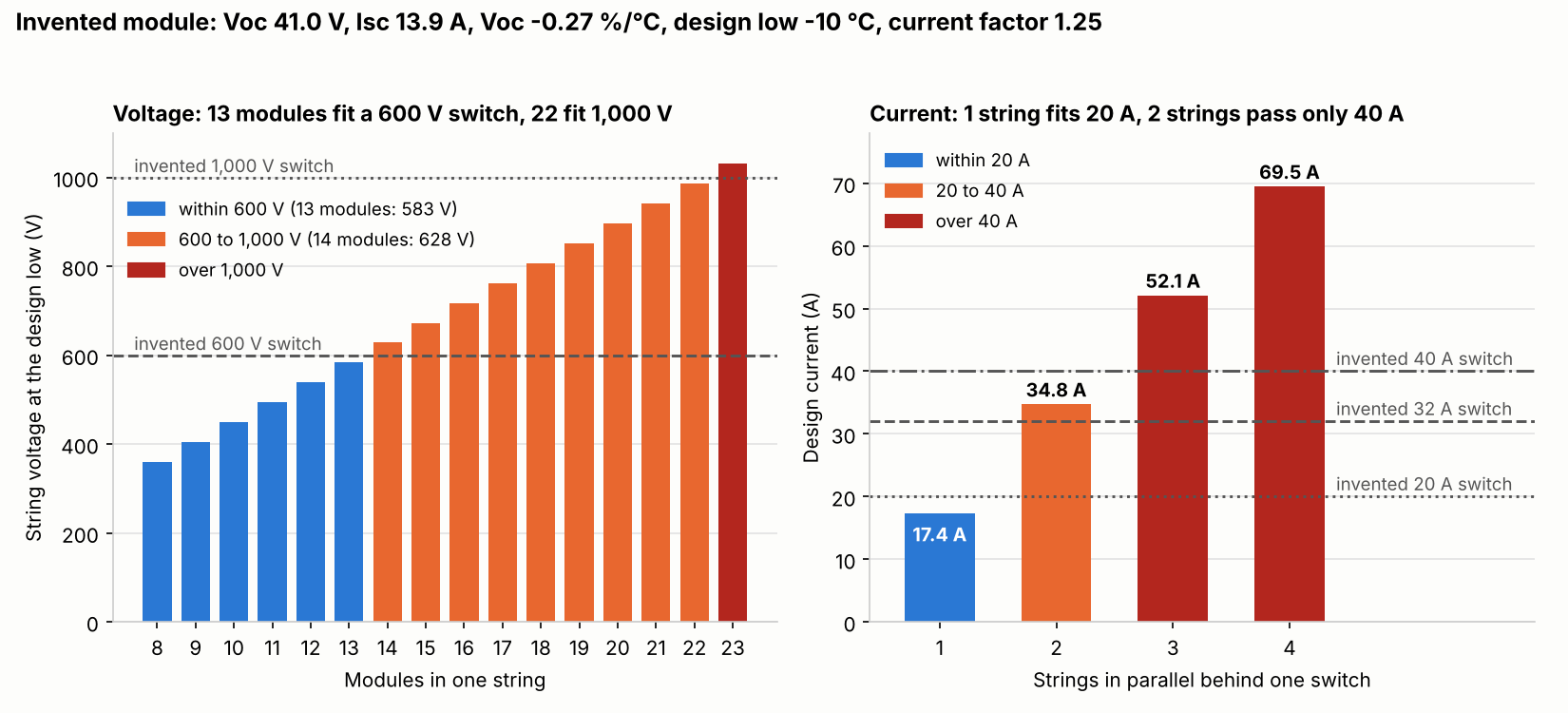
Figure 1. With example inputs, a 600 V switch takes 13 modules at the -10 °C design low, and two parallel strings at 34.8 A pass only the example 40 A switch.
| Case and modules x strings (example) | String voltage | Design current | Example switch | Result |
|---|---|---|---|---|
| A: 13 x 1 | 583.4 V | 17.4 A | 600 V, 20 A | Pass: 16.6 V and about 2.6 A to spare. |
| B: 14 x 1 | 628.2 V | 17.4 A | 600 V, 20 A | Fail: 28.2 V over. |
| C: 13 x 2 | 583.4 V | 34.8 A | 600 V, 32 A | Fail: about 2.8 A over. |
| D: 13 x 2 | 583.4 V | 34.8 A | 600 V, 40 A | Pass: about 5.3 A to spare. |
| E: 14 x 1 | 628.2 V | 17.4 A | 1,000 V, 20 A | Passes the switch. Fails an AHJ line that prints 600 V. |
Case E shows why you read the AHJ line as well as the switch. See string sizing.
DC disconnect rating calculator
Defaults are example.
How do plan sets and single line diagrams show it?
As a block between the array and the inverter, with its rating and place. The documents ask for these items.
- Torrance: with several inverters, a directory of the location of all AC and DC disconnects.
- A blank SLD template hosted at hydro.mb.ca (undated, V2.0) shows a "DC Disconnect" block with no rating. Only its AC disconnect is marked "(Lockable)".
- The SolarAPP+ example has a "DC String Inverters Equipment Disconnects" signage heading. Its label leaves Maximum Voltage blank.
See single line diagram, three-line diagram and permit plan set.
How solar software handles the DC disconnect
One of three tools documents adding a DC disconnect to the diagram, and none explains a rating check. Yes means the page documents it. Partly means it names a disconnect without saying whether it is DC. No means the example shows signage only.
| Tool | DC disconnect on the diagram? |
|---|---|
| Solargraf | Yes |
| Aurora Solar | Partly |
| SolarAPP+ | No (signage only) |
- Solargraf. Electrical Design Tool article, "Published on 31 Jul 2023": under Disconnects, click + Add next to the DC disconnect component, then click in the design. The design tool guide (5 March 2026) names only a battery disconnect option. The permit settings article (19 March 2026) does not mention it.
- Aurora Solar. Instant Plan Sets help page (no date): a "PV System Disconnect" dropdown where "Only appropriately sized disconnects will be shown". It does not say AC or DC. The Europe-only SLD editor article (no date) has a disconnect block with a fuse rating field.
- SolarAPP+. Example approval document (NEC 2017 PV, sheet dated 09/07/2021): signage headings and a label with Maximum Voltage blank. It is a review path, not a drawing tool.
To compare tools that draw the disconnect block, see the best solar SLD software list. Also see permitting software and plan set services.
Common mistakes with DC disconnects
FAQs
Do microinverter systems need a DC disconnect?
Not always. Dublin’s checklist says roof-top micro-inverter systems have none and asks for a lockable AC disconnect. Torrance lets listed connectors act as the disconnecting means. See microinverters.
Must a DC disconnect be lockable or visible-break?
Under the NEC, yes in general: EC&M’s code-basics article says the PV system disconnecting means must be capable of being locked in the open position, citing 690.13(E) and the general lockable-disconnect rule at 110.25. That is a code-wide answer, not a local one. The three California checklists we read do not repeat it on their DC disconnect line. They ask for a lockable AC disconnect instead (Torrance also asks for visible blades there), which does not mean the DC side is exempt, only that those particular city forms do not spell it out. SMA’s 2004 guide separately lists a lockable DC switch as a product feature. Confirm the current section numbers against your AHJ’s adopted NEC edition and the inverter manual.
Can the inverter’s built-in switch be the only DC disconnect?
It can be, if the AHJ accepts it. SolarEdge calls its unit an integral part of the inverter, and RC62 (commercial roofs) prefers that to a separate isolator. SMA’s 2004 guide says the AHJ may still ask for more. Confirm with the AHJ.
Where does a DC disconnect go?
It sits between the strings and the inverter, at or within sight of the inverter. It can be built in or a separate box. Some AHJs also want one before DC wiring enters a building.
Is a DC disconnect the same as a DC isolator?
Yes. Isolator is the UK and EU word for the same device. The sources differ on whether UK rules make it mandatory.
Related terms
- Rapid shutdown: the roof-level shutdown function.
- String inverter: often has the switch built in.
- Labels and placards: the disconnect signs.
Next step: check your string voltage at the design low temperature against your switch rating, then confirm the AHJ’s own line before you finalise the plan set.
Sources
Dates are as printed in each document. All opened October 2026.
| Source | Used for |
|---|---|
| City of Torrance, California, Photovoltaic Inspection and Solar Checklist (Rev. 2/28/2023) | Voltage, location, lockable, ESS |
| Butte County, California, Form DBP-69 (revised 4.10.18, 2016 CEC) | Voltage, location, building entry |
| City of Dublin, California, residential PV plan submittal checklist (Rev 2026 in file name, 2025 CEC, 2023 NEC) | Voltage, location, microinverters, label values |
| City of Seal Beach, California, solar PV submittal requirements (undated) | Cut sheets, inverter rating |
| SolarAPP+ example approval document (NEC 2017 PV, sheet 09/07/2021), checked October 2026. This link no longer resolves (checked November 2026). SolarAPP+ is now run through gosolarapp.org, so look there for a current example | Label and block lines |
| RC62, fire safety with PV panel installations (FPA, MCS, Solar Energy UK, version 2, 2023) | UK isolator wording, fire service switch |
| EC&M, Mike Holt, NEC requirements for solar, part 3 (19 August 2024, appears to cover the 2023 NEC) | Lock-open wording, 690.13 and 690.15 |
| Designing Buildings wiki, DC isolators for photovoltaic systems (FB 68) (BRE guide of 7 October 2014, wiki edited 5 January 2021) | UK mandatory wording, fire risk |
| SMA, Sunny Boy 3000TL to 5000TL manual page (no date shown) | DC load-break switch |
| SMA America, DC Disconnect Switch for Sunny Boy 3300U/3800U (copyright 2004, legal page 2005) | Product features, AHJ note, ratings |
| SolarEdge, DC Safety Unit with Conduits, Addendum (MAN-01-00584-1.1, no date) | Integral unit, AS/NZS 5033 |
| Blank SLD template hosted at hydro.mb.ca (undated, V2.0) | Diagram template |
| BSI shop page, BS 7671 Requirements for Electrical Installations (checked 30 October 2026, a shop page, not the standard text) | BS 7671 title |
| Solargraf: Electrical Design Tool, design tool guide, permit settings. Aurora: Instant Plan Sets, SLD editor. | Software table |
Last updated 30 October 2026. Next scheduled review: 30 January 2027.