Key takeaways
- DERMS is a layer of software, not one product. A 2022 paper says it can mean anything from decentralised virtual power plants to fully centralised utility systems. It turns a grid limit into setpoints for single devices.
- SunSpec’s page says California Rule 21 requires IEEE 2030.5 by default for DER on investor-owned utility networks. The page is undated, so check the current rule.
- DOE (July 2024) calls last-in-first-out and pro rata the two most common curtailment methods. In our invented example both cut 520 kW from 2,520 kW. Pro rata trims every device by 20.6%, while last-in-first-out switches off the newest.
- A cut sized to a forecast leaves any miss uncut. In the example the forecast is 2,300 kW and the actual is 2,520 kW, so 220 kW stays over the limit.
Installers rarely buy a DERMS. Utilities and aggregators run them. To enrol batteries in utility programmes, see the best VPP software for solar installers.
DERMS at a glance
A DERMS sits between the grid operator’s goals and the devices. It turns a group request into commands for single devices. An example is "export no more than 2,000 kW". The DER page defines devices.
| Item | Detail |
|---|---|
| Formula | No standard formula. Our worked model: cut = wanted export minus limit. Pro rata allows each device limit ÷ total × its own wanted export. Last-in-first-out cuts the newest device first. |
| Unit | kW for limits and setpoints. KWh for events over time. |
| Where it matters | Flexible connections, export limits, programme enrolment and device communications. |
| Standard or guide | IEEE 2030.11-2021 (guide, functional specification). No single rule says what a DERMS must be. |
| In software | Utility and aggregator platforms. Installers mostly see their effects, not the platform. See the software table. |
Why does DERMS matter for installers?
It decides when a site you built may export, and how much. A utility or aggregator runs it. Your design and your device choice sit inside its rules.
DOE’s July 2024 paper on flexible connections says they shape imports and exports in constrained periods. NREL’s August 2019 fact sheet covers flexible interconnection. There the PV developer accepts curtailment risk instead of paying for traditional upgrades. DOE’s September 2023 VPP report says active management of DERs requires systems "often called DER management systems, or DERMS". For sign-up and payments, see virtual power plant.
What does a DERMS do?
Company, EPRI and trade-press pages describe jobs. The jobs group as monitor, forecast, find limits, dispatch and report. The table shows who describes each. It also shows what you meet in the field.
| Function | What the pages say | What an installer meets |
|---|---|---|
| Monitor and model | Oracle lists "DER modeling". Schneider says its DERMS tracks DER "in real time and forecasted output". | Telemetry from your device or gateway. See SCADA. |
| Forecast | Oracle says it models and forecasts DER behaviour. Virtual Peaker (4 September 2026) lists "forecasting and optimization". | See solar power forecasting. |
| Find limits (hosting capacity) | DOE (July 2024): hosting capacity is the amount of DER or EV charging energy a distribution system can take. Schneider lists a hosting capacity heat map. | An interconnection offer with an export limit or a flexible connection. See interconnection application. |
| Dispatch and curtail | Schneider lists "generation curtailment, load shed, and shift". Virtual Peaker lists sending signals to devices to "curtail, shift, or discharge". | Setpoints that cap export or call a battery. See the worked example. |
| Report and verify | Virtual Peaker lists tracking event performance. Oracle lists DER market management. | See fleet monitoring. |
DERMS is not one box. The 2022 Journal of Modern Power Systems and Clean Energy paper says it "can refer to very different levels of software hierarchies". DOE’s paper describes utility setups where DERMS works with an ADMS (advanced distribution management system). Avangrid’s demonstration is one. EPRI’s 2018 page wants the extra capacity from active management quantified.
Which standards link a DERMS to devices?
These documents matter. IEEE 2030.5 and OpenADR carry messages. IEEE 1547-2018 sets what a device must do. IEEE 2030.11 is a guide to what a DERMS should do.
| Document | What the page says | Source and date |
|---|---|---|
| IEEE 2030.5 | SunSpec: Rule 21 requires DER on investor-owned utility networks to use it by default, as set out in CSIP, and names IEEE 2030.5-2018. | SunSpec page, undated |
| OpenADR | Describes itself as a "non-proprietary, open standardized Demand Response (DR) & Distributed Energy Resources (DER) interface". Version 2.0 uses XML and SOAP. 3.0 uses JSON and a REST API. | OpenADR Alliance webinar slides, November 2023 |
| IEEE 1547-2018 | A DER must have a local interface that can communicate. It must support at least one of IEEE 2030.5, IEEE 1815 or SunSpec Modbus. The slides say cybersecurity was out of scope for the 2018 version. | NREL slides, 26 August 2021 (revised 21 September 2021) |
| IEEE 2030.11-2021 | A guide to DERMS functional specification. It "proposes a set of core functions" and uses the IEEE 2030 smart grid reference model. | T&D World, 18 May 2021 (approved 9 May 2021). NREL slides list it as published June 2021 |
Notes on the table:
- IEEE 2030.5 revision: IEEE 2030.5-2023 now revises it, per the ANSI webstore listing (no date shown), while SunSpec’s page still cites 2018.
- IEEE 2030.5 use: SunSpec’s blog (15 December 2025) says utilities use DERMS platforms to send power limits and volt-var settings. DOE (July 2024) says a Southern California Edison pilot receives power limits through channels "such as IEEE 2030.5".
- OpenADR: the slides say 3.0 will not make 2.0 obsolete.
These are secondary or summary pages, not the standards’ text. EPRI’s 2018 working group page said the standards on each side of a DERMS were built separately. It said they were not yet proven in practice. It asked if their messages carry enough information for group control. The current programme should be checked before promising a device will work.
How does a DERMS split a limit across devices?
It repeats these steps each control interval. Only step 3, the rule, changes the winners and losers.
- Forecast or read each device’s wanted export.
- Add them up and subtract the limit. The surplus is the cut.
- Pick a rule. DOE (July 2024) names two common ones. Last-in-first-out cuts the first applicant last. Pro rata cuts all devices in proportion.
- Send each device its allowed export as a setpoint.
- Measure, then repeat at the next interval.
Worked example: 2,520 kW wanted on a 2,000 kW limit
All sizes and the limit are example. Devices are listed oldest connection first. That stands in for application order. The numbers are one instant in kW, not a day of energy.
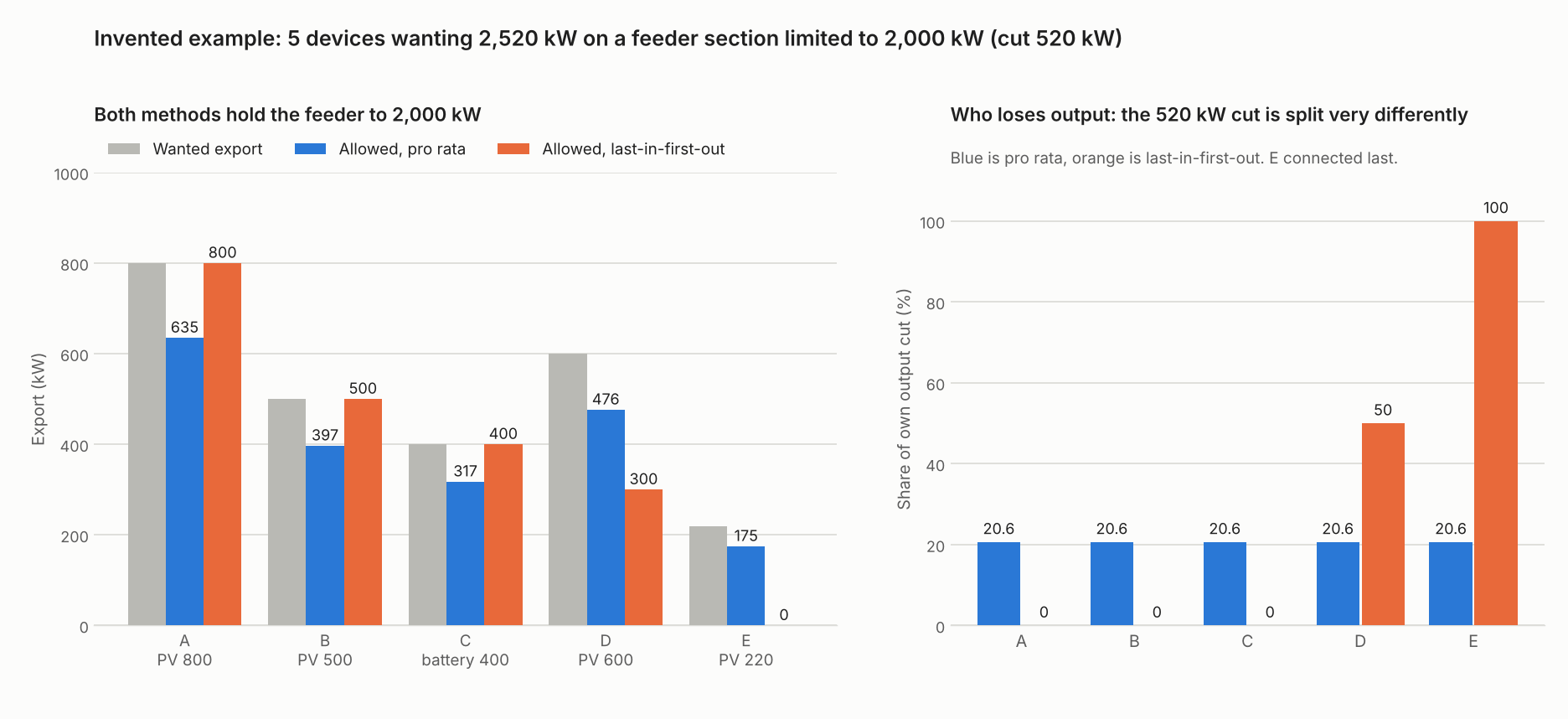
Figure 1. In the example both rules cut 520 kW, but pro rata trims every device by 20.6% while last-in-first-out switches off the newest and halves the next.
| Device (example) | Wanted kW | Pro rata allowed kW | Pro rata cut | LIFO allowed kW | LIFO cut |
|---|---|---|---|---|---|
| A ground-mount PV | 800 | 634.9 | 20.6% | 800 | 0% |
| B rooftop PV | 500 | 396.8 | 20.6% | 500 | 0% |
| C battery, discharging | 400 | 317.5 | 20.6% | 400 | 0% |
| D ground-mount PV | 600 | 476.2 | 20.6% | 300 | 50% |
| E rooftop PV, newest | 220 | 174.6 | 20.6% | 0 | 100% |
| Total | 2,520 | 2,000 | 2,000 |
Pro rata allows each device 2,000 ÷ 2,520 = 79.4% of its wanted export. Last-in-first-out removes E’s 220 kW, then 300 kW of D. The feeder total is the same. But E’s owner loses all output under one rule. Under the other, E loses 20.6%.
The limit changes who is hit. Same devices, other limits:
| Limit (example) | Cut needed | Pro rata cut for every device | Last-in-first-out result |
|---|---|---|---|
| 2,200 kW | 320 kW | 12.7% | E off. D cut 100 kW (16.7%) |
| 2,000 kW | 520 kW | 20.6% | E off. D cut 300 kW (50%) |
| 1,500 kW | 1,020 kW | 40.5% | E and D off. C cut 200 kW (50%) |
Forecasting matters as well. Suppose the DERMS forecasts 2,300 kW. The devices reach 2,520 kW. A cut sized to the forecast is 300 kW. You need 520 kW. That leaves 220 kW above the limit until the next interval. This is a simple model. It does not show how any utility’s system behaves.
Try your own limit and devices below.
How solar software handles DERMS
Of the three DERMS company pages read in October 2026, only Schneider’s lists forecasting, dispatch, hosting capacity and IEEE 2030.5 together. Uplight only mentions forecasting and dispatch. These platforms are bought by utilities and aggregators, not installers.
| DERMS companies: what their pages say | Forecasting and dispatch | Hosting capacity | IEEE 2030.5 | OpenADR |
|---|---|---|---|---|
| Schneider Electric EcoStruxure DERMS | Yes | Yes | Yes | Not stated |
| Oracle DERMS (Edge DERMS) | Yes | Not stated | Not stated | Not stated |
| Uplight | Mentioned only | Not stated | Yes | Not stated |
"Yes" means the company’s own page says it. "Not stated" means it is not on the page read in October 2026. "Mentioned only" means the page names it without saying how it works.
What each company page says:
- Schneider Electric: Forecasting: tracks DER "in real time and forecasted output". Dispatch: lists "generation curtailment, load shed, and shift" and grouped dispatch "as one virtual resource". Hosting capacity: a hosting capacity heat map. Protocols: yes for IEEE 2030.5: "Certified for communication using IEEE 2030.5". OpenADR: Not stated. Page read: Microsoft Marketplace listing, no date printed.
- Oracle: Forecasting: models and forecasts DER behaviour. Dispatch: scheduling, dispatch and active network management. Hosting capacity and protocols are not stated (page read: Oracle page, updated 1 September 2026).
- Uplight: This is an integration guide, not a product page. It says it gives insight for "forecasting and dispatch". The method is not explained, so forecasting and dispatch are rated Mentioned only. Protocols: yes for IEEE 2030.5 integration, including CSIP compliance support. OpenADR and hosting capacity are not stated (page read: Uplight guide, modified 11 June 2026).
These ratings cover the pages read, not whole products. For battery and VPP tools installers can buy, see the best VPP software for solar installers list.
Common mistakes with DERMS
FAQs
Is DERMS the same as a virtual power plant?
No. A DERMS is software. A virtual power plant is a group of devices dispatched as one resource. Its operator may use a DERMS. See the virtual power plant page for sign-up and payment terms.
What is the difference between DERMS and ADMS?
A DERMS manages groups of DER devices. An ADMS (advanced distribution management system) is the utility’s system for running the distribution network. An NREL webinar deck (December 2022) says an ADMS "enables distribution dispatchers to monitor and operate their system". It says a DERMS "is a software platform that manages behind-the-meter (BTM) DERs" and may rely on the ADMS. DOE’s July 2024 paper describes utilities that use both but does not define the boundary. Avangrid’s demonstration is one. Oracle says its DERMS feeds DER models to ADMS features. It says users can model DER assets "to support power flow state estimation and other ADMS features". Check the utility’s own documents for where the line falls.
Does an installer need to buy a DERMS?
Not usually. Utilities and aggregators run DERMS. Oracle says it helps utilities. Virtual Peaker says a utility or aggregator uses it. Your side is devices, settings and sign-up. For site monitoring, see remote diagnostics.
Which protocol does a DERMS use: IEEE 2030.5 or OpenADR?
Whichever the programme names. SunSpec says Rule 21 requires IEEE 2030.5 by default. That is on California investor-owned networks. OpenADR describes itself as an interface for demand response and DER. The programme document names the protocol.
What is hosting capacity?
DOE (July 2024) defines it as the amount of DER or EV charging energy a distribution system can integrate. Beyond it, you need controls or upgrades. A DERMS can help by managing exports.
Related terms
- DER: the devices a DERMS manages.
- Virtual power plant: devices dispatched as one resource.
- Software-agnostic and hardware-agnostic: what works with more than one maker.
Next step: to put customer batteries into a utility or aggregator programme, start with the best VPP software for solar installers.
Sources
NREL (the National Renewable Energy Laboratory) was renamed the National Laboratory of the Rockies (NLR) in December 2025. Its nrel.gov pages retired in May 2026. This page links to the current nlr.gov addresses and keeps the name NREL for documents published under it.
All pages were checked in October 2026. Dates are as each page prints them.
- US DOE, Flexible DER and EV Connections (July 2024).
- US DOE, Virtual Power Plants liftoff report (September 2023).
- NREL, Hosting Capacity Analysis for Policy Makers (August 2019).
- NREL, Distribution Grid Management in the Presence of DERs (webinar deck, 16 December 2022, checked 30 October 2026).
- IEEE SCC21, 1547.3 cybersecurity guide page (checked 30 October 2026).
- NREL, IEEE 1547-2018 implementation slides (26 August 2021, revised 21 September 2021).
- EPRI, DERMS Working Group page (October 2018, as the page prints it).
- Journal of Modern Power Systems and Clean Energy, DERMS and aggregators (2022).
- T&D World on IEEE 2030.11 (18 May 2021).
- SunSpec, IEEE 2030.5 and CSIP certification (no date printed).
- ANSI webstore, IEEE 2030.5-2023 (no date shown).
- SunSpec blog on IEEE 2030.5 (15 December 2025).
- OpenADR Alliance, 2.0 to 3.0 slides (November 2023).
- Oracle, DERMS (updated 1 September 2026).
- Schneider Electric, EcoStruxure DERMS listing (no date printed).
- Uplight, IEEE 2030.5 guide (modified 11 June 2026).
- Virtual Peaker blog (4 September 2026).
Last updated 30 October 2026. Next scheduled review: 30 January 2027.