Key takeaways
- SCADA polls, stores and commands. A data logger collects and forwards readings. A monitoring portal mostly displays them.
- On an assumed plant of 100 inverters with 52 registers each, a scan takes 3.64 s at 9600 baud and 1.04 s at 115200 baud.
- Modbus TCP with 10 sessions takes 0.15 s on the same assumed plant.
- At 9600 baud, 78% of each read is bytes and gaps on the line. At 115200 baud, the assumed 40 ms device response is 77% of it.
- At a 5 s scan, the assumed plant makes 179.7 MB a day of raw register payload. The historian stores a different size.
To compare SCADA and plant controller products, see the best solar SCADA software.
SCADA at a glance
SCADA reads field devices, shows the plant to operators and sends control commands.
| Item | Detail |
|---|---|
| Core parts | Field devices, an RTU or PLC, a network, a control server with a historian, and an operator screen (HMI) |
| Common links | Modbus RTU and TCP, DNP3, IEC 61850, OPC-UA and others. AlsoEnergy lists these across its two datasheets. |
| Control actions | Preset commands, curtailment, voltage or power factor control, ramp control. Company pages in the table below. |
| Standard or rule | No solar-specific SCADA standard found on the pages read. This page states no grid-code requirement. Take those from the interconnection agreement. |
| In software | SCADA and power plant controller products, usually sold with a historian and HMI. |
The core parts list follows section 2.3.2 of the April 2022 NIST SP 800-82 Rev. 3 draft. NIST withdrew that draft when it published the final version, so check the final text (see Sources).
Why SCADA matters for utility-scale and C&I plants
SCADA matters when you must control something, not just watch it. It also matters when a grid operator or offtaker needs live data.
Emerson’s controller page says it aggregates the plant’s components into a single unit "from the standpoint of the transmission system operator". It also makes changes on grid operator instructions. AlsoEnergy lists closed-loop curtailment and closed-loop ramp control. It also lists utility or ISO telemetry over DNP3 or Modbus.
A Power Factors customer story of 9 October 2020 describes a 150 MWdc project with 16 solar plants that have single-axis trackers. Each plant has a control room with a local plant server, as the owner required. Operators can control inverters and trackers on site or remotely.
No company page read sizes SCADA for C&I. Whether a C&I site needs it depends on whether anything must be controlled or reported to a utility. The interconnection application and the utility’s terms settle it. Availability guarantees sit under O&M.
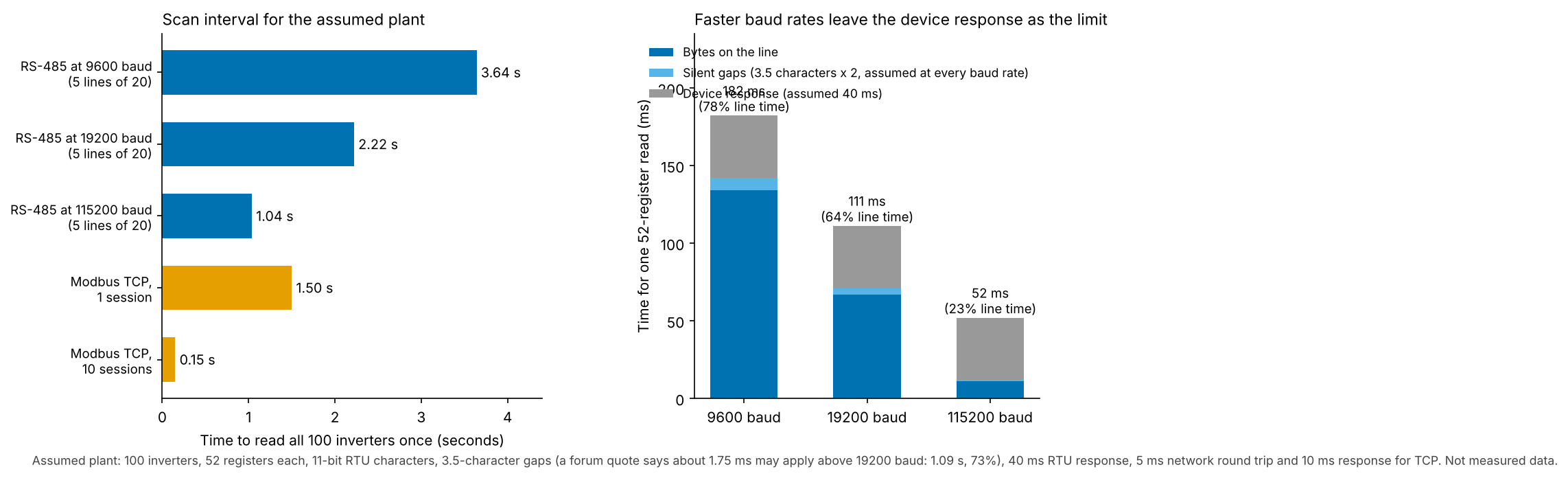
Figure 1. On an assumed 100-inverter plant, slow RS-485 takes 3.64 s per scan and Modbus TCP with 10 sessions 0.15 s. At 115200 baud the device sets the pace: 1.04 s, 77% device response (3.5-character gaps assumed).
How does SCADA differ from a data logger or a monitoring portal?
SCADA reads, stores and commands. A logger mainly collects and forwards. A portal mainly displays.
| Item | Data logger or gateway | Monitoring portal | SCADA |
|---|---|---|---|
| Main job | Collect readings from devices and send them on | Show stored data, charts and alerts | Poll, store, show and send commands |
| Sends commands? | Usually no | Usually no | Yes, from the HMI or a plant controller |
| Where it runs | On site | Often cloud | On site and at a control centre |
| See | Data logger or gateway | Monitoring software guide, fleet monitoring | This page |
The split is a pattern, not a rule. AlsoEnergy’s PowerTrack SCADA datasheet, for example, puts dataloggers, an HMI, controls and storage in one product. GreenPowerMonitor logs and restricts every command that runs on a device. Module-level monitoring sits below the inverter. It is a separate data channel.
How does a solar SCADA system work?
A field controller polls devices over a plant network. A control server stores the data. Operators act through the HMI or a plant controller.
NIST’s draft guide says SCADA joins data acquisition, data transmission and HMI software. A typical setup has a control server at a control centre. It also has one or more field sites. RTUs or PLCs at those sites control actuators or monitor sensors. The control server stores and processes their data. The historian and HMI sit in the control centre.
- The master polls each device for a block of registers, like status, power and temperatures.
- The plant network carries the request and reply. Serial Modbus RTU runs on a shared RS-485 line, as in the ABB D11-D13 meter manual. Modbus TCP uses Ethernet.
- The control server saves the values in the historian and raises alarms. See alerts and alarms.
- A plant controller sends setpoints to inverters, as a Moxa case study on GreenPowerMonitor describes. Emerson’s SCADA page says Ovation Green gives output control at the plant’s point of interconnect.
Saved data can feed a KPI dashboard or a digital twin. AlsoEnergy lists an OPC-UA server for third parties and a SQL database connection. An API is another route.
What must a solar SCADA system integrate?
It must read and command inverters. It must read meters and weather stations. It must control trackers. It must swap signals with the utility or grid operator.
| Device | What the sources show |
|---|---|
| Inverters | Status and power are read. Limits are written. See power factor and reactive power. |
| Meters | An Enika EM511 manual (rev. 1.8, May 2023) documents Modbus RTU frames and baud rates from 9.6 to 115.2 kbps. Each meter has its own register map. |
| Weather stations | No source read covers their protocols. Take the register map from the station’s manual. |
| Trackers | Emerson’s SCADA collects tracker data, AlsoEnergy lists tracker controls, and the Power Factors story says operators control trackers locally or remotely. |
| Utility or grid operator | AlsoEnergy lists utility and ISO telemetry over DNP3 or Modbus, and TSO communication. The utility sets which signals and response times apply. |
In the Solectria XGI 1500 manual (Rev G), a power limit (WMaxLimPct, register 40295) has an enable flag (40299). A power factor setting (OutPFSet, 40300) has its own enable (40304). Reads use function 3 and writes use function 6.
How long does one SCADA scan take? A polling budget
Result: 100 inverters on 5 RS-485 lines of 20 at 9600 baud take 3.64 s per scan. Scan time is the device count on the busiest line times the time for one read. The plant, line layout and response times are assumed, not measured.
| Set-up | One read (ms) | Scan (s) | Two-write limit sweep, busiest line (s) |
|---|---|---|---|
| RS-485 at 9600 baud | 182.1 | 3.64 | 2.65 |
| RS-485 at 19200 baud | 111.0 | 2.22 | 2.13 |
| RS-485 at 115200 baud | 51.8 | 1.04 | 1.69 |
| RS-485 at 115200 baud, 1.75 ms gaps | 54.7 | 1.09 | – |
| Modbus TCP, 1 session | 15.0 | 1.50 | 3.00 |
| Modbus TCP, 10 sessions | 15.0 | 0.15 | 0.30 |
A dash means the model did not work out that cell. The sweep column writes a power limit and an enable flag to each device. These are two single-register writes, with no scan running. In the model, they need 2.65 s to reach all 20 devices on one 9600-baud line.
- Baud rate is not everything. A twelvefold higher baud rate, from 9600 to 115200, cuts the scan only from 3.64 s to 1.04 s. The 40 ms response stays the same.
- Response time can dominate. If each device took its 500 ms maximum, the 115200-baud scan would be 10.24 s.
- Register count matters on slow lines. Reading 125 registers instead of 52 stretches the 9600-baud scan from 3.64 s to 6.99 s.
Data volume follows the interval. One scan carries 10.4 kB of register payload. That is 179.7 MB a day at 5 s and 15.0 MB at 60 s. At 1 s it would be 898.6 MB. These are raw bytes, not the stored size. The model leaves out retries, timeouts, meters, weather stations and controller traffic.
How the model works. It uses one read of R registers (function 3), with these formulae.
- Character time: tc = bits per character ÷ baud.
- RS-485 read time = (8 + 5 + 2R) × tc + 2 × 3.5 × tc + device response. The 8-byte request and the 5 + 2R byte reply include address, function code and 2-byte CRC.
- Modbus TCP read time = network round trip + device response.
- Scan time = devices on the busiest line (or session) × read time.
- Payload per day = (86,400 ÷ scan interval) × devices × R × 2 bytes.
| Assumption | Value and basis |
|---|---|
| Plant (assumed) | 100 inverters. One read of 52 registers each. |
| Register basis | The Solectria manual shows SunSpec model 103 as 52 registers and a Modbus TCP response time of 10 ms. |
| RS-485 layout (assumed) | 5 lines of 20 devices, polled in parallel. 11 bits per character (start, 8 data, parity, stop). |
| RS-485 response (assumed) | 40 ms. This is the typical answer time of the Enika meter, used as a stand-in. Its manual gives 500 ms as the maximum. |
| Silent gap | 3.5 character times between frames at every baud rate. The specification is not among the pages read. |
| Assumption | Value and basis |
|---|---|
| Silent gap, alternative | A mailing-list post quoting the specification we could not open recommends 1.75 ms above 19200 baud. At 115200 baud that gives 1.09 s and a 73% device share. |
| Modbus TCP (assumed) | 5 ms round trip and 10 ms device response. Frame size 12 bytes out and 9 + 2R bytes back. Network overhead ignored. |
| Read limit | 125 registers per read, from the Enika manual and Kollmorgen help. The Enika manual also prints 1 to 20 in a table, so devices differ. |
Check your own polling budget
The calculator below uses the same formulae on your inputs. Its five buttons load the table’s set-ups.
The 10,000-device and 255-per-line limits are set by the calculator, not by a standard.
How solar software handles SCADA
Of the four tools, Emerson Ovation Green, GreenPowerMonitor and AlsoEnergy PowerTrack document both SCADA and a plant controller, and only AlsoEnergy names its links. Yes and Partly reflect only the pages named (checked October 2026). Partly means the page covers some of it, and Not stated means the pages read do not name the links.
| Software | SCADA documented? | Plant controller or commands? | Links named |
|---|---|---|---|
| Emerson Ovation Green | Yes | Yes | Not stated |
| Power Factors Unity | Partly | Partly | Not stated |
| GreenPowerMonitor (DNV) | Yes | Yes | Not stated |
| AlsoEnergy PowerTrack | Yes | Yes | Yes |
- Emerson Ovation Green: the SCADA page says it collects data from inverters, trackers and combiner boxes. The controller page says it manages active and reactive power and ramp rates. Neither page is dated (copyright 2026).
- Power Factors Unity: rated from a customer story dated 9 October 2020: it covers SCADA and PPC for a 150 MWdc project. It has an HMI and local or remote inverter and tracker control. The current product page is not among the pages read.
- GreenPowerMonitor (DNV): the GPM SCADA page lists 1-second data, preset commands on devices and logged command control. It is paired with a GPM Power Plant Controller for voltage, power factor and active and reactive power. The page has no date.
- AlsoEnergy PowerTrack: the SCADA datasheet (undated, v22) lists an HMI, tiered polling and OPC-UA. The power plant control datasheet (undated, v22) lists closed-loop curtailment, ramp and voltage or power factor control, and Modbus TCP and RTU, DNP3, IEC 61850 and others.
For a wider comparison of products, see the best solar SCADA software list.
Common mistakes with SCADA
FAQs
How often should SCADA poll solar inverters?
Poll as often as the use needs, within what the line allows. The pages read give no standard rate. GreenPowerMonitor’s page advertises 1-second data, and AlsoEnergy lists tiered polling rates. On our assumed 100-inverter plant, RS-485 at 9600 baud cannot scan faster than 3.64 s.
What is the difference between SCADA and a power plant controller?
SCADA monitors and commands many devices. A power plant controller manages the plant’s output at the point of interconnection. Emerson describes it as regulating active and reactive power and ramp rates. GreenPowerMonitor says it pairs its SCADA with its controller.
Does a commercial solar site need SCADA?
It needs SCADA only if something must be controlled or reported to a utility or offtaker. The pages read set no size threshold. If neither applies, a logger and a portal may be enough. The interconnection terms say which case you are in.
How much data does a solar SCADA produce?
Data volume follows the points read and the interval. Our assumed plant has 100 inverters at 52 registers each. At a 5 s scan, it makes 179.7 MB a day of raw register payload. Historian storage differs, and the model does not cover it.
Related terms
- O&M: the work and contracts that keep a plant running.
- Alerts and alarms: rules that turn plant data into messages.
- Data logger or gateway: the device that collects site data and sends it on.
Next step: run your own plant through the polling budget above, then shortlist products from the best solar SCADA software.
Sources
- NIST SP 800-82 Rev. 3, initial public draft, April 2022, section 2.3.2. NIST’s draft page is marked withdrawn and obsoleted on 28 September 2023 by the final SP 800-82 Rev. 3. NIST’s final page dates it September 2023 and points to a Revision 4 draft. The final PDF is not among the pages read (checked October 2026).
- libmodbus mailing list, 3.5t timeout while transmitting, quoting the Modbus over Serial Line specification, which says a 1.75 ms inter-frame delay is recommended above 19200 baud. Secondary source. The specification was not opened.
- Emerson, Solar SCADA System and What is a power plant controller (checked October 2026).
- Power Factors, SCADA and PPC for the 150 MW Aurora project, 9 October 2020 (checked October 2026).
- GreenPowerMonitor, GPM SCADA and Moxa, GreenPowerMonitor case study, a partner document, undated (checked October 2026).
- AlsoEnergy, PowerTrack SCADA datasheet and power plant control datasheet, both undated, v22 (checked October 2026).
- Solectria, XGI 1500 Smart Grid Feature and Modbus Manual, Rev G, undated page (checked October 2026).
- Enika, EM511 communication protocol, rev. 1.8, 23 May 2023 (checked October 2026).
- ABB, D11-D13 meters communication manual, Revision A, undated, section 1.1 (checked October 2026).
- Kollmorgen, Modbus Read Holding Registers (3) and uModbus, Modbus functions (checked October 2026).
- Industrial Monitor Direct, Modbus RTU frame detection, 11 June 2026, and its note on the 253-byte limit. Both cite the Modbus specifications, which are not among the pages read (checked October 2026).
Last updated 30 October 2026. Next scheduled review: 30 January 2027.