Key takeaways
- A VPP is control software plus enrolled devices. It is not a building. It is not a new kind of battery.
- Our example fleet of 1,000 batteries (40% taking part, 70% charge, 20% reserve) has 11.5 MW rated and gives 1.35 MW and 2.70 MWh in a 2-hour event.
- Energy, not power, sets the limit. A 13.5 kWh battery at 11.5 kW runs flat out for 1.17 hours, so a 3-hour event cuts MW by a third.
- Programmes set the rules. A Massachusetts document dated 13 March 2026 prints USD 275 per kW.
- In wholesale markets, FERC Order 2222 lets aggregations as small as 100 kW join, through an aggregator.
To enrol customers and run a battery fleet in software, see the best VPP software for solar installers.
Virtual power plant at a glance
A VPP turns many small devices into one dispatchable block that a utility or market operator can call on.
| Item | Detail |
|---|---|
| Formula | Fleet MW = batteries taking part × the smaller of rated kW and (kWh above reserve ÷ event hours) ÷ 1,000. This is our model built on assumptions. It is not a programme formula. |
| Unit / typical range | kW, MW and MWh. DOE’s Liftoff page gives 33 GW for VPP capacity and is undated. Its September 2023 report gave 30 to 60 GW, mostly in demand response programmes. They are separate sources, so do not read the two figures as a trend. |
| Where it matters | Battery quotes, programme enrolment, backup promises and customer income. |
| Standard or rule | No single rule. FERC Order 2222 (issued 17 September 2020) says aggregations can be as small as 100 kW in wholesale markets. Each programme sets its own terms. |
| In software | Fleet platforms dispatch. Device apps enrol. See the software table. |
Why do virtual power plants matter for installers?
Installers meet a VPP as an enrolment step, and a battery sale can now come with a programme. See the best VPP software for solar installers. The programme sets which devices qualify. It sets when you must commission and what you can promise. If you promise the wrong backup or income, the blame lands on you.
How does a virtual power plant work?
An operator enrols devices and forecasts what each can give. It then sends dispatch signals and settles payment. Each step cites a source document.
- Devices connect to a cloud platform. SwitchDin’s page says its platform "securely connects every device".
- The owner enrols with a programme or aggregator. Sol-Ark’s page says owners "enroll in an available utility or aggregator program".
- The operator forecasts each site. Canary Media (21 February 2023) reports on Lunar’s Gridshare. It forecasts battery state of charge, consumption and generation, site by site.
- The platform dispatches. FranklinWH’s guidance says event alerts come around 24 hours ahead. The Massachusetts document says notices go to the customer’s inverter.
- The programme measures and pays. In Massachusetts, performance is the average discharge in kW-AC over the event. Pay comes in October, November or December.
How is a VPP different from peak shaving, a microgrid and demand response?
A VPP is the aggregation. Peak shaving, islanding and demand response are goals or boundaries. One site or a VPP can serve them.
| Term | What it is | Who or what is in control |
|---|---|---|
| Virtual power plant | Many sites dispatched as one resource for grid services. | An operator or aggregator, under programme terms. |
| Peak shaving | One site cutting its own highest kW to cut a demand charge. | The site’s own controller, driven by its tariff. |
| Microgrid | Loads and sources inside one electrical boundary that can run with or without the grid. | One controllable entity at the site. |
| Demand response | Cutting load on request. CESA says traditional demand response is "limited, one-way load reductions during emergencies". | The programme operator. DOE (2023) calls it the most common form of VPP. |
So a site can peak-shave on its own bill. It can sit inside a microgrid. It can also join a VPP. The battery then has several jobs. See battery storage design, energy arbitrage and self-consumption for those jobs.
What VPP programmes exist?
Four programme or market documents are summarised below. Each is dated, and each can change.
- Massachusetts ConnectedSolutions, small-scale batteries: programme details dated 13 March 2026 for Eversource, National Grid and Cape Light Compact customers. It prints USD 275 per kW. It lists 30 to 60 events a season (June to September, 3 p.m. to 8 p.m., 2 or 3 hours each).
- California Demand Side Grid Support (DSGS): Utility Dive (20 May 2026) says it relies heavily on residential batteries. An organised test the previous July gave over 539 MW on average for two hours. A trade group’s release of 30 June 2026 said a budget deal moved USD 22 million into DSGS, enough to carry the programme through 2026. A later report from Canary Media (1 September 2026) says the finalised budget language sets no new money for 2027, after a USD 70 million Senate proposal was dropped. Check the programme’s current status before quoting a 2027 payment.
- Company programme, Sol-Ark VPP: a 2026 page lists utility programmes. They are in New York, Connecticut, Massachusetts and Rhode Island. It says pay depends on the programme. It adds "participation and financial benefits are not guaranteed".
- Wholesale markets, FERC Order 2222: FERC’s explainer (updated 25 September 2025) says the aggregator joins the market directly. Each market operator’s compliance status is not covered here.
What must an installer know before enrolling a customer?
Three questions matter for each programme: which devices qualify, who enrols and by when, and who gets paid. The documents differ on all three.
The table sets the three documents side by side. Not stated means the document we cite does not say.
| Item | Massachusetts ConnectedSolutions (13 Mar 2026) | Sol-Ark VPP page (2026) | FranklinWH guidance (7 Apr 2026) |
|---|---|---|---|
| Device eligibility | Approved makers only (listed below the table). Inverter 50 kW or less. Behind the meter. | A Sol-Ark hybrid inverter with a battery, an internet connection and utility customer status. | Not stated. The system must be commissioned before enrolment. |
| Who enrols | The customer applies on the Mass Save site. The battery maker submits to the administrator. | Owner or site operator, in the MySolArk app. | The homeowner, in the app under Settings, Virtual Power Plant. The utility then accepts or rejects. |
| Deadline or notice | Application by 11:59 p.m. on 31 May for the full season. Later enrolees get 0 kW for missed events. | Not stated. | Alerts about 24 hours before an event. |
| Payment | USD 275 per kW of average event kW, paid October to December to the customer or the party named on the application. Rate fixed for 5 years. | Varies by programme. Not guaranteed. | No figures in the document. |
| Opt-out | Opting out of an event gives 0 kW for it. No part-season unenrolment. | Not stated. | Event participation is on by default. The owner can opt out per event. |
Massachusetts approved makers, as printed: Enphase, Generac (formerly Pika Energy), SolarEdge, Sol-Ark, Outback Connected to Sonnen, SunPower and Tesla.
The Massachusetts document also says solar output cannot be curtailed to raise battery discharge. Check backup power promises against the reserve setting. For how platforms reach devices, see API and SCADA. Where a customer exports, also check net metering terms.
Worked example: how many MW does a battery fleet deliver?
This is an illustration. We assumed participation, charge and reserve. It is not a programme result. Unit data come from Tesla’s Powerwall 3 North America datasheet (2024). It lists 11.5 kW maximum continuous discharge. It lists 13.5 kWh nominal energy. The sheet does not say usable energy. So 13.5 kWh is a stand-in.
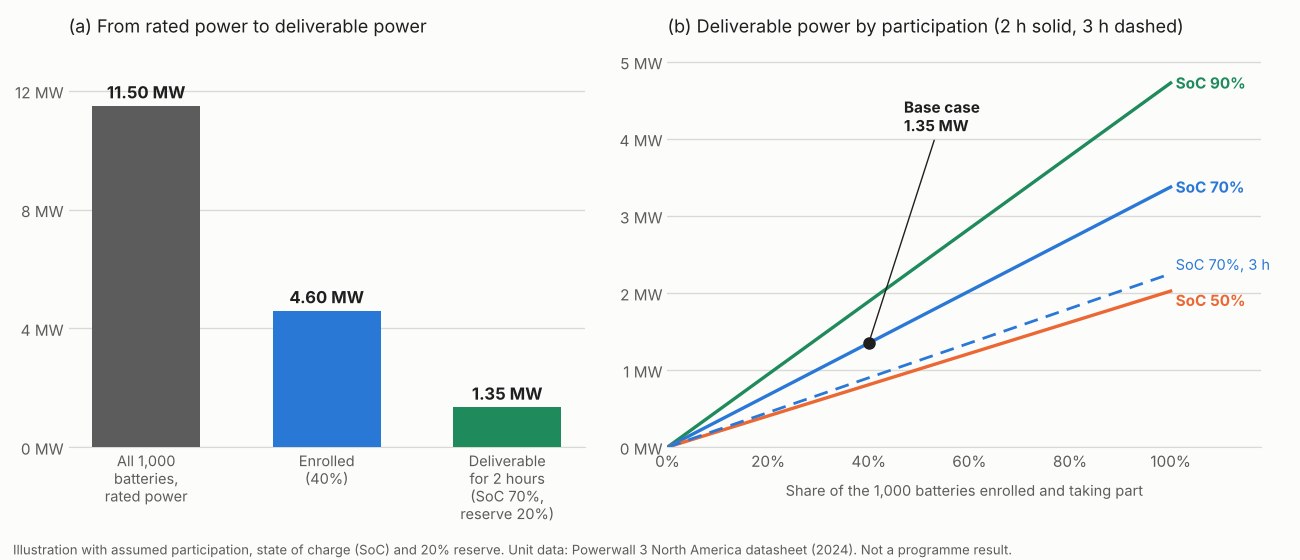
Figure 1. Only 11.7% of the fleet’s rated power is deliverable in the illustration. Few batteries take part, and each holds limited energy.
| Step | 2-hour event | 3-hour event |
|---|---|---|
| Fleet and unit (datasheet) | 1,000 batteries (assumed). 11.5 kW, 13.5 kWh | Same |
| Taking part (assumed 40%) | 400 batteries | 400 batteries |
| Energy above reserve (assumed 70% charge, 20% reserve) | 13.5 × 0.50 = 6.75 kWh | 6.75 kWh |
| Output per battery | 6.75 ÷ 2 = 3.375 kW (below 11.5, so energy-limited) | 6.75 ÷ 3 = 2.25 kW |
| Fleet power | 400 × 3.375 = 1,350 kW = 1.35 MW | 0.90 MW |
| Fleet energy | 2.70 MWh | 2.70 MWh |
Sensitivity: deliverable MW for a 2-hour event, with reserve at 20%.
| Taking part | Charge 50% | Charge 70% | Charge 90% |
|---|---|---|---|
| 20% | 0.405 | 0.675 | 0.945 |
| 40% | 0.810 | 1.350 | 1.890 |
| 60% | 1.215 | 2.025 | 2.835 |
The same grid for a 3-hour event, in MW:
| Taking part | Charge 50% | Charge 70% | Charge 90% |
|---|---|---|---|
| 20% | 0.270 | 0.450 | 0.630 |
| 40% | 0.540 | 0.900 | 1.260 |
| 60% | 0.810 | 1.350 | 1.890 |
Output rises with participation. It also rises with charge above reserve. Reserve matters as much. At 70% charge in a 2-hour event, reserves of 10, 20, 30 and 40% give 1.62, 1.35, 1.08 and 0.81 MW.
Payment sketch at the printed Massachusetts rate. Suppose one battery gave the modelled output in each event. Then 275 × 3.375 = 928.13 USD a season for 2-hour events. For 3-hour events it is 275 × 2.25 = 618.75 USD. Real results differ. Opt-outs and lost connections count as 0 kW. Charge also varies by event.
The model uses one average charge for the whole fleet. Averaging is only exact when all batteries sit above reserve and below their power cap. Spread charge evenly from 0 to 100% (mean 50%). Then the true 2-hour total is 0.864 MW, not 0.81 MW. For a 0.5-hour event with charge from 45 to 95%, it is 4.27 MW, not 4.60 MW.
VPP event calculator
Change the fleet size, battery kW and kWh and participation. Change charge, reserve and event length too. The page example loads by default. It is an illustration, not a programme result.
How solar software handles virtual power plants
Of the five tools, two are device-maker apps that enrol customers and two are fleet platforms for operators. Derapi’s page describes a device-access layer. The table shows where each tool sits.
| Software | Supports VPP participation? (role) | What the page says (source and date) |
|---|---|---|
| Sol-Ark VPP / MySolArk | Yes, enrolment (device-maker app) | "Enroll Your System With The MySolArk App". Dispatch is not described on the page. Source: 2026 |
| FranklinWH | Yes, enrolment and event alerts (device-maker app) | Homeowner enrols under Settings, Virtual Power Plant. Utility accepts or rejects. Alerts about 24 hours ahead. Source: 7 Apr 2026 |
| SwitchDin | Yes, orchestration (platform for operators and manufacturers) | Says operators decide "when, where and how to deploy resources in their fleet" and offers third-party API connectivity. Source: company page, undated, October 2026 |
| Lunar Gridshare | Yes, orchestration (fleet platform) | "Take control of your entire fleet with Gridshare, our edge DERMS." Canary Media reports forecasting and rotating full-power discharge across groups of homes. Source: company page, undated, October 2026. Canary Media, 21 Feb 2023 |
| Derapi | Partly (API layer) | Company page: "Launch and scale VPP programs faster." It describes connecting devices. A trade article calls it "an API platform for distributed energy resources". Source: company page, undated, October 2026. 24 Feb 2025 |
Partly: the page names a VPP use but covers only part of the job, such as device access.
Installers who want ranked options for enrolment and fleet tools can use our list of the best VPP software for solar installers.
Common mistakes with virtual power plants
FAQs
Is a virtual power plant the same as demand response?
No. Demand response is one service a VPP can provide. DOE’s 2023 report calls demand response the most common form of VPP. CESA says VPPs go further. They combine resource types and export power, not only cut load.
How much can a home battery earn in a VPP?
There is no single figure. Each programme sets its own rate. The Massachusetts document dated 13 March 2026 prints USD 275 per kW. That is on average event kW. Sol-Ark’s page says benefits are not guaranteed.
What happens if a customer opts out of an event?
In Massachusetts the customer scores 0 kW for that event and stays enrolled. The customer cannot leave mid-season and keep the incentive. FranklinWH’s guidance says opt-out per event is allowed.
Can small batteries join wholesale markets?
Through an aggregator, yes. FERC’s explainer says aggregations can be as small as 100 kW under Order 2222. The aggregator is the direct market participant. Rules differ by market operator.
Does a VPP need a special battery?
It needs a device the programme accepts and a link to the platform. Massachusetts lists approved inverter makers. FranklinWH’s guidance gives no device list. Check each programme.
Related terms
- Distributed energy resources: the devices a VPP aggregates.
- Battery storage design: sizing kWh and kW for a stated goal.
- Peak shaving: cutting one site’s highest kW draw.
Next step: to find enrolment and fleet tools that suit your battery brands, see the best VPP software for solar installers.
Sources
All sources below were checked in October 2026. Dates are as each page prints them.
- US DOE, Virtual Power Plants Liftoff page (undated).
- US DOE, VPP Liftoff report (September 2023, first 100,000 of 116,210 characters read).
- CESA, VPPs 101 (modified 9 October 2026 in page metadata).
- FERC, Order No. 2222 explainer (last updated 25 September 2025).
- ConnectedSolutions for Small Scale Batteries, program details (dated 3/13/26).
- Utility Dive on California VPP financing (20 May 2026).
- Sol-Ark, Virtual Power Plants (copyright 2026).
- FranklinWH, Energy Storage Solutions guidance (7 April 2026).
- FranklinWH, ConnectedSolutions (National Grid) guidance (2 February 2026).
- SwitchDin, Virtual power plants (undated).
- Lunar, Gridshare enterprise page (undated, checked 30 October 2026).
- Derapi home page (undated, checked 30 October 2026).
- Advanced Energy United, California budget agreement and DERs (30 June 2026, checked 30 October 2026). A trade group’s release, not the budget text.
- Canary Media, "California guts its biggest virtual power plant" (1 September 2026, checked November 2026).
- Canary Media on Sunrun’s battery fleets (21 February 2023).
- pv magazine USA on Solis and Derapi (24 Feb 2025).
- Tesla, Powerwall 3 datasheet, North America (2024).
Last updated 30 October 2026. Next scheduled review: 30 January 2027.