Key takeaways
- "Agnostic" is a company label, not a tested grade. Solytic’s page title says "Hardware-Agnostic". AlsoEnergy calls PowerTrack "a hardware agnostic application". VCOM’s page lists devices without using the word.
- A device list shows brands, not depth. VCOM’s import list has 53 rows, and 44 tick inverters.
- Solytic’s article (10 December 2025) says a connection "is always possible". Its list "makes no claim to completeness". It needs a data connection that "can be set up".
- A Modbus port does not guarantee a match. SMA says its Modbus interface "is deactivated by default". SunSpec’s 2015 draft says implementations need not support every control mode.
- Invented example: a platform lists 5 of 6 brands. At full depth it covers only 22.5% of a 200-site fleet.
To compare platforms by the devices they read, see the best solar fleet monitoring software for installers.
Software-agnostic and hardware-agnostic at a glance: why it matters for installers
The label matters when your fleet has more than one inverter brand. One platform saves logins. But only for the devices and data it really reads.
| Item | Detail |
|---|---|
| Hardware-agnostic | Works with devices from several makers: inverters, loggers, meters, weather sensors, batteries. |
| Software-agnostic | Exchanges data with other software, for example through an API or a file import. |
| Not promised | Every model, every data type, control of settings, or that the link keeps working. |
| Standard or rule | No standard defines the word on the pages read. SunSpec publishes Modbus information models that devices may follow. |
| In software | Monitoring platforms with import lists. |
For an installer the risk is a gap found late. A platform that "supports" your inverter may show energy but no string data or alarms. So a fault goes unseen. Alerts are covered on alerts and alarms. Exit costs are on company lock-in.
What does "agnostic" promise, and what does it leave out?
It promises a mixed fleet in one view. It does not promise the same depth for every brand. Each company’s own device list sets its meaning.
- Wording seen. Solytic’s product page is titled "Solar PV Monitoring Platform, Hardware-Agnostic". The page says the portal is "compatible with over 40 manufacturers and requires no additional hardware" (page modified 21 October 2026). AlsoEnergy says "as a hardware agnostic application, PowerTrack supports non-native data ingest from 3rd-party vendors" (checked November 2026). The VCOM page says "Compatibility with data loggers from various manufacturers" under "Open platform". No agnostic wording was found.
- Brand count. "Over 40" is Solytic’s wording, and by our count its list names 42 manufacturers. Neither number counts models, firmware or data types.
- Read versus write. Most lists cover data coming in. Sending settings back is a separate question. See remote diagnostics and configuration.
What does software-agnostic mean?
It means the tool can send data to other software. It can also take data from it. An open interface is a door. It is not a finished integration.
- VCOM lists an "Interface (VCOM API) for external applications (e.g. ERP systems)".
- PowerTrack’s page names "3rd-party CMMS and BI applications". See CMMS.
- Solar-Log’s datasheet lists an "API for developers", and Solarfox, Climkit and LaMetric as integrations.
Check who builds and maintains each link. For the basics, see API and webhooks.
How do platforms connect to other makers’ devices?
There are three routes. You can read the device locally. You can take files or messages from a logger. Or you can call the maker’s cloud. Each route has limits.
- Local protocol. The platform or its logger reads registers over Modbus. See data logger and gateway.
- Logger push or pull. Solar-Log’s datasheet says devices from the listed manufacturers "require an FTP or MQTT interface to be compatible with WEB4". It names Huawei’s SmartLogger and meteocontrol’s blue’Log X-Series. The latter needs its own meteocontrol FTP licence (datasheet EN 04.2026, version 6.0). In VCOM’s list, meteocontrol’s own blue’Log X-Series row ticks all 9 data types.
- Maker’s cloud API. In VCOM’s list, 25 of 53 rows have "API" in the name. Examples are SolarEdge API and Huawei FusionSolar API. In Solytic’s list, 7 of 50 rows are API links. Those links depend on the maker’s service.
Solytic’s list mixes routes. It has 31 FTP, 8 HTTP, 7 API and 4 email rows. That is 50 in all (article updated 10 December 2025).
Where do SunSpec and Modbus fit?
SunSpec gives Modbus devices a shared map. SunSpec calls its Modbus "an open standard, referenced in IEEE 1547-2018" (specifications page, metadata modified 13 October 2026). Its models say what each register means. A client can read a named model, not a private map.
That helps. It is not a promise. A 2015 SunSpec draft (version 1.5) has a section on inverter control models. It says: "It is not required for implementations to support all modes and options". The draft is old. Read it with the current specifications page.
SMA’s technical note (version 1.1, undated) says: "The Modbus interface of SMA products is deactivated by default". It covers 4 product families, each with a firmware version. A reset to defaults turns Modbus off again. See SCADA for plant-level control.
How do you read a supported-device list?
Read it as a claim about brands. Then test it for depth. A row with your brand does not say which data types or settings work.
VCOM’s import compatibility list (last updated 22 October 2026) has 53 rows. It ticks up to 9 data types per row and shows a measuring interval. Figure 1 shows a count from the table. Of its 53 rows, 44 tick inverters, only 15 of those 44 also tick string monitoring, and 18 rows tick a single data type. 11 rows tick a battery type (the page uses two slightly different battery labels, and we counted both). The page warns: "Please note that the actual data collected may vary due to the local hardware or configuration."
Solytic’s article says: "The following list makes no claim to completeness". It adds that you can include unlisted loggers "provided that a data connection to the logger can be set up". It also says: "Individual solutions are available upon request".
The same article also says: "No matter which hardware solution you are currently using, a connection to Solytic’s software is always possible". Read the two statements together. Solytic’s list gives a connection type per row but no data types per device, unlike VCOM’s list.
Ask these questions before you trust a list.
- Which model and firmware? SMA’s note lists firmware versions.
- Which data types: totals, strings, events, settings?
- Which route: local, logger file or maker’s cloud?
- Who maintains the link, and what is the list’s date?
- Can you test one real site first?
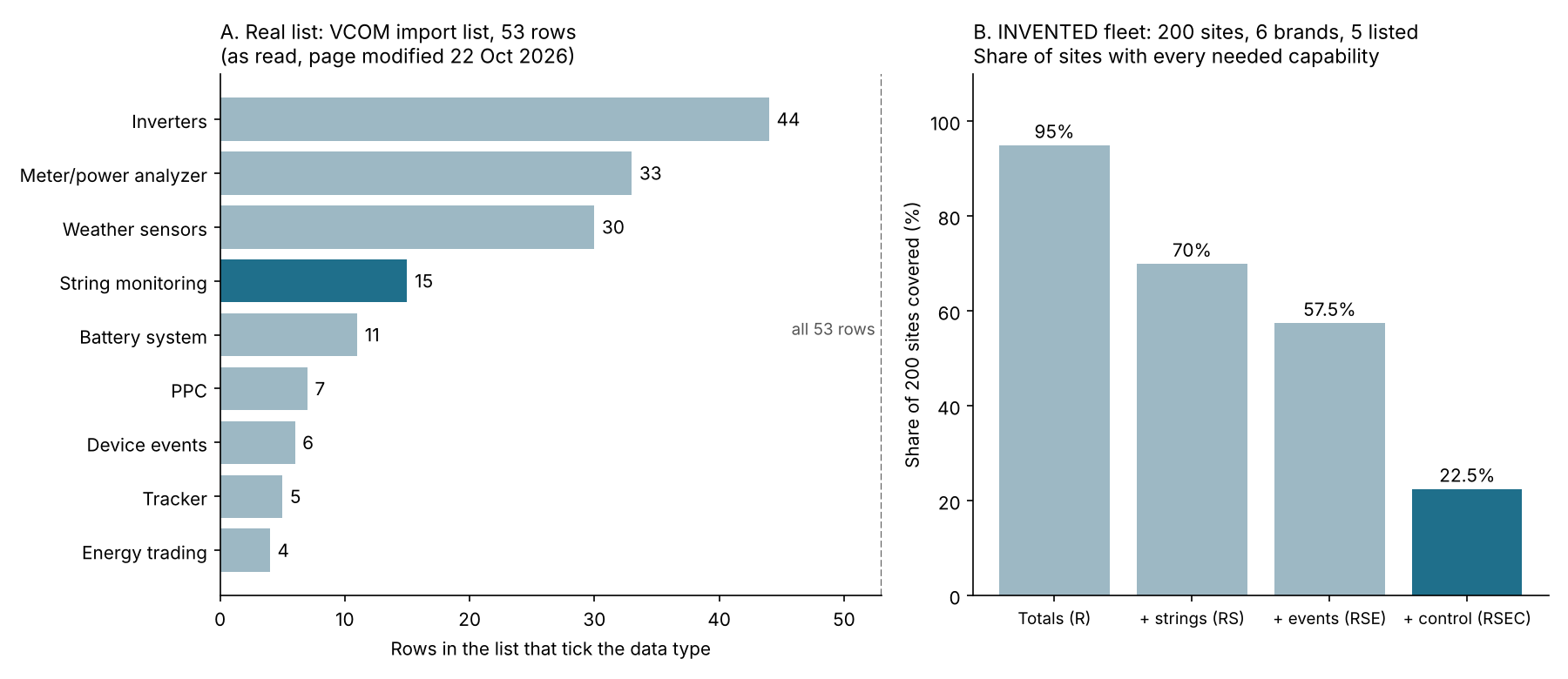
Figure 1. In VCOM’s import list, 44 of 53 rows tick inverters but only 15 of those 44 tick string monitoring. In an example 200-site fleet, a platform that lists 5 of 6 brands covers 22.5% of sites at full depth.
Worked example: 5 of 6 brands listed, 22.5% of sites at full depth
Count sites, not brands. The fleet below is example. It has 200 sites and 6 brands. We made up the features for one platform. The letters are our shorthand. R is totals. S is strings or inputs. E is device events and alarms. C is control.
| Brand (example) | Sites | Platform supports (example) |
|---|---|---|
| Brand A | 70 | R, S, E |
| Brand B | 45 | R, S, E, C |
| Brand C | 30 | R |
| Brand D | 25 | R, S |
| Brand E | 20 | R, E |
| Brand F | 10 | None |
| What you need | Brands that qualify | Sites covered (of 200) |
|---|---|---|
| Totals (R) | A, B, C, D, E | 190 (95%) |
| Totals and strings (RS) | A, B, D | 140 (70%) |
| Totals, strings and events (RSE) | A, B | 115 (57.5%) |
| All four (RSEC) | B | 45 (22.5%) |
A sales page could say "5 of 6 brands". If your team needs string alarms, the platform covers 115 sites. So 57.5% is the usable figure. Brand F’s 10 sites need another tool. The features are example. Real lists differ by model and firmware.
Calculator: fleet coverage at the depth you need
Enter your brands, site counts and the letters from the company’s own list. The starting values are the example fleet above.
Open the fleet coverage calculator on its own page if it does not load above.
How solar software handles agnostic claims
Of the four tools read in October 2026, only VCOM states depth per device. Solytic and PowerTrack use the agnostic wording but state none. "Yes" means the company’s own page says it.
| Software | Agnostic wording | Device list published | Depth stated per device |
|---|---|---|---|
| Solytic | Yes | Yes | Not stated |
| meteocontrol VCOM Cloud | Not stated | Yes | Yes |
| AlsoEnergy PowerTrack | Yes | Not stated | Not stated |
| Solar-Log WEB Enerest 4 | Partly | Partly | Not stated |
Not stated means the company page we cite does not say. Partly means the page covers only part of it.
- Solytic: Title "Hardware-Agnostic". "compatible with over 40 manufacturers". The list has 50 rows, 42 manufacturers by our count. "makes no claim to completeness". It gives the connection type per row, but data types per device are not stated. Pages: Product page, modified 2026-10-21. Knowledge article, 10 December 2025.
- meteocontrol VCOM Cloud: "Compatibility with data loggers from various manufacturers". No agnostic wording found. The import list has 53 rows. It gives up to 9 data types and an interval per row. "actual data collected may vary". Pages: VCOM monitoring page (no date printed). Import list, last updated 22 October 2026.
- AlsoEnergy PowerTrack: "As a hardware agnostic application". The page states no device list and no depth. Page: PowerTrack page (undated).
- Solar-Log: Lists "Compatibility with data loggers from other manufacturers". It names Huawei SmartLogger and meteocontrol blue’Log X-Series, and leaves others to online help. It requires FTP or MQTT and states no depth. Page: Datasheet EN 04.2026, version 6.0.
The Solytic row uses the product page for wording. It uses the dated article for the list. To compare more platforms, see the best solar monitoring software.
Common mistakes with agnostic claims
FAQs
Does hardware-agnostic mean it works with every inverter?
No. It means more than one maker. Solytic’s list makes no claim to completeness. VCOM’s list has 53 rows. Ask for the list and test your own model.
Does a Modbus port make an inverter work with any platform?
No. The platform must know the register map. The port must be on. SMA’s Modbus is off by default. SunSpec models give a shared map. But a 2015 draft says implementations need not support every control mode or option.
What does hardware-agnostic mean in solar monitoring?
It means the platform reads devices from more than one maker, such as inverters, loggers and meters. It does not count models, firmware or data types, so "over 40 manufacturers" says little about depth. By our count, Solytic’s list names 42 manufacturers across 50 rows, and your inverter’s row is the one that counts.
Is software-agnostic the same as having an API?
No. An API lets other software connect, while software-agnostic claims the tool does so with several products. Check which links exist, such as ERP or CMMS, and who maintains them.
How do I test a platform before I commit?
Pick one live site per brand. Connect it. Then compare strings, alarms and any settings you need against the inverter’s own portal. Our calculator turns the results into a site-coverage figure.
Related terms
- Company lock-in: the cost of leaving one supplier.
- Data logger and gateway: the device that reads and forwards site data.
- Fleet monitoring: watching many sites in one view.
Next step: before you commit, test one live site per brand, then shortlist from the best solar fleet monitoring software for installers.
Sources
- Solytic, Solar PV Monitoring Platform, page modified 21 October 2026 (checked October 2026).
- Solytic, data loggers and devices that work with Solytic Monitoring, last updated 10 December 2025 (checked October 2026).
- meteocontrol, VCOM import compatibility list, last updated 22 October 2026, and VCOM monitoring (no date printed) (checked October 2026).
- AlsoEnergy, PowerTrack page (no date printed, checked October 2026).
- Solar-Log, WEB Enerest 4 datasheet, EN 04.2026, version 6.0 (checked October 2026).
- SunSpec Alliance, specifications, page metadata last modified 13 October 2026 (checked October 2026).
- SunSpec, Inverter Models, document 12020, version 1.5, draft, change history 2015, no cover date relied on (checked October 2026).
- SMA, SunSpec Modbus technical information, version 1.1, no date printed (checked October 2026).
Last updated 3 November 2026. Next scheduled review: 3 February 2027.