Key takeaways
- Diagnostics reads. Configuration writes. Company documents set different gates for writes. Some state none.
- KOSTAL needs the owner to turn access on, for 24 hours or for good. Victron needs its "Full" setting. SMA needs grid operator approval for grid-relevant changes.
- Not every product has remote firmware. Victron, Solectria, Solar-Log and Sungrow list it. SMA lists automatic firmware update for the EDMM-20. KOSTAL says updates cannot be sent over its link.
- In our invented example of 500 sites, you break even when remote fixes cover 20.5% of faults. At 40%, the saving is 12,900 USD a year.
- Forescout’s post of 3 June 2025 says it counted almost 35,000 solar devices from 42 companies with exposed management interfaces, as of 9 May 2025.
To read faults and push changes from one platform, see the best solar monitoring software.
Remote diagnostics and configuration at a glance
Installers and O&M teams use a company portal or monitoring platform. Remote diagnostics reads what a device reports. Remote configuration sends it new settings. The second needs more trust than the first.
| Item | Detail |
|---|---|
| Diagnostics (read) | Events, error messages, live values, diagnostic files. Named by KOSTAL, Solectria, Solar-Log and Victron. |
| Configuration (write) | Settings, firmware, restart, grid profile, power limits. Support differs by company and model. |
| Gates seen | Owner switch. Installer role. A "Full" setting on the device. Grid operator approval for grid-relevant settings. |
| Standard or rule | No single standard found in the company documents read. SMA’s Sunny Tripower TL-30 manual requires grid operator approval for grid-relevant parameters. |
| Needs | The device online, and an internet link from each site’s logger or inverter. |
| In software | Inverter makers’ portals and monitoring platforms. See the software table below. |
Why does remote service matter for installers?
A visit costs technician time and travel. A fix from the office costs minutes. It is a trade-off, not a free win.
Tigo’s blog of 9 February 2022 says a truck roll costs about 150 to 300 USD. It ties that to a 2020 source on home costs and says commercial visits cost more. It is a company blog quoted second-hand. Use your own visit cost. The maths below uses example values.
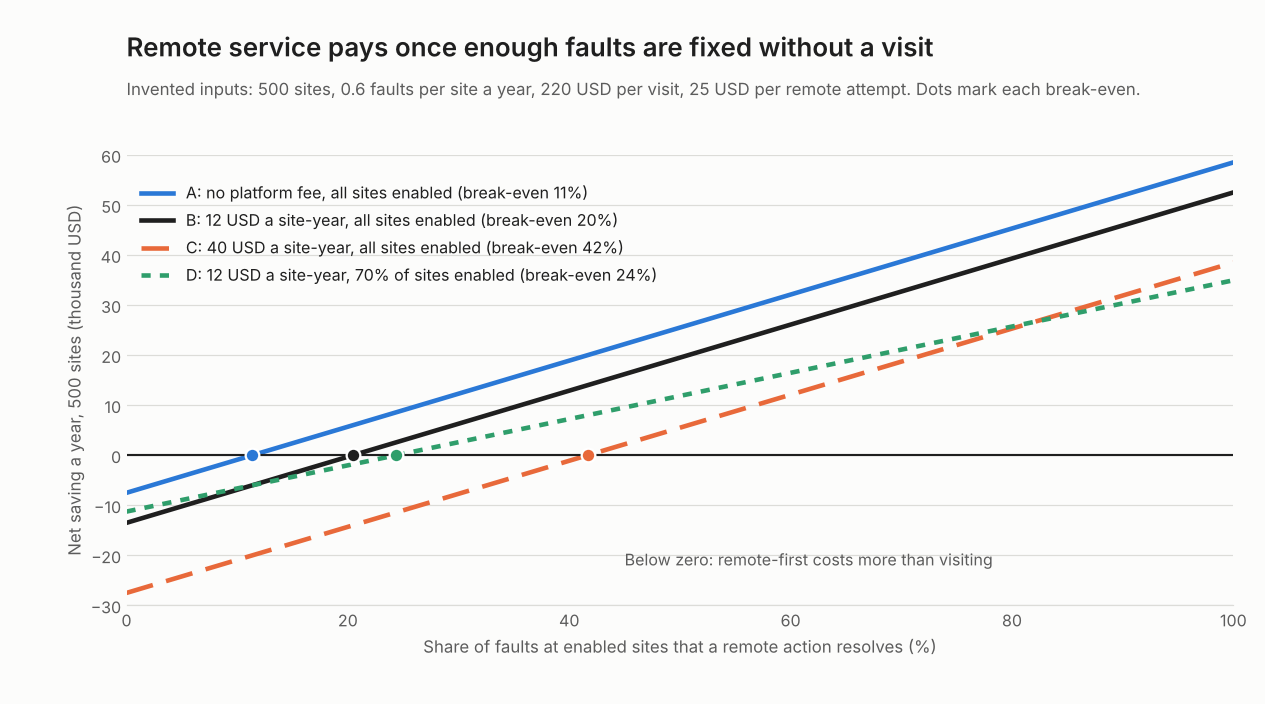
Figure 1. In example cases A to D for 500 sites, remote-first service breaks even at 11% to 42% of faults fixed remotely. The range depends on platform cost and on how many sites have access enabled.
What can an installer diagnose remotely?
An installer can read events, error messages and live values. Some products also let them pull diagnostic files. The device must be online. You see only what the device reported.
KOSTAL’s manual says an installer can read events and study faults. Its news item lists "Real-time diagnostics". Solectria’s datasheet says users can "perform diagnostics". Solar-Log lists commands for "diagnostic files". Victron’s console gives "full remote control of a GX Device".
A remote view cannot see a loose plug, dirt or a shaded string. For those, see thermal inspection. Rules that call for a check are on alerts and alarms. Data quality depends on the data logger interval.
What can an installer change remotely?
Company documents list remote changes to settings, firmware, grid profiles and power limits. Each one has conditions. No company document reviewed says how an installer changes a grid code remotely after commissioning.
The first table covers settings and firmware. The second covers grid-related changes. Each gives the company’s own words and the gate on its page.
| Change | Company | What the page says | Gate on the page |
|---|---|---|---|
| Inverter settings | Victron VRM | "Remotely change settings including Assistants in your MultiPlus, MultiPlus-II, Quattro and high power VE.Bus Inverters." | "Full" access setting on the GX device |
| Firmware | Victron | "Remotely update Victron products straight from the VRM Portal" | "Full" access setting |
| Firmware | Solectria | Users can "update firmware" | Not stated |
| Firmware | Solar-Log | "Remote commands (firmware updates, diagnostic files, ...)" | Not stated |
| Firmware | SMA EDMM-20 | "Automatic FW update of EDMM-20 and Speedwire devices via SMA Update Portal" | Not stated |
| Firmware | Sungrow iSolarCloud | iSolarCloud "supports on-click remote firmware updates" | Installers, in some areas |
Grid-related changes carry stricter gates.
| Change | Company | What the page says | Gate on the page |
|---|---|---|---|
| Grid profile at activation | Enphase, July 2023 newsletter | "the ability to select grid profile on the System Activation page, easier access to enable power production remotely" | Not stated |
| Grid-relevant parameters | SMA Sunny Tripower TL-30 | "When changing grid-relevant parameters, the SMA Grid Guard code must be available." | "The changes to the grid-relevant parameters must be approved by the responsible grid operator." |
| Fleet-wide parameters | SMA ennexOS function document, version 1.4 | "Remote parameterization of Data Manager and suitable connected devices" and "System-wide parameter adjustment of suitable connected devices" | No mention of Grid Guard in either SMA document |
| Power limit | Huawei FusionSolar manual, updated 18 August 2025 | Sets "Active Power Control" in the management system, with modes including "Grid connection with limited power" and a "Maximum grid feed-in power". | Inverter and Smart Dongle powered on and linked. No owner step named |
Not stated means the page we cite does not say. The feature may still exist. The EDMM-20 datasheet (version 10/2024) lists remote parameterisation too.
These changes come with conditions.
- Victron conditions: the remote VE.Configure page needs a GX device with Venus OS v2.17 or later and an internet link. It also needs the "Full" access setting, and the GX must be powered from the battery. VE.Bus firmware 416 and 417 cannot be configured remotely. Some changes briefly switch the unit off and on.
- Firmware conditions: Victron’s firmware page needs the "Full" access setting. Victron adds: "Stable systems should be left with their current firmware." Sungrow says the function is "mainly available to installers". It is "only available to users in a certain areas". KOSTAL says "Updates cannot be uploaded to the device via this connection."
The SMA manual and the SMA ennexOS documents are separate. They do not say how the Grid Guard rule applies to a remote change. For power limits and power factor, see SCADA and power factor and reactive power.
A failed write can strand a device. Victron says a failed VE.Direct MPPT update is unlikely, but then "it is not possible to reconfigure them remotely".
Who has to allow a remote change, and what are the risks?
KOSTAL needs the owner to switch access on. Victron needs its "Full" setting on the GX device. SMA needs grid operator approval for grid-relevant parameters. The gates differ by company.
- Owner. KOSTAL’s manual says "the inverter owner must first enable remote access on the inverter". Its news item adds a choice of 24 hours or permanent access.
- Installer role. KOSTAL’s manual names the "Installer" role. Its news item names the "Installation" role plus a "System Admin" sign-up for the customer’s system.
- Local setting. Victron needs its "Full" access setting on the GX device. Find it under GX menu, Settings, VRM Online Portal, VRM Portal.
- Grid operator. SMA’s wording is quoted above. Take the rule from your grid terms. See commissioning.
This is not legal or security advice. A Forescout post of 3 June 2025 reports 46 new vulnerabilities in solar systems. It counts "almost 35,000 solar power devices from 42 vendors with exposed management interfaces". The count uses Shodan data as of 9 May 2025.
Its research page says attackers could "tamper with their configurations" of vulnerable inverters. It says do not expose inverter management interfaces to the internet. If you must manage a device remotely, it says to "consider placing it behind a VPN".
Safeguards: written owner consent, a log of values before and after each write, and access removed when no longer needed. KOSTAL’s time-limited access helps.
How much does remote service save? Truck-roll break-even
Remote-first pays when the share of faults fixed remotely tops the break-even share. That share rises with attempt cost and platform cost. It falls as faults per site rise.
Use these terms per site per year. f is faults. e is the share of sites with access on. s is the share of faults fixed remotely at those sites. V is visit cost, A is attempt cost and P is platform cost.
- Saving = f × e × (s × V − A) − P.
- Break-even s = (A + P ÷ (f × e)) ÷ V.
A fault not fixed remotely needs exactly one visit. Every fault at an enabled site gets a remote try. A failed try still costs A.
| Input (example) | Value |
|---|---|
| Sites | 500 |
| Faults per site per year | 0.6 (case E: 0.2) |
| Visit cost V | 220 USD (inside the Tigo range, by our choice) |
| Remote attempt cost A | 25 USD (20 minutes at an assumed 75 USD an hour) |
| Platform cost P | 0, 12 or 40 USD per site per year |
| Access enabled e | 100% (case D: 70%) |
| Case | Change from case B | Break-even share fixed | Fleet saving at 40% fixed (USD a year) | At 60% fixed (USD a year) |
|---|---|---|---|---|
| A | No platform cost | 11.4% | 18,900 | 32,100 |
| B | None: P 12 USD | 20.5% | 12,900 | 26,100 |
| C | P 40 USD | 41.7% | -1,100 | 12,100 |
| D | 70% of sites enabled | 24.4% | 7,230 | 16,470 |
| E | 0.2 faults per site | 38.6% | 300 | 4,700 |
In case B, 300 visits a year fall to 180. Cost falls from 66,000 to 53,100 USD. Platform cost bites hardest at sites with few faults. Where owners do not switch access on, the saving shrinks. Count enabled sites, not installed sites. The model leaves out the cost of a wrong change, set-up time and contract penalties.
Calculator: remote-first break-even
Enter your own costs and fault rate. Presets repeat the cases above. All starting values are example. If the calculator does not load, open the remote-first break-even calculator on its own page.
How solar software handles remote diagnostics and configuration
Of the seven platforms we checked in October 2026, Victron, KOSTAL and Solar-Log document both reading and writing. SMA, Huawei and Sungrow do not document remote diagnostics on the pages read. "Yes" means the company document says it. "Partly" means it says so with limits or no detail. "Not stated" is as defined under the grid table above.
| Software | Remote diagnostics | Remote settings | Remote firmware |
|---|---|---|---|
| Victron VRM | Yes | Yes | Yes |
| KOSTAL Solar Portal (Plenticore G3) | Yes | Yes | No, per its manual |
| SMA Sunny Portal (ennexOS) | Not stated | Yes | Partly (EDMM-20 only) |
| Solar-Log WEB Enerest 4 | Yes | Partly | Yes |
| Solectria Remote Access Portal | Yes | Not stated | Yes |
| Huawei FusionSolar | Not stated | Yes | Not stated |
| Sungrow iSolarCloud | Not stated | Not stated | Partly |
What each company document says is listed below.
- Victron VRM: Diagnostics: Remote console, "full remote control of a GX Device". Configuration: Remote VE.Configure and remote firmware update. Needs the "Full" setting. Source: VRM Portal manual, no date printed.
- KOSTAL: Diagnostics: Read events, analyse faults, "Real-time diagnostics". Configuration: No firmware upload over this connection. Owner enables access. Source: Plenticore G3 manual and news item, no date printed
- SMA Sunny Portal (ennexOS): Diagnostics: not stated on the pages read. Configuration: Remote parameterisation of Data Manager and connected devices. Automatic firmware update of the EDMM-20 via the SMA Update Portal. Source: ennexOS function document version 1.4 (no date printed). EDMM-20 datasheet version 10/2024
- Solar-Log: Diagnostics: Remote commands include "diagnostic files". Configuration: yes for firmware updates, in "Remote commands (firmware updates, diagnostic files, ...)". "Remote configuration (HTTP transfer only)" is listed with no detail. Source: Datasheet, EN 04.2026, version 6.0
- Solectria: Diagnostics: users can "perform diagnostics". Configuration: users can "update firmware". Settings are not stated. Source: Remote Access Portal datasheet FL.XGI.RAP.01, 02/27/24.
- Huawei FusionSolar: Diagnostics: not stated on the pages read. Configuration: Active Power Control, including a limited-power mode, is set in the management system. Source: FusionSolar manual (inverters and SDongle), updated 18 August 2025
- Sungrow iSolarCloud: Diagnostics: not stated on the pages read. Configuration: A Sungrow article says it "supports on-click remote firmware updates", for installers, in some areas. It is a news how-to, not a manual. Source: Sungrow article, 24 October 2023
SolarEdge and Fronius are not rated because no company documentation for them is cited. To compare platforms, see the best solar monitoring software. For inverter-maker apps, see the best solar inverter monitoring apps.
Common mistakes with remote service
FAQs
Can an installer change an inverter’s grid code remotely?
Not on the evidence read: no company document says an installer can change a grid code remotely after commissioning. Enphase’s July 2023 newsletter lists grid profile selection on its System Activation page. SMA’s Sunny Tripower TL-30 manual requires grid operator approval for grid-relevant parameters. Ask the company and read your grid terms first.
Does the system owner have to allow remote access?
For KOSTAL Plenticore G3, yes. The owner turns it on at the inverter, for a set time or for good. Victron needs the "Full" setting on the GX device. The other documents reviewed do not say.
Can firmware be updated remotely?
Victron, Solectria, Solar-Log and Sungrow list it. SMA lists automatic firmware update for the EDMM-20. KOSTAL says updates cannot be sent over its link. Victron also says stable systems should keep their current firmware.
How many faults must be fixed remotely to beat a visit?
In our example case B it is 20.5%. The formula is in the maths section. The calculator takes your own costs. Sites with few faults need a higher share.
Is remote access a security risk?
Yes, if the device’s web page is open to the internet. Forescout’s post of 3 June 2025 advises against that. It suggests a VPN if you need remote management.
Related terms
- SCADA: plant control from a central system.
- Fleet monitoring: ranking many sites by performance.
- Inverter: the device you change.
Next step: before you rely on remote writes, check each company’s gate in the table above. To read faults across many sites, compare the best solar monitoring software, or the best solar inverter monitoring apps for maker apps.
Sources
All pages checked October 2026. The Victron, KOSTAL and SMA manual pages print no publication date.
- Victron VRM manual: intro, remote VE.Configure and firmware update.
- KOSTAL Plenticore G3 manual: remote access and KOSTAL news item.
- SMA Sunny Tripower TL-30: operating parameters, SMA ennexOS function document, version 1.4, and SMA EDMM-20 datasheet, version 10/2024.
- Solar-Log WEB Enerest 4 datasheet, EN 04.2026, version 6.0.
- Solectria Remote Access Portal datasheet, FL.XGI.RAP.01, 02/27/24.
- Huawei FusionSolar manual: setting parameters over the WebUI, updated 18 August 2025.
- Sungrow article on one-click firmware update, 24 October 2023.
- Enphase installer newsletter, July 2023.
- Forescout blog on exposed solar devices, 3 June 2025 as printed, and Forescout research page.
- Tigo blog on truck rolls, 9 February 2022.
Last updated 30 October 2026. Next scheduled review: 30 January 2027.