Key takeaways
- On example reads (retail 0.20, export 0.05 USD per kWh), three months cost 120 USD under net metering, 210 under net billing and 240 with no export credit.
- Net billing matches net metering when the export rate equals the retail rate on flat rates. Both cost 120 USD at 0.20.
- The netting interval changes the bill. In an example two-hour example, 15-minute netting costs 0.16 USD and hourly netting gives a 0.05 USD credit.
- Credits come as kWh, as dollars or as cash. Utah’s Schedule 137 sheet (effective 1 March 2026) carries credit forward, then it expires at period end.
- Four of the five tools in the table describe an export rate. Energy Toolbase says it models net billing but names no export-rate field. Only OpenSolar’s help and NREL’s SAM slides state a netting interval.
To model export rates and netting in software, see the best solar financial modeling software list. To show the result in a customer quote, see the best solar proposal software list.
Net billing and export tariffs at a glance
Net billing prices what you buy and what you export on their own. The export rate sets what each exported kWh is worth.
| Item | Detail |
|---|---|
| Net billing | Price imports at retail, credit exports at the export rate, add the fixed charge. |
| Net metering | Offset imports with exports and banked kWh, price what is left at retail, add the fixed charge. |
| Unit and range | Currency per kWh for each rate. NREL’s 2017 brief says the sell rate under net billing is typically less than the retail rate. NREL’s 2025 report says it is often set from an estimate of avoided utility costs. |
| Where it matters | Savings in proposals, payback, on-site use and battery design. |
| Standard or rule | No single standard. Regulators and utilities set it: Utah PSC (Schedule 137), CPUC (reported by EIA), Ofgem (Great Britain). |
| In software | A billing mode with an export rate, a netting interval and carry-over. See the software table. |
Why does the export rate matter for installers?
Under net billing, a kWh used on site is worth the retail rate. An exported kWh is worth the export rate. That split sets the saving.
A proposal that credits every export at retail overstates savings. This is so where the tariff pays an export rate. Our example costs 90.00 USD more over three months under net billing. See self-consumption and solar-plus-storage for ways to raise on-site use. The net metering page has the annual bill example and state tariffs.
How do net billing, net metering and gross metering differ?
They differ in what an exported kWh earns. They also differ in how long imports and exports are netted. NREL’s 2017 brief sets out the three in the table below.
| Arrangement | What an exported kWh earns | Netting interval |
|---|---|---|
| Net metering | A credit in kWh that offsets use in the billing cycle. Self-used and credited kWh are worth the retail rate. | Billing cycle |
| Net billing | Exports are credited at a predetermined sell rate when exported. Self-used kWh are worth the retail rate. | Instantaneous, nearly always. Denmark’s hourly netting is an exception. |
| Buy-all, sell-all (nearest to gross metering) | All generation is paid at a predetermined sell rate. Self-use is not allowed. | Not applicable |
Source: NREL, Compensation Mechanism Basics, October 2017 (NREL/BR-6A20-68469). A feed-in tariff is only a sell rate, not a billing method. See gross metering.
Energy Toolbase’s help says newer net metering is better called net billing. Its reason is that exports are worth less than imports. NREL’s January 2025 report says net billing credits exports at a unique rate. This is often from the utility costs it avoids.
The export rate can vary by time. EIA reported on 18 July 2024 on California’s net billing tariff. It pays a rate that varies by time of day. On average the rate is lower than NEM 2.0’s flat retail rate. See NEM 3.0.
In Great Britain, Ofgem says Smart Export Guarantee payments use export meter readings. Its page says rates must always be above zero. Licensees set the rate and terms.
Why does the netting interval change the bill?
The netting interval is how long imports and exports are offset before pricing. When the export rate is below retail, a longer interval nets more kWh at the retail rate.
The table uses two example hours of 15-minute reads. Hour 1 has 0.9 kWh imported and 0.9 exported. Hour 2 has 0.5 imported and 1.5 exported. Retail is 0.20 and export 0.05 USD per kWh (example).
| Netting interval | What is netted | Result (example reads) |
|---|---|---|
| 15 minutes | Nothing beyond each read | 1.4 kWh × 0.20 − 2.4 kWh × 0.05 = 0.16 USD |
| 1 hour | Hour 1: 0.9 against 0.9 kWh cancel. Hour 2: 0.5 imported, 1.5 exported, so 1.0 kWh net export | 1.0 kWh × 0.05 = 0.05 USD credit |
| Whole window, kWh credit | 1.4 kWh imported against 2.4 exported, so 1.0 kWh net export | 0.00 USD now, 1.0 kWh banked for later use |
With an export rate below retail, hourly netting saves (retail − export rate) × the kWh netted inside each hour. Here that is 1.4 × 0.15 = 0.21 USD. The table’s two results differ by the same amount. The 1.0 kWh banked is worth 0.20 USD at retail if used before it expires.
OpenSolar’s help says "Instantaneous" for net billing and "Within Billing Period" for net energy metering. SAM’s 2021 slides list an hourly time step for net billing. They list monthly kWh for net energy metering. The two sources describe different intervals for net billing, so the interval is worth comparing before the tools.
How are export credits valued and paid?
Credits arrive as kWh, as dollars on the bill, or as cash. The tariff also sets carry-over and expiry. Each changes the value.
- kWh credit: net metering banks surplus kWh. They are worth the retail rate only if you use them before they expire.
- Dollar credit: Utah’s Schedule 137 sheet (Rocky Mountain Power, effective 1 March 2026) sets a per-kWh export credit. It applies against Power and Energy Charges. Excess credit carries to the next monthly bill within the annualized billing period. Then it expires. The minimum monthly amount is still billed.
- Cash payment: Ofgem’s December 2019 guidance says renewable export must be metered. The licensee says how often it pays. No rules set the frequency.
- Expired credit: NREL’s 2017 brief says leftover net metering credit may be paid at a rate from zero to full retail. OpenSolar’s help lists a separate sell rate for it.
The seasonal Utah credits are on the net metering page. Retail prices are on tariff databases.
How do you calculate a net billing bill?
Net the reads over the tariff’s interval. Price imports at retail and exports at the export rate. Then add carry-over and fixed charges.
- Read import and export kWh for each interval or month.
- Take the retail rate, export rate and fixed charge from the tariff.
- Net the reads over the interval the tariff names.
- Price net imports at the retail rate and net exports at the export rate.
- Subtract any credit carried in. Carry surplus forward if the tariff allows it. Drop credit that expires.
- Add the fixed charge. Compare with the bill with no export credit.
Worked example: three example months, four methods
On example reads, net metering costs 120 USD over three months and net billing costs 210 USD. The gap is 90 USD. It comes from 600 exported kWh valued at 0.05 instead of 0.20.
| Input (example) | Value |
|---|---|
| Rates and fixed charge | Retail 0.20 USD per kWh, export 0.05 USD per kWh, fixed 10 USD a month, flat |
| Meter reads: import, export, used on site (kWh) | Month 1: 150, 450, 250. Month 2: 400, 100, 300. Month 3: 500, 50, 200. |
| Credits | Surplus kWh (net metering) or USD (net billing) carries to the next month. Leftover after month 3 is lost. |
| Bill (USD) | Month 1 | Month 2 | Month 3 | Three months |
|---|---|---|---|---|
| No solar | 90.00 | 150.00 | 150.00 | 390.00 |
| Solar, no export credit | 40.00 | 90.00 | 110.00 | 240.00 |
| Net billing (dollar credit) | 17.50 | 85.00 | 107.50 | 210.00 |
| Net metering (kWh credit) | 10.00 | 10.00 | 100.00 | 120.00 |
| Gross metering | 55.00 | 130.00 | 137.50 | 322.50 |
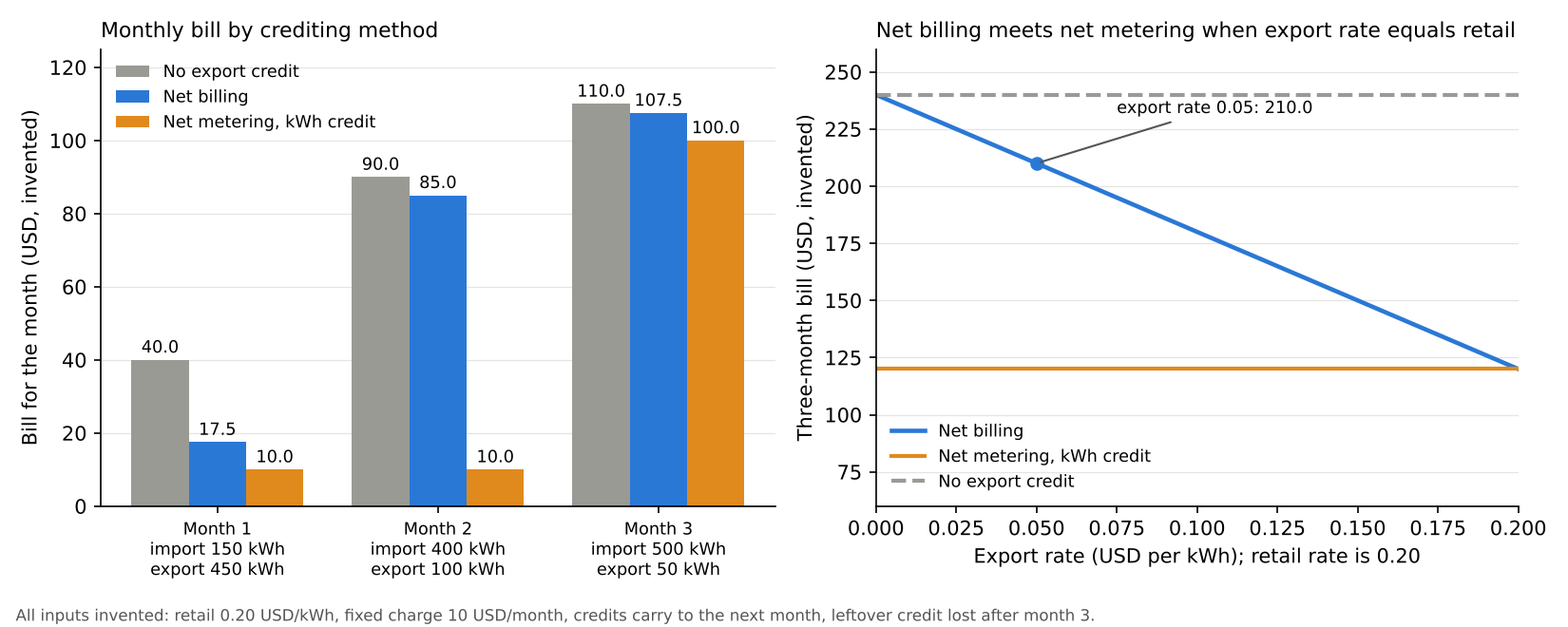
Figure 1. On example reads, net billing costs 90 USD more than net metering at a 0.05 export rate and the same at 0.20.
Gross metering sells all output at the export rate and buys all use at retail.
Month 1, net billing: 150 × 0.20 = 30.00. Less 450 × 0.05 = 22.50. Plus 10.00 fixed. That is 17.50 USD. Import and export are metered separately. So pricing monthly totals gives the same result as instantaneous netting. Under net metering, month 1 leaves 300 kWh surplus, so only the fixed charge is paid. Month 2 uses that bank up. 400 imported less 100 exported less 300 banked is zero.
Two checks:
- Without carry-over, net metering costs 180 USD. That is 60 USD more, because month 1’s 300 kWh surplus is lost.
- With a zero export rate, net billing equals the no-export-credit bill of 240 USD.
Net billing and export rate calculator
Enter up to 12 months of kWh, both rates and the fixed charge. The "Page example" button loads the values in the tables above.
How solar software handles net billing and export rates
Four of the five tools describe an export rate, but only OpenSolar and SAM state a netting interval. Energy Toolbase says it can model net billing but names no export-rate field. Solargraf mentions an hourly buyback rate, not a netting rule.
| Software | Models net billing with an export rate? | Source |
|---|---|---|
| Aurora Solar | Yes | Aurora help, Edit Existing Utility Rates, no date shown |
| OpenSolar | Yes | OpenSolar support, no date shown |
| Energy Toolbase | Not stated | ETB help, Metering Types, no date shown |
| Solargraf | Yes | Solargraf help, published 10 December 2021 |
| SAM (NREL) | Yes | NREL SAM webinar slides, 29 September 2021 |
Not stated means the company page we cite does not say.
- Aurora Solar: export rate options are retail rate, retail minus a fixed reduction, retail minus a percentage reduction, or a flat rate. The retail-rate option can represent a 1:1 credit. A true-up period sets how often excess credits expire. No netting interval stated.
- OpenSolar: Net Billing: netting "Instantaneous", with a sell rate for net excess exports. Credits are not guaranteed. Net Energy Metering and Buy All Sell All are listed too.
- Energy Toolbase: "can model any Net Metering or Net-Billing scenario, anywhere in the country." No export-rate field or interval described.
- Solargraf: its "Net Metering 3.0 (Net billing)" section says the buyback rate "is pre-defined by the CPUC" for every hour of the year. Net feed-in tariffs pay at the time of production. Gross feed-in needs two meters.
- SAM (NREL): slides list net billing and net billing with carryover, in dollars hourly, plus net energy metering in kWh monthly.
Ratings are for the pages read in October 2026 (re-read 30 October). For ranked tools, see the best solar financial modeling software list. The best solar proposal software list covers tools built for proposals.
Common mistakes with net billing
FAQs
What is the difference between net billing and an export tariff?
Net billing is a billing method that prices imports and exports on their own. An export tariff is the rate that pays for exports. It can also be the supplier product. In Great Britain, Ofgem says SEG payments use export meter readings.
Is the export rate always lower than the retail rate?
Usually. NREL’s 2017 brief says the sell rate under net billing is typically less than retail. EIA says California’s export rate varies by time of day, so check the tariff for your hours.
Do net billing credits carry over?
Sometimes, depending on the tariff. NREL’s 2025 page says you typically cannot bank kWh within a billing cycle under net billing. Utah’s Schedule 137 sheet carries dollar credits to the next monthly bill. This is within the annualized billing period. OpenSolar’s help says credits are not guaranteed.
How much less does net billing pay than net metering?
In our example, 90 USD less over three months: 210 USD under net billing against 120 USD under net metering. The gap comes from 600 exported kWh valued at 0.05 instead of 0.20.
What is the difference between net metering and net billing?
Net metering credits exports as kWh that offset use in the billing cycle. Net billing credits exports at a set sell rate when they are exported. Self-used kWh are worth the retail rate under both.
Related terms
- Net metering: credits for exports, usually in kWh at the retail rate.
- Gross metering: all output sold, all use bought.
- NEM 3.0: California’s net billing tariff for new systems.
- Self-consumption: solar used on site as it is made.
- Utility bill analysis and bill offset: reading bills and sizing solar to them.
- Behind the meter: generation on the customer’s side of the utility meter.
- Grid parity: when solar cost per kWh meets the grid price.
- Renewable portfolio standard: a state rule that sets a renewable share for utilities.
Next step: find your tariff’s export rate and netting interval, enter them in the calculator above, then compare tools in the best solar financial modeling software list.
Sources
- NREL: Grid-Connected Distributed Generation: Compensation Mechanism Basics, October 2017. Energy compensation mechanisms, last updated 28 March 2025. Rooftop Solar Deployment, Potential Electricity Rate Impacts, and the Timing of Revisions to State Net Metering Policy, January 2025. SAM webinar slides, Electricity Bill Calculator Updates, 29 September 2021.
- EIA: Today in Energy, 18 July 2024.
- Utah PSC: tariff approval letter, 23 February 2026. Also Schedule 137 sheet, filed 26 January 2026.
- Ofgem: Smart Export Guarantee page (no date shown) and SEG guidance for generators, December 2019.
- Software: Aurora. OpenSolar. Energy Toolbase. Solargraf.
Last updated 30 October 2026. Next scheduled review: 30 January 2027.