Key takeaways
- The word "meter" covers three devices: the supplier’s meter, an energy meter you fit, and bare CTs on a gateway.
- SMA’s manual says its Energy Meter is not an energy meter as defined in the EU Directive 2004/22/EC (MID). That is SMA’s own wording. The EU repealed 2004/22/EC with effect from 20 April 2016 and replaced it with Directive 2014/32/EU, but SMA’s current manual still cites the older directive.
- Arrow rules differ by product. Enphase’s consumption CT arrow points toward the loads. SolarEdge’s European guide says arrows point to the grid. Fronius says an arrow may mark either end.
- An accuracy class is not the error at low load. One maker’s table gives class 1.0 ±1.0% at rated current and ±3.0% at 5% of it, with no limit below 5%.
- In the invented day, a reversed grid CT turns 19.70 kWh of true consumption into 41.62 kWh, and derived consumption is negative in 13 of 24 hours.
To see which platforms read grid flow from a meter or CTs, see the best solar monitoring software.
Smart meter and CT clamp at a glance
A CT senses current, and a meter or gateway turns that signal into kilowatts. Most sites work out consumption from three readings.
| Item | Detail |
|---|---|
| Formula | Consumption = solar output + grid import - grid export. Import and export come from one meter or CT pair at the main feed. |
| CT signal | Fronius requires a CT that gives 333.33 mV AC at rated current. |
| Where it matters | Self-consumption, load profiles, export limits, battery control and bill checks. |
| In software | Monitoring platforms show the result. See the software table and the best solar monitoring software. |
Why do smart meters and CT clamps matter for installers?
A meter at the main feed sees only net grid flow. The platform adds solar output to get consumption. One bad CT then spoils every figure built on it.
That includes self-consumption, the load profile you use to size a battery, and any export limit. The bill check against net metering fails too. The fault can hide. By day, a reversed grid CT in our example still gives believable positive consumption. See commissioning for the test sheet.
What does each device measure?
The supplier’s meter measures what crosses the supply point for billing. A meter or CT pair you fit measures the same flow for control and monitoring.
- Supplier’s meter: Octopus Energy (Great Britain) says a generation meter "measures the amount of electricity you are generating". An export meter "helps us calculate what you might be exporting back to the grid". Without a smart meter, a site may have two meters instead.
- Installer-fitted energy meter: SolarEdge’s guide lists export+import, consumption and production roles. The export+import meter sits "at the grid connection point". Fronius calls its Smart Meter "bidirectional", for self-consumption. SMA says its meter is not an energy meter as defined in the MID. Its PV data "may deviate" from the main meter.
- CT clamp: Enphase’s gateway supports "split-core or clamp-style" CTs for consumption. It supports solid-core CTs for revenue-grade PV production metering. SolarEdge says split-core CTs "can be opened for installation around a conductor".
A "smart meter" sold with an inverter is a site meter, not the supplier’s. For export payments see MCS certification.
How accurate are CT clamps and meters?
An accuracy class sets the error limit at set currents and a rated burden. It covers the CT alone. The meter, the wiring and the solar reading add their own errors.
Clean Tech Controls says a class 0.5 CT’s error should not exceed 0.5 percent at rated current and burden. Continental Control Systems names IEC 60044-1 and IEC 61869-2 and lists these ratio limits. We could not read the standards.
| Class (Continental table) | At 100% and 120% of rated current | At 20% | At 5% | At 1% |
|---|---|---|---|---|
| 1.0 | ±1.0% | ±1.5% | ±3.0% | No limit printed |
| 0.5S (Continental groups it with 0.5) | ±0.50% | ±0.50% | ±0.75% | ±1.50% |
Continental gives one set of limits for both and labels 0.5S "extended range". The standard’s own limits for plain class 0.5 below 100% may differ, so check the current edition. Continental also cites ANSI/IEEE C57.13-2008. Company figures use other bases.
- SolarEdge’s European meter guide lists ±1.0% from 1% to 100% of rated CT current, with SE-ACT-0750 CTs. We read an earlier copy, because the file we cite would not open.
- Fronius IP page: "Class 1 (EN 62053-21)". Fronius US manual, a separate document: ±0.5% of reading, at 5% to 100% of rated CT current and power factor 1.0.
- Enphase CT-200 sheet: "accuracy class of 1%". SMA: CTs "should have at least accuracy class 1".
- Emporia: current "typically within ±2%" (CT accuracy page). Its bad-balance article says the Vue is calibrated for ±2% on whole-home kWh against a utility meter.
Low load is the weak spot. Take 240 V and unity power factor (our assumption). Then 5% of a 100 A CT is 1.2 kW. For 200 A it is 2.4 kW. This example’s night load of 0.35 kW is 1.5% of a 100 A rating. It is 0.7% of 200 A. Class 1.0 has no printed limit there.
Which way should the CT arrow point?
Follow the arrow rule in your own product’s guide. The product pages give different rules, and each product sets which direction is positive.
| Product | Arrow rule quoted | Source and date |
|---|---|---|
| Enphase | Consumption CT arrow "must point away from the utility meter and toward the loads". Production CT arrow points away from the PV, toward the PV breaker. CT-200 sheet: arrow "toward the load (away from the grid)". | Tech brief TEB-00021-4.0, April 2025 |
| SolarEdge | Install section: "arrows pointing to the grid for consumption or export measurement". Fault section (NAM guide): the arrow should point "toward the source of the power being measured". | European meter guide |
| Autarco | Each clamp’s "arrow pointing towards the grid". | Help page, undated |
| Emporia | Each 200 A CT’s arrow "must point toward the breaker, away from incoming power". | Help page, 20 August 2026 |
| Fronius | "CTs are directional." "An arrow might indicate either the load or the source (public grid)." | Smart Meter US manual |
The same pages list these symptoms.
- Enphase: "otherwise, readings will be negative". Fronius: backwards CTs, or swapped white and black wires, give negative power.
- SolarEdge (guide v2.0, November 2023) warns of it. "If showing export when the inverter is not producing, one or more CTs are in the wrong orientation."
Enphase’s brief says you can fix a backward CT by flipping meter polarity in its Installer Portal. Log any software flip on the commissioning record.
Where do export limits, storage and monitoring use them?
Each one needs the grid reading. So each inherits its errors. The grid CT or meter is the sensor for the control loop.
- Export limiting. Some operators allow PV only if "no active power is fed into the utility grid" (SMA zero-export page). It limits feed-in for SMA and third-party inverters "to 0%". Third-party inverters must connect through SunSpec Modbus. The page does not name the meter. SolarEdge says its meter is used for export limitation with third-party generators. See G98 and G99 and the interconnection application.
- Self-consumption and storage. Victron’s EM24 Ethernet manual says it can be a "Grid meter and used as control input for an ESS System". Enphase’s IQ Battery CT arrow points away from the battery, toward its breaker. See battery storage design.
- Monitoring. Emporia nets import and export within each 15-minute interval. Its mains CTs must sit upstream of the solar tie-in. So they see flow both ways. Enphase puts a load-with-solar consumption CT between the main load centre and the utility meter.
Worked example: a reversed grid CT, one example day
Every input is example. Solar is a half-sine from 06:00 to 18:00, and it peaks at 4 kW. The day total is 30.66 kWh. Load is 19.70 kWh with a 0.35 kW night base. The grid CT sign is reversed. So the meter shows import as export. The solar reading is correct. The platform derives consumption as solar + import - export.
| Reading (example day) | CT correct | Grid CT reversed |
|---|---|---|
| Solar, kWh | 30.66 | 30.66 |
| Import shown, kWh | 12.26 | 23.22 |
| Export shown, kWh | 23.22 | 12.26 |
| Derived consumption, kWh | 19.70 | 41.62 |
| Self-consumption, (solar - export) / solar | 24.3% | 60.0% |
| Hours with negative derived consumption | 0 of 24 | 13 of 24 |
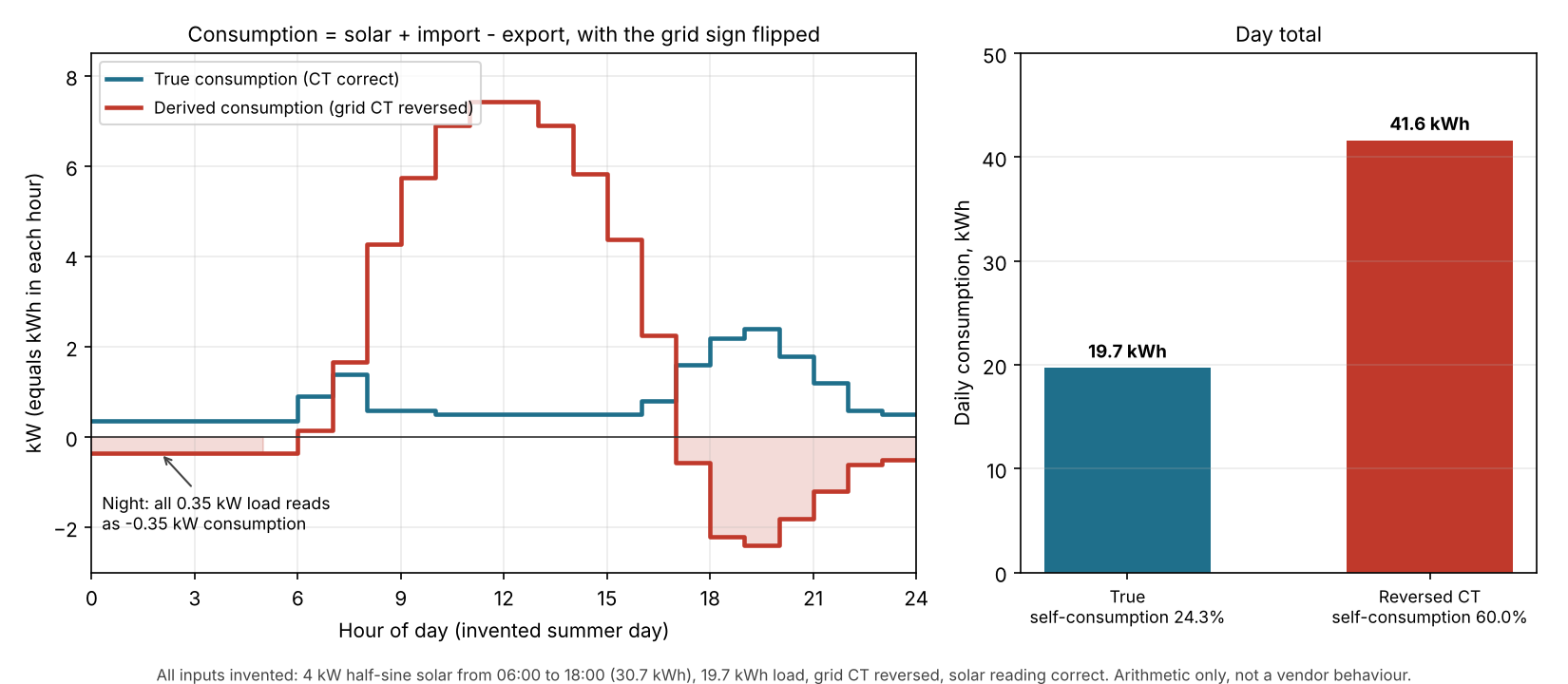
Figure 1. Flipping the grid sign makes derived consumption 2 x solar - load. It is below zero at night and 2.1 times the true day total (example inputs).
The error is 2 x (solar - load) summed over the day. Here that is 21.92 kWh. A night check catches it. With no solar, a correct meter shows import. A worst-case tolerance error is smaller. Suppose each of the three readings has an example error of 1%. All the errors go the worst way. Consumption would be out by up to 0.66 kWh (3.4%). At 2% it is 1.32 kWh (6.7%). That is maths, not a measured error.
CT and meter rating calculator
The calculator reproduces the example day and checks a rating mismatch. A meter set to 200 A with a 100 A CT reads double, because the CT gives 333 mV at its own rating.
If the calculator does not load, open the CT and meter rating calculator on its own page.
How solar software handles smart meters and CT clamps
All six platforms read grid flow through a meter or CTs, according to company hardware pages, not portal help. Arrow and sign rules differ by product, so each row needs its own commissioning check.
| Software | Reads grid flow with a meter or CTs? | What the page says |
|---|---|---|
| Enphase Enlighten | Yes | "The Enphase IQ Gateway uses a pair of clamp CTs for monitoring consumption." Up to 200 A, accuracy class of 1%. |
| SolarEdge Monitoring | Yes | Meter roles include Export+Import and Consumption. Wrong orientation shows as export when not producing. |
| Fronius Solar.web | Yes | Smart Meter at the feed-in or consumption point. 333 mV CTs. "CTs are directional". A 2020 webinar page says it can make a zero-export system. |
| SMA Energy Meter / Sunny Portal | Yes | Reads values "at the connection point". CTs above 63 A. With Sunny Home Manager, configure the meter in Sunny Portal. The zero-export page does not name the meter. |
| Victron VRM | Yes (meter) | EM24 Ethernet can be the ESS grid meter. The manual’s FAQ mentions CT support for other meters. |
| Emporia Vue | Yes | Import and export are netted in each 15-minute interval. Bidirectional should be on for solar circuits. |
The table does not rank the six platforms, because all six read grid flow. Page and date for each row:
- Enphase Enlighten: CT-200 instructions (footer Rev01-03-03-2022). Tech brief April 2025.
- SolarEdge Monitoring: European meter guide (Version 1.0, August 2019). Troubleshooting guide v2.0, November 2023.
- Fronius Solar.web: US manual (010-02112023, undated). IP page (2026 footer). Webinar, 9 December 2020.
- SMA Energy Meter / Sunny Portal: Energy Meter manual v1.6 (© 2004 to 2014). EDMM-20 zero-export page (undated).
- Victron VRM: Energy Meter manual rev 07, September 2024.
- Emporia Vue: Solar monitoring page (undated).
To rank the platforms side by side, see the best solar monitoring software. For inverter-specific apps, see the best solar inverter monitoring apps. Use solar SLD software to show the meter point on drawings. For test records, see solar commissioning software.
Common mistakes with smart meters and CT clamps
FAQs
Can a site meter replace the supplier’s smart meter?
No. SMA says its Energy Meter is not an energy meter as defined in the MID. Its PV data may deviate from the main meter. Payments follow the supplier’s or scheme’s rules.
Does split-core or solid-core matter?
Only for revenue-grade metering. Enphase’s gateway supports solid-core CTs for revenue-grade PV production metering and split-core or clamp-style CTs for consumption. It says production CT leads must not be extended for revenue-grade metering. Paralleled production CTs are no longer revenue-grade.
Where does the consumption CT go?
Upstream of the loads and, with solar, where it sees the grid flow. Enphase: between the main load centre and the utility meter. Autarco: between the grid connection and the load or inverter split. Emporia: upstream of the solar tie-in.
What happens if a CT arrow is backwards?
Readings go negative or change sign, depending on the product. In this example’s day, a reversed grid CT made consumption read 41.62 kWh instead of 19.70 kWh. Check at night: with no solar, a correct meter shows import.
Related terms
- Data logger or gateway: the device reads meters and uploads data.
- Self-consumption: the share of solar used on site.
- EV charger integration: a load that depends on the same grid reading.
Next step: once the CT sign checks out at night, see how platforms report it in the best solar monitoring software.
Sources
- Enphase, Guidelines for CT installation, TEB-00021-4.0 (April 2025, checked October 2026).
- Enphase, Installing CT-200-Clamp (footer Rev01-03-03-2022, checked October 2026).
- SolarEdge, Energy Meter with Modbus Connection installation guide (Version 1.0, August 2019, for Europe, APAC and South Africa, checked October 2026).
- SolarEdge, Meter Troubleshooting Guide NAM (version 2.0, November 2023, checked October 2026).
- Fronius, Smart Meter US operating instructions (version 010-02112023, undated, checked October 2026).
- Fronius, Smart Meter IP 5kA-3 (2026 footer, checked October 2026).
- Fronius Canada, zero export webinar (9 December 2020, checked October 2026).
- SMA, Energy Meter manual, version 1.6 (undated, checked October 2026).
- SMA, Zero export (EDMM-20) (undated, checked October 2026).
- Victron, Energy Meter manual EM24 Ethernet (rev 07, September 2024, checked October 2026).
- Emporia help: CT accuracy (28 August 2026), bad balance (20 August 2026), solar monitoring (no date). Checked October 2026.
- Autarco, common issues when installing a smart meter (undated, checked October 2026).
- Octopus Energy, generation and export meters (undated, checked October 2026).
- Continental Control Systems, CT accuracy standards (modified 18 October 2022, checked October 2026). A maker’s page, not the standard.
- Clean Tech Controls, CT accuracy class (24 March 2023, checked October 2026).
- UK legislation, Directive 2014/32/EU, Article 52 (Repeal) (checked November 2026).
Last updated 3 November 2026. Next scheduled review: 3 February 2027.