Key takeaways
- Simple rule: cell temperature = air + irradiance × (NOCT − 20) ÷ 800. At 800 W/m² and 20 °C air, the cell is at NOCT by definition.
- Three of the four datasheets read list the same 800 W/m², 20 °C and 1 m/s.
- At their 800 W/m² point, the four datasheets print 69.8% to 76.0% of the STC power.
- The rule reproduces three of those printed powers within 0.8%. It overstates the 2015 Astronergy sheet by 4.7%, which the printed tolerance does not explain.
- Invented weather (28 °C air, 700 W/m²): the cell sits at 47.2 to 50.8 °C by module. Using the air temperature instead overstates power by 5.3% to 10.4%.
pvlib and HOMER Pro document a NOCT input, and PVsyst does in part. To use NOCT in a yield model, see the best solar simulation software list.
NOCT and NMOT at a glance
NOCT and NMOT are one-number thermal ratings on a datasheet. They tell you how hot the cell runs in a standard moderate-weather test.
| Item | Detail |
|---|---|
| Formula | Tcell = Tair + G × (NOCT − 20) ÷ 800 (Penn State AE 868). G is irradiance in W/m². |
| Unit / printed range | °C, with a tolerance. Four sheets read print 42 ± 3 to 46 ± 2 °C. |
| Where it matters | Hot-day power, low-light power and yield models. |
| Standard or rule | The NREL talk (2010, earlier edition of IEC 61215) calls the 800, 20 and 1 test the IEC 61215 primary method. |
| In software | An input to a thermal model in some tools, or not used at all. |
The same NREL talk quotes 41.6 to 52.3 °C for rack-mounted silicon in California Energy Commission data.
Why do NOCT and NMOT matter for installers?
A datasheet power rating is for a 25 °C cell, but a working cell is hotter. NOCT or NMOT is the only operating temperature most sheets give you.
The ambient and cell temperature page covers the models. The standard test conditions page defines STC. This page reads the rating off real sheets and tests it.
What are the NOCT test conditions, and how do they differ from STC?
NOCT fixes the weather and lets the cell find its own temperature. STC fixes the cell temperature at 25 °C and the light at 1,000 W/m².
| Item | STC | NOCT or NMOT |
|---|---|---|
| Irradiance | 1,000 W/m² (Qcells footnote) | 800 W/m² (all four sheets and sources below) |
| Cell temperature | 25 ± 2 °C, fixed (Qcells footnote) | The result of the test, 42 to 46 °C on the sheets read |
| Air temperature and wind | Not part of the definition | 20 °C and 1 m/s (Penn State, pvlib, EEPower, three of four sheets) |
| Other details printed | AM 1.5 spectrum | AM 1.5 on the sheets. Open rack and open circuit in some sources |
Sources add test details. The NREL talk describes the test (September 2010, earlier edition of IEC 61215). It uses an open rack at a 45 degree tilt in open circuit. It notes the test does not represent module temperature under load. HOMER’s help also says no load. PVsyst’s help adds free air circulation all round and says the exact conditions are in IEC/TS 61836.
The same NREL talk says the procedure has a stated uncertainty of ±4 °C. One module measured over eight months gave 45.3 to 48.9 °C. Three modules tested side by side gave 48.9, 48.6 and 48.6 °C. Their earlier reported values were 42.4, 47.9 and 52.3 °C. Treat the printed value as nominal.
Are NOCT and NMOT the same rating?
No. The REC, Kumax and Astronergy sheets print the same 800 W/m², 20 °C and 1 m/s, but the standardised NMOT test differs. It uses a 37 degree tilt and a loaded module. Treat the NOCT rule as an approximation for NMOT.
- Dualsun’s FAQ lists NMOT at 800 W/m², 1 m/s, 20 °C and AM 1.5, "usually" 40 to 45 °C. Its title says "NMOT ex NOCT", but the body does not say NMOT replaces NOCT.
- IEC 61215-2:2021 removed the NMOT test from the 61215 series (foreword, change h). A 2026 draft record places it in IEC 61853-2. The 2026 record says NMOT is measured at (37 ± 5)° tilt with the module at maximum power. NOCT is 45 degrees, open circuit (NREL).
- One blog (TheGreenWatt, 15 April 2026) says NMOT reads 2 to 3 °C below NOCT. Nothing else read supports that, so do not apply an offset.
- As a check, the NOCT rule matches the printed NMOT power within 0.1% to 0.8% on the three NMOT sheets (see the rule-check table further down).
What does a datasheet give you?
A sheet gives a temperature with a tolerance, and often a power table at the same point. The temperature is the rating. The power is a free check on it.
| Sheet (revision as printed) | Label and value | Conditions printed | Power at the point | Pmax coefficient |
|---|---|---|---|---|
| Qcells Q.TRON BLK M-G2+ 425 W (Rev06 NA, March 2025) | NMOT 43 ± 3 °C | 800 W/m², AM 1.5 | 321.2 W | −0.30 %/K |
| REC Alpha Pure-R 430 W (UL EN 6.2025) | NMOT 44 ± 2 °C | AM 1.5, 800 W/m², 20 °C, 1 m/s | 327 W | −0.24 %/°C |
| Kumax CS3U-400MS 400 W (V5.6, October 2019) | NMOT 42 ± 3 °C | 800 W/m², AM 1.5, 20 °C, 1 m/s | 298 W | −0.36 %/°C |
| Astronergy ASM6612P 305 W (2015-05-29) | NOCT 46 ± 2 °C | 800 W/m², 20 °C, 1 m/s | 213.0 W | −0.408 %/K |
Table notes: the REC power block and the Astronergy coefficient carry no clear label on the sheet, so they are matched by position. A second REC print and the Astronergy copy were re-read and agree. The rule below assumes 20 °C and 1 m/s for Qcells, which does not print them. The Kumax sheet names Canadian Solar Inc. as maker. All four are third-party copies. See equipment datasheets for print revisions.
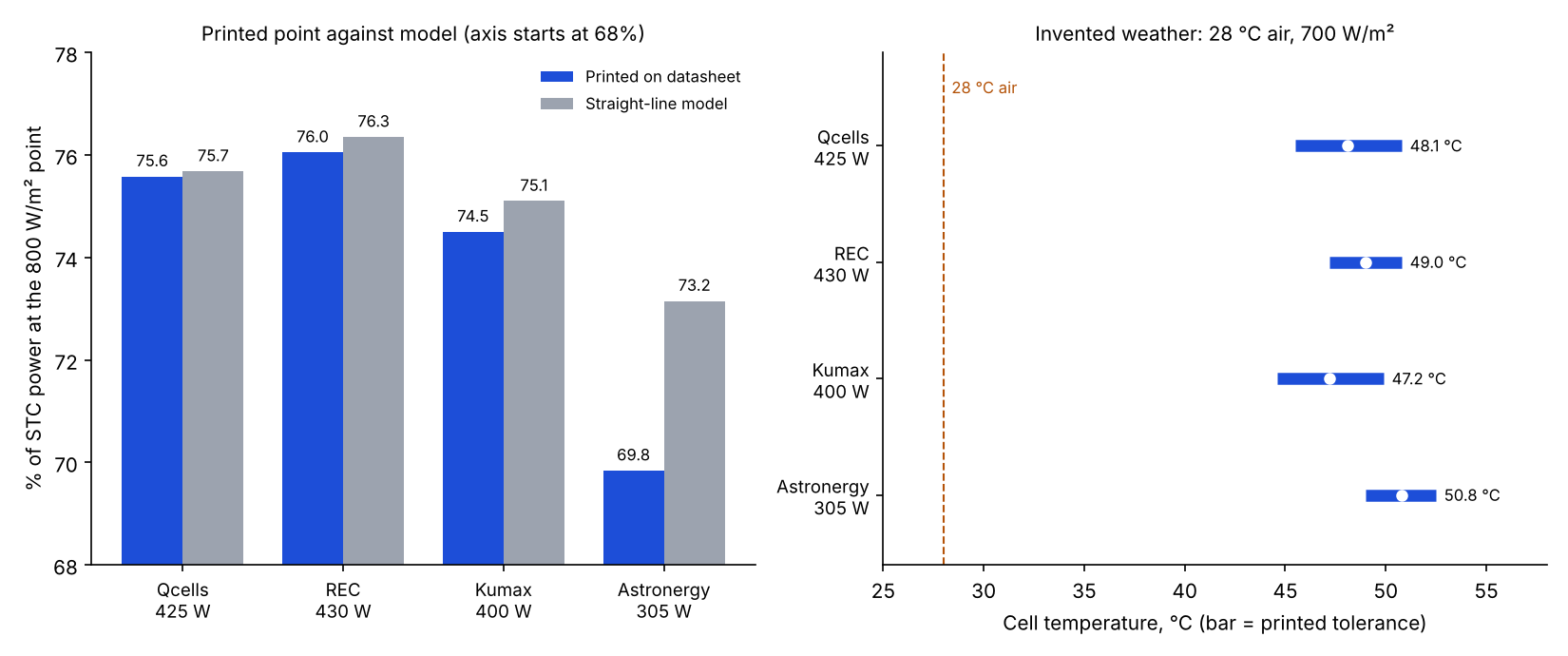
Figure 1. The straight-line rule matches three printed NMOT points within 0.8% but overstates the older Astronergy NOCT point by 4.7% (right panel uses example 28 °C air and 700 W/m²).
How do you estimate cell temperature and low-light power from NOCT?
Use the rule for cell temperature, then the Pmax coefficient for power. It is a straight-line estimate, not a model of low-light behaviour.
- Read STC power, the Pmax coefficient and NOCT or NMOT from your exact sheet print.
- Cell temperature: Tcell = Tair + G × (NOCT − 20) ÷ 800.
- Power: P = Pstc × G ÷ 1,000 × (1 + γ × (Tcell − 25)), with γ as a fraction per °C. The temperature coefficient page covers this step.
- Check the sheet: at 800 W/m² and 20 °C, the rule gives Pstc × 0.8 × (1 + γ × (NOCT − 25)). Compare it with the printed power.
The weather in the cell-temperature table further down is example (28 °C air, 700 W/m²). Pstc is the rating at standard test conditions.
| Module | Printed point, W | Rule at 800 and 20, W | Gap |
|---|---|---|---|
| Qcells 425 W | 321.2 | 321.6 | +0.1% |
| REC 430 W | 327.0 | 328.3 | +0.4% |
| Kumax 400 W | 298.0 | 300.4 | +0.8% |
| Astronergy 305 W | 213.0 | 223.1 | +4.7% |
Next, the example weather is applied to each module.
| Module | Cell at 700 W/m² and 28 °C air, °C (tolerance range) | Power, W (% of STC) | Air temperature used instead, W |
|---|---|---|---|
| Qcells | 48.1 (45.5 to 50.8) | 276.9 (65.1%) | 294.8 (+6.5%) |
| REC | 49.0 (47.2 to 50.8) | 283.7 (66.0%) | 298.8 (+5.3%) |
| Kumax | 47.2 (44.6 to 49.9) | 257.6 (64.4%) | 277.0 (+7.5%) |
| Astronergy | 50.8 (49.0 to 52.5) | 191.1 (62.6%) | 210.9 (+10.4%) |
For three sheets, the printed point lies inside the range the rule gives for the printed tolerance. For the Astronergy sheet it does not: a ±2 °C tolerance moves the rule’s answer by only about 2 W. The sheet may include low-light loss that a straight line omits, but it does not say. To match, the rule would need a coefficient of about −0.6 %/K, not the printed one.
The tolerance matters little to power. For the Qcells sheet, ±3 °C moves the cell by ±2.6 °C and power by under 1%. Mounting matters more. See ambient and cell temperature. Wind and the module’s construction shift it too.
NOCT and NMOT check calculator
The defaults are the Qcells sheet and the example weather above. For more free tools, see our best free solar calculators for installers.
How solar software handles NOCT and NMOT
On the help pages read, pvlib and HOMER Pro document a NOCT input, and PVsyst documents it in part. HelioScope and PV*SOL do not mention it. Ratings reflect what each help page documents, not a test of the model.
| Software | Does it use NOCT or NMOT? |
|---|---|
| pvlib python | Yes |
| HOMER Pro | Yes |
| PVsyst | Partly |
| HelioScope | Not stated |
| PV*SOL | Not stated |
Not stated: the help pages read do not mention NOCT or NMOT. Partly: PVsyst defines NOCT but says it is not a PVsyst parameter.
- pvlib python: the noct_sam function takes a NOCT in °C, defined at 800 W/m², 20 °C air and 1 m/s wind. It also takes module efficiency, a transmittance-absorptance default of 0.9, array height and stand-off. Source: pvlib docs page, version 0.16.2.dev8, no date printed, checked October 2026.
- HOMER Pro: the help derives cell temperature from NOCT at 0.8 kW/m², 20 °C and no load. Source: HOMER support, "pv cell temperature", updated 19 October 2026, checked October 2026.
- PVsyst: a help page defines NOCT and says PVsyst offers a NOCT derived from its own U-values. It says NOCT is not a PVsyst parameter, because it is not useful for simulated conditions. Source: PVsyst help, "NOCT definition", no date shown, checked October 2026.
- HelioScope: the Cell Temperature Model page names a Sandia model and a diffusion model. NOCT and NMOT do not appear on it. Source: HelioScope help, no date shown, checked October 2026.
- PV*SOL: the Module temperature page and the module parameters page do not mention NOCT or NMOT. The parameters page says its entries are valid only for STC. Source: PV*SOL help (2022 path), no date shown, checked October 2026.
Ranked tools that model cell temperature are in the best solar simulation software list. For the library, see pvlib.
Common mistakes with NOCT and NMOT
FAQs
What is a normal NOCT value?
There is no single normal value. The four sheets read print 42 to 46 °C. The NREL talk quotes 41.6 to 52.3 °C for rack-mounted silicon in California Energy Commission data.
How accurate is the printed NOCT?
Sheets print ±2 or ±3 °C, but the NREL talk states ±4 °C for the procedure. Its side-by-side test found three modules within 0.3 °C of each other. Their earlier reported values spanned 9.9 °C.
Does the rule include wind and mounting?
No. The simple rule has no wind or mounting term, and the test itself is on an open rack. Sandia’s NOCT page adds stand-off and wind adjustments, which the ambient and cell temperature page explains.
Is NMOT replacing NOCT?
Not in the sense of one label for the same test. IEC 61215-2:2021 removed the NMOT test from the 61215 series. A 2026 draft of IEC 61853-2 defines it, with a 37 degree tilt and a loaded module. Sheets still print either label.
Related terms
- Standard test conditions: the 25 °C, 1,000 W/m² rating point.
- Ambient and cell temperature: the models that turn air temperature into cell temperature.
- Temperature coefficient: the per-degree change in power, voltage or current.
- Vmp and Imp: peak-power voltage and current, also shown at the NMOT point.
Next step: run your own sheet through the calculator above, then see which yield models take a NOCT input in the best solar simulation software list.
Sources
- Penn State AE 868, Temperature and PV Performance Optimization (no date shown, checked October 2026).
- Sandia PVPMC, NOCT cell temperature (metadata 27 June 2023, checked October 2026).
- pvlib, temperature.noct_sam (version 0.16.2.dev8, no date, checked October 2026).
- NREL, Measuring and Modeling NOCT, NREL/PR-520-49505 (22 to 23 September 2010, checked October 2026).
- EEPower, Understanding PV System Standards, Ratings, and Test Conditions (no date shown, checked October 2026).
- Dualsun FAQ, NMOT ex NOCT values (no date shown, checked October 2026).
- iTeh, IEC 61215-2:2021 (edition 2.0, foreword and contents, checked October 2026). Its foreword item h reads "Removal of the nominal module operating test (NMOT)... from the IEC 61215 series", as also shown on the EN IEC 61215-2:2021 record, checked October 2026.
- TheGreenWatt, NMOT (15 April 2026, checked October 2026).
- iTeh, FprEN IEC 61853-2:2026 (record dated 17 September 2026, checked October 2026). The standard text is not covered here.
- Datasheets, third-party copies, checked October 2026: Qcells, REC, Kumax and Astronergy.
- HOMER, pv cell temperature (updated 19 October 2026, checked October 2026).
- PVsyst, NOCT definition (no date shown, checked October 2026).
- Not-stated rows (no date shown, checked October 2026): HelioScope, PV*SOL module temperature and PV*SOL parameters.
Last updated 30 October 2026. Next scheduled review: 30 January 2027.