Key takeaways
- The stack has five layers from the sun side. These are front glass, encapsulant film, cells, a second encapsulant film, then a polymer backsheet or rear glass.
- Three datasheets print three builds. REC prints a polymer backsheet and no encapsulant row. Solarwatt prints POE encapsulation and 2 mm rear glass. The Qcells sheet prints 1.6 mm rear glass and no encapsulant row.
- Fault terms point to layers. Browning is the encapsulant. Chalking, cracking and yellowing are the backsheet. Delamination is lost adhesion between layers.
- A cracked backsheet is an insulation fault. Owen-Bellini and co-authors, in Scientific Reports, call it a safety hazard. They also tie it to leakage currents and inverter tripping.
- IEA PVPS (2017 report) found no appropriate discolouration test in the IEC 61215 edition it reviewed. The FAQ on yellowing has the detail.
To log cracked backsheets and delamination found in the field, see best solar thermal inspection software. Before you order, ask the maker which encapsulant is used. See equipment datasheets.
Backsheet and EVA encapsulant at a glance
The encapsulant holds the layers together. The backsheet seals the rear and insulates it.
| Item | Detail |
|---|---|
| Layers | Five, sun side to rear: glass, encapsulant, cells, encapsulant, backsheet or glass (DOE). |
| Materials named in sources | Encapsulant: EVA is "the most commonly used" (TU Delft). One datasheet prints POE. Backsheet: in a 37-module field study, outer layers included polyamide, PET, PVF and PVDF, and the core was often PET. |
| Where it matters | Datasheet checks, rear-side inspection, safety triage of cracked backsheets, glass-glass choices. |
| Standard or rule | No single rule for the materials. For the IEC 61215 discolouration test, see the FAQ on yellowing (IEA PVPS 2017 report). The standard text is not quoted here. |
| In software | One thermal tool lists delamination as a finding. None of the design tools read has a field for layer materials. |
Why backsheet and EVA encapsulant matter for installers
These layers decide whether a module stays sealed and insulated for its life. That makes them a datasheet question at purchase and a safety question in the field.
IEA PVPS Task 13 writes that "in most cases the encapsulant and backsheet films seem to play a major role" in module degradation. It adds that the backsheet type "influences many degradation mechanisms". The cause is its barrier. It blocks water vapour, oxygen and acetic acid.
For O&M, rear-side faults matter in two ways. One is safety: a failed insulating barrier. The other is yield. One paper ties cracked backsheets to leakage currents and inverter tripping. For buyers, the datasheet may not name the encapsulant at all. The table below shows this.
What is in the laminate stack?
Five layers, laminated in an oven. DOE says the stack is laminated "to make the module waterproof". The rear layer is "a tough polymer backsheet or another piece of glass".
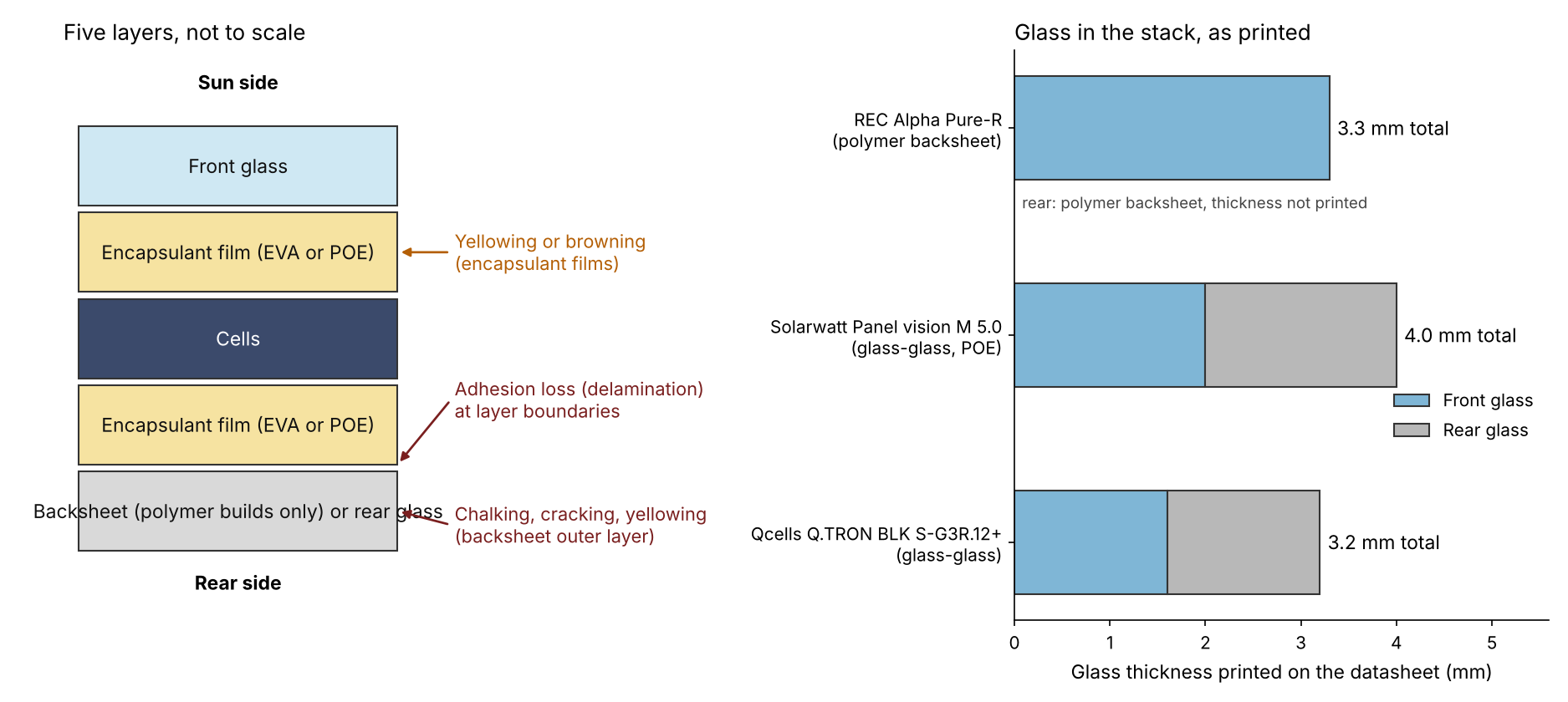
Figure 1. Fault terms map to layers. Glass totals run from 3.2 to 4.0 mm across the three sheets, and REC’s 3.3 mm is front glass only.
Encapsulant. TU Delft says the film should stay stable in heat and strong UV. It should also be optically transparent. EVA "has a refractive index very close to that of glass", so reflection losses are minimal. It comes in thin sheets. Heating to 150 °C creates cross-links that bond the module. POE is another encapsulant. The Solarwatt sheet below prints it.
Backsheet. Julien and co-authors (preprint, 22 October 2019) describe backsheets as "multilayered polymer sheets laminated to the backside of a PV module". Their jobs include electrical insulation. They also keep out liquid water. The 37 field modules in that study came from 19 makers. They covered six climate zones.
Glass-glass and bifacial. A second sheet of glass replaces the backsheet. TU Delft notes that in bifacial modules the rear surface must also be transparent. See bifacial module.
What do datasheets say about the laminate?
They print the front and rear layers. Of the three read here, only one prints the encapsulant. The rear row has three names.
| Datasheet | Front layer as printed | Rear layer as printed | Encapsulant row |
|---|---|---|---|
| REC Alpha Pure-R, US print, footer "UL EN 6.2025" | 0.13 in solar glass, anti-reflective surface | Row "Backsheet": "Highly resistant polymer (Black)" | Not stated |
| Solarwatt Panel vision M 5.0, Rev 11, 13.06.2025 | Tempered solar glass, 2 mm, anti-reflective finish | Tempered glass, 2 mm (row "Backing material") | "Solar cells in POE encapsulation" |
| Qcells Q.TRON BLK S-G3R.12+ BFG, Rev04, 2025-08 (distributor-hosted copy) | "1.6 mm thermally pre-stressed glass with anti-reflection technology" | Row "Back Cover": "1.6 mm semi-tempered glass" | Not stated |
Not stated: the datasheet does not print it.
REC’s sheet is the US print, which gives inches. Its 0.13 in of glass is 3.3 mm. Printed glass totals are 3.3 mm (front only), 4.0 mm and 3.2 mm. The modules differ in cells, size and strength. So this is no quality ranking. A missing encapsulant row does not mean EVA. Ask the maker. See equipment datasheets.
What do yellowing, cracking and delamination mean?
Each term points to a layer. Browning is the encapsulant. Chalking and cracking are the backsheet outer layer. Delamination is lost adhesion.
| Term | Layer | Suggested first step |
|---|---|---|
| Encapsulant browning | Encapsulant film | Photograph it. Note the module position and compare neighbours. |
| Acetic acid from EVA | EVA film | Cell-level damage needs imaging. See electroluminescence testing. |
| Backsheet yellowing and chalking | Backsheet outer layer | Look for cracks on the same module with close photos. |
| Backsheet cracking | Backsheet, through the film | Treat it as a safety item and escalate it. Do not log it as cosmetic. |
| Delamination | Layer boundaries | Photograph it. A thermal tool may report it as a hot spot. |
What the sources say about each term:
- Encapsulant browning. IEA PVPS: failure modes such as browning of encapsulants "are directly related to the encapsulant film". For the IEC 61215 discolouration test (2017 page), see the FAQ on yellowing.
- Acetic acid from EVA. IEA PVPS says it causes corrosion of the stringing and tabbing ribbons. The Scientific Reports paper says: "Acetic acid is a known by-product in EVA resulting from the hydrolysis of the vinyl-acetate monomers."
- Backsheet yellowing and chalking. Chalking is when the outer surface "is eroded and leaves a fine residue when wiped" (Owen-Bellini). A Solar Energy paper on polyamide backsheets from five sites linked yellowing to NO2 concentration.
- Backsheet cracking. Owen-Bellini and co-authors write: "Backsheet failure occurs when the insulating barrier is compromised, often upon the formation of cracks."
- Backsheet cracking, effects. The same paper says cracked backsheets "have also led to increased leakage currents and inverter tripping". It adds that cracking "poses serious safety hazards through arcing or electrical shocks."
- Delamination. Raptor Maps defines it as "compromised adhesion between glass, encapsulant or layers". IEA PVPS (2014 report page) lists "back sheet adhesion loss" among failure types. Julien and co-authors write: "debonding within the backsheet, and between the backsheet and adjacent layers, can occur."
These are ways faults arise in samples. They are not rates for whole fleets. Julien and co-authors studied 37 modules taken from the field. The modules were aged 0 to 28 years. The Scientific Reports paper aged two mini-modules in one stress test. The Solar Energy paper found no simple link between any single weathering factor and cracking. For a yearly output loss, see degradation rate.
How solar software handles backsheet and EVA encapsulant
Thermal tools carry the laminate finding. Design and modelling tools carry no field for the rear build. Of five tools read, one lists delamination and one folds it into hot spot causes. None has a field for layer materials.
| Software | Documents a laminate finding or field? | Method | What the page says | Page read |
|---|---|---|---|---|
| Raptor Maps | Yes (delamination only) | Remote thermal | Quoted below | Reviewing Solar Energy Anomalies. Copyright 2025, no other date. October 2026 |
| Sitemark | Partly | Remote thermal | Quoted below | Thermal anomaly types. Date stamp 22 September 2026. October 2026 |
| PVsyst | Not stated | Modelled | The module main interface and basic data pages do not mention backsheet, encapsulant, glass-glass or delamination. | Two help pages. No date shown. October 2026 |
| Aurora Solar | Not stated | Design | The Enabling Solar Components page names no module construction field. | Help article. No date shown. October 2026 |
| OpenSolar | Not stated | Design | The hardware components page names no module construction field. It lists warranty, performance and region-specific specifications as customisable component fields. | Support article. No date on the page. October 2026 |
Not stated: the company page we cite does not say. Partly: the page covers only part of the job. What the Raptor Maps and Sitemark pages say:
- Raptor Maps. A "Delamination" anomaly: "compromised adhesion between glass, encapsulant or layers". A "Cracking" anomaly (module surface) is listed too. The words backsheet and EVA do not appear.
- Sitemark. There is no separate delamination, backsheet or encapsulant anomaly type. Hot spot causes "would cover snail trails, micro-cracks, delamination, back-sheet issues, shattered glass, etc."
Ranked thermal and drone tools are in best solar thermal inspection software. For how findings are sorted, see anomaly classification.
Common mistakes with backsheet and EVA encapsulant
FAQs
Do glass-glass modules have a backsheet?
No. DOE says the rear layer is a backsheet "or another piece of glass". The Solarwatt and Qcells sheets above print rear glass, 2 mm and 1.6 mm. The Solarwatt sheet prints POE encapsulation. The Qcells sheet prints no encapsulant row, so ask the maker.
Is POE better than EVA?
Not settled for field use. In one lab test, POE did better. An MRS 2022 abstract by NLR (formerly NREL) and SLAC authors aged bifacial PERC mini-modules for 1,000 hours at 85 °C and 85% relative humidity. The bias was zero, positive or negative 1,000 V. POE-based modules lost "less than 5%" of power against "a maximum of 35%" for EVA-containing ones. That is a mini-module result, not a field result. The MRS abstract page no longer resolves, checked November 2026, so ask the maker for newer field data before relying on these figures.
Does IEC 61215 test for yellowing?
Not in the edition IEA PVPS reviewed. IEA PVPS (2017 report) says that IEC 61215 edition had no appropriate discolouration test and no pass or fail criterion. Check the current edition for visual-inspection limits. A Solar Energy paper by NLR (formerly NREL) and partners says tests such as IEC 61215 are inadequate for finding backsheet cracking. These are the sources’ words, not the text of the standard.
Where is the rear construction on a datasheet?
It is in the mechanical rows. The three sheets read call it "Backsheet", "Back Cover" and "Backing material". If a sheet has no such row, ask the maker.
Related terms
- Solar panel (module): the full set of parts, with frame and junction box.
- Junction box: the sealed box on the rear that holds diodes and cable leads.
- Bifacial module: a module that collects light on both faces.
- Thermal inspection: infrared imaging of modules to find hot spots.
Next step: look for the "Backsheet", "Back Cover" or "Backing material" row on your module’s datasheet. To log a cracked backsheet or delamination from a thermal survey, read the best solar thermal inspection software list.
Sources
All pages were checked in October 2026 and the quoted passages re-read on 30 October 2026.
- DOE, Solar Photovoltaic Manufacturing Basics (published 17 May 2021, modified 7 April 2025).
- TU Delft DelftX PV3x, Structure and Materials of PV Modules, transcript (file name says 2017).
- IEA PVPS Task 13, Assessment of Photovoltaic Module Failures in the Field (cited 22 September 2017).
- IEA PVPS Task 13, Review of Failures of Photovoltaic Modules (cited 28 May 2014).
- Julien and co-authors, Characterizing Photovoltaic Backsheet Adhesion Degradation, Part I: Field Modules (preprint, 22 October 2019).
- Owen-Bellini and co-authors, Towards validation of combined-accelerated stress testing through failure analysis of polyamide-based photovoltaic backsheets, Scientific Reports 11:2019 (2021).
- Impact of environmental variables on the degradation of photovoltaic components, Solar Energy vol. 199, NREL/JA-5K00-76275 (record shows no date).
- MRS Spring Meeting 2022 abstract, Ulicna and co-authors, bifacial mini-modules with EVA or POE (page no longer resolves, checked November 2026).
- Datasheets: REC Alpha Pure-R, US print. Solarwatt Panel vision M 5.0. Qcells Q.TRON BLK S-G3R.12+ BFG (distributor-hosted copy).
- Tool pages: Raptor Maps. Sitemark. PVsyst module main interface and basic data. Aurora Solar. OpenSolar.
Last updated 30 October 2026. Next scheduled review: 30 January 2027.