Key takeaways
- The IRS Form 4562 instructions list recovery periods from 3 to 50 years, by property class.
- MACRS sets when a business deducts the cost of an asset, not how much. On invented inputs, a front-loaded schedule and a 20-year straight-line schedule both save 250,000 USD of tax.
- Timing changes the value. At an example 8% discount rate, the front-loaded schedule is worth 200,811 USD today. The 20-year one is worth 122,727 USD.
- Depreciable basis is not always the price. The 2025 Form 4562 instructions say to subtract credits and deductions tied to the property.
- Four of the 5 tool help pages read name MACRS. The fifth, HelioScope, takes a schedule you enter.
To model MACRS or a custom depreciation schedule in a commercial proposal, see the best solar financial modeling software.
MACRS depreciation at a glance: why it matters for installers
MACRS sets how fast a US business gets tax relief on a solar asset it owns. For a commercial buyer, that timing can shift the payback. It can also shift the tax line in a proposal.
| Item | Detail |
|---|---|
| Formula | Deduction in year n = depreciable basis x the schedule percentage for year n. Tax saved = deduction x tax rate, if the owner can use it. |
| Unit and range | Percent of basis per tax year. The IRS Form 4562 instructions (2025) list 10 classes, from 3 to 50 years. |
| Where it matters | Commercial proposals and the owner’s year-by-year cash flow. |
| Standard or rule | US federal tax rules: IRS Publication 946 and the Form 4562 instructions. Both are the tax-year 2025 editions read for this page. |
| In software | Financial inputs in design and proposal tools. Some have a MACRS option. Some take your own schedule. |
Tax timing changes the owner’s cash flow. That is why installers care. A proposal with only pre-tax payback may understate the gain for an owner who pays tax. A wrong schedule overstates it. See the financial modelling page for where tax sits in a cash-flow model.
Publication 946 (Chapter 1, "Property You Own") says: "To claim depreciation, you must usually be the owner of the property." So who owns the system matters. See third-party ownership.
What is a MACRS recovery period?
The recovery period is the number of years you take to recover the cost. The IRS Form 4562 instructions (2025) split assets into classes. Each class has its own period.
The instructions’ "Recovery Period for Most Property" table lists 3, 5, 7, 10, 15, 20 and 25 years for the numbered classes. It gives 27.5 years for residential rental property. It gives 39 years for nonresidential real property. Railroad gradings and tunnel bores get 50 years. That is 10 classes.
The class is just part of the schedule. The convention sets how much of the first year counts. The Form 4562 instructions say it "determines the portion of the tax year for which depreciation is allowable". The IRS percentage tables are in Publication 946.
The 2025 IRS pages say two separate things about energy property. Solar or wind energy property that began construction after 2024 is no longer 5-year property. Separately, qualified facilities (defined by reference to section 45Y) and energy storage can be 5-year property. The two pages give different dates for the second rule, shown below. The pages read here do not say which category fits a given solar system.
| Page (2025 edition) | What it says |
|---|---|
| Form 4562 instructions | The 5-year list includes "Certain energy property specified in section 168(e)(3)(B)(vi)". |
| Form 4562 instructions | "Section 70509 of P.L. 119-21 removed solar or wind energy property from the definition of 5-year property." It applies to property that began construction after 31 December 2024. |
| Publication 946, What’s New for 2025 | The same sentence: "Section 70509 of P.L. 119-21 removed solar or wind energy property from the definition of 5-year property." It applies to "solar or wind energy property beginning construction after December 31, 2024". |
| Publication 946, What’s New for 2025 | A "qualified facility" under section 45Y(b)(1)(A), or an energy storage technology, placed in service after 31 December 2024 is 5-year property. |
| Form 4562 instructions | The 5-year list names any qualified facility and energy storage technology "and placed in service after 2025". |
Treat the class as an input to confirm with your tax adviser, not a default.
What is depreciable basis, and does a tax credit change it?
Depreciable basis is the amount the schedule works on. Publication 946 (2025) says: "The basis of property you buy is its cost plus amounts you paid for items such as sales tax."
For the Form 4562 line, the instructions (2025) start with the cost or other basis. Then they say: "From that result, subtract any credits and deductions allocable to the property." Examples include the section 179 deduction.
That paragraph gives no credit-related percentage. For the energy credit, the Form 3468 instructions (2025) have a "Basis reduction" heading under Part VI, the energy credit. Read that text before you rely on it. Our investment tax credit page covers the credit itself.
Tools differ on this. NLR’s (formerly NREL’s) SAM help page says: "SAM reduces the depreciation basis by 50% of the ITC amount as required by U.S. Internal Revenue Service rules." The statute agrees for the energy credit. Section 50(c)(3) of the Internal Revenue Code says "only 50 percent of such credit shall be taken into account" (Cornell LII). The IRS pages read here do not print the size.
OpenSolar’s setup gives "(100% - (ITC(%) * 0.5))" for percentage of basis, so SAM and OpenSolar agree on one half. HelioScope defines its depreciation basis as the "Amount of the total system price that is eligible for a depreciation schedule". It says "Currently in the US, set at 87%". It gives no reason for 87%, so do not assume it matches the one-half rule. Check the setting in your own tool.
How to calculate MACRS depreciation
- Find the depreciable basis. That is cost, less any credit-related cut you have confirmed.
- Pick the recovery class and convention. Then take the schedule percentages for that class from Publication 946.
- Multiply the basis by each year’s percentage to get the deduction.
- Multiply each deduction by the tax rate. Check that the business owes enough tax each year to use it.
- Discount each year’s saving to get a present value. Then compare with other schedules.
Worked example: same total, different value
Every input here is example. The cost is 1,000,000 USD. The tax rate is 25%. The discount rate is 8%, and savings land at the end of each year. The front-loaded schedule is example too. It is 18, 28, 22, 14, 11 and 7 percent over six tax years, adding to 100%. It is not an IRS table.
Case B uses an example 200,000 USD credit. It also uses an example 50% basis share, the setting SAM’s help describes. The credit’s own value is not counted.
Front-loaded schedules save the same total tax but are worth more today.
| Case (example) | Basis (USD) | Year-1 deduction / Year-1 tax saved (USD) | Total tax saved (USD) | Present value (USD) |
|---|---|---|---|---|
| A: front-loaded | 1,000,000 | 180,000 / 45,000 | 250,000 | 200,811 |
| A: straight-line, 20 years | 1,000,000 | 50,000 / 12,500 | 250,000 | 122,727 |
| B: front-loaded, reduced basis | 900,000 | 162,000 / 40,500 | 225,000 | 180,730 |
| B: straight-line, 20 years | 900,000 | 45,000 / 11,250 | 225,000 | 110,454 |
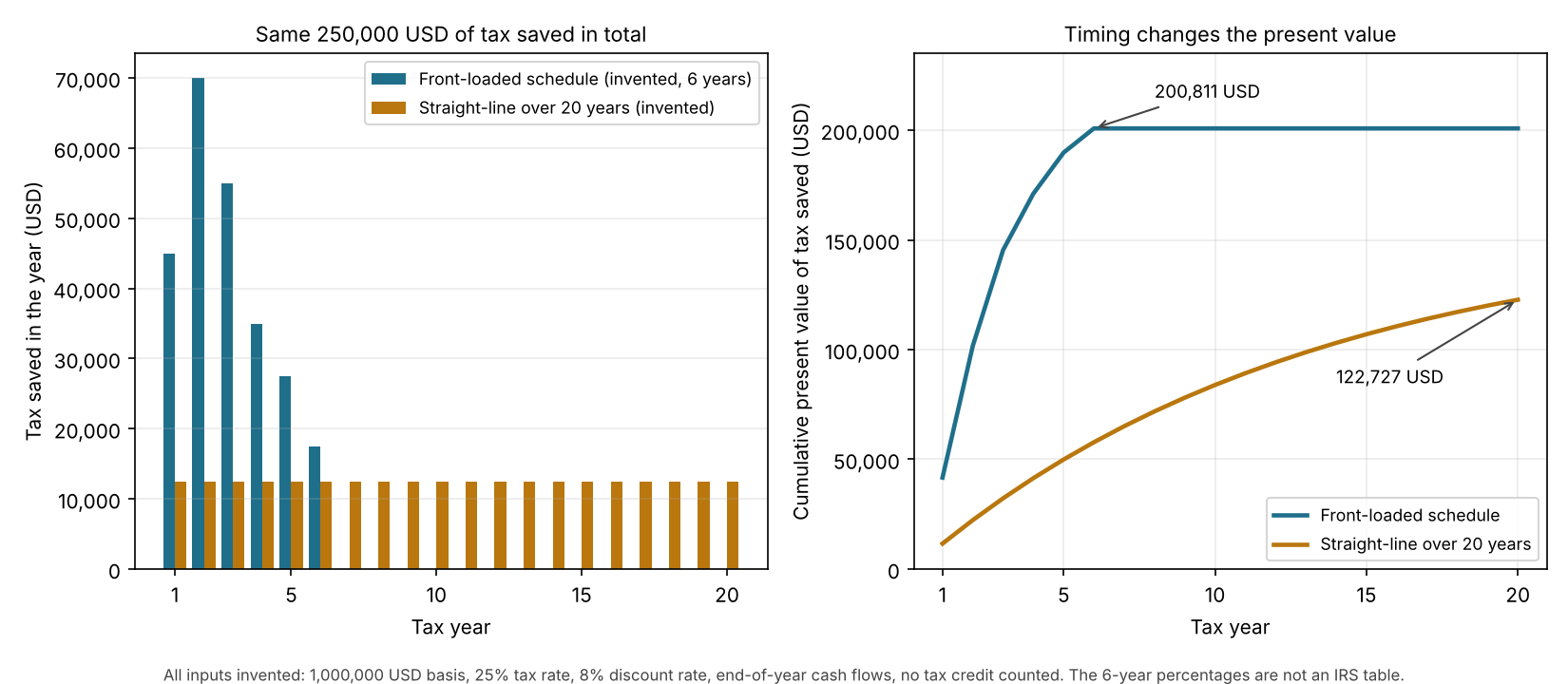
Figure 1. On example inputs, both schedules save the same 250,000 USD of tax. One is front-loaded. The other is 20-year straight-line. At 8%, the front-loaded one is worth 78,084 USD more in present value.
The gap shifts with the discount rate. In case A it is 53,356 USD at 4% and 88,475 USD at 12%. Cutting the basis by 100,000 USD cuts the total tax saved by 25,000 USD, which is 100,000 x 25%. The schedule, the tax rate and the owner’s tax room all change the result.
Test your own schedule
Enter your cost, tax rate, discount rate and schedule. The calculator opens with case A. Its basis share starts at 0, so type in any figure you have confirmed.
If the calculator does not load, open the MACRS timing calculator on its own page.
How solar software handles MACRS depreciation
Four of the five tools we checked name MACRS, and the fifth, HelioScope, takes a schedule you enter. Rows come from company help pages read in October 2026. "Yes" means the page names MACRS as something the tool models or shows. "Partly" means the page has depreciation inputs but does not name MACRS.
| Software | Names MACRS or a MACRS option? | Source and date |
|---|---|---|
| Aurora Solar | Yes | Aurora help, two articles. No date shown in the copies read |
| OpenSolar | Yes | OpenSolar support article. No date shown in the copy read |
| Solargraf | Yes | Solargraf help, "MACRs breakdown displayed within Pricing section", 20 April 2023 |
| HelioScope | Partly | HelioScope help, "How to Model Depreciation", shown 8 July 2025 |
| SAM (NLR, formerly NREL) | Yes | SAM help, depreciation page. No date shown |
- Aurora Solar: Depreciation applies to off-takers who buy the system. Options are none, straight-line (5, 15 or 20 years) and MACRS (5, 7, 15 or 20 years). A commercial export shows a depreciable basis. It uses default tax rates that an admin sets.
- OpenSolar: A "Depreciation Benefit" incentive type has fields for basis, percentage of basis, tax rate and jurisdiction. The user also enters a comma-separated depreciation percentage for each year. The page names MACRS and bonus depreciation alongside the ITC. Its example prints 5.76 for year 6 in one place. The setup steps print 5.72.
- Solargraf: Users can view a breakdown of annual MACRS payments in the Pricing section. Hover text shows the depreciation basis, bonus amount and new basis. Yearly tax savings appear below.
- HelioScope: Depreciation inputs, but the page does not name MACRS. Inputs are the effective tax rate, a year-1 bonus depreciation percentage, a depreciation basis and a schedule you set that "should add up to 100%".
- SAM (NLR, formerly NREL): Depreciation allocations by class and a 5-year MACRS option with a half-year convention. It also has bonus depreciation as a percentage. A check box cuts basis by 50% of the ITC amount. Its 5-year half-year option prints 20, 32, 19.2, 11.52, 11.52 and 5.76 percent. Confirm against Publication 946 Table A-1.
HelioScope earns only "Partly" here, not a "Yes" for its depreciation input. This column asks only whether MACRS is named. A "Yes" does not mean the tool picks the right class or basis for your project. The financial modelling page covers the wider cash-flow model. For ranked options, see the best solar financial modeling software and the best commercial solar proposal software.
Common mistakes with MACRS depreciation
FAQs
Is MACRS the same as bonus depreciation?
No. MACRS is the schedule. Bonus depreciation is an extra first-year deduction. The 2025 IRS pages call it a "special depreciation allowance": 100% for certain qualified property acquired after 19 January 2025, or an election for 40%. HelioScope applies it in year 1 as a percentage of system price, and Solargraf only in Year 1. Aurora’s help page describes bonus depreciation as 50% (enacted 2008). That differs from the 100% IRS figure above, so check the date of any company wording.
How many years is MACRS for solar?
Most installer-scale systems are still 5 years, because they claim the credit as a 45Y/48E "qualified facility," and both 2025 IRS pages keep that category on the 5-year list for property placed in service after 2024. The exception is a system that is generically "solar or wind energy property" rather than a 45Y qualified facility: the same pages removed that broader category from 5-year status for property beginning construction after 31 December 2024. Which category a given system falls in is the adviser question above, and the choice matters less than it used to, because 100% bonus depreciation is back for property placed in service after 19 January 2025.
Does the ITC reduce depreciable basis?
Yes, the Form 4562 instructions (2025) subtract credits tied to the property, but they give no percentage in that line. SAM’s undated help page and OpenSolar’s setup both use one half of the ITC. The statute, Internal Revenue Code section 50(c)(3), says only 50 percent of an energy credit reduces basis.
Does a PPA or lease customer get MACRS?
Not usually. Publication 946 says you must usually own the property to claim depreciation. So the third-party owner (lessor) claims it. NREL (2016), as cited on our ownership page, says lessors use depreciation benefits. Aurora’s help is consistent: "Depreciation is only relevant for off-takers who chose to purchase an installation, either by cash or via a loan". See third-party ownership.
Related terms
- Investment tax credit: a credit claimed by the owner against tax.
- IRA tax credits: the credits created or changed by that act.
- Net present value: how future savings are discounted to today.
- Solar incentives and rebates: how incentives reach a proposal.
Next step: if your commercial proposals need a tax-timing line, compare the best commercial solar proposal software.
Sources
- IRS Publication 946 (2025), How To Depreciate Property. "For use in preparing 2025 Returns". No day date. Sections used: Introductory Material, What’s New for 2025. Chapter 1, Property You Own. Checked October 2026.
- IRS Instructions for Form 4562 (2025). Tax-year 2025. No day date. Checked October 2026.
- IRS Instructions for Form 3468 (2025). Tax-year 2025. No day date. Checked October 2026.
- NLR (formerly NREL) System Advisor Model help: Depreciation. No date shown. Checked November 2026.
- Internal Revenue Code section 50, Cornell LII. Subsection (c)(3), basis adjustment. Checked October 2026.
- Aurora help: depreciation and Aurora help: commercial depreciation benefit. No date shown. Checked October 2026.
- OpenSolar support: depreciation-based tax benefits. No date shown. Checked October 2026.
- Solargraf help: MACRs breakdown displayed within Pricing section. Published 20 April 2023. Checked October 2026.
- HelioScope help: How to Model Depreciation. Shown 8 July 2025. Checked October 2026.
Last updated 3 November 2026. Next scheduled review: 3 February 2027. This page is not tax advice.