Key takeaways
- The IRS page says the bonus raises the investment credit rate by 10 or 2 percentage points (reviewed 23 January 2026) and the production credit by 10 percent.
- 26 USC 48E, as printed on Cornell LII, sets the US-content threshold by construction start at 40, 45, 50 or 55 percent. For calendar year 2026 it is 50 percent.
- In our example, a project at 52 percent passes in 2026 and fails after 2026.
- Notice 2025-08 gives safe harbour tables with a fixed cost percentage per listed item. Its section 11 makes it effective 16 January 2025.
- The owner certifies. The installer keeps the build date, parts list and maker records. None of the four tools checked documents the calculation.
No tool we read computes it. Try the calculator below. To model the credit change in finance, see the best solar financial modeling software and the best solar proposal software.
Domestic content bonus at a glance, and why it matters to installers
It is a higher credit rate for a project that passes a US-content test. The owner claims it, but the owner needs the installer’s parts records to do so.
| Item | Detail |
|---|---|
| What it is | An increase to the investment tax credit (ITC) or production tax credit (PTC). |
| ITC increase | The energy percentage or applicable percentage rises by 10 or 2 percentage points (IRS page, reviewed 23 January 2026). |
| PTC increase | The credit rises by 10 percent. |
| The test | The project is "built with certain percentages" of US-made steel, iron or manufactured products (IRS wording). Construction start year sets the threshold. |
| Who certifies | The taxpayer, on a certification statement filed with the annual return. |
| In software | No documented calculation on the pages read. See the software table. |
The money is large. In our example, the gap between the 10-point and 2-point versions is 32,000 USD. A parts swap after the quote can change the result. The threshold also steps up each year. A late start can lose a bonus that an early start would have kept.
The threshold values below are from section 48E. Check which section your project’s credit falls under. This page covers the bonus only. For the base credit and when construction counts as begun, see investment tax credit. For the wider picture, see solar incentives and rebates.
How does the domestic content bonus work?
The owner shows that enough of the project’s cost is US-made. If the test is met, the IRS adds points to the credit rate.
- The test. The IRS says the owner certifies the project "was built with certain percentages" of US steel, iron or manufactured products. It calls the bonus "available to taxpayers that certify their qualified facility" meets the test.
- The threshold. 26 USC 48E(a)(3)(B), Cornell LII copy, prints 40 percent for construction that begins before 16 June 2025. It prints 45 percent from that date to the end of 2025. It prints 50 percent in calendar year 2026 and 55 percent after 31 December 2026. It prints lower values for offshore wind. This page ignores them. A company blog from SolarEdge gives the same 45, 50 and 55. The statute applies the threshold to an "adjusted percentage" (26 USC 45(b)(9)(C), that text is not quoted here).
- The increase. The IRS page says the ITC rate rises "by either 10-percentage or 2-percentage points". The 10-point increase applies if any one of three things is true. The project’s maximum net output is "less than 1 megawatt". Construction began "before January 29, 2023". Or it satisfies prevailing wage and apprenticeship requirements. Otherwise it is 2 points. Your tax adviser applies them.
- The safe harbour. Notice 2025-08 "provides an updated elective safe harbor". Instead of using each maker’s direct costs, the owner may use the notice’s tables. Section 5.05 covers ground-mount solar. Section 5.06 covers rooftop solar. Sections 6.02 and 7.02 cover land-based wind and battery storage.
- The tables. Each table lists items with a fixed cost percentage. The rooftop table groups items as PV module, inverter and non-steel roof racking. Unlisted items are ignored. Listed items that are not US-made count as zero. The domestic cost percentage is the sum of the US-made listed items.
The notice modifies Notice 2023-38 and Notice 2024-41. It also says a taxpayer may use only one of the available safe harbours. See IRA tax credits for the wider law.
Worked example: three example projects
The same project can pass in one year and fail in the next. Here is a rooftop system with five example cost shares: cells 30, rest of module 26, inverter 22, rails 14 and fasteners 8, adding to 100. They are not the notice’s figures.
The later the construction start, the fewer projects pass. Only project C passes in every period.
| Construction start (threshold) | Project A | Project B | Project C |
|---|---|---|---|
| US-made items (example shares) | Inverter 22, rails 14, fasteners 8 | Cells 30, inverter 22 | Cells 30, rest of module 26 |
| Domestic cost percentage | 44% | 52% | 56% |
| Before 16 Jun 2025 (40%) | Pass | Pass | Pass |
| Rest of 2025 (45%) | Fail | Pass | Pass |
| 2026 (50%) | Fail | Pass | Pass |
| After 2026 (55%) | Fail | Fail | Pass |
Thresholds are as printed in 26 USC 48E(a)(3)(B). Project B passes in 2026 but fails if construction begins after 31 December 2026. The table tests the threshold only. IRS Notice 2025-42 ends the solar credit for a facility that begins construction after 4 July 2026 and enters service after 31 December 2027. So the "After 2026" row matters only for a project in service by then.
To run the same test on a real project, follow five steps.
- Find the notice table for your project type. Copy its items and cost percentages.
- Mark each item that is US-made. Treat any item you cannot document as not US-made.
- Add the cost percentages of the marked items. That sum is the domestic cost percentage.
- Find the threshold for the year construction begins.
- Compare the two. Then apply the 10-point or 2-point increase to the basis your tax adviser gives you.
On an example 400,000 USD basis, the 10-point version is 40,000 USD and the 2-point version is 8,000 USD. The basis is not a real eligible-cost figure.
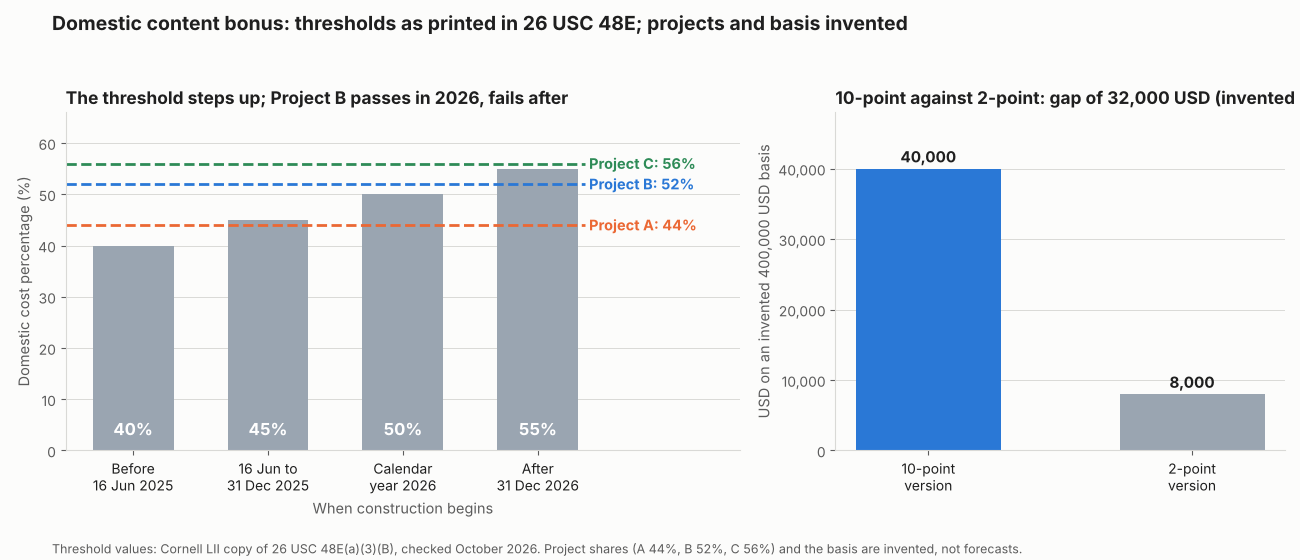
Figure 1. The printed threshold rises from 40 to 55 percent, so an example project at 52 percent passes for 2026 but not after. On the example basis, the gap between the 10-point and 2-point versions is 32,000 USD.
Domestic content threshold calculator
Enter your items, cost shares and which are US-made. It shows the percentage. It also shows the threshold for your start period and the value of the increase.
Not showing? Open the domestic content threshold calculator on its own page. It reproduces the table above. It warns on blank, negative, out-of-range or ambiguous numbers such as 1.000. It shows no pass or fail when the figure equals the threshold.
What records should an installer keep for the domestic content bonus?
The taxpayer must certify and keep the records. Installers help by keeping parts evidence the owner’s tax adviser can use.
Notice 2025-08 says the taxpayer "must meet the general recordkeeping requirements under § 6001". It also says the taxpayer states on the certification statement that it relies on the safe harbour. The notice names Form 8835 and Form 3468 for that statement. The IRS page says it goes with the return for the first year the credit is reported.
The IRS does not publish an installer checklist. These five records give the owner’s tax adviser something to work from.
- The date physical construction began, with a dated record. It sets the threshold. See investment tax credit.
- An as-built bill of materials with model numbers and quantities.
- Maker statements or datasheets that say where each listed item was made.
- Purchase orders and invoices that match the bill of materials.
- A copy of all of the above in the handover pack.
On a lease or power purchase deal, the financier may be the taxpayer. See third-party ownership.
How solar software handles the domestic content bonus
Only SubcontractorHub documents any part of domestic content, and none of the four tools describes the calculation (checked October 2026).
| Software | Documents domestic content? | Source and date |
|---|---|---|
| Aurora Solar | Not stated | Aurora help, Incentives (no date in copy read). Searched October 2026 |
| OpenSolar | Not stated | OpenSolar support, Applying Incentives to a Project (no date in copy read). Searched October 2026 |
| SubcontractorHub | Partly | SubcontractorHub help centre, "Updated over a month ago" as shown October 2026 |
| Unirac U-Builder | Not stated | Unirac resources page (no page date, footer "© 2026"), read October 2026 |
Not stated: the company page we cite does not say. Partly: the page covers a related setting but no calculation.
- Aurora Solar: the incentives help page read does not mention domestic content or a bonus rate. A search of the help site found no domestic content article.
- OpenSolar: the incentives page read tells users with a qualifying project to re-select the federal ITC. It does not mention domestic content. A search of the support site found no matching article.
- SubcontractorHub: a "Show IGS Domestic Content Toggle" setting controls whether domestic content information goes to IGS when a proposal is generated. A role permission is also needed. No calculation is described.
- Unirac U-Builder: Unirac’s domestic content page offers sales guides and sample letters. It says racking "may qualify" depending on configuration and bill of materials. It describes documents, not a calculation in U-Builder.
None of the four pages read describes a domestic cost percentage calculation. Use the calculator above as a check. Then confirm with a tax professional. Tools that carry the result into owner finance are ranked in the best solar financial modeling software list.
Common mistakes with the domestic content bonus
FAQs
Is the domestic content bonus the same as a pricing adder?
No. This bonus is a tax credit increase claimed by the project owner. A pricing adder is an extra charge on a quote. People also call this bonus the domestic content adder. Check which one a speaker means.
Who files the domestic content certification?
The taxpayer. The IRS page says the taxpayer files the certification statement with the annual return. This is for the first year the bonus is reported. Notice 2025-08 names Form 8835 and Form 3468 for it.
What is the domestic content threshold for 2026?
26 USC 48E(a)(3)(B), as printed on Cornell LII, gives 50 percent for construction that begins during calendar year 2026. It gives 55 percent after 31 December 2026. Check the current text before you quote it.
Does the safe harbour guarantee the bonus?
No page read says so. Notice 2025-08 lets a taxpayer elect it and requires records under section 6001. Whether a project qualifies is a tax question for the owner’s adviser.
What counts as US-made?
The IRS page says the steel, iron or manufactured products were mined, produced or manufactured in the United States. The notice’s tables list which items count for each project type.
Related terms
- Investment tax credit. The base credit that the bonus increases.
- Solar incentives and rebates. The four common types and how to check each one.
- Bill of materials. The parts list that backs a domestic content claim.
Next step: put your domestic cost percentage into the owner’s cash flow with the best solar financial modeling software or the best solar proposal software.
Sources
- IRS, Domestic content bonus credit (page last reviewed or updated 23 January 2026, checked October 2026).
- IRS Notice 2025-08, First Updated Elective Safe Harbor for the Domestic Content Bonus Credit (sections 3, 5.05, 5.06, 9, 10 and 11). Section 11 gives 16 January 2025 as the effective date. Taxpayers may rely on it until 90 days after any change. The copy read prints no release date, but National Law Review (21 January 2025) reports its release on 16 January 2025 (checked 30 October 2026).
- IRS Notice 2025-42, beginning of construction for wind and solar facilities (section 1, checked 30 October 2026).
- 26 USC 48E, Cornell Legal Information Institute copy (subsection (a)(3)(B), thresholds confirmed 30 October 2026, no currency date printed, history to Pub. L. 119-21).
- 26 USC 48, Cornell Legal Information Institute copy (subsection (a)(12), 2 and 10 percentage points, checked October 2026).
- SolarEdge blog, H.R. 1 domestic content requirements (company blog, dated 06-11-2025 as printed, used to cross-check 45, 50 and 55 percent, checked October 2026).
- SubcontractorHub help centre, how to enable the domestic content toggle for IGS Solar (checked October 2026).
- Unirac, Domestic content resources (company page, checked October 2026).
- Aurora Solar help, Incentives and OpenSolar support, Applying Incentives to a Project (checked October 2026).
Last updated 30 October 2026. Next scheduled review: 30 January 2027.