Key takeaways
- IP65 is dust-tight and protected against water jets. IP67 is an immersion rating, not a stronger IP65.
- Water digits 7 and 8 are immersion tests. Only a dual code such as IP66/IP67 shows jet resistance as well.
- NEMA’s FAQ says it is "not possible to state that an IP degree rating is equivalent to a NEMA Type designation".
- One maker can print different codes on different sheets. Enphase’s IQ8P-3P sheet prints NEMA Type 6/IP67, but its IQ8M and IQ8A sheet shows no IP code in the text read.
- None of the four tools’ help pages names an IP field, so the code belongs in your bill of materials.
To compare a printed code against a datasheet, see equipment datasheets, then test it in the calculator below.
IP rating at a glance
An IP rating states which dust and water tests an enclosure passed. It is printed on datasheets as IP followed by two characters.
| Item | Detail |
|---|---|
| Format | IP, then a solids digit, then a water digit. X replaces a digit that was not rated. There are 70 two-digit codes. |
| Standard | IEC 60529, "Degrees of protection provided by enclosures (IP Code)". Edition 2.2 (2013) was read. It covers equipment rated up to 72.5 kV. |
| Where installers see it | Inverter manuals and datasheets, module junction boxes, combiner and disconnect enclosures. |
| Not covered | Icing, corrosion and similar tests. NEMA Types address those. IP ratings do not. |
| In software | No IP field named on the help pages read. See the software section. |
Why the IP rating matters for installers
The IP code tells you which dust and water tests a part passed. It is the first filter when you choose where a part can sit.
The water digit matters most. A part tested against jets and a part tested against immersion passed different tests. Mix them up and you pick the wrong equipment.
On US jobs the code may not be enough. NEMA’s enclosure FAQ says NEC 110.28 states: "IP ratings are not a substitute for Enclosure Type ratings". That is NEMA’s account of the code. We could not open the NEC text, so confirm it in the edition your authority having jurisdiction (AHJ) enforces. For module boxes, see junction box, which shows how two IP68 claims differ.
How to read an IP code
Read the first digit as solids and the second as water. A higher number means a different test. For water, it is not always a harder one.
| Digit | First digit: solids | Second digit: water |
|---|---|---|
| 0 | No protection | No protection |
| 1 | Objects over 50 mm | Vertical drips |
| 2 | Objects over 12.5 mm | Drips, enclosure tilted up to 15 degrees |
| 3 | Objects over 2.5 mm | Spray up to 60 degrees from vertical |
| 4 | Objects over 1 mm | Splashing from any direction |
| 5 | Dust-protected | Jets, 6.3 mm nozzle. 12.5 L/min. At least 3 minutes |
| 6 | Dust-tight | Powerful jets, 12.5 mm nozzle. 100 L/min. At least 3 minutes |
| 7 | Not used | Immersion up to 1 m for 30 minutes |
| 8 | Not used | Continuous immersion. Depth and time agreed with the maker |
| 9 | Not used | Hot, high-pressure spray (not handled on this page) |
- X: an X means that digit was not rated. IPX4 has a splash rating and no solids rating.
- Jets are not graded evenly: digit 6 uses 8 times the flow of digit 5 (100 against 12.5 L/min).
- Dual codes: IEC 60529 lets a part carry two codes if it passed both jets and immersion, such as IPX5/IPX7. Read a dual code as one combined rating.
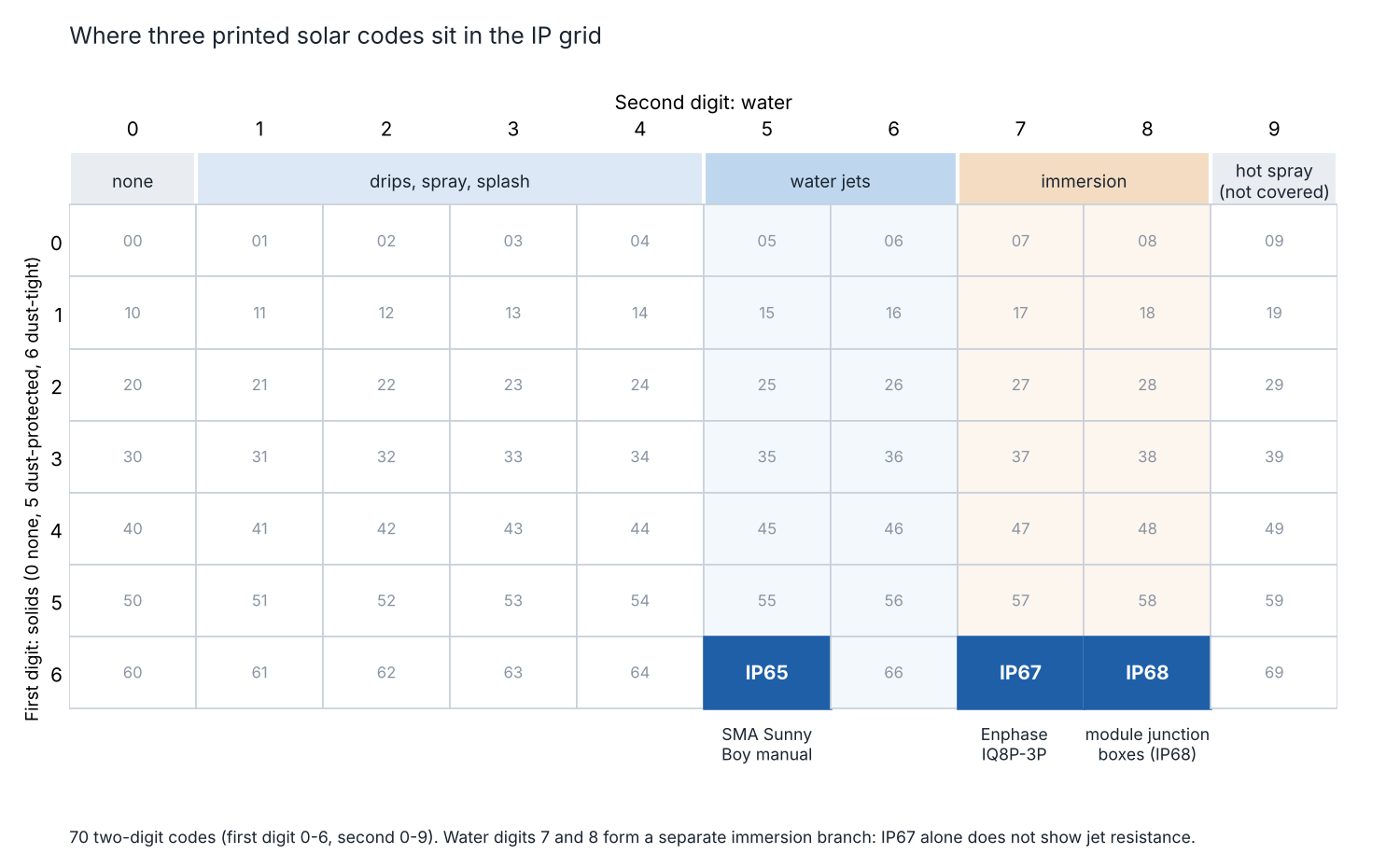
Figure 1. Water digits 7 and 8 sit on a separate immersion branch, so IP67 is not a stronger IP65. The SMA, Enphase and junction-box codes are examples, not a survey.
Worked check: does the printed code fit the site?
Compare each code with what the site needs. IEC 60529 says a digit up to 6 implies all lower ones. A part rated only 7 or 8 is unsuitable for water jets unless a second code covers them.
| Printed code | Example site need | Result | Why |
|---|---|---|---|
| IP65 | Solids 5 or more. Jets | Meets | Solids 6. Water 5. |
| IP65 | Solids 5 or more. Temporary immersion | Does not show | Water 5 is a jet test. |
| IP67 | Solids 5 or more. Jets | Does not show | Water 7 is an immersion test. |
| IP66/IP67 | Solids 6. Jets | Meets | The IP66 part covers jets. The IP67 part covers immersion. |
| IPX4 | Solids 5 or more. Splashing | Does not show | X means solids were not rated. |
| IP68 | Solids 6. Continuous immersion | Meets on the code | Depth and time are the maker’s. Read the sheet. |
The rows use the same rules as the calculator below. They compare printed codes only. They are not the IEC test.
IP code check calculator
Enter a printed code and a site need, and the calculator says whether the code shows it.
What do datasheets print next to the IP code?
Makers print the IP code, a NEMA Type, or both. The line changes by model and by sheet, so read the one for your model.
| Document | Printed |
|---|---|
| SMA Sunny Boy manual, SBxx-1AV-41 data page | "Degree of protection for electronics in accordance with IEC 60529: IP65". A separate line gives protection class I under IEC 62109-1. |
| SMA Sunny Boy manual, SB30-50TL-21 symbols page | "Degree of protection IP65: The product is protected against dust intrusion and water jets from any angle." |
| Enphase IQ8M and IQ8A sheet, DSH-00243-3.0-EN-2024-12-10 | "NEMA Type 6/Outdoor". No IP code in the text read. |
| Enphase IQ8P-3P sheet, DSH-00236-8.0-EN-2026-06-04 | "NEMA Type 6/IP67" on the environmental line, which begins "Outdoor". |
A NEMA Type also covers icing and corrosion, which is why a sheet may print one, the other or both.
How solar software handles IP rating
We found no IP field on the help pages of Aurora Solar, OpenSolar, HelioScope or SolarAPP+, so the code stays on the datasheet. The table shows only what those pages name, not what each library stores inside.
| Software | IP field named? | What the pages say | Pages read, October 2026 |
|---|---|---|---|
| Aurora Solar | None named | The Components page lists properties by component type, such as "Properties: none" for string inverters. No IP or NEMA property. | Components page, no date shown. API "List Inverters" page, modified 21 April 2026, lists no fields. |
| OpenSolar | None named | The inverter CSV fields are code, id, cost, price and labour adjustments, and ids. No IP field. | Import and export page and add-components page, no date shown. |
| HelioScope | None named | Staff add parts from an emailed manufacturer spec sheet. No IP or NEMA value named. | Upload page, no date in the text read. |
| SolarAPP+ | None named | The article says the CEC List holds equipment meeting standards "required for installation in California". No IP or NEMA rating named. | Help article, last updated 10 October 2025. |
None named means the pages we read show no IP or NEMA field. Until a tool names one, put the code and NEMA Type in your bill of materials. To see which design tools hold equipment libraries, read the best solar design software list.
Common mistakes with IP ratings
FAQs
What does IP65 mean?
IP65 means the part passed the top dust test and the water-jet test. SMA’s manual describes IP65 as protection against "dust intrusion and water jets from any angle".
Is IP67 better than IP65?
Not in every respect. Digit 7 is a test of temporary immersion. IEC 60529 treats a part with only 7 or 8 as unsuitable for water jets. RS Components says such parts "need not necessarily meet" the IPX5 and IPX6 criteria. A dual code such as IPX5/IPX7 covers both.
What does the X in IPX4 mean?
The X means that digit was not required or rated. IPX4 has a splash rating and no solids rating.
Is an IP rating the same as a NEMA rating?
No. NEMA’s enclosure FAQ says it is "not possible to state that an IP degree rating is equivalent to a NEMA Type designation". See equipment datasheets.
Which IP rating do inverters and junction boxes need?
The maker’s manual for your model sets the answer, and the mounting place sets the need. SMA lists IP65 for the Sunny Boy. Enphase lists NEMA Type 6/IP67 for the IQ8P-3P. For IP68 module boxes, see junction box.
Related terms
- Junction box: the sealed box on a module that holds the bypass diodes.
- Inverter: the device that converts DC to AC.
- String inverter: one inverter for several module strings.
- Microinverter: a small inverter at each module.
- Combiner box: the enclosure that joins string circuits.
Next step: copy the code and NEMA Type from your exact model’s sheet into your bill of materials. Then see which tools hold equipment libraries in the best solar design software.
Sources
- IEC 60529 edition 2.2, public incorporation-by-reference copy, dated 2013-08 as printed (checked October 2026).
- ANSI Webstore, IEC 60529 Ed. 2.2 b:2013 listing (checked October 2026).
- Tameson, IP rating chart, published 15 January 2025, modified 8 October 2025 (checked October 2026).
- RS Components, IP ratings, published 6 January 2023, modified 21 June 2024 (checked October 2026).
- NEMA, FAQ on enclosures, undated. FAQ 11 and FAQ 19 read on 30 October 2026. The NEC text itself was not read.
- SMA, Sunny Boy SBxx-1AV-41 general data and SB30-50TL-21 product overview, no date shown (checked October 2026).
- Enphase IQ8M and IQ8A data sheet and IQ8P-3P commercial data sheet, revision codes as printed (checked October 2026).
- Aurora, Components and API, List Inverters (checked October 2026).
- OpenSolar, import and export hardware and add hardware components (checked October 2026).
- HelioScope, upload new modules and inverters (checked October 2026).
- SolarAPP+, CEC List article, last updated 10 October 2025 (checked October 2026).
Last updated 30 October 2026. Next scheduled review: 30 January 2027.