Key takeaways
- The US Department of Energy lists four jobs. They are to change DC to AC, ride through small grid disturbances, handle reactive power and report data.
- Seven datasheet limits decide whether a layout fits: maximum voltage, MPP range, start-up voltage, input current, rated AC power, maximum PV power and temperature range.
- In the worked example, an SMA SB5.0-1AV-41 with a 500 W module fits strings of 7 to 13 modules (estimated), using news-reported stand-in temperatures for Canberra.
- Current catches large modules. The sheet allows 2 strings per input, but one 500 W string draws 14.98 A of 15 A. Two would draw 29.96 A.
- Four of the five design tools we read document a voltage check. Only KACO’s documents a current check.
To check string length and voltage limits in software, see the best solar design software.
Inverter at a glance
The inverter sits between the modules and the AC supply.
| Item | Detail |
|---|---|
| What it does | Converts DC to AC, tracks the maximum power point, supports the grid and reports data. |
| Types | String, central, microinverter and hybrid (battery-capable). |
| Limits designers read | Seven. SMA SB5.0-1AV-41 example: 600 V, 175 to 500 V, 125 V, 15 A, 5,000 W, 7,500 Wp, -25 to +60 °C. |
| Standard or rule | No single design standard. The datasheet sets the limits. A grid code can change rated power: SMA lists 4,600 W for this model under VDE-AR-N 4105. |
| In software | Design tools warn on voltage and, less often, current. Simulators model the loss when the array exceeds the AC rating. |
Why does inverter choice matter for installers?
A layout outside the inverter’s limits loses energy or needs rework on site.
PVsyst’s help treats the maximum input voltage as a hard limit. It treats the MPP window as a softer one. A string outside it causes small losses. The string sizing, MPPT and DC/AC ratio pages cover the detailed methods. This page covers the datasheet as a whole.
What does an inverter do?
It changes DC to AC. Modern units also track the power peak, support the grid and report data.
- Convert: it turns the direct current from a solar panel into alternating current (DOE).
- Track: each input follows the voltage where its power is highest. See the MPPT page. DOE does not cover this job.
- Support the grid: small inverters are generally expected to ride through small voltage or frequency disruptions, and modern ones can provide and absorb reactive power (DOE).
- Report: inverters can monitor the system and provide a portal for communication with computer networks (DOE). See the best inverter monitoring apps.
What types of inverter are there?
Four matter in design: string, central, microinverter and hybrid. They differ in how many modules share a unit.
- String: one inverter takes a set of panels, a string (DOE). Our example is this type. See string inverter.
- Central: every panel attaches to a single central inverter (DOE). No central inverter datasheet is used here.
- Microinverter: a smaller inverter sits on every panel (DOE). There is no series string, so limits move to each module and AC branch. See microinverter and MLPE.
- Hybrid: a string inverter that also connects a battery. DOE does not name it as a type. See hybrid inverter and AC and DC coupling.
Which datasheet numbers do designers check?
Seven limits, each tied to a different part of the layout. Values are for the SMA SB5.0-1AV-41, from SMA’s online manual. A 10/2023 datasheet agrees where it prints the same items.
| Datasheet limit | What it limits | SB5.0-1AV-41 | Design check |
|---|---|---|---|
| Maximum DC input voltage | Open-circuit voltage of a string | 600 V | Modules × cold Voc stays under it |
| MPP voltage range | Where the tracker holds full power | 175 to 500 V | Hot Vmp above the floor, cold Vmp under the ceiling |
| Start-up voltage | When the inverter begins to feed in | 125 V | Modules × hot Voc above it |
| Maximum input current. Maximum short-circuit current | Current on one MPP input | 15 A. 20 A | Parallel strings × Imp. × Isc |
| Rated AC power | The output cap. The ratio’s denominator | 5,000 W (4,600 W under VDE-AR-N 4105) | Array kWp ÷ AC kW |
| Maximum PV array power | Largest array the maker allows | 7,500 Wp | Modules × watts |
| Operating temperature range | Ambient air the unit is rated for | -25 to +60 °C | Site extremes sit inside it |
Efficiency. The sheet prints two figures for one unit: 97.0% maximum and 96.5% European weighted. The standard that sets the weights is not covered here. So compare like with like: European with European, CEC with CEC.
Derating and the 20 A figure. The datasheet gives an operating range but no derating curve. The maker can supply the curve. SMA’s manual calls 20 A the short-circuit limit per input. The French datasheet calls it a per-string limit.
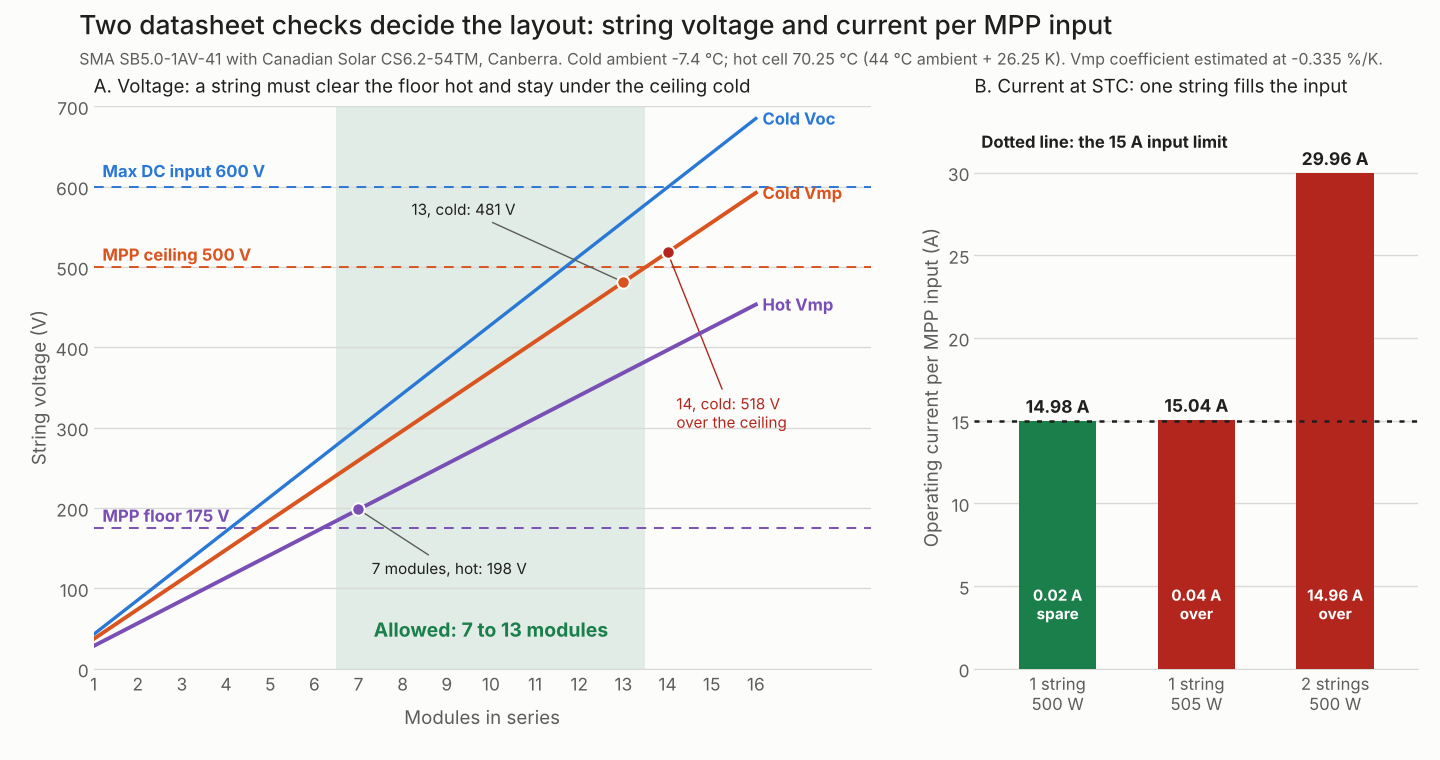
Figure 1. Strings of 7 to 13 modules fit this inverter. But one 500 W string already fills the 15 A input.
Worked example: a Canadian Solar 500 W module on an SMA SB5.0 at Canberra
This is a design exercise with stand-in temperatures from Canberra news pages. SMA’s guide for this inverter lists EU and UK declarations of conformity, so the page does not check approval or grid-code rules for Australia.
| Input | Value | Source |
|---|---|---|
| Inverter | SB5.0-1AV-41: 600 V. MPP 175 to 500 V. Start 125 V. 15 A and 20 A per input. 2 inputs. 7,500 Wp. 5,000 W | SMA online manual, SBxx-1AV-41 technical data (no revision shown). Datasheet SB30-60-DS-fr-61, 10/2023 |
| Module | CS6.2-54TM-500: Voc 39.6 V. Vmp 33.4 V. Isc 16.00 A. Imp 14.98 A. Coefficients: Voc -0.25, Isc +0.045, Pmax -0.29 %/K. NMOT 41 ± 3 °C | Canadian Solar sheet V1.2_EN, March 2025 (distributor copy) |
| Vmp coefficient | Not printed. We estimate -0.335 %/K (Pmax minus Isc coefficient). The sheet’s NMOT row implies -0.337 %/K, which includes a small light effect. | Our estimate. Method on the string sizing page |
| Design low (stand-in) | -7.4 °C ambient, the Canberra Airport low of July 2018. It is not a code value or a record. | Canberra Times, 30 July 2022, which cites it as the last colder morning |
| Design high (stand-in) | 44 °C ambient, the Canberra Airport all-time record set in January 2020, as the ABC page states. It is not a code value. The cell is 44 + 26.25 K = 70.25 °C (NMOT scaled to 1,000 W/m²). | ABC News, 28 January 2026 |
No free table of design extremes for this site is cited. The values are an earlier cold morning and the all-time record high, both from news pages. Your AHJ or standard may call for other values. Voltage-at-temperature maths is on the Voc and Isc page.
| Test | Calculation | Modules |
|---|---|---|
| Maximum by 600 V | Cold Voc 42.81 V. 600 ÷ 42.81 = 14.02 | 14 |
| Maximum by 500 V ceiling (est.) | Cold Vmp 37.03 V (est.). 500 ÷ 37.03 = 13.50 | 13 |
| Minimum by 175 V floor (est.) | Hot Vmp 28.34 V (est.). 175 ÷ 28.34 = 6.18 | 7 |
| Minimum by start-up | Hot Voc 35.12 V. 125 ÷ 35.12 = 3.56 | 4 |
| Window | Highest minimum, lowest maximum | 7 to 13 (est.) |
In the window table, "est." marks numbers that use the estimated Vmp coefficient.
The 600 V test alone allows 14, at 599.3 V cold. The ceiling cuts it to 13, because 14 modules reach 518.4 V cold Vmp. The SB6.0 on the same SMA page has a 210 V floor. That raises the minimum to 8.
Sensitivity. Maximum 13 holds for a design low from -20.2 to 4.3 °C. Minimum 7 holds for a hot cell up to 100.1 °C. A 60 °C cell, PVsyst’s help default, gives 6. Method: string sizing.
Of the five layouts below, two pass and three fail, each on a different limit. Every Vmp figure uses the estimated coefficient.
| Layout (inputs A + B) | Array / DC/AC on 5,000 W | Voltage | Current per input | Result |
|---|---|---|---|---|
| 7 + 7 | 7.0 kWp / 1.40 | Cold Voc 299.7 V. Cold Vmp 259.2 V. Hot Vmp 198.4 V | 14.98 A of 15 A | Pass |
| 8 + 7 | 7.5 kWp / 1.50 | 8 modules: cold Vmp 296.2 V, hot 226.7 V | 14.98 A | Pass, at the 7,500 Wp limit |
| 6 + 6 | 6.0 kWp / 1.20 | Hot Vmp 170.0 V, below 175 V | 14.98 A | Fail (passes at a 60 °C cell) |
| 14 on one input | 7.0 kWp / 1.40 | Cold Voc 599.3 V passes. Cold Vmp 518.4 V is over 500 V | 14.98 A | Fail |
| 2 × 7 on one input | 7.0 kWp / 1.40 | Passes | 29.96 A. Isc 32.00 A against 20 A | Fail |
DC/AC is array kWp ÷ rated AC power: 7.0 ÷ 5.0 = 1.40. On SMA’s 4,600 W figure under VDE-AR-N 4105 the same array is 1.52. The DC/AC ratio page covers how to choose the ratio. The inverter clipping page covers the loss above the cap.
Current is the tight check. One 500 W string draws 14.98 A, 0.02 A under the limit. The 505 W variant on the same sheet has an Imp of 15.04 A, which is 0.04 A over.
Isc × 1.25 is 20.00 A, equal to the 20 A limit. The 1.25 margin comes from the string sizing page, and SMA’s own factor is not cited. KACO says its inverters limit current above the input rating. The SMA pages read do not say what this one does, so SMA would need to confirm before the 505 W is used.
Inverter datasheet check calculator
Enter your own values. The defaults reproduce the 7 + 7 row. The buttons load the 505 W and parallel-string cases.
How solar software handles inverter checks
Four of the five tools below document a voltage check, and only KACO’s documents a current check.
| Software | Voltage limits, hot and cold | Current per input | DC/AC or overload | Source, checked October 2026 |
|---|---|---|---|---|
| OpenSolar | Yes. Warns when Voc or Vmp leave the range from stringing or temperature. | Not stated. | Yes. Ratio guidance with warnings. | Support page, 24 July 2025. |
| HelioScope | Yes. Sets minimum and maximum string lengths from ASHRAE data. | Not stated. | Not stated. | Help article, 9 July 2025. |
| KACO String Sizing Tool | Yes. Compares minimum MPP voltage and open-circuit voltage with limits. | Yes. Generator current against maximum input current. | Partly. A hint appears above a Pdc/Pac of 1.2. | Tool page, undated. KACO inverters only. |
| FIMER String Sizer | Partly. Takes site temperatures, module and inverter and "calculates all the allowable string configurations". Checks not described. | Not stated. | Not stated. | Product page, © 2025. The tool itself is not described. |
| PVsyst | Yes. Vmpp at set temperatures against MPPT limits. Low-temperature Voc against inverter and module maxima. | Not stated. | Yes. Pnom ratio and overload-loss warnings. | Help, two undated pages. |
Not stated: the company page we cite does not say. Partly: the page names the check but not how it works. Ranked options for checking inverter limits are in our guide to the best solar design software.
Common mistakes with inverters
FAQs
What size inverter do I need for an array?
Divide the array’s kWp by the inverter’s rated AC power. Then check the maker’s maximum PV power. Our 7.0 kWp example on 5,000 W gives 1.40 and stays under 7,500 Wp.
Is maximum DC voltage the same as the MPP range?
No. The maximum (600 V here) is a hard ceiling on open-circuit voltage, so it uses the cold Voc. The MPP range (175 to 500 V) is where the tracker works. PVsyst’s help says a string outside it causes small losses.
Which efficiency figure should I compare?
Use the same type for every inverter. One SMA sheet gives 97.0% maximum and 96.5% European weighted. So the label alone moves the figure by 0.5 points.
Can two strings share one MPP input?
Only if their summed current stays under the input limit. Parallel strings add their currents. Here the 15 A input takes one 500 W string. Keep roof faces on separate inputs.
Related terms
- MPPT: the tracker that holds an input at its power peak.
- String sizing: choosing modules per string inside the inverter window.
- DC/AC ratio: array kWp divided by inverter kW.
- Inverter clipping: energy lost above the AC cap.
- AC vs DC power: the two kinds of current in a PV system and where each sits.
- IP rating: the code for dust and water protection.
Next step: type your own module and inverter limits into the calculator above, then see which tools flag the same limits in the best solar design software list.
Sources
- SMA online manual, Sunny Boy 5.0 / 6.0 technical data (checked October 2026, no revision shown).
- SMA datasheet SB30-60-DS-fr-61, 10/2023, distributor-hosted copy (checked October 2026).
- SMA quick reference guide SBxx-1AV-41-IS-xx-18, version 1.8 (checked October 2026).
- Canadian Solar TOPHiKu6 CS6.2-54TM datasheet, V1.2_EN, March 2025, distributor-hosted copy (checked October 2026).
- US Department of Energy, Solar Integration: Inverters and Grid Services Basics (checked October 2026).
- Canberra Times, coldest morning in four years at Canberra Airport (published 30 July 2022, updated 6 October 2023, checked October 2026).
- ABC News, ACT heatwave, 28 January 2026 (checked October 2026).
- OpenSolar, inverter sizing and stringing recommendations (checked October 2026).
- HelioScope, stringing (checked October 2026).
- KACO string sizing tool (checked October 2026).
- FIMER String Sizer (checked October 2026).
- PVsyst help, array voltage sizing according to inverter and inverter and array sizing (checked October 2026).
Last updated 30 October 2026. Next scheduled review: 30 January 2027.