Key takeaways
- A combiner adds string currents. It does not convert power. Invented example: 12 strings of a 9.0 A module at 1.25 x Isc give 135 A at the output.
- Datasheets rate inputs, maximum voltage, output current and fuse range. Shoals 1500 V combiners list 400 A or more. ARCCOM lists 96 to 288 A at 600 or 1000 V.
- The current basis can decide the result: 16 example strings draw 180 A at 1.25, or 225 A with a second 1.25, against an ARCCOM’s 192 A.
- A string inverter with direct string inputs may need no combiner. SMA’s STP 50-41 lists 12 string inputs and "No DC fuses required".
- Aurora Solar, HelioScope and Solargraf place combiners or recombiners on the diagram. None of the pages read documents a rating check.
Combiners appear on the single-line diagram, so to draw one see the best solar SLD software. For the field-side checks, see the best solar commissioning software.
Combiner box at a glance
A combiner box sits between the strings and the inverter. It gives many string circuits one protected output, so one pair of larger cables runs on.
| Item | Detail |
|---|---|
| Where it sits | After the strings. Aurora’s help page says its combiner component connects to strings, other combiner boxes, inverters and disconnects. |
| What to check | Input count, maximum voltage, output current, fuse range and enclosure. |
| Standard or rule | The datasheets read cite UL 1741. Code sections depend on the edition your AHJ adopted (see NEC 690). |
| In software | A diagram component in the three tools read. No page read documents a rating check. |
Why does the combiner box matter for installers?
Its ratings cap how many strings you can land. It is also a point where crews meet live DC wiring.
NLR’s (formerly NREL) O&M best practices (3rd edition, December 2018) say "Electricians working on energized DC circuits (combiner box and array)" need training and protective gear.
What is inside a combiner box?
Fuse holders or breakers, busbars, and often a disconnect, surge protection and monitoring. Parts vary by maker and model.
| Part | What the datasheets say |
|---|---|
| Fuse holders | Yaskawa ARCCOM offers string fuses of 4, 6, 8, 10, 12 and 15 A. Fuse sizing is on the overcurrent protection page. |
| Busbars | Shoals specifies plated, 90 °C-rated copper or aluminium bus bars. MidNite’s MNPV6 sheet: "15 position PV negative bus bar, 14 position ground bus bar, 120 amp Plus bus bar for breakers and 80 amp bus bar for fuses". |
| Surge protection | Shoals Rev I and Rev Q include a Type I surge protective device. Eaton’s catalogue page offers an optional one rated 30 kA. MidNite provides knock-outs for lightning arrestors. |
| Disconnect | Shoals fits a 1500 V load-break disconnect (500 A on Rev I, up to 600 A on Rev Q). Eaton offers integral disconnects in a ladder from DS100 (100 A) to DS600 (600 A). See DC disconnect. |
| Monitoring | Eaton offers optional DC current monitoring. The ARCCOM sheet includes a dry-contact arc-fault detection output rated 24 V and 5 A. The Shoals sheets list none. |
Combiner, recombiner or AC combiner?
A combiner takes string circuits. A recombiner is a second stage. An AC combiner joins microinverter circuits after conversion, so it is a different device.
| Type | What it joins | Example from the documents read |
|---|---|---|
| DC combiner | String circuits | Shoals 1500V Standard Combiner (Rev. I, 3/6/2025): up to 18, 24 or 32 inputs by model. |
| Recombiner | Outputs of other boxes | Shoals 1500V Fused Recombiner (Rev. C, 3/7/2025): 3 or 4 inputs, 400 A output, fuses up to 250 A per input. The sheet prints no separate per-input current rating. It does not say what feeds the inputs. Aurora’s page says "combiner boxes and re-combiner boxes (both are represented by the combiner box component)". |
| AC combiner | Microinverter branch circuits | Enphase IQ Combiner 5/5C (DSH-00007-6.0, September 2024): up to four 2-pole branch circuits and a 64 A maximum continuous current. It also holds the IQ Gateway. See microinverters. |
What do manufacturer datasheets rate?
Each sheet prints a different mix of inputs, voltage, current and fuse limits. Table 1 shows what six documents print. It is not a ranking.
Table 1. Ratings as printed, with each document’s revision or date. Not stated means the sheet we cite does not print it.
| Document | Inputs | Maximum voltage | Output or bus current | Fuse limit |
|---|---|---|---|---|
| Shoals 1500V Standard Combiner, NEC 2023, Rev. I, 3/6/2025 | Up to 18, 24 or 32 by model | 1500 V DC | 400 A. One model 400 A or 500 A | Maximum overcurrent protection 32 A |
| Shoals 1500V High Current Combiner, NEC 2023, Rev. Q, 1/13/2026 | Up to 12, 16, 16 or 14 by variant | 1500 V DC | 400 or 500 A. One variant also 600 A | 65 A. 80 A on one variant |
| Shoals 1500V Fused Recombiner, NEC 2023, Rev. C, 3/7/2025 | 3 or 4 | 1500 V DC | 400 A output. No per-input current rating printed | 50 to 250 A fuses |
| Yaskawa Solectria ARCCOM, copyright July 2016 (DOCR-070385-L) | 8, 12, 16 or 24 | 600 or 1000 V DC | "Maximum Continuous Current" 96, 144, 192 or 288 A | 4 to 15 A string fuses |
| Eaton Crouse-Hinds CCBF series, Copyright 2015 Commercial Products Catalog (no revision) | 1 to 48. 37 to 48 not third-party certified | 600 or 1000 V DC | Not stated | F08, F10, F12 or F15 options. Fuses up to 30 A offered |
| MidNite Solar MNPV6 (no date printed) | Six breakers or four fuse holders | 150 V (breakers). 600 or 1000 V (fuse holders) | Bus bars: 120 A (breakers), 80 A (fuses) | Not stated |
Notes from the same sheets:
- Shoals Standard: Type 4X. An earlier revision printed a maximum Isc of 20.5 A. The current Rev I sheet (checked November 2026) does not show that figure, only a 10 kA short-circuit current rating for the disconnect. Confirm the module Isc limit with Shoals before ordering.
- Shoals High Current: Type 4X. Type I surge device included.
- Shoals Fused Recombiner: Type 4X. An earlier revision printed an Isc of 320 A. The current Rev C sheet (checked November 2026) does not show that figure, only a 10 kA short-circuit current rating for the disconnect. Confirm the module Isc limit with Shoals before ordering.
- Yaskawa Solectria ARCCOM: Type 4, 4X optional. Listed to UL 1741 and UL 1699B.
- Eaton Crouse-Hinds CCBF: optional surge device and current monitoring.
- MidNite Solar: Type 3R. ETL listed to UL 1741.
The ARCCOM sheet prints totals only. Dividing 96 A by 8 inputs gives 12 A each, which is our arithmetic, not a printed limit. A 600 or 1000 V option is part of the order, so check the variant.
Yaskawa Solectria’s current PV combiner line is the XGI 1500 Combiners, and ARCCOM no longer appears in the company’s product navigation (checked November 2026). Treat the ARCCOM figures in Table 1 and in cases C and D below as a worked example of the sizing method, not as a product you can still order. Check a maker’s current datasheet for any box you plan to buy.
Do string inverters make a combiner box unnecessary?
Sometimes. If every string lands directly on an inverter input, no external combiner is needed. Check the inverter datasheet for its input count.
SMA’s Sunny Tripower CORE1 sheet (STP50-41-DS-en-11) prints "Number of independent MPPT inputs / strings per MPP input 6 / 2". That is 12 direct string inputs. It prints "No DC fuses required" and an input-side disconnection device. It does not mention combiner boxes. A larger array needs more inverters or a combiner. See string inverters and MPPT.
How do you check strings against a combiner box? A worked check
Compare four numbers with the box ratings. The lower of the input limit and the output limit is the most strings the box takes.
- Inputs used = strings divided by strings per input, rounded up. It must not exceed the box inputs.
- The highest cold string voltage must not exceed the box maximum voltage (see Voc and Isc).
- Output current = strings x Isc x 1.25, against the output rating. An EC&M explainer applies a second 1.25 to size the overcurrent device, which gives 1.5625 overall. We did not read the code text, so confirm the factor in the NEC edition your AHJ adopted. Some editions carry an exception that can remove the second 1.25 where the combiner and its overcurrent device are listed for 100% continuous duty. Electricians debate when that exception applies, so ask the manufacturer and your AHJ rather than assume it. Ask the manufacturer which basis its "Maximum Continuous Current" uses.
- The fuse must not exceed the box’s stated maximum.
Example module: Isc 9.0 A. That is 11.25 A per string at 1.25 and 14.06 A with the second 1.25. Example string: 810 V cold (18 modules at 45.0 V). Example string fuse: 15 A, not sized here.
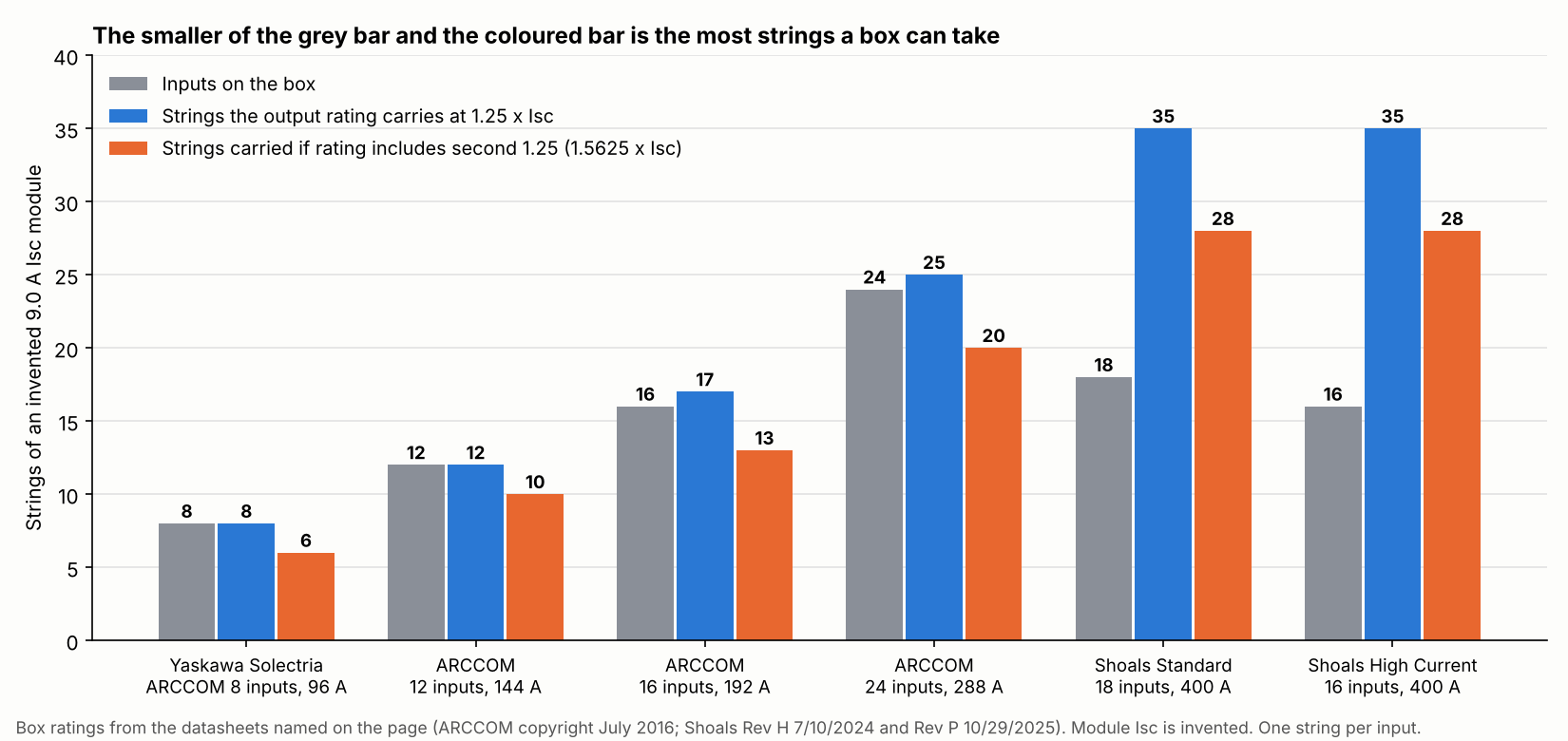
Figure 1. With an example 9.0 A module, inputs limit both Shoals boxes, while the second 1.25 makes output the limit on every ARCCOM size.
| Case (example) and box | Strings | Output at 1.25 / if rating includes the second 1.25 (x 1.5625) | Rating | Result |
|---|---|---|---|---|
| A: Shoals Standard, 18-input model | 12 | 135.0 A / 168.8 A | 400 A | Pass on both bases. |
| B: Same box | 24 | 270.0 A / 337.5 A | 400 A | Fail: 24 inputs needed, 18 on the box. The 24-input Shoals Standard model would pass. |
| C: ARCCOM, 16 inputs, 1000 V | 16 | 180.0 A / 225.0 A | 192 A | Pass at 1.25 (12.0 A spare). Fail with the second 1.25 (33.0 A over). |
| D: ARCCOM, 12 inputs, 600 V option | 12 | 135.0 A / 168.8 A | 144 A | Fail: 810 V against 600 V. Output passes at 1.25 only. |
| E: Shoals High Current, 16 inputs, 400 A | 28 (2 per input) | 315.0 A / 393.8 A | 400 A | Pass on both bases. 14 inputs used. Example 15 A fuse is under 65 A. |
| F: Shoals Fused Recombiner, 4 inputs | 36 (12 behind each of 3 inputs) | 405.0 A / 506.3 A | 400 A | Fail on output at 1.25 alone. The sheet prints no per-input current rating, only a 250 A per-input fuse limit, so the per-input current cannot be checked against a stated rating here. The most strings by output: 35 or 28. |
Only cases A, C and E can pass, and case C passes on one basis only. Case C shows why you should settle the basis before ordering. Case F assumes each input takes one combiner of 12 strings. The sheet does not say.
Combiner box rating calculator
It repeats the table for your own values. Defaults are example, and the presets copy the datasheet values in Table 1.
Where does a combiner box appear in the plan set?
As a block between the strings and the inverter, with its model, input count and output rating.
- The labels and placards page covers enclosure signs. See also string sizing.
- The single line diagram page lists the combiner among the blocks that one city’s standard plan asks for.
- The commissioning report page lists a combiner row: strings connected to the right inputs. Compare commissioning software.
How solar software handles the combiner box
All three tools read place a combiner or recombiner on the diagram. None of the pages read documents a rating check against datasheet limits. Not stated: the company page we cite does not say.
| Tool | On the diagram? | Rating check? |
|---|---|---|
| Aurora Solar | Yes | Not stated |
| HelioScope | Yes (combiner box with a set number of inputs, recombiner) | Not stated |
| Solargraf | Yes (DC combiner box, Enphase AC combiner) | Not stated |
What each page says, and limits:
- Aurora Solar: Components help page (no date printed): "combiner boxes and re-combiner boxes (both are represented by the combiner box component)". The component lists no properties.
- HelioScope: "Add a recombiner box" article (no date printed): "To add combiner boxes to the design,click +add combiners". The number of inputs is set in the Combiner Poles field. The conductor sizing article (updated 9 July 2025) mentions "As combiner boxes and inverters are moved".
- Solargraf: Electrical Design Tool article ("Published on 31 Jul 2023"): add the DC combiner box component, then click in the design. Design tool guide (5 March 2026): Enphase designs use the IQ Combiner 5/5C or 6C. It mentions built-in checks generally and does not name the combiner in them.
For ranked tools that draw the combiner on the diagram, see the best solar SLD software.
Common mistakes with combiner boxes
FAQs
Does a combiner box include a disconnect?
Some do. Shoals lists a load-break disconnect, and Eaton lists integral disconnects in a ladder of sizes. MidNite says up to three breakers may serve as one.
Is the maximum current per input or total?
It varies by maker, so read the sheet. ARCCOM prints "Maximum Continuous Current" as totals by size. Shoals Rev I prints a 400 A output and a 32 A overcurrent limit. The Eaton sheet we cite prints no output rating.
Is monitoring built in?
Not on every sheet. Eaton lists optional DC current monitoring. The Yaskawa ARCCOM sheet lists an arc-fault detection output, and the Shoals sheets list none.
Do microinverter systems use a DC combiner box?
The Enphase IQ Combiner 5/5C uses AC breakers (the sheet lists 120/240 VAC). Its sheet calls it a pre-wired solution for IQ Series microinverters. Solargraf selects it in those designs.
How many strings can go in a combiner box?
The lower of the input count and the output rating sets the limit. Inputs used must not exceed the box inputs, and output current (strings times Isc times the sizing factor) must stay under the output rating. Settle which current basis the maker uses first.
Related terms
- Overcurrent protection: the fuse window and parallel-string check.
- DC disconnect: the switch ratings and location.
- Solar array: how strings and subarrays group.
Next step: put the combiner, its input count and its output rating on your diagram with a tool from the best solar SLD software list.
Sources
Dates are as printed in each document. All opened October 2026.
| Source | Used for |
|---|---|
| Shoals, 1500V Standard Combiner, NEC 2023, Data Sheet I (3/6/2025. The Rev. H sheet cited in an earlier pass now 404s, checked November 2026) | Table 1 |
| Shoals, 1500V High Current Combiner, NEC 2023, Data Sheet Q (1/13/2026. Supersedes Rev. P, which raised the fuse limit on one variant from 70 A to 80 A, checked November 2026) | Table 1 |
| Shoals, 1500V Fused Recombiner, NEC2023, Data Sheet C (3/7/2025. The Rev. B sheet cited in an earlier pass now 404s, checked November 2026) | Recombiner, Table 1 |
| Yaskawa Solectria Solar, ARCCOM string combiner datasheet (copyright July 2016, DOCR-070385-L, file name says Rev I, now a discontinued product, per Solectria’s current PV Combiners navigation, which lists only the XGI 1500 Combiners. The altE link itself now redirects to altE’s homepage rather than the PDF, checked November 2026) | Table 1, cases C and D |
| Eaton Crouse-Hinds series solar combiner boxes (Copyright 2015 Commercial Products Catalog. This link now 404s and we could not find a current equivalent Eaton datasheet at the same model number, checked November 2026. Treat the Eaton row in Table 1 as a historical worked example and confirm current ratings with Eaton before specifying) | Parts, Table 1 |
| MidNite Solar, MNPV6 data sheet (no date printed, hosted by a distributor) | Busbars, Table 1 |
| Enphase, IQ Combiner 5/5C data sheet (DSH-00007-6.0, September 2024, distributor copy) | AC combiner |
| SMA, Sunny Tripower CORE1 STP 50-41 technical data (STP50-41-DS-en-11, distributor copy) | Direct string inputs |
| EC&M, Calculating Current Ratings of Photovoltaic Modules (trade article dated 8 November 2012, not code text, checked 30 October 2026). Other current sources confirm the underlying 125% plus 125% rule still appears in NEC 690.8 and 690.9 (checked November 2026), but confirm the exact clause and lettering against the edition your AHJ adopted. | Second 1.25 factor |
| NREL, Best Practices for O&M of PV and Energy Storage Systems, 3rd edition (NREL/TP-7A40-73822, December 2018). NREL (the National Renewable Energy Laboratory) became the National Laboratory of the Rockies (NLR) in December 2025. We cite this 2018 report under the name it was published with and link it at its current nlr.gov address. | Live DC work |
| Company help pages: Aurora Components (no date), HelioScope recombiner (no date), HelioScope conductor sizes (9 July 2025), Solargraf EDT (31 July 2023), Solargraf design tool guide (5 March 2026) | Software table |
Last updated 30 October 2026. Next scheduled review: 30 January 2027.