Key takeaways
- O&M has three jobs. They are monitoring, planned (preventive) work and repair (corrective) work.
- Guides quote 97 to 99%, with 98% the most common. About 95% appears for standalone stations or portfolios of small ones.
- On our invented 2 MWdc plant, one year reads 97.67%, 99.04% or 100%. It depends on how you define it. The guarantee is 98%.
- Response time ends when a technician arrives, and repair time starts then. A contract should set a repair-time or spares term as well.
- Of six tools checked, only two document an availability sum with exclusions. The rest handle work orders.
To compare tools that log O&M work orders, see the best solar CMMS software. For availability data, see the best solar monitoring software.
Solar O&M at a glance
O&M is the service after handover. You buy it as a fee plus promises on uptime, speed and reports.
| Item | Detail |
|---|---|
| Core jobs | Operations (monitoring, administration), preventive maintenance, corrective maintenance. |
| Core measures | Availability (%), response time (hours), sometimes performance ratio, plus a monthly report. |
| Where it matters | Owner returns, lender and PPA terms, warranty claims and installer service income. |
| Standard or rule | No single standard. SolarPower Europe and NREL publish best-practice guides. Each contract sets its own definitions. |
| In software | Monitoring platforms, ticketing and CMMS (computerised maintenance management) tools. |
Why do O&M terms matter for installers?
The contract says who pays when a plant loses energy. Owner returns, lender and PPA terms, warranty claims and installer service income all depend on how its terms are defined. In the worked example below, the contractor carries only some of the lost energy.
This page covers the contract and how its numbers are measured. For alert rules, see alerts and alarms. For the day-one tests, see the commissioning report page. For the wider process, see commissioning.
What does solar O&M cover?
NREL splits the work into operations and maintenance. Maintenance is preventive or corrective. SolarPower Europe (SPE) adds predictive and extraordinary work.
- Operations: NREL lists five areas. They are admin, running the plant, work directions, monitoring, and staff knowledge and records.
- Preventive: planned work. NREL says the schedule depends on the gear, the site and the warranty.
- Corrective: NREL says it is "required to repair damage or replace failed components".
- Extraordinary: SPE’s version 3.0 Executive Summary says this is "usually not covered by the O&M fixed fee".
What is in an O&M contract, and how are scope and price measured?
A contract turns scope into numbers. These are a fee, an availability level, response times, remedies and reports. Each needs a clear meaning. If not, nobody can test it.
| Term | How it is measured |
|---|---|
| Fee | Fixed or variable, with a per-MW sanity check, yearly escalation and a payment schedule |
| Availability guarantee | Annual percentage with listed exclusions |
| Response time | Hours, set per fault severity |
| Remedies | Liquidated damages (LDs, agreed payments for a miss) and sometimes bonuses |
| Liability cap | Share of contract value or of the annual fee |
| Spares | Parts held and who pays |
| Reports | Monthly. Planned and unplanned work, availability, output against expected |
| Outside the fee | Major component replacement. Extraordinary work |
The terms above draw on the SgurrEnergy contract checklist, the Soltell availability article and the Welsh Government contracts note (the Welsh guide). Where they give figures:
| Term | Figure or note | Source |
|---|---|---|
| Availability guarantee | 98%, a best-practice minimum over a year | SolarPower Europe v3.0 |
| Availability guarantee | 98 to 99% | Sgurr |
| Availability guarantee | 97 to 99% | Soltell |
| Availability guarantee | About 95% for standalone stations or portfolios of small ones | Welsh guide |
| Response time | By severity, no hours given | Welsh guide and Sgurr |
| Liability cap | About 5 to 20% of contract value, or about 100% of the annual fee | Sgurr |
| Spares | About 0.2% of modules, 12-month warranty on spares | Sgurr |
- Remedies: SolarPower Europe v3.0 links availability to both. Sgurr says the market is moving from PR guarantees to availability and response time for independent operators.
- Spares: the Welsh guide says spares cut avoidable downtime.
- Outside the fee: LegalDocuments.co.uk guide (components). SolarPower Europe v3.0 (extraordinary work).
The SolarPower Europe figure comes from version 3.0 (printed December 2018), which calls 98% over a year a best-practice minimum. Newer editions exist (version 5.0 in 2021, a sixth in 2025). We did not open them, so check the current edition.
The sources differ. They cover plants of other sizes and years. Sgurr says its benchmarks draw on SPE and market practice. So those two are not independent.
How is an availability guarantee calculated?
Availability is the share of expected output the plant could deliver. The contract figure leaves out downtime. That is time the contractor does not control.
Company pages show two methods. GreenPowerMonitor counts minutes, with manual exceptions. Avathon counts energy. It says contracts typically use the production method: 1 − loss ÷ (actual output + loss). This page uses the reference method: 1 − loss ÷ reference energy. The reference method gives the contractual figure in the worked example. The production method gives about 99.03% on the same events, slightly lower.
- Exceptions: GreenPowerMonitor lets users enter exceptions that remove periods later.
- Exclusions: Soltell lists grid blackouts and force majeure. The Welsh guide adds faults in a high-voltage link that is bought on its own.
- Spares: Sgurr says spare-part delays should not be excluded.
SPE v3.0 says uptime counts all outages. Availability applies exclusions. Its Section 11 formulas are not among the sources read. For a plain meaning and formulas, see availability.
How are response times measured?
SPE v3.0 adds the time to acknowledge an alarm to the time to reach the plant. That sum is response time. Resolution time then runs to the fix. The Welsh guide puts response time on the owner in the availability sum and says to confirm this.
The clocks start at different points. The Welsh guide counts from fault notice to arrival. SPE counts from the alarm. Confirm the start point and who owns each delay.
| Step (event A, assumed hours) | Hours | Clock |
|---|---|---|
| Alarm to acknowledgement | 2 | Acknowledgement time |
| Acknowledgement to technician on site | 22 | Intervention time |
| Response time (the two above) | 24 | Response time |
| Arrival to fix: 72 waiting for a spare, 48 repairing | 120 | Resolution time |
| Alarm to fix | 144 | Total downtime (6 days) |
A 24-hour response target is met here. Yet the plant was down for six days. Only a repair-time or spares term covers the other 120 hours. The clocks follow SPE v3.0. The hours are assumed.
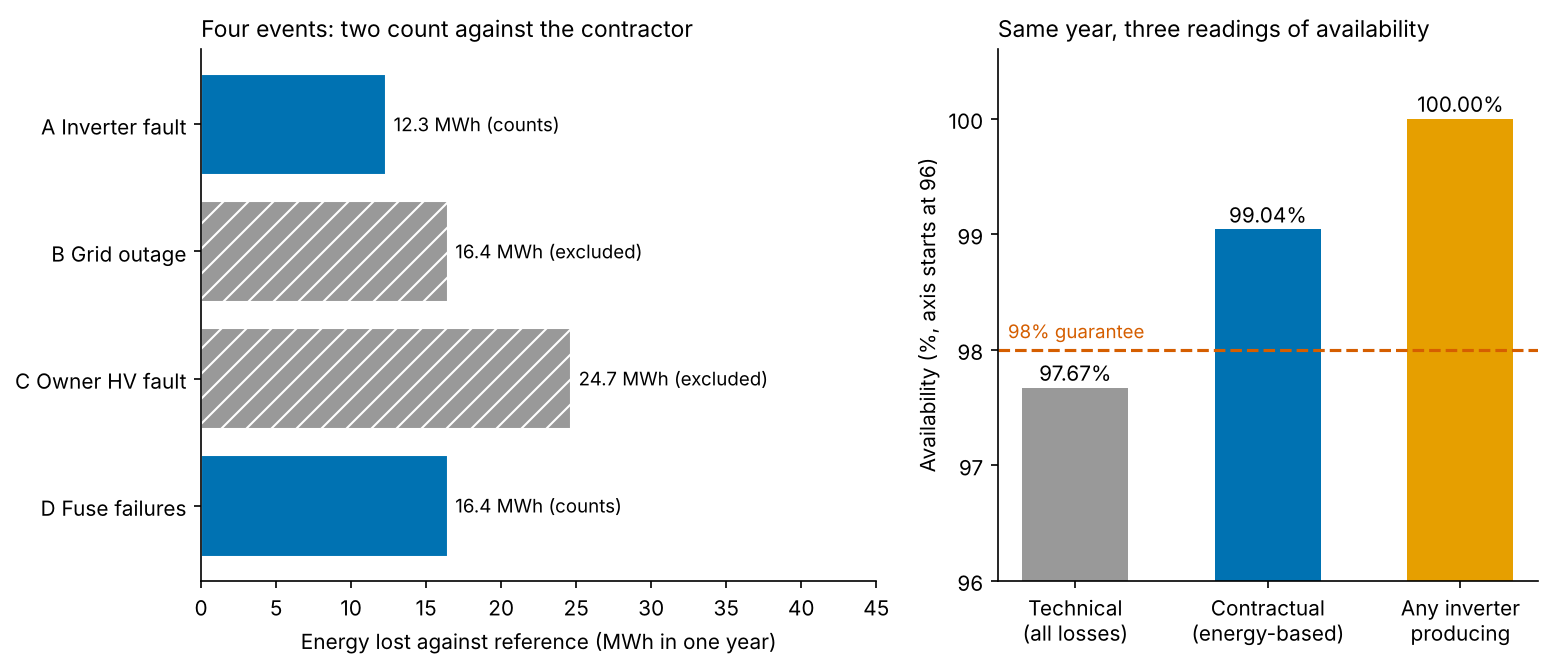
Figure 1. One year passes or fails a 98% guarantee by definition: 97.67% with every loss, 99.04% after exclusions, 100% if only whole-plant outages count.
Worked example: one year on a 2 MWdc plant
The contractor stocks common spares. The part for event A was not one of them. The owner carries the grid and transformer faults. So the contractor loses 28.77 MWh. That is 47.9% of its 60 MWh allowance.
The assumptions are ours. Reference energy is 3,000 MWh a year (1,500 kWh per kWdc). We spread it evenly at 8.219 MWh a day. Real days vary by season. Winter outages would cost less. Each loss is the share down × days × 8.219 MWh. We then use the energy-based formula above.
| Event | Share down | Days | Lost (MWh) | Counts against contractor? |
|---|---|---|---|---|
| A Inverter fault, spare not held | 25% | 6 | 12.33 | Yes |
| B Grid outage | 100% | 2 | 16.44 | No (grid) |
| C Owner-procured HV transformer fault | 100% | 3 | 24.66 | No (owner) |
| D Combiner fuse failures | 10% | 20 | 16.44 | Yes |
| Contractor total | 28.77 | Contractual: 1 − 28.77 ÷ 3,000 = 99.04% | ||
| All events | 69.86 | Technical: 1 − 69.86 ÷ 3,000 = 97.67% |
A 98% guarantee allows 60 MWh of contractor loss. That is about 29 days of a 25% inverter outage. At an assumed 60 USD per MWh, all four events cost about 4,192 USD. The "any inverter" reading gives 100%. The contractor owns no whole-plant outage. Agree which reading the contract uses before you sign.
Check an availability guarantee
This calculator applies the energy-based formula to four events. The example button loads the table above.
How solar software handles O&M
Of the six tools we checked in October 2026, only GreenPowerMonitor and Avathon document an availability sum with exclusions. The other four cover work orders, at least in part.
| Software | Availability with exclusions? | Work orders or tickets? |
|---|---|---|
| GreenPowerMonitor (DNV) | Yes (time-based) | Not stated |
| Avathon knowledge base (no profile page) | Yes (energy-based) | Not stated |
| meteocontrol VCOM Cloud | Not stated | Yes |
| Power Factors Unity | Not stated | Yes |
| PowerTrack | Not stated | Yes |
| Solytic | Not stated | Partly |
Not stated: the company pages we read do not say. Partly: the page mentions the feature with few details. What each page says:
- GreenPowerMonitor (DNV): formula above. You can enter exceptions by hand. That page shows no technical versus contractual split.
- Avathon: reference-energy and production methods, set at onboarding from contract terms.
- meteocontrol VCOM Cloud: licence-based CMMS module with work orders, assignees, status and time tracking. Alarms or automations can open tickets. The VCOM datasheet (copyright 2023) lists "recurring events such as annual inspections and vegetation maintenance". The help page does not describe preventive plans.
- Power Factors Unity: lists "higher availability" as a benefit. Preventive, corrective and emergency work orders, plus dashboards for backlog, response times and SLAs.
- PowerTrack: work orders created from events with timeline, duration and severity.
- Solytic: a February 2021 product post says tickets are logged on their own and reports use templates.
For tools that handle work orders and service tickets, see the best solar CMMS software.
Common mistakes with O&M contracts
FAQs
What availability guarantee is normal in solar O&M?
Guides quote 97 to 99%. Of these, 98% is the most common (Soltell). The Welsh guide gives about 95% for standalone stations or portfolios of small ones. Check the exclusions before you compare numbers.
What is the difference between preventive and corrective maintenance?
Preventive work is planned. It keeps gear in good shape. Corrective work fixes damage or swaps failed parts. Confirm that the fixed fee covers both.
What is the difference between response time and resolution time?
Response time runs until a technician reaches the plant. Resolution time runs from arrival to the fix. Contracts can set a target for each, and SPE counts the clock from the alarm.
Does the fixed O&M fee cover everything?
No. LegalDocuments.co.uk puts major component replacement outside the standard fee. SPE says the same of extraordinary work. Read the exclusions as closely as the scope.
Is monitoring the same as O&M?
No. The Welsh guide says a monitoring-only contract gives alarm portals. The owner usually handles the response. Full O&M adds the repair work.
Related terms
- Availability: the share of expected production a plant can deliver.
- Performance guarantee: a promise about output or ratio.
- Warranty claims and RMA: how failed equipment is replaced.
- Asset management: the owner’s oversight of a plant.
Next step: match your contract’s availability and ticket terms to a tool. Start with the best solar CMMS software for work orders, or the best solar monitoring software for availability data.
Sources
- NREL O&M best practices, 3rd edition (Oct 2026, Section 10.1 and Appendix F not read).
- SolarPower Europe O&M guidelines, version 3.0 (Oct 2026, Section 11 not read).
- SolarPower Europe guidelines page, version 5.0 dated 23 December 2021 (checked 30 October 2026, its text not opened).
- SolarQuarter: SolarPower Europe updates O&M Best Practice Guidelines, February 2025 (checked 30 October 2026, says the report is the sixth edition).
- Welsh Government Energy Service contracts note (2025-26, Oct 2026).
- SgurrEnergy contract review checklist (Oct 2026).
- Soltell article on availability (Oct 2026).
- LegalDocuments.co.uk O&M guide: general information, not legal advice (Oct 2026).
- GreenPowerMonitor help page (Oct 2026).
- Avathon knowledge base page (Oct 2026).
- meteocontrol help: CMMS and work orders (Oct 2026).
- Power Factors field service page (Oct 2026).
- AlsoEnergy PowerTrack page (Oct 2026).
- Solytic product update post, 16 February 2021 (Oct 2026).
Last updated 30 October 2026. Next scheduled review: 30 January 2027.