Key takeaways
- Four current texts use four size lines: under 1,000 kW (EIA-861), up to 1,000 kW (Indiana), up to 2,000 kW (Texas) and up to 20,000 kW (FERC). Only the two statutes define the term. The repealed EU Directive 2009/72/EC sets no size.
- Exactly 1,000 kW is outside the EIA wording ("less than 1 megawatt"). It is inside Indiana’s size cap ("not more than one (1) megawatt").
- Indiana’s text excludes a net metering facility on a net metering tariff (see net metering). Our 8 kW home is under all four size lines. On a net metering tariff it still fails Indiana’s text.
- In eight example sites, only 2 (A, C) pass all four current texts. A 25,000 kW site passes none.
- The label does not choose the interconnection route. The utility’s tier does. The tier comes from size and the operator’s rules.
To file the interconnection once you know your route, see the best solar interconnection software.
Distributed generation at a glance
DG is about where a plant sits and how it connects. It is not a technology. Solar is one fuel among several, and each source decides what counts.
| Item | Detail |
|---|---|
| What it is | Generation at or near a customer’s site, or on the distribution system. The wording changes by source. |
| Size | No single line. The texts below use under 1,000 kW, up to 1,000 kW, up to 2,000 kW and up to 20,000 kW. |
| Standard or rule | No standard for the term. Statutes, survey forms and utility tariffs each define it for their own use. |
| Where it matters | It decides which statistics, tariffs, programmes and interconnection tracks apply to a project. |
| In software | Tools model what comes with DG, such as an export cap. None of the four below defines DG. |
Why does the definition matter for installers?
The label tells you which rule set applies. A project can be DG under one wording. It can fall outside another. The programme text is the one that counts.
It also keeps DG apart from nearby terms. DER is the wider class of devices. Behind-the-meter is a meter position. Community solar is a billing model. A solar farm is a plant type. One project can fit several of these terms.
How do published sources define distributed generation?
The table lists five sources: four current texts and one repealed EU Directive. Each words it for its own purpose. Only the repealed EU Directive and the two statutes define the term. The EIA form uses it in a survey schedule. FERC sets a size cap for a procedure.
| Source (region) | Wording | Size and conditions |
|---|---|---|
| EIA-861 instructions, Schedule 7B (US, current form, OMB No. 1905-0129, expires 31 July 2029) | "generators of less than 1 megawatt (1000 kilowatts) installed at or near a customer’s site", including other sites within the system. The form has no standalone definition. | Under 1,000 kW. Grid-connected plants of 1 MW or more need not be reported on Schedule 7B. Basis (AC or DC) not printed. |
| Indiana Code 8-1-40-3 (US state) | "As used in this chapter, "distributed generation" means electricity produced by a generator or other device that is:" on the customer’s premises, customer-owned and interconnected in parallel. | "not more than one (1) megawatt", or the customer’s average annual use if lower. Excludes emergency-only generators and net metering facilities on a net metering tariff. |
| Texas Utilities Code 39.916(a)(1) (US state, term is "distributed renewable generation") | Generation from a renewable technology installed on a retail customer’s side of the meter. | "not more than 2,000 kilowatts". |
| Directive 2009/72/EC, Article 2, point 31 (EU, repealed with effect from 1 January 2021) | "generation plants connected to the distribution system". | No size. The network level is the test. Historical wording only. |
| FERC pro forma small-generator procedures (US federal, 2013 and 2016 notices) | "small generating facilities of no larger than 20 megawatts (MW)". This sets the scope of the procedures. It is not a DG definition. | Up to 20,000 kW. |
A July 2001 DOE report does not define DG. It defines distributed energy resources as "small, modular, decentralized, grid-connected or off-grid energy systems". They sit "in or near the place where energy is used" (DOE/GO-102001-1211). The DER page covers the FERC, PJM, IEEE and EIA wording for that wider term.
The Indiana and Texas text comes from secondary legal sites. Directive (EU) 2019/944, Article 72, repealed the Directive "with effect from 1 January 2021", so it is shown as historical wording only.
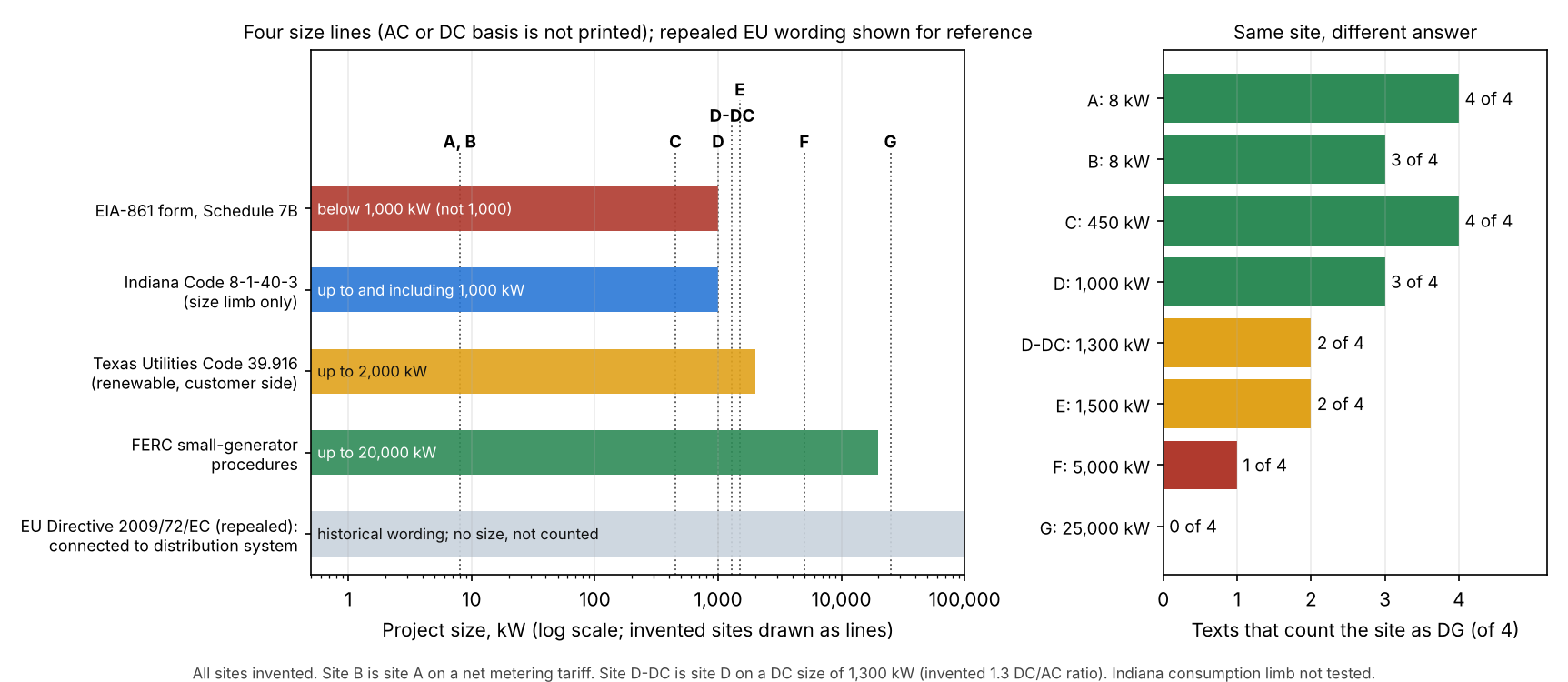
Figure 1. The four size lines run from 1,000 kW to 20,000 kW. Across eight example sites, a project passes between 0 and 4 of the four current texts.
What does distributed generation mean for interconnection?
The DG label does not pick your route to the grid. The operator’s tier does. Its size line can differ from the DG definition you used.
- US tracks follow size, not the label. FERC’s January 2013 proposed rule lists a 10 kW Inverter Process and a Fast Track Process. It described Fast Track as covering facilities "no larger than 2 MW" at that date. It proposed to revise that. A tier sets the screens a project meets. Being called DG does not. Utilities and states set their own tiers. See the interconnection application and PTO pages.
- Other countries use their own routes. Great Britain uses G98 and G99. India uses DISCOM approval.
- The grid can cap export. Aurora’s help says export limits are "utility-defined caps on the maximum instantaneous power (kW) a property can export to the grid". See hosting capacity maps, IEEE 1547 and anti-islanding.
Worked example: eight example sites, four current texts
All sites, owners and voltages are example. Sizes are kW on the AC side, except D-DC. The table tests only the size, siting, ownership, technology and tariff parts of each text. The repealed Directive fits every site except G and is not counted. The EIA test uses size only.
Only small customer-side sites pass all four texts, and the number passed falls as size grows.
| Site (example), kW | EIA-861 | Indiana | Texas | FERC cap |
|---|---|---|---|---|
| A: Home roof, customer-owned (8 kW) | Yes | Yes | Yes | Yes |
| B: Same home roof, on a net metering tariff (8 kW) | Yes | No | Yes | Yes |
| C: Shop roof, customer-owned (450 kW) | Yes | Yes | Yes | Yes |
| D: Warehouse roof, customer-owned (1,000 kWac) | No | Yes | Yes | Yes |
| D-DC: Site D counted on its DC size (1,300 kW DC, ratio 1.3 example) | No | No | Yes | Yes |
| E: Carport array, customer-owned (1,500 kW) | No | No | Yes | Yes |
| F: Ground array, utility side, third-party owned (5,000 kW) | No | No | No | Yes |
| G: Ground array, utility side, connected at 132 kV (25,000 kW) | No | No | No | No |
Texts passed out of four: A 4, B 3, C 4, D 3, D-DC 2, E 2, F 1, G 0. Sites A to E are on the customer’s side and customer-owned. F and G are on the utility side. D-DC is site D counted on a DC size of 1,300 kW. That comes from an example DC/AC ratio of 1.3. Indiana’s second size limb (average annual use) is not tested. Site G is entered as not on the distribution system.
Site D, at exactly 1,000 kW, fails the EIA text and passes Indiana. Counted on DC size, site D fails Indiana too. Site B differs from site A only by its tariff. When you say a project is DG, state the size basis and the tariff. The solar farm page covers the AC and DC trap in more detail.
Check your own project
Enter a size and the siting facts. The calculator opens with site A. It has presets for the other sites.
How solar software handles distributed generation
None of these four tools defines DG. Three pages document an export cap and one documents grid map layers.
| Software | Sets a grid export or injection limit? | Shows distribution-grid data? | Page read (October 2026) |
|---|---|---|---|
| PVsyst | Yes | Not stated | PVsyst help, Grid power limitation. No date. It names version 7.3. |
| SAM | Yes | Not stated | SAM help, Grid Limits. No date or version note. |
| Aurora Solar | Yes | Not stated | Aurora help, Using Grid Export Limits. No date in the text read. |
| PVcase Prospect | Not stated | Yes, US only, on request | PVcase help, Exclusive and US-only features Overview. No date in the text read. |
Yes: the page read says so. Not stated: the page we cite does not say.
- PVsyst: the limit is entered in kW or kVA, as a constant or a time series, at the inverter or the injection point. The page says "The only way to limit power is to not produce it".
- SAM: "Enable interconnection limit" and a limit in kWac. SAM treats power above it as curtailed. Limits do not restrict imports.
- Aurora Solar: a "Grid export limit" in System settings, Advanced, in kW. Excess goes to the battery first. The rest is curtailed and shown as a separate band.
- PVcase Prospect: "Distribution Grid layers" give "a preliminary distribution grid map, including the locations of DG lines and substations". The page does not define "DG".
Tools built for interconnection and site checks are ranked in the best solar interconnection software and best solar site selection software lists.
Common mistakes with distributed generation
FAQs
Is distributed generation the same as DER?
No. DG is electricity generation, while DER is the wider class that also covers storage and some loads. The DER page covers the FERC, PJM, IEEE and EIA wording for that wider term.
Is rooftop solar distributed generation?
Yes, on size. An example 8 kW roof passes all four current texts. Indiana’s text excludes a net metering facility on a net metering tariff, so the same roof on that tariff fails Indiana. Check your programme’s definition.
Is a solar farm distributed generation?
Sometimes. A plant on the distribution system can count. This example’s 5,000 kW utility-side array passes FERC’s 20 MW line but fails the EIA, Indiana and Texas lines. See solar farm.
Does distributed generation have to be renewable?
Not in every wording. The Texas term requires a renewable technology. The EIA form text, the repealed EU Directive and FERC’s cap name no technology. This is a plain reading of the texts.
Related terms
- DER: generation, storage and some loads, on the distribution system or behind a meter.
- Behind-the-meter: equipment on the customer’s side of the utility meter.
- Hosting capacity map: a utility’s screen of how much generation a feeder can take.
Next step: once you have a size and tariff for your project, move on to the filing with the best solar interconnection software.
Sources
- EIA-861 instructions, current form, OMB No. 1905-0129, expires 31 July 2029 (EIA). The wording and expiry date were read on a Catalyst Cooperative copy of the form, checked 30 October 2026, because eia.gov blocked our fetch.
- Indiana Code 8-1-40-3, FindLaw, current as of 1 January 2026, and Legalfix copy, 2019 code year.
- Texas Utilities Code 39.916, Interconnection of distributed renewable generation, 2026 compilation.
- Directive 2009/72/EC, Article 2, 13 July 2009, legislation.gov.uk copy. Repealed by Directive (EU) 2019/944, Article 72, checked 30 October 2026.
- FERC notice of proposed rulemaking, RM13-2-000, 17 January 2013, and Order No. 828 notice, Federal Register, 1 August 2016. Fast Track wording from the Federal Register notice of 1 February 2013.
- DOE, Distributed Energy Resources at Federal Facilities, DOE/GO-102001-1211, July 2001.
- Company pages: PVsyst, SAM, Aurora and PVcase (checked October 2026).
Last updated 30 October 2026. Next scheduled review: 30 January 2027.