Key takeaways
- Four published lines serve four purposes: under 1 MW, above 1 MW, above 5 MWac and above 100 MW. Name the one you follow.
- LBNL medians for 736 US plants above 5 MWac: 2.8 acres per MWdc for fixed-tilt, 4.2 for tracking. These count array area, not the whole site.
- Tracking uses about 50% more land per MWdc (4.2 against 2.8 acres). It gives about 12% less energy per acre (394 against 447 MWh). These are medians of different plants.
- An invented 80 MWac plant at DC/AC 1.3 is 104 MWdc: under 100 MW on AC and over it on DC. State the basis.
To compare tools that lay out and size a solar farm, see the best utility-scale solar design software.
Solar farm at a glance
"Solar farm" is a trade label, and the documents we read do not define it. The size, land and rules you get depend on which document you use.
| Item | Detail |
|---|---|
| What it is | A ground-mounted PV plant with arrays, inverters, collection cables, a substation and roads. It is built to send power to the grid, not to serve one building. |
| Size | No single line. EIA’s small-scale cut is under 1 MW. LBNL’s dataset starts above 5 MWac. England’s planning cut is 100 MW. |
| Land | LBNL medians: 2.8 acres per MWdc (fixed-tilt) and 4.2 (tracking). |
| Standard or rule | None for the term. Planning and grid rules are national or local. |
| In software | Utility-scale design tools cover site screening, layout, electrical design and yield, to different degrees. |
Why does the definition matter for installers and developers?
The label sets which benchmarks, planning route and tools apply. A small ground array and a plant of hundreds of MW share modules. They do not share benchmarks, design software or consenting.
It also splits three ideas people mix up. A solar farm is a kind of plant. Community solar describes how output is shared and billed. Behind-the-meter describes which side of a meter a system sits on. One project can be a farm and sell through a community scheme.
Where do published documents draw the size line?
Four documents give four lines. Each has a different job: statistics, a land study, a dataset or a planning law.
| Source | Line | Basis and scope |
|---|---|---|
| EIA, Today in Energy, 2 December 2015 | Under 1 MW is small-scale PV. | US statistics. The 1 MW definition states no basis. The page’s chart note says MWac. No utility-scale line is given. |
| NREL (now NLR), land-use report NREL/TP-6A20-56290, data to Q3 2012 | Ground-mounted facilities above 1 MW. | A US land-use study. It counts direct area (arrays, access roads, substations, service buildings) apart from total area inside the site boundary. |
| LBNL, U.S. Utility-Scale Solar, 2025 Data Update (October 2025) | "ground-mounted projects with a nameplate capacity >5 MWAC". | US dataset of 1,759 projects, 111 GWac, to the end of 2024. AC basis. |
| England, Infrastructure Planning (Onshore Wind and Solar Generation) Order 2025 | Solar above 100 MW is a nationally significant project. The threshold was 50 MW before. | England only. Made 9 June 2025. In force 31 December 2025. The amending article only swaps the figure and states no AC or DC basis. |
Use the line your task needs: LBNL’s for data, current planning text for consent. State the basis, AC or DC, first. See capacity factor for why.
How much land does a solar farm need?
LBNL’s median plant uses 2.8 acres per MWdc with fixed-tilt racking and 4.2 with tracking. These are 2019 reference values (Bolinger and Bolinger, 2022). The sample is 736 US ground-mounted plants above 5 MWac, online from 2007 to 2019. The density analysis uses 2011 to 2019. This is direct array area. Total leased or fenced site area is larger.
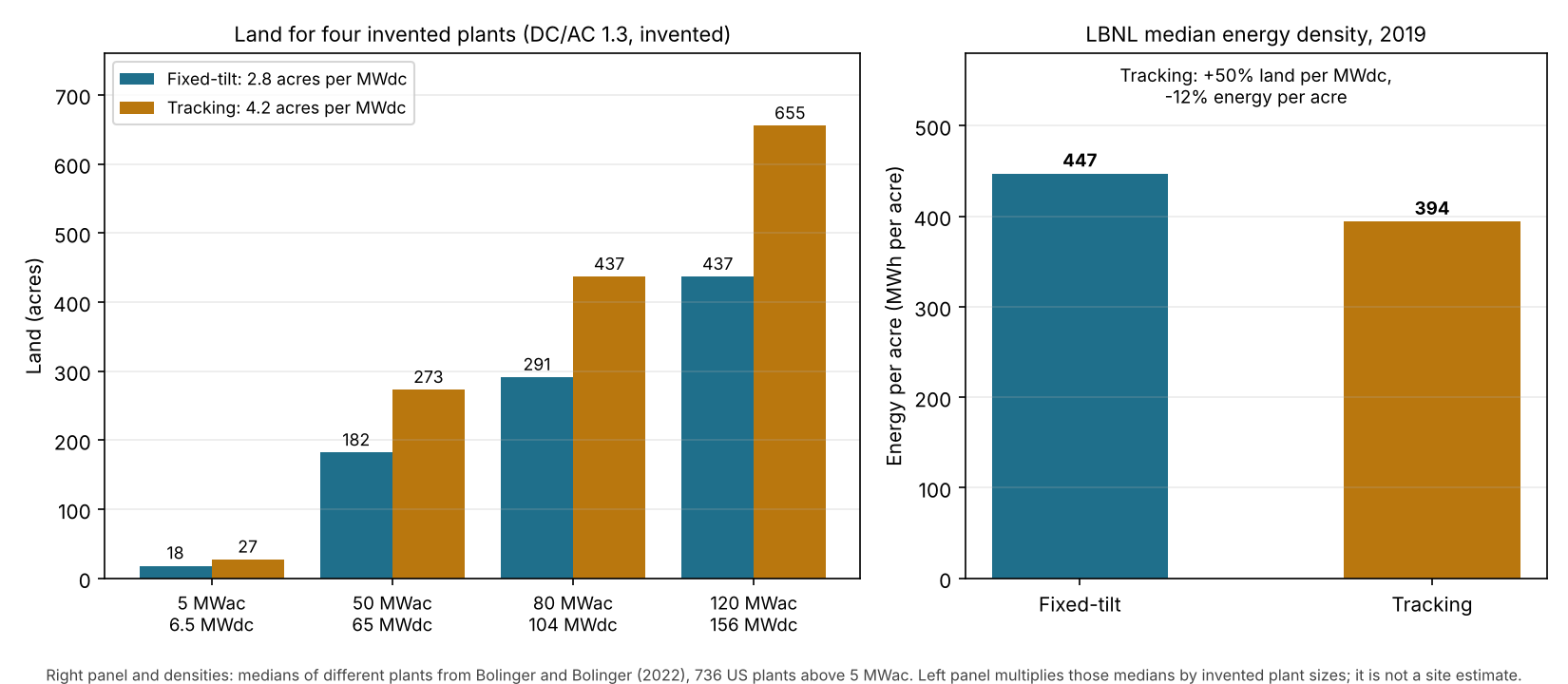
Figure 1. At LBNL’s medians, tracking needs about 50% more land per MWdc than fixed-tilt, and its median energy per acre is about 12% lower.
LBNL also reports how many new plants chose single-axis tracking. Its 2025 edition says 99% of new project capacity added in 2024 did (slide 25). Its 2026 edition gives a tracking share for 2025, cited here as 96% (slide 25), but we could not re-open the PDF this pass to confirm the exact figure against a later search snippet suggesting a lower share. Check slide 25 of the 2026 edition deck before quoting this number. See single-axis tracker.
The 50% is 4.2 divided by 2.8 acres. LBNL also gives 0.35 and 0.24 MWdc per acre, which give about 46%. Both come from one dataset. LBNL ties fixed-tilt’s tighter packing to its higher ground coverage ratio. Its fixed-tilt density also falls at higher latitudes, because lower ratios avoid self-shading. See ground coverage ratio.
These are medians of different plants, not a rule for your site. Slope, setbacks, wetlands and the grid connection all change the answer. Layout optimisation, terrain modelling and ground-mount design cover the site work.
Worked example: four example plants
This table applies the two LBNL medians to four example plant sizes. All use an example DC/AC ratio of 1.3. It is a screening sum, not a site estimate.
| Case | MWac / MWdc | Above 5 MWac? | Above 100 MW on AC / on DC? | Acres, fixed (2.8) / tracking (4.2) |
|---|---|---|---|---|
| A | 5 / 6.5 | No | No / No | 18.2 / 27.3 |
| B | 50 / 65 | Yes | No / No | 182 / 273 |
| C | 80 / 104 | Yes | No / Yes | 291.2 / 436.8 |
| D | 120 / 156 | Yes | Yes / Yes | 436.8 / 655.2 |
Case A is not above 5 MWac, because LBNL’s line is "above". Case C shows the basis trap: 80 MWac is 104 MWdc. Case D matches the 120 MWac average LBNL reports for new projects.
For energy, take example yields of 1,250 kWh per kWp for fixed-tilt and 1,650 for tracking. Case B then makes 81,250 and 107,250 MWh a year. On the AC size that is a capacity factor of 18.6% and 24.5%. Per acre it is 446 and 393 MWh. Tracking is 12% lower, in line with LBNL’s medians.
Check your own plant
Enter a size in MWac and your DC/AC ratio. Add the mounting type and your own land and yield figures. The calculator opens with case B.
If the calculator does not load, open the solar farm land calculator on its own page.
How solar software handles a solar farm
On the company pages we read, only RatedPower and DNV SolarFarmer name site screening, and only RatedPower covers electrical design in full. The table lists what each page says, as checked in October 2026. None of the four pages shows a date, and each has a 2026 copyright line.
| Software | Site screening | Layout and terrain | Electrical | Yield |
|---|---|---|---|---|
| PVcase Ground Mount | Not stated. The page ties site selection to a separate product, PVcase Prospect. | Yes. "Terrain-responsive solar design" with "automated grading". | Partly. "Automated 3D cabling". Stringing and single-line diagrams are not named on this page. | Yes, early stage. QuickYield estimates yield inside the tool. |
| RatedPower | Yes. Parcel navigation and "customized suitability analysis". Interconnection data only in selected geographies. | Yes. A layout editor with setbacks, roads and slope limits. Cut and fill feed the CAPEX estimate. | Yes. Users "relocate power stations and refine MV and LV connections". Single-line diagrams are listed as outputs. | Yes. A simplified model that "reconciles with PVsyst", plus a 3D ray-traced mode. |
| PVFarm | Not stated. Not a listed solution on the page. | Partly. Grading is named ("multiple grading strategies"). Layout appears only as a heading. | Partly. The heading "Integrate Precise Electrical Analysis into Your PV Layout". LV, MV and single-line diagrams are not named. | Not stated. Heading only. The page says "projects up to 800MW dc". |
| DNV SolarFarmer | Yes. "Site selection analysis including mapping, terrains, solar resources and environmental restrictions". | Partly. It lets you evaluate layouts on yield and builds horizon lines from terrain data. Generating a layout is not described. | Partly. The page names "Full electrical mismatch calculation for any size site". Cable design is not mentioned. | Yes. 2D and 3D shade modelling. |
A "Yes" means the company page names the function. Partly means it names only some of it. Not stated: the company page we cite does not say. More tools are in the best utility-scale solar design software list and the best software for utility-scale developers list. For detail by stage, see site selection software, substation design and MV and LV design.
Common mistakes with solar farms
FAQs
How big is a solar farm?
There is no fixed size. EIA calls plants under 1 MW small-scale, and England draws its planning line at 100 MW. LBNL’s October 2025 update gives 120 MWac as the average new project.
How many acres per MW does a solar farm need?
LBNL’s medians are 2.8 acres per MWdc of array area for fixed-tilt and 4.2 for tracking. At an example DC/AC ratio of 1.3, that is 3.6 and 5.5 acres per MWac. Total site area is larger. Your site will differ.
Is community solar the same as a solar farm?
No. Community solar describes how output is shared and billed. A solar farm describes a kind of plant. The two can overlap. Read the community solar page for the billing side.
In England, does a solar farm need national planning consent?
In England, yes, if the plant is above 100 MW: it is a nationally significant project from 31 December 2025. This page does not cover the route for smaller plants or other countries. Your planning authority or adviser can confirm the route.
Related terms
- Community solar: a way to share a project’s output through subscriptions.
- Capacity factor: energy divided by rated capacity times hours, on an AC or DC basis.
- Curtailment: output cut below what the plant could make.
- Agrivoltaics: farming or grazing under or between solar rows.
- Floating solar: PV on floats over a reservoir or lake.
Next step: enter your plant’s MWac and DC/AC ratio in the calculator above to see which size line it crosses. Then compare the best utility-scale solar design software. To run a plant, see the best solar farm management software.
Sources
- LBNL, Land requirements for utility-scale PV, Bolinger presentation of 1 February 2022 (checked October 2026).
- LBNL, U.S. Utility-Scale Solar, 2025 Data Update slides, October 2025 (checked October 2026).
- LBNL, U.S. Utility-Scale Solar, 2026 Edition slides, slide 25 (checked 30 October 2026).
- NREL, Land-Use Requirements for Solar Power Plants in the United States, NREL/TP-6A20-56290 (checked October 2026).
- EIA, Today in Energy, 2 December 2015 (checked October 2026).
- legislation.gov.uk, SI 2025/694, made 9 June 2025 (checked October 2026).
- Mills and Reeve, solar NSIP threshold raised to 100MW (checked October 2026).
- Planning Inspectorate advice of 24 January 2017, 50 MW threshold (checked October 2026).
- Company pages: PVcase Ground Mount, RatedPower, PVFarm, DNV SolarFarmer (checked October 2026).
Last updated 3 November 2026. Next scheduled review: 30 January 2027.