Key takeaways
- Five levels run from module to system: module, string, subarray, array and system. Tools disagree on where "array" sits.
- DC rating is modules times module watts at STC. Tilt and azimuth do not change it. Example: 24 modules of 410 W give 9.84 kWdc.
- Orientation changes the energy model and the MPPT wiring, not the rating. SAM’s help says to enable as many subarrays as the inverter has MPPT inputs.
- SAM caps a design at 4 subarrays. PVsyst’s help says it allows an unlimited number.
- Of the 5 tools in the table, SAM and PVsyst name the subarray, and HelioScope calls its group a field segment.
To split an array into subarrays on MPPT inputs in software, see the best solar design software.
Solar array at a glance: why the word needs care
An array is the DC generator of a solar system. Before you copy an array kWdc or module count between tools, check how each tool defines the word.
| Item | Detail |
|---|---|
| Formula | Array kWdc = modules × module watts at STC ÷ 1,000. This is the nameplate formula on SAM’s help page. |
| Levels | Module, string, subarray, array, system. |
| Where it matters | Layout, MPPT wiring, string checks, simulation, permit sheets and proposals. |
| Standard or rule | No single definition across the sources cited. See Table 1. |
| In software | A named group with its own tilt and azimuth: a subarray, a sub-array or a field segment. |
The word matters for money, approval and risk.
- Money: a wrong split models some modules at the wrong tilt. The energy figure shifts while kWdc stays put.
- Approval: sheets list module counts, strings and inputs, so a mixed-up scope shows as a mismatch. See single line diagram.
- Risk: mixed faces or string lengths on one input can cost power. The MPPT page models cases.
How do module, string, subarray, array and system differ?
Each level adds one thing. A string adds series voltage. A subarray adds parallel strings at one orientation. An array adds orientations, and a system adds the inverter and the grid.
Table 1. The five levels, with what the cited pages say and an example (410 W modules).
| Level | What the sources say | Example |
|---|---|---|
| Module | DOE: cells are "connected in chains to form larger units known as modules or panels". See solar panel (module). | 1 module, 410 W. |
| String | SAM help: "The number of modules connected in series in a single string". | 14 modules, 5.74 kWdc. |
| Subarray | SAM help: strings "connected in parallel to form a subarray". pvlib: "An Array is a set of modules at the same orientation." PVsyst: a sub-array is homogeneous, with one module model. | Subarray A, 1 string of 14, 5.74 kWdc. |
| Array | DOE: "Modules can be used individually, or several can be connected to form arrays." OpenEI: "An interconnected system of PV modules that function as a single electricity-producing unit." SAM help: the array "may consist of up to four subarrays". | A and B together, 24 modules, 9.84 kWdc. |
| System | DOE: "One or more arrays are then connected to the electrical grid as part of a complete PV system." pvlib: a PVSystem has "a single inverter, but can have multiple instances of Array". | The arrays plus an 8.0 kWac inverter. |
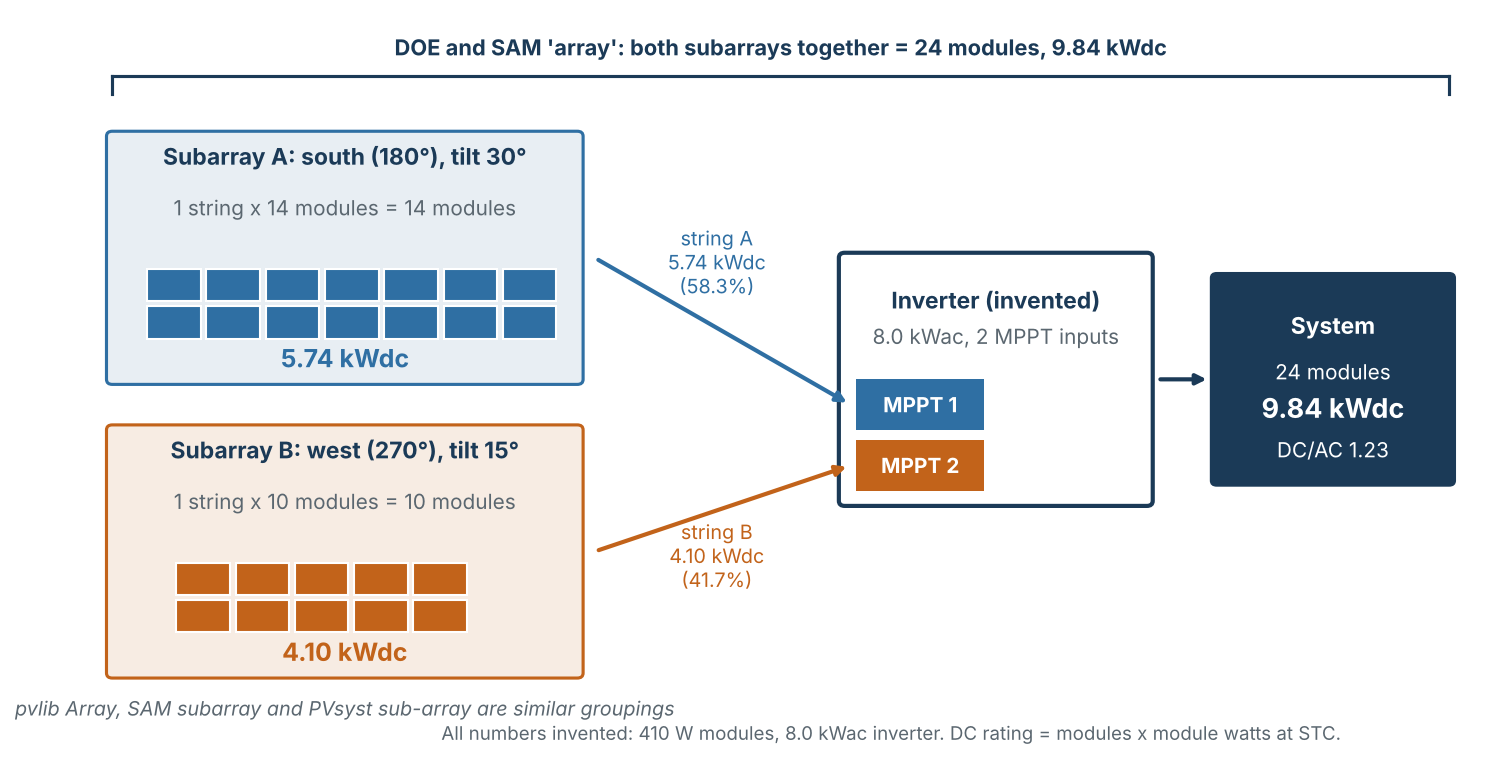
Figure 1. Two subarrays on two MPPT inputs add up to one 9.84 kWdc array in the DOE and SAM sense, but each is an "Array" in pvlib’s.
The two scopes are the main trap. In pvlib’s current docs the Array is one orientation. Its 0.9.3 user guide says "same orientation and module type". In SAM and DOE wording the array is the whole.
A subarray should hold one orientation. PVsyst’s page says all modules in a sub-array "should be in the same orientation". It still allows "2 orientations on the same inverter input" when strings run in parallel.
How do design tools split an array?
They split it wherever orientation, tracking or string length changes. PVsyst also splits by module model and inverter model. Two roof faces on one inverter become two groups.
SAM’s help says each subarray "may have different string lengths, orientation, and tracking". Its help also says "There should be the same number of enabled subarrays as inverter MPPT inputs."
In pvlib, orientation comes from each Array’s mount, either fixed tilt or a single-axis tracker.
PVsyst ties each sub-array to one module model, one inverter model and one orientation. To feed one inverter from two sub-arrays, define both with the same inverter model. Select "independent MPPT inputs". By default, PVsyst’s page says, an inverter with n inputs is modelled as "n identical inverters of 1/n the total inverter nominal power". Power sharing then applies.
HelioScope groups modules into field segments, each with its own azimuth and tilt. Electrical settings sit one level up. "A Wiring Zone is where you define the electrical settings for one or more Field Segments."
How does the layout on a roof or ground map to arrays?
Each roof face has one tilt and azimuth, so a face can be one group. So can a ground field of rows at one tilt and azimuth. Setbacks and obstructions remove modules without starting a new group. See keep-out zones, solar panel layout, row spacing and pitch and string sizing.
Worked example: two subarrays on two MPPT inputs
All inputs are example. A roof has a south face and a west face. Subarray A is 14 modules in one string. Subarray B is 10 modules in one string. Each string goes to its own MPPT input.
Table 2. Example inputs: 410 W modules at STC, an 8.0 kWac inverter with 2 MPPT inputs.
| Group | Orientation | Strings × modules | Modules / kWdc | MPPT input / share of array |
|---|---|---|---|---|
| Subarray A | South (180°), tilt 30° | 1 × 14 | 14 / 5.74 | 1 / 58.3% |
| Subarray B | West (270°), tilt 15° | 1 × 10 | 10 / 4.10 | 2 / 41.7% |
| Array | Both | 2 strings | 24 / 9.84 | 2 inputs / 100% |
The array rating is 24 × 410 ÷ 1,000 = 9.84 kWdc. The two subarrays sum to the same figure. The string voltage is not checked here because no module voltages are given. See string sizing.
Table 3. Three ways to enter the same 24 modules (same example inputs).
| Entry | Subarrays | Inputs used | Array kWdc |
|---|---|---|---|
| As drawn | 2 | 2 | 9.84 |
| Both groups on input 1 | 2 | 1 | 9.84 |
| One group, all 24 at 30° south | 1 | 1 | 9.84 |
- As drawn: Each group is modelled at its own tilt and azimuth. Each MPPT input sees one orientation.
- Both groups on one input: Input 1 carries 14 and 10 modules, two orientations, in strings of unequal length. Power can be lost here, and the loss depends on string length, not only on the faces.
- One group: 10 modules are modelled at the wrong tilt and azimuth. The rating cannot show it.
The rating is 9.84 kWdc in all three rows, so it cannot tell you whether the split is right. The energy effect is not computed here. See energy yield simulation and mismatch loss.
Calculator: split an array and find the DC rating
Enter module watts, MPPT inputs and up to 4 subarrays. It opens with the example above and flags mixed orientations on one input.
If the calculator does not load, open it on its own page.
How solar software handles arrays and subarrays
In the company pages checked in October 2026, 2 of the 5 tools document a group with its own tilt and azimuth tied to an MPPT input.
| Software | Documents a grouping unit? | Own tilt and azimuth? | Tied to an MPPT input? |
|---|---|---|---|
| PVsyst | Yes | Yes | Yes |
| SAM | Yes | Yes | Yes |
| HelioScope | Yes | Yes | Partly |
| Aurora Solar | Not stated | Not stated | Not stated |
| OpenSolar | Not stated | Not stated | Partly |
- PVsyst: The sub-array. "Each sub-array is associated with an orientation." Two sub-arrays with the same inverter model and "independent MPPT inputs" selected. Pages: Sub-arrays. Multi-MPPT inverters. No date shown.
- SAM: The subarray, up to four. Subarrays may differ in "orientation, and tracking". A "Set MPPT inputs" option. Same number of enabled subarrays as inputs. Pages: SAM help, PV System Design. No date shown.
- HelioScope: The field segment, not called an array. Azimuth and tilt are settings of the field segment. Its inverter page says it assumes 2 MPPTs per inverter by default. The maximum power imbalance between the two zones is 70/30. The pages do not say how segments map to inputs. Pages: Field segment settings article (id 4465795476755). Create multiple Wiring Zones. Stringing in HelioScope (9 July 2025). How HelioScope Models Inverters. Only Stringing shows a date.
- Aurora Solar: The pages do not state a grouping unit, its own tilt and azimuth, or an MPPT link. Pages: Step-by-step design guide. Multi-Input MLPE page. No date shown.
- OpenSolar: The article says OpenSolar accounts for some effects "by grouping subarrays and modeling them independently" (PVWatts section). Manual stringing gives "full control" over how modules connect to MPPT inputs. The pages describe no user setting for a subarray. Pages: Stringing, Micro-Inverters, and Power Optimizers. No date shown.
"Yes" means the page names the setting. Partly means the pages cover only part of it. Not stated: the company page we cite does not say. HelioScope’s rating is for the field segment’s own orientation. The page does not link it to an input. To compare tools that handle subarrays, see the best solar design software.
Common mistakes with solar arrays
FAQs
Is a solar array the same as a solar panel?
Usually not. DOE treats a module and a panel as one unit. It treats an array as several modules connected together. OpenEI says that in smaller systems an array can be a single module.
How many subarrays does a design need?
One for each distinct orientation or tracking choice, and in PVsyst one for each module model. In SAM’s multi-MPPT setup, the count should also match the inverter’s MPPT inputs. SAM allows up to 4. PVsyst’s help says its number is unlimited.
Does splitting an array change its kWdc?
No. The total is modules times module watts however you group them. Only the energy model and the loading on each MPPT input change, so the rating cannot show whether the split is right.
Is array size in kW or kWp?
kWp and kWdc both mean DC nameplate. A bare "kW" can be AC or DC. This page uses kWdc at STC. See watts, kW and kWp and standard test conditions.
Related terms
- Solar panel (module): the single unit an array is built from.
- String sizing: how many modules go in series per string.
- MPPT: the inverter input that tracks one voltage per group.
- Tilt angle: the module slope that defines a subarray with azimuth.
Next step: once your split is set, check which tools name subarrays and MPPT inputs in the best solar design software.
Sources
- US DOE: Solar Photovoltaic Technology Basics. Page metadata shows modified 2 September 2026. First published 22 October 2020. Checked October 2026.
- OpenEI: Definition: PV array. Cites DOE EERE and NREL glossaries. Checked October 2026.
- pvlib: pvsystem.Array, version 0.16.2.dev13. Checked October 2026.
- pvlib: PVSystem user guide, version 0.9.3. Checked October 2026.
- SAM help: PV System Design (National Laboratory of the Rockies, formerly NREL). No date shown. Checked October 2026.
- PVsyst help: Sub-arrays and Multi-MPPT inverters. No date shown. Checked October 2026.
- HelioScope help: Create multiple Wiring Zones and inverter topologies. Also the field segment settings article (title not shown), Stringing in HelioScope (9 July 2025), and How HelioScope models inverters (no date shown). Others show no date. Checked 30 October 2026.
- Aurora help: Step-by-step guide for designing a PV system and Multi-Input MLPE. No date shown. Checked October 2026.
- OpenSolar support: Stringing, Micro-Inverters, and Power Optimizers. No date shown. Checked October 2026.
Last updated 30 October 2026. Next scheduled review: 30 January 2027.