Key takeaways
- A watt is a joule per second (NIST SP 811, updated 18 August 2025). A watt-hour is that power held for one hour.
- kWp is modules times watts at standard test conditions. This example’s 14 modules at 420 W make 5.880 kWp, on a 5.000 kWac inverter.
- Programmes choose the basis. NY-Sun’s manual (version 19, January 2025) uses DC. National Grid’s Massachusetts SMART provision (M.D.P.U. No. 1647, effective 1 July 2026) uses AC.
- The same 10.0 kW limit fits 23 of these modules read as DC, or 28 read as AC.
- Four of five tool pages name a DC or AC basis. The PVWatts V8 API page says only "Nameplate capacity (kW)".
To see which tools label DC and AC size, see the best solar simulation software. Proposal tools print the size on the quote: see the best solar proposal software.
Wattage, kW and kWp at a glance
Wattage is the power rating of one device. Add the module ratings for the array size in kWp. The inverter has its own AC rating.
| Item | Detail |
|---|---|
| Formula | 1 kW = 1,000 W. System kWp = modules × module watts at STC ÷ 1,000. |
| Unit / typical range | W, kW and MW measure power. kWp and kWdc are DC. kWac is AC. |
| Standard or rule | NIST SP 811 defines the watt (J/s) and the prefixes. No standard cited says which basis a "system size" uses. Each programme states its own. |
| In software | Design tools sum module wattage to a DC size and show the inverter’s AC rating. |
How do module wattage, system size and inverter rating differ?
Module wattage is one module’s power at STC. System size is the sum of those ratings. Inverter rating is the AC power it can deliver. Each sits on a different datasheet line.
| Level | Label | Printed on |
|---|---|---|
| One module | W or Wp | Module datasheet |
| Array | kWp, kWdc | Proposal, design tool, bill of materials |
| Inverter output | W, kW, kWac. VA | Inverter datasheet |
| Inverter input | W | Inverter datasheet |
| Size limit | kW, basis varies | Programme or network rules |
Examples from the datasheets read:
- One module: Qcells Q.TRON BLK M-G2+ (Rev06, March 2025, NA version). The cover says "415 - 440 Wp", the table row "Power at MPP" is in W and the power tolerance is "+5 W / −0 W".
- Array: Sum of module ratings. 14 × 420 W = 5.880 kWp.
- Inverter output: SMA Sunny Boy 5.0-US: "AC nominal power" 5000 W and "Max. AC apparent power" 5000 VA at 240 V.
- Inverter input: Same sheet: "Max. usable DC power" 5150 W.
- Size limit: See the decision table below.
The Qcells sheet writes Wp on the cover and W in its table. NIST’s guide (section 7.4) says it is incorrect to attach letters to a unit to give information about the quantity. It does not mention Wp or kWac. Solar practice uses them anyway, so write the basis in words next to the number. For kVA, MW and national statistics, see kilowatt and megawatt. For module parts and counts, see solar panel (module).
Why do the DC and AC sizes differ?
Modules are rated under test conditions that a roof rarely sees. The inverter is rated at the AC power it delivers. Designers often fit more DC than AC, so the AC size is smaller.
Module watts are measured at 1,000 W/m² and a 25 °C cell: see standard test conditions. How far to oversize, and what clips, are on DC/AC ratio and inverter clipping.
Which size should you quote? A decision table
State both sizes, each labelled. Use DC for the module list, price per watt and yield per kWp. For a limit, use the basis in the rule’s own wording and read it before you design to it.
| Job | Usual basis | What to write |
|---|---|---|
| Proposal headline | DC, with AC beside it | kWp and kWac, both labelled. |
| Price and yield ratios | DC | Same basis for the price and the energy. |
| Incentive basis, New York example | DC | Modules × watts at STC. |
| Tariff limit, Massachusetts example | AC | The inverter’s AC rating. |
| Inverter order | AC nominal, W and VA | The line that matches your grid voltage. |
| Grid connection form | As the operator’s form says | Read the form’s wording first. |
Wording from the pages read, by job:
- Proposal headline: SAM labels "Nameplate DC capacity" and "Total AC capacity". PVsyst defines array Pnom at STC. Enerflo’s help article says "The System Size in our system is DC."
- Incentive basis, New York example: NY-Sun Program Manual, version 19, January 2025: "all capacity measurements used in this document are Direct Current (DC) ratings unless noted otherwise". Incentives are "based on DC module wattage ratings at standard test conditions (nameplate rating)".
- Tariff limit, Massachusetts example: National Grid SMART Provision, M.D.P.U. No. 1647, effective 1 July 2026: eligibility is a total installed capacity "less than or equal to five megawatts (measured in MW AC)". The base rate relates to the unit’s "rated alternating current capacity".
- Inverter order: The SMA sheet prints both, equal for this model at 240 V.
- Grid connection form: Rules differ by network: see DNO G98 and G99 and interconnection application.
The two programme rows are examples from two US states, not a US rule. Programme text changes, so read the current version.
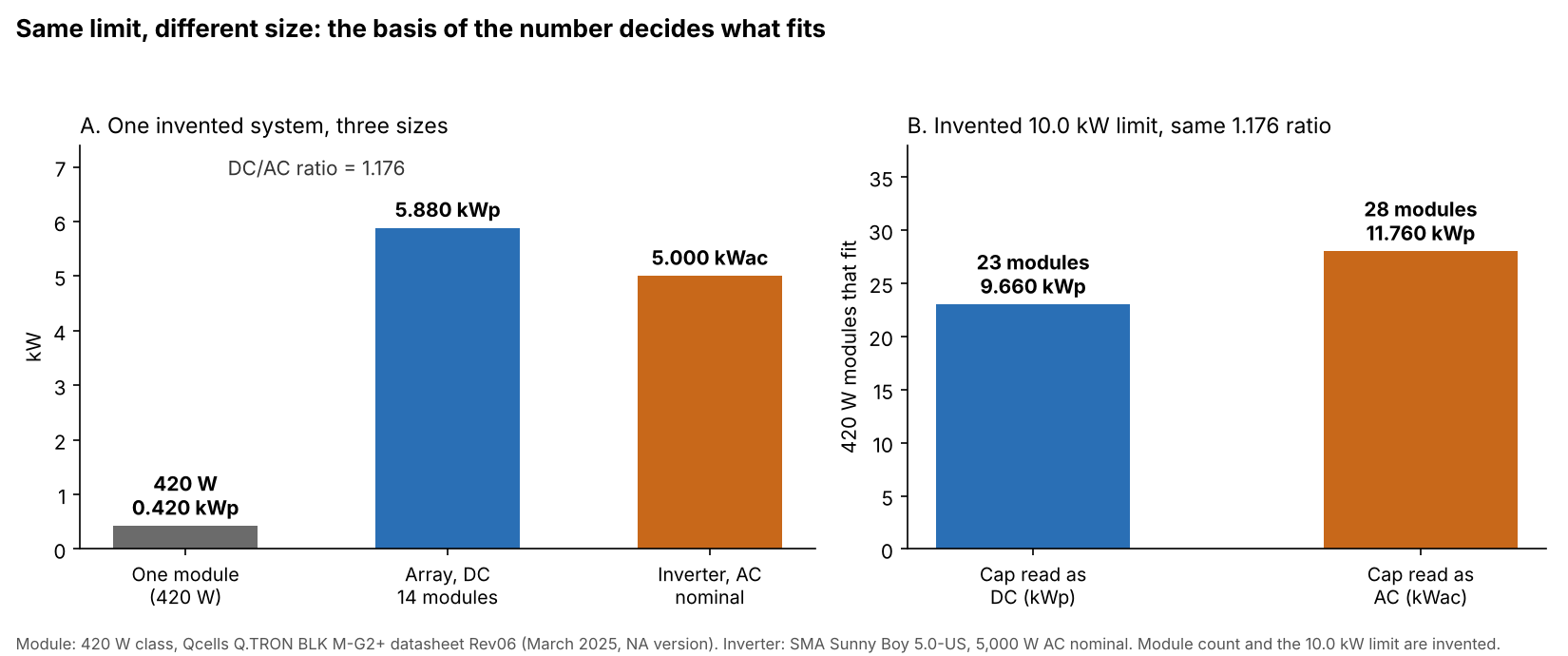
Figure 1. Reading an example 10.0 kW limit as DC or as AC changes how many 420 W modules fit, 23 or 28, at the example’s 1.176 ratio.
What is the difference between W and Wh?
A watt is a rate. A watt-hour is an amount: 1 Wh is 1 W held for 1 hour. A kWp rating has no hours in it, so it is never a kWh.
| Case | Calculation | Result |
|---|---|---|
| 420 W module held at 420 W for 3 hours (example hours) | 420 W × 3 h | 1,260 Wh, or 1.26 kWh |
| 5.880 kW array held at 5.880 kW for 2 hours (arrays rarely hold their rating) | 5.880 kW × 2 h | 11.76 kWh |
Energy units are on kilowatt-hour. Energy per kWp is on specific yield. The share of the year at rated power is on capacity factor.
How do you check a size limit?
Divide the limit by the module kW and round down to whole modules. Read as DC, use the limit as it is. Read as AC, multiply it by the DC/AC ratio first, holding the ratio fixed.
Worked example: one array, one limit, two readings
The module is the 420 W class and the inverter is the SMA Sunny Boy 5.0-US (5,000 W AC nominal). The module count (14) and the 10.0 kW limit are example. The ratio is 5.880 ÷ 5.000 = 1.176.
Table 1. Array and inverter sizes.
| Item | Calculation | Result |
|---|---|---|
| Array size, DC | 14 × 420 W ÷ 1,000 | 5.880 kWp |
| Upper tolerance | 14 × (420 + 5) W ÷ 1,000 | 5.950 kWp, 1.2% above |
| Inverter size, AC | 1 × 5,000 W ÷ 1,000 | 5.000 kWac |
| Array against max usable DC power (5150 W) | 5,880 W ÷ 5,150 W | 1.142, above 1.000, so the inverter would limit input |
Table 2. The same example 10.0 kW limit read as DC and as AC, with the ratio held at 1.176.
| Limit read as | Modules that fit | Array size | Inverter size at the ratio |
|---|---|---|---|
| DC | 23 (10,000 ÷ 420, rounded down) | 9.660 kWp | 8.214 kWac (not a stock size) |
| AC | 28 (10,000 × 1.176 ÷ 420, rounded down) | 11.760 kWp | 10.000 kWac |
The AC reading admits 5 more modules, 21.7% more. The design differs because the rule’s wording changes how many modules fit. The 1.142 line is only the inverter’s DC power line. String voltage and current limits are separate checks: see string sizing.
Calculator
Enter module count, module watts, the inverter’s AC rating and an optional limit. It returns kWp, kWac, the ratio and the modules that fit under the limit on each reading. It also turns watts and hours into watt-hours. The defaults reproduce the sizes in Table 1 and both rows of Table 2.
How solar software handles wattage and system size
Four of the five tools below state whether their system size is DC or AC, and PVWatts does not. Ratings follow the pages read in October 2026, for labels only.
| Software | Does the page state a DC or AC basis? |
|---|---|
| PVsyst | Yes |
| SAM | Yes |
| pvlib | Yes |
| Enerflo | Yes |
| PVWatts (NREL) | Partly |
Partly means the page labels outputs, not the size input. The notes below give the page wording and the page read.
- PVsyst: The array’s Pnom "is defined at STC". The inverter’s Pnom "is defined as the output AC power". Page read: PVsyst help, inverter and array sizing (undated).
- SAM: "Nameplate DC capacity" in kWdc is the array’s maximum DC power at the reference conditions. "Total AC capacity" in kWac is the total inverter capacity in AC kilowatts. Page read: SAM help, PV system design (undated).
- pvlib: The DC model’s pdc0 is module power at 1000 W/m² and the reference cell temperature, in W. The inverter model’s pdc0 is the inverter’s DC input limit. Page read: pvlib 0.16.1 docstrings.
- Enerflo: "The System Size in our system is DC." The article adds that system size affects pricing. Page read: Enerflo help, Price Summary vs System Production (shows "Updated: this week", no date).
- PVWatts (NREL): The V8 API describes system_capacity as "Nameplate capacity (kW)". It does not say DC or AC there. Its outputs are labelled kWhac and kWhdc. Page read: PVWatts V8 API documentation (version 8.0.0 in its example response).
Tools that label DC and AC size appear in our lists of the best solar simulation software and the best commercial solar design software.
Common mistakes with wattage and kWp
FAQs
Is kWp the same as kW?
No. kWp is kilowatts at STC, the module rating, and is a DC figure. A plain kW has no stated basis, so find out whether it is DC or AC before you compare it with a limit.
Is the kW on a quote DC or AC?
It is DC if it equals modules × module watts at STC, and AC if it matches the inverter datasheet’s AC nominal power. If a quote shows one unlabelled kW, ask the installer which.
Why does the datasheet say Wp in one place and W in another?
Wp and W both mean power at STC. The Qcells sheet writes Wp on its cover and W in the electrical table. NIST’s guide advises against adding letters to a unit, but trade labels are common. Take the figure from the electrical table.
What is the difference between kW and kWh?
A kW is a rate of power. A kWh is that rate held for hours. A 5.880 kW array held at full rating for 2 hours makes 11.76 kWh.
How many modules make 1 kW?
Divide 1,000 by the module watts. At 420 W that is 2.38, so 3 whole modules reach 1 kWp and 2 do not. Count modules in whole numbers against the limit.
Related terms
- Kilowatt and megawatt: power prefixes, kVA and who states capacity on which basis.
- Kilowatt-hour: energy, power multiplied by hours.
- Standard test conditions: the lab basis for module watts.
- Peak watt (Wp): module rated power at standard test conditions.
Next step: ask which basis an unlabelled kW uses, then see how tools label it in the best solar simulation software.
Sources
- Units (checked October 2026): NIST SP 811, chapter 4 and chapter 7 (updated 18 August 2025).
- Programmes (checked October 2026): NY-Sun Program Manual, version 19, January 2025. National Grid SMART Provision, M.D.P.U. No. 1647, header read in October 2026: issued 13 August 2026, effective 1 July 2026.
- Datasheets: Qcells Q.TRON BLK M-G2+ series, Rev06, March 2025, NA version (distributor copy). SMA Sunny Boy 3.0 to 7.7-US datasheet, footer code SB3.0-7.7-US-DUS170619 (distributor copy, no revision stated).
- Tools (all checked October 2026): PVsyst help. SAM help. PVWatts V8 API. Enerflo help. pvlib inverter.pvwatts, with pvsystem.pvwatts_dc, version 0.16.1.
Last updated 30 October 2026. Next scheduled review: 30 January 2027.