Key takeaways
- PV arc-fault protection covers series arcs only. Wiles (IAEI, 2022) says the NEC 690.11 devices "must deal with series arcs only at this time".
- Documents print different limits. SMA’s paper on the draft Subject 1699B says 300 W and 2 seconds. SolarEdge’s April 2025 note for UL 1699B (2018) says 2.5 seconds and 750 J.
- Our check combines 2011 draft test arcs with the 2018 limits, so it shows scale, not a verdict. If the 750 J limit applied, a 900 W arc would reach it in 0.83 s.
- SMA, SolarEdge and Huawei all document one lock-out count. Five arc events in 24 hours need a manual restart. Restart after fewer events differs by maker.
- The NEC guide sample lists a voltage threshold and exceptions (see the FAQs). The inverter’s own listing and your AHJ’s edition decide the job.
A plan set must name the NEC edition and the inverter’s arc-fault listing. For help, see the best solar plan set services.
Arc-fault protection at a glance
Arc-fault protection is a function, not a box. It is usually built into the inverter. It finds the arc and stops current. Then it restarts or locks out.
| Item | Detail |
|---|---|
| What it is | UL 1699B covers PV arc-fault circuit interrupters, arc-fault detectors, interrupting devices, and inverters, converters and charge controllers with built-in protection. |
| Arc type covered | Series arcs. Parallel arcs are outside it (SMA paper, Wiles 2022). |
| Where it sits | Wiles (2022) says it is inside the inverter in residential and moderately sized commercial systems. |
| Standard or rule | UL 1699B (Ed. 1-2018 on the ANSI listing). NEC 690.11 in the edition your AHJ adopted. See NEC 690. |
| In software | Inverter apps hold the settings and alarms. See the software table. |
Why does arc-fault protection matter for installers?
An arc is a fire risk. The protection sits inside equipment you commission. UL’s scope says the devices aim to mitigate the effects of arcing faults. These faults may pose a risk of fire ignition.
Know the arc setting and reset rule of the inverter you specify. Do not clear a lock-out without finding the cause. SMA says qualified persons should investigate recurring faults at once. Wiles (2022) says no handheld arc-fault simulators exist. SolarEdge’s note lists a built-in Manual AFCI Test.
What are series and parallel arcs, and which does AFCI address?
A series arc forms across a break in a conductor that carries current. A parallel arc forms across failed insulation between two conductors. PV arc-fault protection deals with the series arc.
SMA’s white paper (undated) defines the series arc as "a failure in the intended continuity of a conductor, connection, module, or other system component". It defines the parallel arc as a "failure in insulation between two conductors". It says NEC 690.11 does not cover it. Wiles (IAEI, March 2011) said the new device "must detect series arcs in the dc PV circuits, interrupt them, disable equipment, and annunciate". A UL presentation (February 2011) says AFCI works for series arcing.
The UL 1699B listing adds a limit. The devices are "not intended to detect glowing connections". SolarEdge’s note lists the arc location as input and string wires.
How does DC arc-fault protection detect, interrupt and restart?
The device finds an arc and stops current. Then it restarts alone or waits for a person. Makers describe the same three steps but print different restart rules.
| Document | Detect and interrupt | Restart rule |
|---|---|---|
| SMA Sunny Tripower X 30-US manual page (no date printed) | Detects arcs in the PV modules and module wiring of connected strings. The inverter halts current flow. | Default: automatic restart after each arc. Five arcs within 24 hours need a manual restart. The default can be changed "if the installation conditions permit". |
| SolarEdge application note, v1.0, April 2025 | Optimisers and inverters interrupt production after detection. | North America needs a qualified person to re-enable the inverters after checks (quote below). Five arcs in 24 hours need a manual reset. |
| Huawei SUN2000-50KTL manual (updated 29 August 2025) | Detects arc faults from damaged or wrongly connected modules or cables. On by default. | Fewer than 5 triggers in 24 hours: the alarm clears automatically. Five or more: the inverter locks until the alarm is cleared by hand. |
| Tigo support article on AFCI (no date printed) | Describes detection and "immediate DC shutdown at the string, the combiner, or the inverter level". | Says some products "can experience false detections", called nuisance tripping. Contact the maker for updates. |
- SolarEdge, Europe and APAC: the note lists automatic reconnect for these regions only.
- SolarEdge, North America: "a qualified person must re-enable the inverters after properly checking the installation."
- SolarEdge, UL 1699B wording: "After each arc is extinguished, the system shall delay no less than five minutes before resuming operation."
SMA calls its own arc events reliable signs of actual errors. Tigo says some inverter and third-party AFCI products can show false detections.
Only the SolarEdge note prints the five-minute delay. The SMA and Huawei pages print no delay time.
Does module-level hardware change arc-fault protection?
It can change compatibility. Pairing rules sit in maker documents. Check them at design stage. See MLPE and power optimiser.
- Huawei: the AFCI works only with Huawei optimisers or ordinary PV modules. It does not support third-party optimisers or intelligent modules (manual, 29 August 2025).
- Tigo: its MLPEs "cannot detect arc-fault, but some models can help mitigate damage". Passive models do not cause false detections. Active models suit "the vast majority" of AFCI inverters.
- SolarEdge: the note says the power optimisers stop output at module level once they find an arc.
What do UL 1699B and NEC 690.11 say?
UL 1699B is the product standard for the device. NEC 690.11 is the installation rule. Both change by edition. Name the edition on every plan set.
| Product standard document | Edition as printed | What it prints |
|---|---|---|
| ANSI webstore listing | UL 1699B, Ed. 1-2018 | Devices rated 1500 volts or less. Listing gives no detection thresholds. |
| Fronius Primo 10.0-1 208-240 page (no date printed) | "UL 1699B Issue 2-2013" | AFCI built in. "makes each inverter NEC 2011 compliant". |
| SMA white paper (no date, products dated 2012 to 2013) | UL Subject 1699B. 2011 NEC | Detect an arc of "300 W or more". Interrupt "within a maximum time period of two seconds". |
| SolarEdge note, April 2025 | UL 1699B (2018). IEC 63027, no edition printed | "Disrupt arcing event in less than 2.5 seconds, and limit energy to a maximum of 750 J." The note lists both standards. |
Code documents:
| Code document | Edition | What it prints |
|---|---|---|
| Wiles, IAEI, 16 March 2011 | 2011 NEC | "A new requirement was added for a dc PV arc-fault circuit interrupter." |
| Holt guide to the 2017 NEC, sample page 507 | 2017 NEC | 80 V dc or greater between any two conductors. Listed PV AFCI or equivalent. Exceptions are listed under the table. |
| Wiles, IAEI, 1 May 2022 | Not named | 80 V dc or greater. No protection for arrays not mounted on or in buildings, or dc output circuits in metallic raceways or enclosures. |
| Wiles, IAEI, 23 March 2023 | 2023 NEC | "The Exception in Section 690.11 ... has been revised for clarity with subparagraphs." It gives no detail. |
The Holt sample lists no protection for systems not on or in buildings, direct-buried PV and DC-DC converter output circuits, or circuits in metallic raceways.
The Fronius label names a different edition (Issue 2-2013) from the ANSI listing (Ed. 1-2018), so confirm with the maker which edition the inverter was listed to. The two exception lists differ, so read the edition your AHJ adopted. The 2 s and 2.5 s figures come from maker documents, not the UL text. Read the inverter’s listing to see which test it passed.
How fast must an arc be cleared? A worked check
Say the 750 J energy limit and the 2.5 s limit both apply. Then the clearing time shrinks as arc power rises. At 300 W it is 2.5 s. At 900 W it is 0.83 s.
The arc powers come from a UL presentation (February 2011). It covers the draft Subject 1699B. The time is our arithmetic: 750 J / power, at constant power. SolarEdge’s note gives no formula. Our check combines 2011 draft test arcs with the 2018 limits, so treat it as illustrative. These arcs may differ from the 2018 test arcs.
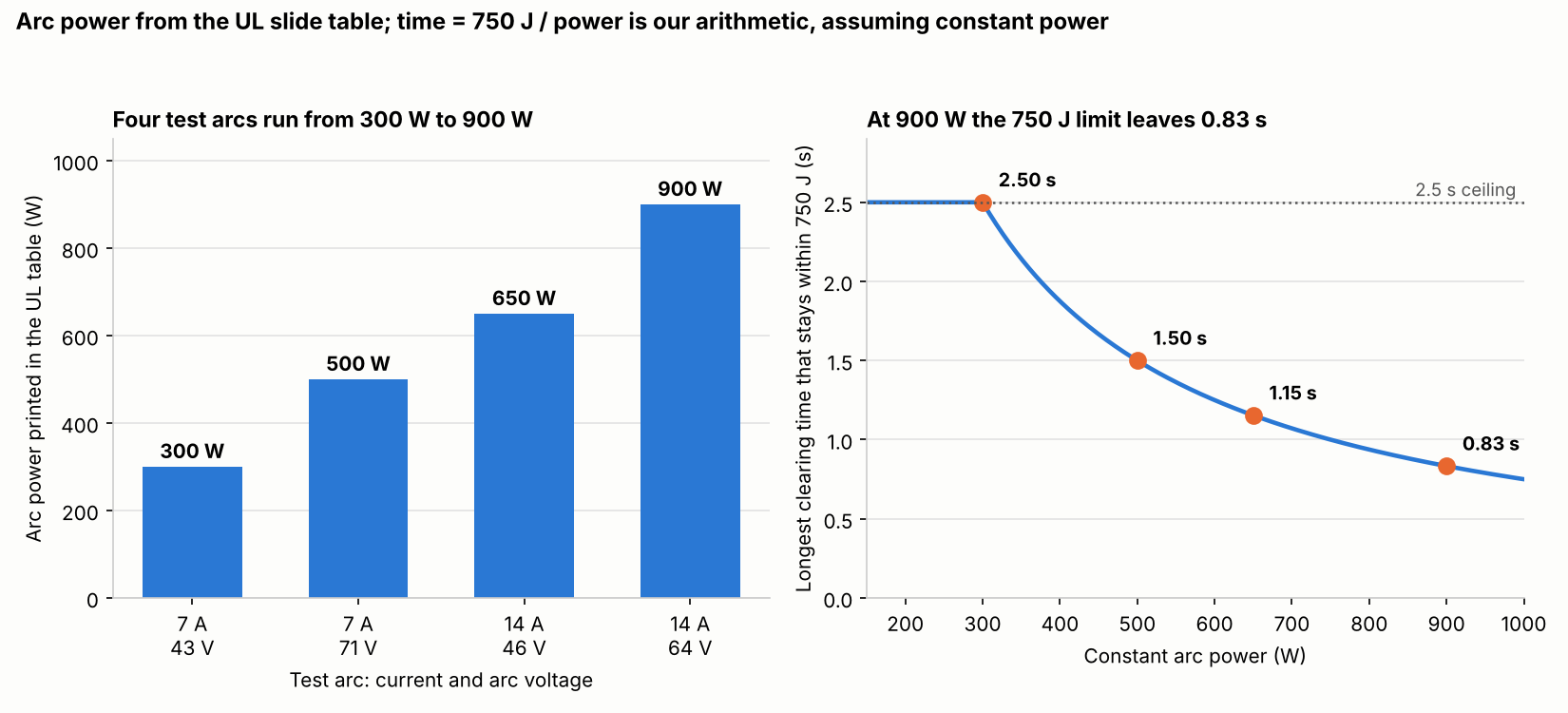
Figure 1. Four UL test arcs run from 300 W to 900 W, and the 750 J limit leaves only 0.83 s at 900 W.
| Test arc | Printed power | Volts x amps | Longest time within 750 J | Energy if cleared at 2.5 s |
|---|---|---|---|---|
| 7 A, 43 V | 300 W | 301 W | 2.50 s | 750 J |
| 7 A, 71 V | 500 W | 497 W | 1.50 s | 1,250 J |
| 14 A, 46 V | 650 W | 644 W | 1.15 s | 1,625 J |
| 14 A, 64 V | 900 W | 896 W | 0.83 s | 2,250 J |
The printed power is rounded, so times use the printed column. At 300 W, 2.5 s gives 750 J. SMA’s 300 W at 2 s gives 600 J. The documents do not agree.
Arc energy and lock-out calculator
Enter an arc and a clearing time to compare with the limits. Then count lost output after repeated arcs. Defaults are invented.
How solar software handles arc-fault protection
SolarEdge and Huawei document arc-fault settings or alarms in their apps. SMA says the default can be changed but names no screen. Tigo’s article says its MLPEs cannot detect arc faults.
The table shows which tools handle arc-fault settings. The bullets show how and where.
| Software | Does it handle arc-fault settings or alarms? |
|---|---|
| SolarEdge SetApp and inverter LCD | Yes |
| Huawei FusionSolar (app and SmartPVMS) | Yes |
| SMA (Sunny Tripower X manual) | Partly |
| Tigo Energy Intelligence | Not stated |
- SolarEdge SetApp and inverter LCD: AFCI screen under Commissioning > Maintenance, with a Manual AFCI Test. The AFCI function is enabled by default (on the DSP versions the note lists). Notes: Application note v1.0, April 2025, read October 2026.
- Huawei FusionSolar (app and SmartPVMS): Disable AFCI in the app. Clear the DC arc fault alarm in the app, or with DC Arc Fault Clearance in SmartPVMS. Notes: SUN2000-50KTL manual updated 29 August 2025, read October 2026.
- SMA (Sunny Tripower X manual): The page says the default can be changed. It names no app or portal screen for it. Notes: Manual page, no date printed, read October 2026.
- Tigo Energy Intelligence: The AFCI article does not name it and says Tigo MLPEs cannot detect arc faults. Notes: Support article, no date printed, read October 2026.
Partly: the page names no screen. Not stated: the article we cite does not name Energy Intelligence. To compare inverter apps, see our ranked list of the best solar inverter monitoring apps.
Common mistakes with arc-fault protection
FAQs
Why does my inverter show a DC arc fault alarm?
It found what it read as an arc, or it reacted to a false detection. SMA and Huawei restart on their own for fewer than five events in 24 hours. SolarEdge’s North America note says a qualified person must re-enable the inverters. They do so after checking the installation. Inspect the connectors and cabling first.
Is arc-fault protection required on a solar system?
Yes for many PV circuits, but the adopted edition decides. The 2017 NEC guide prints the rule at 80 V DC or greater between any two conductors, with exceptions, and Wiles says the 2023 NEC revised that exception’s wording without changing the voltage threshold. NFPA approved a further 2026 edition in September 2025, which most jurisdictions have not yet adopted as of November 2026. Check the edition your AHJ has adopted before applying any of these section numbers.
How do I test arc-fault protection on site?
Wiles (2022) says no handheld arc-fault simulators exist. SolarEdge’s note lists a Manual AFCI Test. It sits in SetApp and on the inverter LCD. Use the maker’s own test where one is documented.
Does IEC 63027 matter outside the US?
The SolarEdge note does not say that any country requires IEC 63027. It lists the standard beside UL 1699B, with the same 2.5 s and 750 J for both. They differ on reset. IEC 63027 needs no manual step if the array stays off for five minutes. The note’s UL 1699B wording adds a five-minute delay. In North America it also needs a qualified person to re-enable the inverters. Check which standard your inverter follows.
Related terms
- Rapid shutdown: a separate function that cuts voltage on rooftop wiring when someone trips a switch.
- Overcurrent protection: fuses and breakers that open when current passes their rating.
- DC disconnect: the manual switch that opens the DC circuit.
- Combiner box: the enclosure that joins string circuits into one protected output.
- Grounding and earthing: joining exposed metal to earth.
Next step: before commissioning, read the inverter’s lock-out count and restart rule, then see which apps show arc-fault alarms in the best solar inverter monitoring apps.
Sources
- ANSI webstore: UL 1699B Ed. 1-2018 listing (checked October 2026).
- SMA America: AFCI white paper (checked October 2026).
- SMA: Sunny Tripower X 30-US manual, AFCI page (checked October 2026).
- SolarEdge: arc fault detection application note, v1.0, April 2025 (checked October 2026).
- Huawei: SUN2000-50KTL manual, AFCI page, updated 29 August 2025 (checked October 2026).
- Tigo support: AFCI compliance article (checked October 2026).
- Fronius: Primo 10.0-1 208-240 technical data (checked October 2026).
- IAEI Magazine: Wiles, 2011 NEC and PV, 16 March 2011 (checked October 2026).
- IAEI Magazine: Wiles, fire and personnel safety, 1 May 2022 (checked October 2026).
- IAEI Magazine: Wiles, 2023 NEC and PV, 23 March 2023 (checked October 2026).
- Mike Holt: guide to the 2017 NEC for solar PV, sample (checked October 2026).
- UL (Zgonena, Ji, Din): UL Subject 1699B, DOE workshop, February 2011 (checked October 2026).
Last updated 30 October 2026. Next scheduled review: 30 January 2027.