Key takeaways
- Voltage is the hard limit. Victron’s 150/70 allows 145 V in operation. Four example 400 W modules in series reach 166.0 V at a -20 °C cell. Three reach 124.5 V.
- Only 3 modules per string fit the 150/70 on a 48 V bank. Two modules give 53.6 V at 65 °C, under the 58.6 V minimum.
- Power and current limits are softer. Victron says the charger limits input power if more PV is connected. Our 12 modules are 120% of a 150/70’s 4,000 W.
- In our model, 2 example modules on a 52 V battery under a PWM clamp gave up 22% of power at -10 °C and 12% at 25 °C.
- Of 5 tools checked, only Morningstar’s calculator is described as checking controller limits. Victron’s manual points to its calculator without naming the checks.
To check an array against a controller’s printed limits, see the best free solar calculators for installers.
Charge controller at a glance
Voltage limits set string length. Current and power limits set array size.
| Item | Detail |
|---|---|
| What it does | Controls battery charging from PV. MPPT types also track the peak (see MPPT). |
| Four sizing checks | Cold Voc against the maximum PV voltage. Hot Vmp against the running minimum. Array Isc against its rating. Array power against the charge limit. |
| Example limits | Victron 150/70: 145 V, 70 A charge, 50 A short-circuit. Morningstar TriStar MPPT 600V: 600 V, 60 A. |
| Standard or rule | No single standard. The manual sets the limits. Code limits are on the NEC 690 page. |
| In software | Maker calculators check arrays against their own controllers. |
Why do charge controllers matter for installers?
A string that works on a summer day can pass the voltage limit on a winter morning. Victron’s manual says the charger will stop charging above its maximum rating. Morningstar says the array’s temperature-compensated maximum Voc should never exceed the controller’s rating.
The method is on the string sizing page. The controller and battery set the limits. Days of autonomy are on off-grid system design.
What is the difference between PWM and MPPT controllers?
A PWM controller pulls the array down to about battery voltage, so it loses power when the array’s peak is higher. An MPPT controller converts the voltage. The array can then run at its own peak (see MPPT). Victron’s manual says its charger can charge a lower-voltage battery from a higher-voltage array.
Our model holds the array exactly at battery voltage, with no drops. It is a single-diode fit to the example module (54 cells in series assumed). The test case is 2 modules in series on a 48 V bank. A datasheet does not set the curve’s knee. Three refits (Voc coefficients -0.22, -0.27 and -0.32 %/°C) show the range. No product was modelled.
| Cell temperature | Peak voltage of 2 modules | Below peak power, battery 52 V | Below peak power, battery 57.6 V |
|---|---|---|---|
| -10 °C | 69.4 V | 22.2% (20.9 to 23.5) | 13.9% (12.5 to 15.3) |
| 25 °C | 62.0 V | 12.3% (12.1 to 12.5) | 3.7% (3.6 to 3.8) |
| 65 °C | 53.6 V | 0.7% (0.0 to 2.2) | 6.7% (2.6 to 13.2) |
The gap is smallest when battery voltage is near the string’s peak voltage. Hot values vary most across refits.
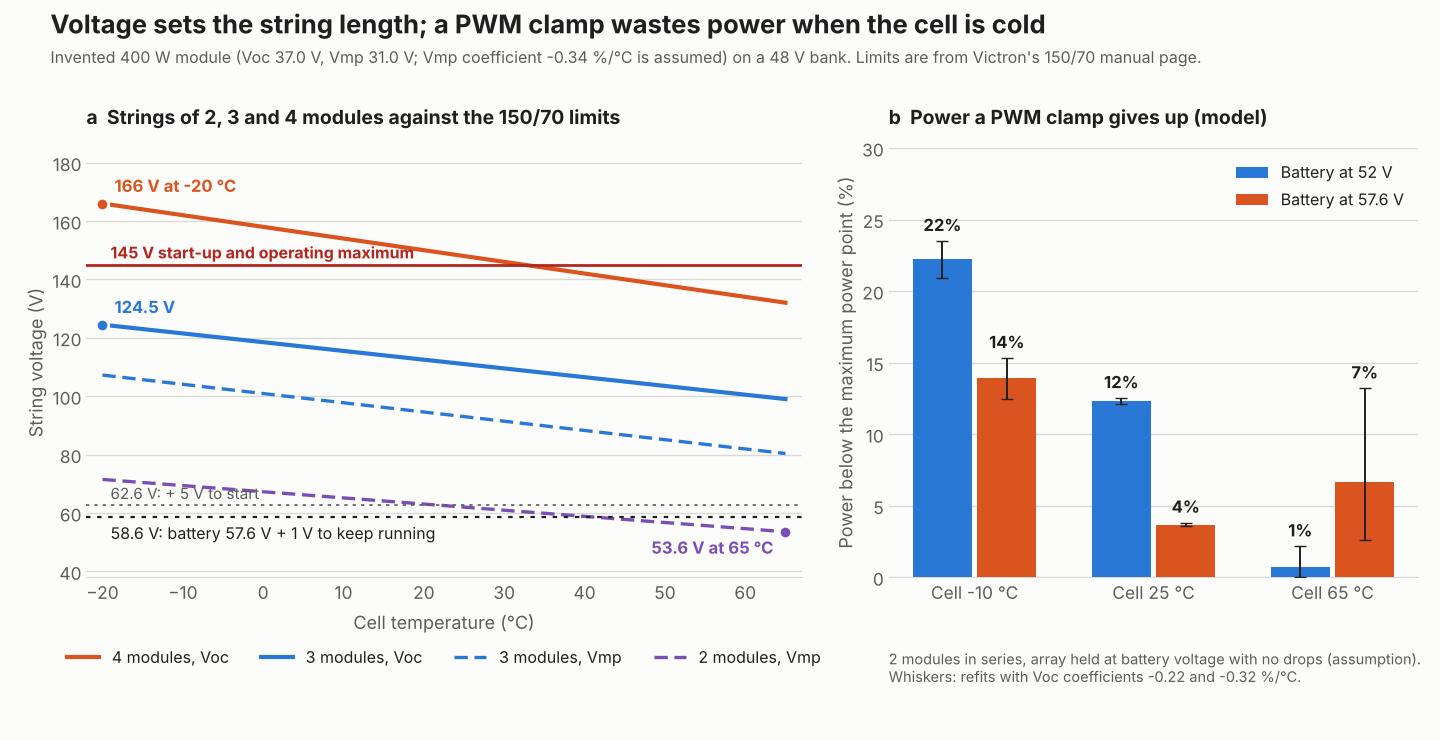
Figure 1. In our example only 3 modules fit the 150/70’s voltage window. A PWM clamp gave up 14% to 22% of power at a -10 °C cell (model).
What are the battery charge stages?
Victron’s 150/70 manual calls its charger a 3-stage charger. The stages are bulk, absorption and float. Equalisation is a separate, optional charge.
- Bulk: the charger gives its maximum charge current.
- Absorption: voltage is held at 57.6 V by default at 48 V. It ends when battery current falls below the tail current (default 2 A). A time limit also applies: 1 to 6 hours at 12 V.
- Float: voltage drops to hold the battery full, 55.2 V at 48 V by default.
Charge voltage also moves with battery temperature. Victron prints -16 mV/°C at 12 V (-64 mV/°C at 48 V, from the same manual row). Morningstar’s TriStar MPPT 600V datasheet (Rev 04/2016.SP) prints -5 mV/°C per cell.
Which numbers size a charge controller?
Four checks, all tied to the battery’s charge voltage. Take each limit from the manual for the exact model.
- Cold string Voc: modules × Voc × (1 + coefficient × (T − 25)) at the coldest cell temperature. It must not exceed the maximum PV voltage. Victron’s manual says to use both Voc and its temperature coefficient (see Voc and Isc and temperature coefficient).
- Hot string Vmp: at the hottest cell, no lower than the running minimum. Victron’s footnote says PV voltage must pass battery voltage plus 5 V to start. After that it must stay over battery voltage plus 1 V. Use the highest charge voltage (see Vmp and Imp).
- Array Isc: strings in parallel × Isc, no higher than the short-circuit rating. Victron’s footnote warns that a higher figure may harm the charger on reverse polarity.
- Charge limit: array STC power ÷ charge voltage is a ceiling for charge current. Victron’s manual says the charger limits output current to its rating. So power depends on battery voltage.
| Printed limit | Victron SmartSolar MPPT 150/70 | Morningstar TriStar MPPT 600V (60 A, 48 V) | Victron Multi RS19 Solar 48/6000 (230 V) |
|---|---|---|---|
| Maximum PV voltage | 150 V absolute at coldest. 145 V start-up and operating | 600 V open circuit | 450 V open circuit |
| Start and minimum | Battery + 5 V to start, then battery + 1 V | 100 V to 525 V operating range. Start-up not stated | 120 V start-up. 65 to 450 V operating |
| Charge current | 70 A | 60 A | 100 A total, AC and PV combined |
| PV short-circuit current | 50 A | Not stated | 16 A short circuit, 12 A operating. The datasheet does not say per tracker |
| Nominal PV power | 4,000 W at 48 V | 3,200 W at 48 V | 3 kW per tracker, 6 kW total |
Victron’s 4,000 W at 48 V is 70 A at about 57.1 V (our division). Morningstar says its nominal ratings use maximum output current times nominal bulk charging voltage. So the example uses 57.6 V.
Worked example: one array, five layouts
The same example array is tried on three controllers. Only one layout passes every check on the Victron controller. The two layouts that follow pass on voltage.
| Input | Value (example unless stated) |
|---|---|
| Module | 400 W. Voc 37.0 V, Vmp 31.0 V, Isc 13.6 A, Imp 12.9 A. Not a product |
| Coefficients | Voc -0.27 %/°C. Vmp -0.34 %/°C, an assumption |
| Site cell temperatures | -20 °C coldest, 65 °C hottest |
| Battery | 48 V bank. 57.6 V charge voltage (Victron’s 48 V absorption default) |
| Array | 12 modules, 4,800 W at STC |
| Layout | Cold Voc against maximum | Hot Vmp against minimum | Isc and array power against rating | Result |
|---|---|---|---|---|
| 1. Victron 150/70, 4 in series, 3 strings | 166.0 V against 145 V | 107.1 V against 58.6 V | 40.8 A against 50 A. 4,800 W against 4,000 W | Fails: cold Voc |
| 2. Victron 150/70, 3 in series, 4 strings | 124.5 V against 145 V | 80.4 V against 58.6 V | 54.4 A against 50 A. 4,800 W against 4,000 W | Fails: Isc |
| 3. Victron 150/70, 3 in series, 3 strings (9 modules) | 124.5 V against 145 V | 80.4 V against 58.6 V | 40.8 A against 50 A. 3,600 W against 4,000 W | Passes |
| 4. TriStar MPPT 600V, 6 in series, 2 strings | 249.0 V against 600 V | 160.7 V against 100 V | 27.2 A, rating not stated. 4,800 W against 3,200 W | Voltage passes. 150% of nominal power |
| 5. Multi RS19 Solar tracker, 6 in series, 1 string (6 modules) | 249.0 V against 450 V | 160.7 V against 65 V | 13.6 A against 16 A. 2,400 W against 3,000 W | Voltage and Isc pass. Imp 12.9 A is above the 12 A operating limit |
Layout 1 fails because 4 modules read 148.0 V even at 25 °C. They exceed 145 V at any cell temperature below 32.5 °C. Layout 2 fixes the voltage, but 4 strings reach 54.4 A. Only 3 strings fit 50 A, and 10 modules fit 4,000 W. So 9 modules is the most.
Only one string length fits the 150/70 window. Two modules give 53.6 V at 65 °C, under the 58.6 V floor. We varied three inputs. Voc coefficient ran from -0.25 to -0.35 %/°C. Vmp coefficient ran from -0.30 to -0.40 %/°C. Cold temperature ran from -30 to -10 °C. Across those ranges, three modules always passed. Four always failed cold Voc and 2 always fell under the floor.
Charge current is a ceiling. At 57.6 V, 12 modules give up to 83.3 A against 70 A. 9 modules give 62.5 A. Going over is not a fault. Victron’s footnote says the charger limits input power. For layouts 4 and 5, read the maker’s wording on oversizing.
Charge controller sizing calculator
Enter a module, an array and the controller’s printed limits. It opens on layout 3. Other free tools are in the best free solar calculators for installers.
If the calculator does not load, open the charge controller sizing calculator on its own page.
Where does a charge controller sit compared with a hybrid inverter?
A stand-alone controller is a separate DC unit between array and battery. A hybrid inverter does the same job in its PV inputs. One datasheet then carries every limit.
Victron’s Multi RS19 Solar datasheet lists 2 trackers, 450 V maximum and 120 V start-up. Its footnote says the maximum PV voltage should not exceed 8 times the battery float voltage. That is 400 V for a 50 V battery. The 100 A charge limit is shared by AC and PV. Check strings against the tracker, as in layout 5.
For where the battery joins the system, see AC vs DC coupling and solar-plus-storage. See also string inverter, inverter and battery storage design.
How solar software handles charge controllers
Only Morningstar’s calculator describes a check against its own controllers. Victron’s manual points to its calculator without naming the checks, and the three design tools we read do not mention charge controllers. All checked October 2026.
| Software | Checks charge controller limits? | Method |
|---|---|---|
| Victron MPPT Calculator | Not stated | Maker tool |
| Morningstar String Calculator | Partly | Maker tool |
| Aurora Solar | Not stated | Design tool |
| OpenSolar | Not stated | Design tool |
| HelioScope | Not stated | Design tool |
Not stated: the company page we cite does not say. Partly: the page describes a check for the maker’s own controllers only. What each page says:
- Victron MPPT Calculator: Victron’s 150/70 manual points to "the MPPT sizing calculator" for array size. The manual only points to the calculator, and its checks are not stated on the pages read. Manual undated.
- Morningstar String Calculator: Morningstar’s page says it finds series and parallel counts that do not damage its controllers. It shows ProStar and TriStar MPPT. Cold Voc check not stated. No visible date.
- Aurora Solar: The "Stringing and Connecting" page does not mention charge controllers, off-grid or batteries. One page read, undated. The MPPT page rates its inverter check.
- OpenSolar: "Inverter sizing and stringing recommendations" does not mention charge controllers or off-grid. One page read, updated 24 July 2025. A related "Battery Design Assistant" article is outside the pages read.
- HelioScope: "Stringing in HelioScope" does not mention charge controllers, off-grid or batteries. One page read, updated 9 July 2025.
For ranked tools for off-grid designs, see the best off-grid solar design software.
Common mistakes with charge controllers
FAQs
Do I need a charge controller with a hybrid inverter?
No, not if its PV inputs fit the array. A hybrid inverter has PV inputs that do the same job as a controller. Victron’s Multi RS19 Solar datasheet lists 2 trackers and a 450 V limit. In layout 5, six modules give 249.0 V cold Voc against that 450 V limit.
Is MPPT always better than PWM?
No. PWM can lose little when battery voltage sits near the array’s peak. MPPT wins at higher array voltage or in the cold. In our model on a 52 V battery, the PWM gap was 12.3% at 25 °C and 22.2% at -10 °C. MPPT also lets higher-voltage strings charge a lower-voltage battery.
How many panels can go on one charge controller?
Count them from the controller’s limits. Voltage sets modules per string. Current and power set the strings. In our example the 150/70 takes 3 in series and 3 strings, 9 modules.
What happens if the array voltage is too high?
Victron’s manual says the charger will stop charging when PV voltage passes the maximum rating. Morningstar says the array’s maximum Voc should never exceed the controller’s rating.
What size charge controller do I need?
In our worked case, 9 modules on a Victron 150/70 at 48 V fit as 3 in series and 3 strings. For another array, run four checks: cold Voc, hot Vmp, array Isc and array power. Take each limit from the manual for the exact model.
Related terms
- MPPT: holds a PV input at its peak-power voltage.
- Voc and Isc: open-circuit voltage and short-circuit current.
- String sizing: choosing modules per string to fit a voltage window.
- Off-grid system design: sizing array, battery and backup with no grid.
- AC coupling vs DC coupling: where a battery joins solar.
Next step: to design the whole off-grid system around the controller, see the best off-grid solar design software.
Sources
All checked October 2026.
- Victron SmartSolar MPPT 150/60 to 250/70 manual (undated): introduction, features, installation, operation, troubleshooting and specifications.
- Victron Multi RS19 Solar datasheet (230 V model, undated, footnote 4, 16 A and 12 A rows re-read 30 October 2026) and Victron MPPT Calculator.
- Morningstar: TriStar MPPT 600V page (modified 8 October 2026), datasheet Rev 04/2016.SP, array oversizing (2013 copyright), string calculator. The announcement page we cited before (p=13271) now returns a 404, so it is dropped.
- Tool help pages: Aurora, OpenSolar and HelioScope.
Last updated 30 October 2026. Next scheduled review: 30 January 2027.