Key takeaways
- Community solar lets many customers share one off-site array. NLR (market data to June 2025) puts about 75% of US capacity in four states: Florida, New York, Massachusetts and Minnesota.
- A subscriber gets a credit on the utility bill and pays the project owner separately. In one Illinois offer, the Citizens Utility Board (July 2025) says the discount is "usually 10–20%".
- Example: credit 0.14 USD per kWh, fee 90% of it. The subscriber nets 100.80 USD a year, or 34.16 USD if extra credit is lost.
- A fixed fee of 75.60 USD a month gives the same 100.80 USD a year, but 3 months end up negative.
- For the owner of the example 1,000 kWdc project, each unsold point of capacity costs 1,512 USD a year in fees.
To size the array behind a project, see the best solar software for utility-scale developers.
Community solar at a glance
One off-site project gives many bill credits. Each subscriber holds a share of the output. They pay the project owner for it.
| Item | Detail |
|---|---|
| Model | Subscribers get "an electric bill credit for electricity generated by their share" of an array (DOE, page last modified 15 May 2026). |
| Credit basis | NLR (updated 20 May 2026): credits are usually in kWh or dollars. They can come from virtual net metering, value-of-solar tariffs, group billing or joint ownership. It depends on the state and utility. |
| Scale | NLR (market data to June 2025): more than 11 GW-AC in 43 states plus DC. About 75% of capacity sits in four states: Florida, New York, Massachusetts and Minnesota. |
| Owners | NLR lists utility-sponsored, special-purpose entity and nonprofit projects. For a private owner see third-party ownership. |
| Rules | NLR: 24 states plus DC had enabling policies in February 2025. Design varies by state and utility. |
| In software | Design tools size the array. Subscriber management tools run allocation and billing. |
Why does community solar matter for installers and developers?
It sells solar to people who cannot host it. NLR says its 2024 study found that 42% of households and 44% of businesses cannot use behind-the-meter solar. DOE’s page puts it at nearly 50% of households and businesses, so sources differ.
You sell a subscription, not a roof job. You build the array, then you must fill it. Unsold share is lost fee income. Credit and carry-over rules set what a subscriber can save and you can sell. For the site side, see solar farm, interconnection queue and hosting capacity map.
How does a community solar subscription work?
The owner gives each subscriber a share of the output. The utility credits that share on the bill. The subscriber pays the owner.
- Build and connect the project. See interconnection application.
- Set each allocation. Solar Power World (19 March 2024) says managers allot "a share of its output based on a utility customer’s energy consumption". They confirm each subscription with the utility. In the Illinois offer CUB describes, the company sets the size in kW from past use.
- Split the output. Each month’s output is split by those shares.
- Apply the credit. In New Jersey, JCP&L’s FAQ describes a dollar credit. It shows on the bill as "Community Solar Credit".
- Collect the fee. CUB says subscribers "pay the solar farm for the credits" at a discount. JCP&L’s FAQ says fees go to the project operator.
Billing can be consolidated or dual, per CUB. Consolidated means one bill. The solar company pays the utility. Dual means two bills. The customer still pays charges the credit misses. JCP&L lists fixed customer charges, kW demand charges and some non-bypassable charges. An NREL case study for New Orleans (TP-6A20-89307, May 2024) writes credits as a rate per kWh. It says rules should cover minimum bills. They should cover roll-over credits too.
Worked example: one subscriber’s credit and fee
In our example case, the 10% discount holds only if extra credit rolls forward. If the credit is lost, the saving falls to 34.16 USD a year.
| Input (example) | Value |
|---|---|
| Project | 1,000 kWdc, 1,200,000 kWh a year (1,200 kWh per kWdc) |
| Subscriber’s share | 0.6% of output = 7,200 kWh a year, 86% of 8,400 kWh use |
| Use | 700 kWh in every month |
| Credit | 0.14 USD per kWh, on all use. Fixed charges are not modelled. |
| Fee | 90% of the credit = 0.126 USD per kWh allocated, or 75.60 USD a month fixed |
| Output shape | Example monthly shares, 4.5% in January to 12.0% in July |
Four cases then run on those inputs.
| Case | Credit. Fees (USD) | Net (USD) | Months negative | Credit lost (kWh) |
|---|---|---|---|---|
| A: fee per kWh, credit rolls forward | 1,008.00. 907.20 | 100.80 | 4 | 0 |
| B: fee per kWh, surplus credit lost | 941.36. 907.20 | 34.16 | 4 | 476 |
| C: fixed fee, credit rolls forward | 1,008.00. 907.20 | 100.80 | 3 | 0 |
| D: fixed fee, surplus credit lost | 941.36. 907.20 | 34.16 | 4 | 476 |
From May to August the allocation runs past the 700 kWh of use. The excess is 476 kWh. If lost, it is worth 66.64 USD, the gap between 100.80 and 34.16. If rolled forward, it is used in September to November.
A per-kWh fee is due on every allocated kWh, but credit stops at use. So May to August are negative. With a fixed fee, January, February and December are negative (January -30.24 USD). March to November are positive. At a fee of 100% of the credit, the saving is 0.00 USD with roll-forward. Without it, you lose 66.64 USD.
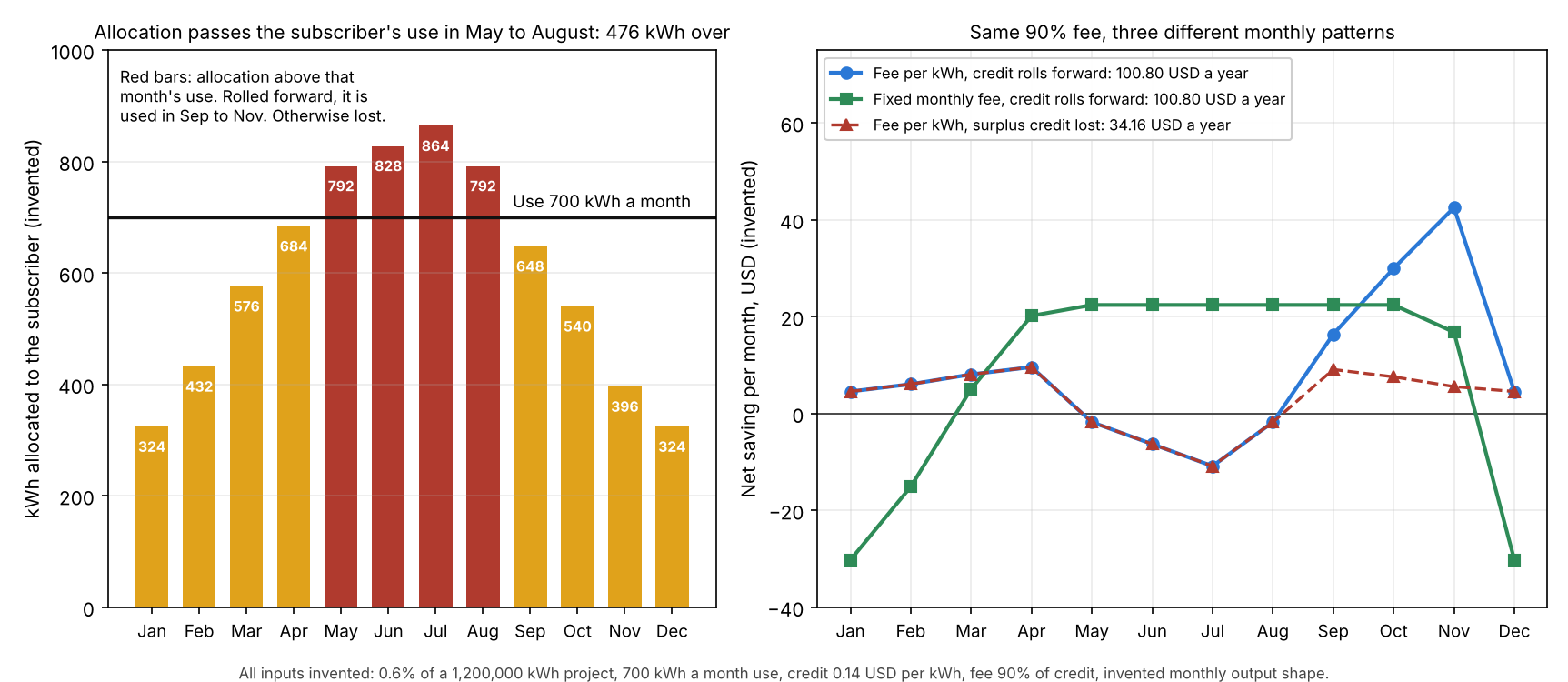
Figure 1. In example data, a 90% fee leaves 100.80 USD a year when surplus credit rolls forward and 34.16 USD when it is lost. A fixed fee turns 3 months negative.
| Share of project subscribed (example) | Fee income (USD a year) |
|---|---|
| 100% | 151,200 |
| 95% | 143,640 |
| 90% | 136,080 |
| 80% | 120,960 |
Fee income is 1,200,000 kWh times the subscribed share times 0.126 USD per kWh. Each point is 1,512 USD. This is before project costs. It ignores any payment for unsubscribed output.
Check your own subscription
Enter the share, use, credit, fee and carry rule. The preset matches case A above.
Community solar rules: three examples
Each state and utility sets its own credit, billing and consumer rules. These three documents show the range. They are not a survey.
| Source | What it says |
|---|---|
| Minnesota Department of Commerce, disclosure form (updated January 2026) | The form asks for the first-year credit value, prices and fees, contract term and first-year savings. It says the credit value "is established by the Minnesota Legislature" and "There are no exit fees for Residential Subscribers". Subscribers can cancel without penalty within three business days. |
| Illinois, Citizens Utility Board (25 July 2025) | One offer: subscribers pay the farm at a discount "usually 10–20%", with consolidated or dual billing and no exit fee. Credits may appear after a delay. |
| New Jersey, state board (16 August 2023) and JCP&L pilot FAQ (undated) | The board made the program permanent after a two-year pilot. Projects must state a bill credit discount of at least 15 percent. The JCP&L FAQ covers the pilot only: a "Community Solar Credit" line and a fee paid to the project operator. |
How solar software handles community solar
None of the three tools we read documents the full flow from allocation to credit. SAM lists a community solar model, and SunCentral is described as billing software. Partly means the page covers only part of the job. Not stated means the page we read does not mention community solar.
| Software | Handles community solar? | Page read |
|---|---|---|
| SAM | Partly | SAM help, Community Solar financial model page, undated (checked November 2026) |
| PowerHub | Not stated | PV Buzz article, 15 February 2024 (trade press, not company documentation) |
| SunCentral (Pivot Energy) | Partly | Pivot Energy product page, no date shown (copyright 2026) |
What each page says:
- SAM: The Community Solar financial model page describes a project that earns revenue from subscriber payments for a share of the project, with up to four subscriber classes and a bill credit rate set in USD per kWh for each class. It does not cover enrolment, invoicing or utility coordination.
- PowerHub: A trade article says it shares project credits among off-takers with revenue and credit splits, and merges invoices into one document. It does not name community solar. The source is trade press, not company documentation.
- SunCentral (Pivot Energy): Pivot calls it "community solar management software" for billing, account administration, auto bill pay and subscriber and waitlist engagement. Credit allocation is not mentioned.
For ranked tools on the project side, see the best solar software for utility-scale developers and the best solar asset management software.
Common mistakes with community solar
FAQs
Do subscribers get cash or a bill credit?
Usually a bill credit. DOE says "Typically, this credit is applied directly to a subscriber’s monthly electric bill." The subscriber pays the owner separately.
How is community solar different from net metering?
Net metering credits a customer’s own exports (see also net billing). Community solar credits a share of an off-site array. NLR says virtual net metering "allows customers to receive bill credits for generation from an off-site solar energy system". See net metering.
What is the difference between consolidated and dual billing?
Consolidated billing gives one bill, and the solar company pays the utility. Dual billing gives two bills, and the customer still pays charges the credit misses. This is CUB’s wording for Illinois.
Can a subscriber keep the subscription after moving?
Sometimes. NLR says participants can keep their community solar share if they move. The move must stay in the same utility service territory or county. Subscriptions may also be sold or donated, so the contract matters.
Is community solar worth it?
It can be, but the saving depends on the fee and on how surplus credit is treated. In the example the discount holds only if extra credit rolls forward, and it shrinks when that credit is lost. Read the programme text and the contract before you sign.
Related terms
- Net metering: bill credits for a customer’s own exports.
- Third-party ownership: someone else owns the system.
- Behind-the-meter: equipment on the customer’s side of the meter.
Next step: before you sell a share, run the subscriber’s fee and carry rule in the calculator above. To size the array itself, see the best solar software for utility-scale developers or the best utility-scale solar design software.
Sources
- DOE, Community Solar Basics, last modified 15 May 2026.
- NLR (formerly NREL, nrel.gov now nlr.gov), Community Solar, last updated 20 May 2026 (checked November 2026). Market data to June 2025.
- NREL/TP-6A20-89307, subscription credit case study, May 2024 (checked November 2026, resolves via docs.nlr.gov redirect to the same report).
- Minnesota Commerce Department, disclosure form, updated January 2026.
- Citizens Utility Board, Illinois offer review, 25 July 2025.
- JCP&L, pilot programme FAQ for subscribers, undated.
- New Jersey Board of Public Utilities, permanent Community Solar Program, 16 August 2023 (checked 30 October 2026).
- Solar Power World, managing subscriptions, 19 March 2024.
- PV Buzz, PowerHub features, 15 February 2024.
- Pivot Energy, SunCentral page, no date shown.
- SAM help, Community Solar financial model, undated (checked November 2026).
Last updated 30 October 2026. Next scheduled review: 30 January 2027.