Key takeaways
- A Level 2 charger is a large, flexible load, so the design must say when the car is plugged in.
- Companies set different start rules for surplus charging. Enphase starts above 25% of the charger’s rated capacity. myenergi gives a nominal 1.4 kW for a single-phase zappi in ECO+ mode.
- In our invented day, 40 miles needs 11.43 kWh in the battery and 12.70 kWh at the charger. A rule that follows surplus covers 100% from solar in two daytime windows. It charges nothing for a commuter plugged in at 18:00.
- With an example 200 A service, a 150 A measured peak and a 20% margin, headroom is 10 A. A managed limit of 2.4 kW fits where a 7.68 kW charger does not.
- OCPP 1.6 and 2.0.1 are not compatible, says the Open Charge Alliance. "OCPP supported" does not say which version, or whether your inverter can control the charger.
To put a charger load into a home design, see the best residential solar design software.
EV charger integration at a glance
An integration has four layers: the load in the design, the control rule, the communication link and the service check. Each layer can fail on its own. For voltage, AFDC describes Level 1 as a 120 V AC plug and Level 2 as 240 V or 208 V.
| Layer | What it decides |
|---|---|
| Load in the design | Daily kWh and the hours the car is plugged in. Energy is miles per day divided by miles per kWh, then losses. See consumption load profile. |
| Control rule | Full power, a time schedule, or following solar surplus. A battery may or may not be allowed to help. |
| Communication | How the charger, meter and inverter or energy manager exchange limits and readings: OCPP, Modbus TCP or a company cloud. |
| Service capacity | Whether the panel, service and feeder carry the charger, or a managed limit. Your AHJ decides the method. |
Why does EV charger integration matter for installers?
A charger can turn a well-sized solar system into an undersized one. It can also overload a panel that was fine before. The car can use more energy than the roof adds. The load lands on the service.
It also changes the sale. Charging in daylight raises self-consumption. That only works if the car is home when the sun shines. Night charging works against the solar design unless a battery or a tariff covers it. See time-of-use optimisation.
How does a charger follow solar surplus?
A controller measures power at the grid connection or inverter. It then sets the charging current to the spare solar power. A charger cannot run below its minimum current. So low surplus means no charging.
Shelly’s documentation shows the pattern. A Pro 3EM measures "real-time power flows directly at the grid connection point". The clever-PV service then "automatically manages charging based on PV surplus including automatic phase-switching". The page says it supports API and OCPP wallboxes.
Both charger-side pages print a start rule.
- Enphase app page (8 October 2025): Green Charging charges with the extra solar power "after your household needs are met". Charging starts if surplus is "more than 25% of the charger’s rated capacity". Power then rises "in 25% increments". The page lists a 7.7 kW IQ 40 as an example. That gives about 1.9 kW.
- myenergi zappi page (undated): the minimum current is 6 A, "~1.4kW for a single phase EV charge". ECO+ starts on "nominally 1.4kW for single phased zappi or 4.2kW for a three-phase zappi". ECO mode "tries to match" charging power to spare local generation.
The Enphase page also lists profiles for battery systems. In Self-Consumption with Battery Assist on, the battery can lift charging to the next 25% step. In Savings, Green Charging runs only in off-peak hours. In Full Backup, the car never uses the battery.
How do chargers talk to inverters and energy managers?
They use an open protocol such as OCPP or Modbus TCP. Or they use a company’s own cloud or API. The answer depends on the pair of products, so check the pair.
The Open Charge Alliance (OCA) page gives these OCPP release years: 1.6 in 2015, 2.0.1 in 2020 and 2.1 in 2025. It says 1.6 and 2.0.1 "are not compatible". It adds that OCPP 2.0.1 ed3 was approved as an IEC standard (IEC63584) in 2024. OCPP links charging stations to a management system. It does not by itself link a charger to a home inverter.
A Rainforest Automation white paper (copyright 2024) says its energy manager limits a networked charger. It uses OCPP, Modbus TCP or IEEE 2030.5. The charger falls back to 12 A if the internet drops. That is one company’s design, not a rule. The evcc community documentation for the SolarEdge Home EV charger shows a Modbus TCP setup (host, port 502). It is not company documentation.
For fleets, see fleet monitoring, software-agnostic and hardware-agnostic claims and the API page.
What limits the service load?
Three things: the charger’s rating, the service rating and the measured house peak. Load management can cap what the service must carry. That needs your AHJ and the code edition to allow it.
We could not read the NEC text itself, so this section reports secondary sources. A Consulting-Specifying Engineer Q&A (1 September 2023) says "NEC 625.42(A) states that the feeder should not exceed the maximum load allowed by the Automatic Load Management system". It advises: "Consult your local AHJ before specifying a cloud-based EMS for this purpose."
ExpertCE says 2023 NEC 220.70 lets the EMS ampere setpoint stand in for the load on a feeder or service. UL’s Code Authority says the 2026 NEC moved Article 750, energy management systems, into Article 130. So section numbers differ by edition. Check the edition your AHJ has adopted. Use the single line diagram to show the managed limit and the metering point.
Worked example: one example day, three plug-in windows
Every input here is example. The car drives 40 miles a day at 3.5 miles per kWh. Charger loss is 10%. The charger is 7.68 kW (32 A at 240 V). It starts at 1.44 kW (6 A). That uses 240 V, while myenergi’s 1.4 kW assumes about 230 V. There is no home battery. Solar surplus after house load is a half-sine. It peaks at 5 kW between 06:00 and 18:00, and totals 38.31 kWh. The car needs 40 / 3.5 = 11.43 kWh in the battery. It needs 11.43 / 0.9 = 12.70 kWh at the charger.
| Plug-in window (example) | Full power from plug-in: solar / grid kWh | Follow surplus: solar / grid kWh |
|---|---|---|
| A: commuter, 18:00 to 07:00 | 0.00 / 12.70 | 0.00 / 0.00 (12.70 kWh not charged) |
| B: home worker, 09:00 to 17:00 | 8.59 / 4.11 (67.6% solar) | 12.70 / 0.00 (100% solar) |
| C: home all day, 07:00 to 18:00 | 4.96 / 7.74 (39.0% solar) | 12.70 / 0.00 (100% solar) |
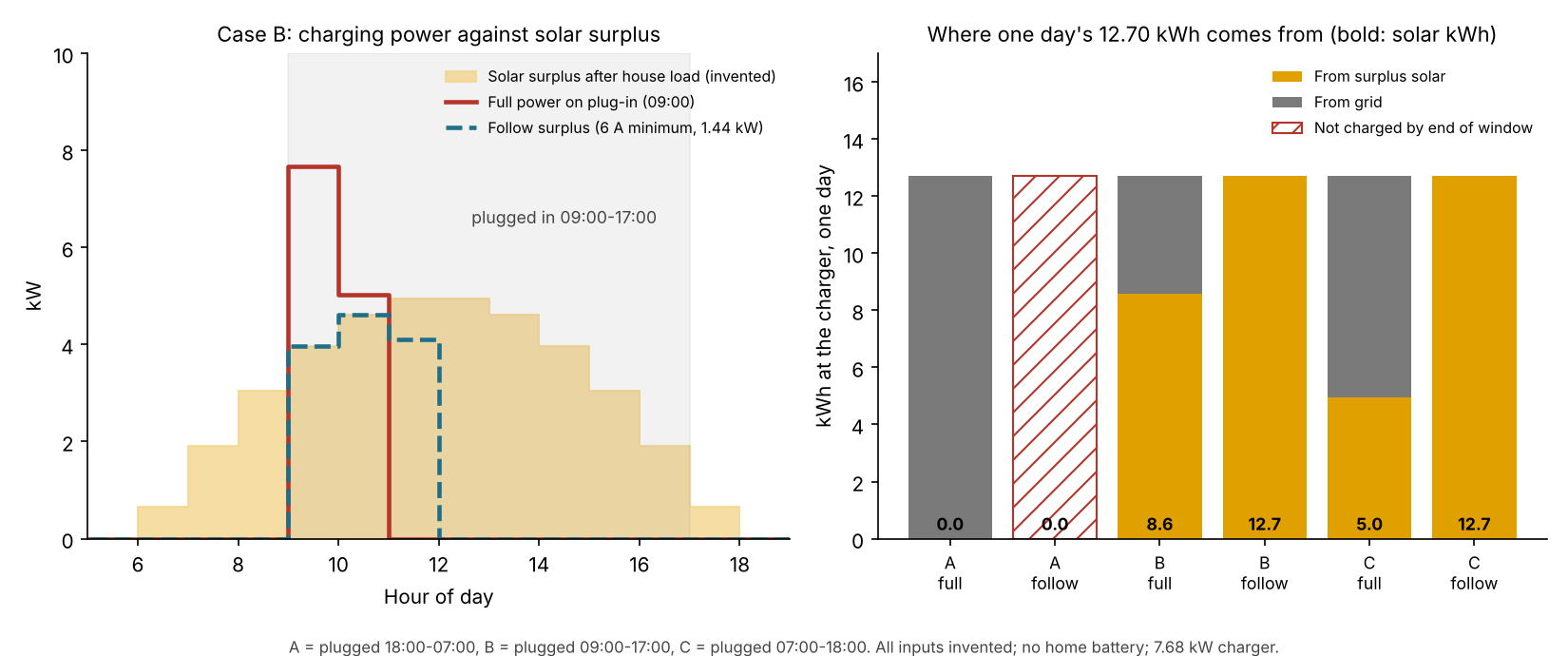
Figure 1. Following surplus lifts the solar share from 67.6% to 100% in case B. The commuter gets no solar either way. The grid covers it under full power. Nothing is charged under follow-surplus (example inputs).
The service check is also example. Take a 200 A service, a 150 A measured peak and a 20% margin. The margin is our planning choice, not a code rule. Headroom is 200 × 0.8 − 150 = 10 A. A 32 A charger at 240 V draws 7.68 kW. A managed limit of 10 A is 2.4 kW. Case B then needs about 5.3 hours at that limit. The plug-in window must be long enough.
Calculator
Enter your own miles, charger size and service figures. It returns the solar match for each plug-in window and the service headroom with a managed limit.
How solar software handles EV charger integration
Aurora Solar, OpenSolar, SMA Sunny Design and Eturnity add an EV load to the design, and HOMER Grid covers it in part. None of the pages we read documents how the charger is controlled. For design tools that model EV load, see the best solar design software list.
| Software | EV load in the design? | Controlled charging modelled? |
|---|---|---|
| Aurora Solar | Yes | Not stated |
| OpenSolar | Yes (Beta) | Not stated |
| SMA Sunny Design | Yes | Not stated |
| Eturnity | Yes | Not stated |
| HOMER Grid | Partly | Partly |
Not stated: the pages read do not say. Partly: the pages describe it only in part. Details and sources for each tool are below.
- Aurora Solar: appliance list has "Electric Vehicle (Yes, No)" with make, model, year and miles per day. Aurora will "calculate the energy per day (kWh)". Lifestyle page: "Users may add pools or EVs as add-on products to a profile shape". Both help pages updated 15 April 2026.
- OpenSolar: annual miles, miles per kWh, and one of four charging schedules. A custom 8760 load curve is added. Home charging only. Support page updated 2 June 2026. A separate page, updated 25 September 2025, adds a Treehouse charger installation as a proposal line, not a load.
- SMA Sunny Design: Web: an EV with charging stations "can now be factored in as a load in PV self-consumption systems". Pro: several stations, with set utilisation times and rates. Page undated.
- Eturnity: schedule only. Daily km, charging power (3.7 kW to 22 kW wallbox) and a start-time preset or custom hour. Up to five setups. The page does not cover load management. Page undated.
- HOMER Grid: a UL press release (15 June 2020) says its EV tool takes vehicle types and a connector’s maximum kW, and has on-demand and smart modes. Current documentation is not cited.
Aurora, OpenSolar, SMA and Eturnity pages show the load going into the design. They do not show the charger’s controller. The Enphase and myenergi rules above come from charger-side pages. They are not design-tool features.
Common mistakes with EV charger integration
FAQs
Can solar charge an EV at night?
Only through a battery or the grid. Enphase’s Self-Consumption profile lets the battery add to solar if Battery Assist is on. Its Savings profile can use the battery after peak hours if enabled. Full Backup never uses it for the car.
What is the minimum solar surplus to charge an EV?
The surplus must reach the charger’s minimum current. myenergi cites a 6 A minimum, about 1.4 kW on one phase. Its ECO+ mode starts on a nominal 1.4 kW for a single-phase zappi. For a three-phase zappi it is 4.2 kW. Enphase starts above 25% of rated capacity.
Does an EV charger need OCPP?
No. OCPP is one of several links, with Modbus TCP and company APIs as others. The charger and the inverter or energy manager must support the same one. The OCA page says OCPP links charging stations to a management system, not by itself to a home inverter.
Does load management remove the need for a service upgrade?
Sometimes. A Consulting-Specifying Engineer Q&A says the 2023 NEC limits the feeder to the maximum load the load-management system allows. Your AHJ and the code edition in force decide if that applies.
Related terms
- Battery storage design: sizing a battery for a home load.
- Peak shaving: cutting the highest demand with storage or load control.
- Inverter: the device that often hosts the meter and the control link.
- Carport solar design: laying out modules on a raised frame over parking bays.
Next step: before you quote a charger, check the service headroom, then compare residential design tools that model the EV load. For the control and communication choice, confirm the version and the device that sends limits, then see the best solar inverter monitoring apps for live readings.
Sources
- Open Charge Alliance, Open Charge Point Protocol (footer 2026, checked October 2026).
- US DOE AFDC, electricity infrastructure (undated, statistics "as of 2023", checked October 2026).
- IAEI, NEC 2026 significant code changes (1 July 2025, checked October 2026). It says Article 750 moved to Article 130 but also lists a 750 on limited-energy grounding, so check the NFPA text. See also UL Code Authority, Article 130 (undated, 2026 edition released 20 August 2025, checked October 2026).
- Leviton, reprint of NFPA 70 (2023) 625.40, 625.42 (undated, the link no longer opens (checked 30 October 2026), so it is not used for quotes).
- ExpertCE, 2023 NEC load calculations with energy management systems (undated, checked 30 October 2026).
- Consulting-Specifying Engineer, EV charging station design Q&A (1 September 2023, checked 30 October 2026).
- Rainforest Automation, Upgrade Avoidance white paper (copyright 2024, company paper, checked October 2026).
- Enphase, Manage EV charging from the Enphase App (8 October 2025, checked October 2026).
- myenergi, What are the zappi charging modes? (undated, checked October 2026).
- Shelly, PV surplus charging for EVs using Shelly 3EM (undated, checked October 2026).
- evcc community docs, SolarEdge Home EV charger (undated, not company documentation, checked October 2026).
- Aurora help, entering energy consumption and Lifestyle Consumption Patterns (both updated 15 April 2026, checked October 2026).
- OpenSolar support, EV transportation load (Beta) (2 June 2026) and Treehouse EV charger services (25 September 2025). Checked October 2026.
- SMA, Sunny Design e-mobility feature (undated, checked October 2026).
- Eturnity help, planning charging stations (undated, checked October 2026).
- UL, HOMER Grid models EV charging stations (15 June 2020, checked October 2026).
Last updated 30 October 2026. Next scheduled review: 30 January 2027.