Key takeaways
- A BESS has two ratings. MW is how fast it can discharge. MWh is how much it holds. Duration is MWh divided by MW.
- EIA counts 43.6 GW of operational US utility-scale battery capacity at the end of 2025, and nearly 52 GW nameplate by June 2026. These are GW, not GWh.
- Our invented need is 10 MW for 4 hours. It takes 11 units of either product, but the 2-hour build gives 21.2 MW against 10.8 MW.
- At a placeholder fade of 2% a year, 11 four-hour units fall below 40 MWh in year 5. 12 units last to year 8 and 13 to year 12.
- Compare efficiency on one basis. For 40 MWh out, a datasheet’s 93.7% round-trip figure needs 42.69 MWh in and NREL’s (now NLR) 85% assumption needs 47.06.
To size or compare a BESS in software, see the best battery energy storage software.
BESS at a glance
A BESS is sold and designed as a system, not as cells. You quote two ratings, power and energy. State the basis for each.
| Item | Detail |
|---|---|
| Formulas | Duration (h) = MWh ÷ MW. Energy delivered per cycle = MW × hours. Charge needed = energy delivered ÷ round-trip efficiency. |
| Unit and range | MW and MWh (kW and kWh for small systems). NREL’s utility-scale battery page models durations of 2, 4, 6, 8 and 10 hours. |
| Where it matters | Utility, commercial and industrial proposals, interconnection, permits and operations. |
| Standard or rule | No single sizing standard. UL 9540 is a system-level safety standard. See the ratings section. |
| In software | Hourly energy models and storage optimisers. See the software table. |
Why does a BESS matter for installers?
The ratings set the price and the revenue. Duration also changes the design: per unit, our 2-hour product gives about twice the MW and the 4-hour product about the same MWh. A buyer who needs power for a peak asks for MW. A buyer who needs to shift a day’s solar asks for MWh. See peak shaving and energy arbitrage. A larger system also meets the grid operator’s study process. See the interconnection queue and the single line diagram. For homes, a battery is the same idea at small scale. See battery storage design.
EIA’s Today in Energy article of 7 August 2026 reports 43.6 GW of operational US battery capacity at the end of 2025. That is the scale installers now design, permit and connect against.
It adds that operators brought another 8.3 GW online by June 2026, reaching nearly 52 GW of nameplate capacity. Operators plan 54 GW more over two and a half years. EIA’s figures cover utility-scale power capacity. They do not give hours of storage. The plans may change.
What is inside a BESS?
A BESS is a battery plus the equipment that converts, controls, cools and protects it. Iberdrola says BESS "are not only batteries, they also incorporate a series of software and hardware tools".
Iberdrola lists six parts. They are batteries and a battery management system (BMS). They also include a power conversion system (PCS) and an energy management system (EMS). The last two are air conditioning and fire extinguishing. Its BMS "monitors temperature and ensures safe and efficient system operation". Its PCS devices "convert the direct current (DC) stored in batteries to alternating current (AC)". Its EMS manages "the power flow between the equipment and the batteries".
That list is one operator’s page, undated (footer 2026). Makers name parts differently. NREL’s utility-scale battery model counts three cost items. They are the lithium-ion pack, the inverter and the balance of system. It is based on lithium iron phosphate (LFP) cells. The PCS is an inverter in all but name. To see how it joins solar, read AC and DC coupling.
Safety listing is checked at system level. The Standards Council of Canada’s record for ANSI/CAN/UL 9540:2020 describes it as a system-level standard, where individual components are not treated as complete systems. Compliance Gate (last modified 7 March 2023) also says UL 9540 covers energy storage systems and equipment. UL has since issued a third edition, ANSI/CAN/UL 9540:2023, effective for new certifications from September 2024, so check which edition your AHJ has adopted. Tesla’s Megapack 2 XL sheet lists the system to UL 1973, UL 9540, UL 9540A and UL 1741 SB. It also lists IEC 62619 and IEEE 1547. This page does not quote NFPA, NEC or IEC text, so confirm requirements with your AHJ.
How is a BESS rated: MW, MWh and duration?
MW is the most power the system can discharge. MWh is the energy it can deliver. Duration is the hours it can hold full power. So a 4-hour system has four times as many MWh as MW.
Every figure has a basis: AC or DC, new or aged, and the temperature. Here are two Megapack 2 XL configurations, per unit. The source is the datasheet, Rev. 1.5.1, dated 10 February 2023. It is a copy filed with the Connecticut Siting Council, not Tesla’s own page.
| Item (per unit, AC basis) | 4-hour | 2-hour |
|---|---|---|
| Energy | 3.916 MWh | 3.854 MWh |
| Power | 0.979 MW | 1.927 MW |
| Energy ÷ power | 4.0 h | 2.0 h |
| Maximum inverter power | 1,320 kVA | 2,400 kVA |
| Round-trip efficiency | 93.7% | 92.0% |
The sheet’s footnote defines efficiency as a "full-depth cycle including all power conversion and thermal system losses, at 25°C". Nominal energy is also given at 25°C. The sheet says duration is configurable. See round-trip efficiency and depth of discharge.
NREL’s 2025 ATB battery page assumes an 85% round-trip efficiency, about one cycle a day and a 15-year lifetime. It does not say whether 85% is AC or DC. It puts fixed O&M at 4% of capital cost, which includes battery augmentation. Augmentation means adding capacity later. Do not mix the two efficiencies in one model.
Worked example: 10 MW for 4 hours
A buyer needs 10 MW for 4 hours. That is 40 MWh at the AC terminals of the units. We count whole Megapack 2 XL units, then add fade. The calculator below reproduces every figure.
- Need (example placeholder): 10 MW for 4 hours = 40 MWh, one full cycle a day.
- Unit data (datasheet, above): 4-hour: 0.979 MW, 3.916 MWh, 93.7%. 2-hour: 1.927 MW, 3.854 MWh, 92.0%.
- Fade (example placeholder): 2% a year, compounded, energy only. Power and efficiency held constant.
- Left out: temperature, standby loads, availability, warranty terms, augmentation cost.
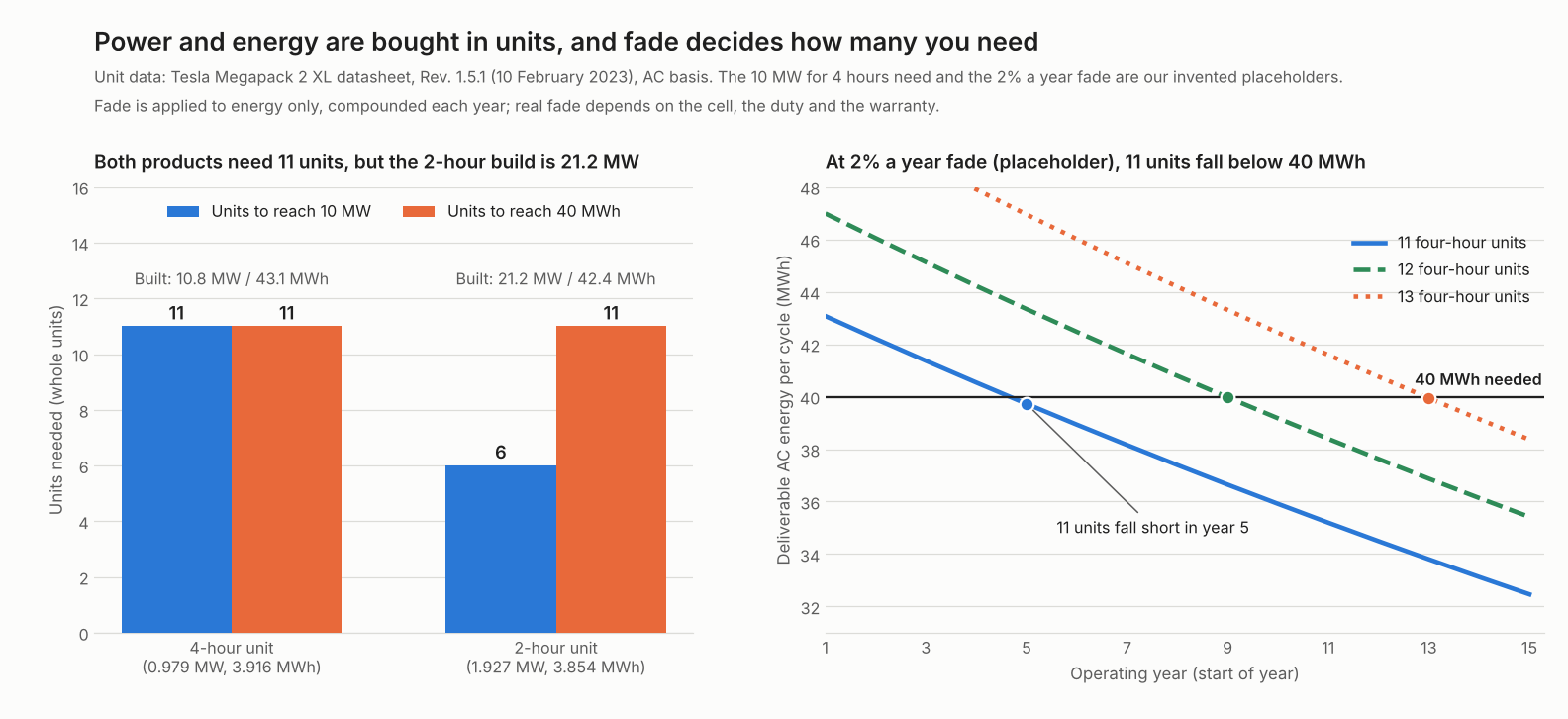
Figure 1. Both unit types need 11 units. At a placeholder 2% a year fade, the 4-hour build drops below 40 MWh in year 5.
| Unit type | Units for 10 MW | Units for 40 MWh | Built (new) |
|---|---|---|---|
| 4-hour | 11 (10.21 rounded up) | 11 (10.21 rounded up) | 10.77 MW, 43.08 MWh |
| 2-hour | 6 (5.19 rounded up) | 11 (10.38 rounded up) | 21.20 MW, 42.39 MWh |
First, the unit counts. The 4-hour unit matches the need, so power and energy give the same count. The 2-hour unit runs short on energy first. Eleven of them give 21.2 MW against 10.8 MW for the 4-hour build, twice the power the buyer asked for.
Next, how fade eats the margin for the 4-hour build.
| Four-hour units built | Energy per cycle, new | First year below 40 MWh |
|---|---|---|
| 11 | 43.08 MWh | Year 5 (39.73 MWh) |
| 12 | 46.99 MWh | Year 9 (39.98 MWh) |
| 13 | 50.91 MWh | Year 13 (39.95 MWh) |
To keep 40 MWh through year 8 takes 12 units. To keep it through year 12 takes 13. The other route is to add units later, which is augmentation.
Losses are separate. At 93.7%, delivering 40 MWh takes 42.69 MWh of charge. So 2.69 MWh (6.3% of the charge) is lost per cycle. Cycled once a day, that is about 982 MWh a year. At NREL’s 85% the charge would be 47.06 MWh. The bases differ, so treat the gap as a warning, not a ranking.
BESS unit count calculator
Change the need, the unit data or the fade. The "Page example" button loads the page’s example. Every default is a placeholder or a datasheet value, as labelled inside.
How solar software handles a BESS
Four of the 5 tools we read model storage in full (Yes), and PV*SOL does so in part (Partly). We rated them from company pages as of October 2026, looking for battery energy and power as separate inputs, converter losses, ageing and a dispatch method. Our core example uses a February 2023 datasheet copy, and newer products will differ.
| Software | Models battery storage? | Source |
|---|---|---|
| PVsyst | Yes | PVsyst help, grid systems with storage, undated |
| HOMER Grid | Yes | HOMER knowledge base, dispatch strategies, undated (footer 2026) |
| SAM | Yes | NREL workshop slides, 15 May 2025 |
| Energy Toolbase | Yes | Energy Toolbase help, undated |
| PV*SOL | Partly | PV*SOL help, battery systems, undated |
Partly: the page covers storage but leaves out inputs we look for. What each page says:
- PVsyst. Four strategies for grid storage. Charging and discharging use generic converters with efficiency curves. It "accounts for battery ageing" and triggers replacement at end of life. No kW or duration on the page.
- HOMER Grid. Dispatch strategies include peak shaving, arbitrage and self-consumption, with battery wear as a cost. No sizing guidance or round-trip efficiency on the page.
- SAM. Stand-alone battery option, calendar and cycling fade, thermal effects on capacity, and separate dispatch options for behind-the-meter and front-of-meter.
- Energy Toolbase. The Storage Capacity Optimizer simulates five systems by default across DC power (kW) and capacity (kWh). Lists degradation rate, charge and discharge efficiency and maximum depth of discharge as system characteristics the optimizer references.
- PV*SOL. Describes AC, DC generator and DC-link coupling and charge limits. Capacity, power, efficiency and ageing values are not on the page read. Commercial systems not mentioned.
For wider comparisons, read the best battery energy storage software and best solar battery storage design software lists.
Common mistakes with a BESS
FAQs
What does BESS stand for?
BESS stands for battery energy storage system. It means the battery with its inverter or PCS, controls, cooling and safety systems, not the cells alone.
What is the difference between MW and MWh in a BESS?
MW is power, the rate of discharge. MWh is energy, the amount stored. In our example the 4-hour unit has 0.979 MW and 3.916 MWh. So it can run at full power for 4 hours.
What does a 4-hour BESS mean?
It can discharge at its rated power for 4 hours. So MWh is four times MW. NREL’s utility-scale battery page models durations of 2, 4, 6, 8 and 10 hours.
How long does a BESS last?
A BESS lasts as long as its cells, duty and warranty allow. NREL’s 2025 ATB page assumes a 15-year lifetime at about one cycle a day. It puts augmentation costs in fixed O&M. That is a cost-model assumption, not a warranty.
Is a home battery a BESS?
Yes. A home battery with its inverter and controls is a small BESS, though the word usually means commercial or utility scale. This page covers the whole system at commercial and utility scale. For homes, see battery storage design.
Related terms
- Battery storage design: choosing kWh and kW for a goal.
- Degradation rate: how output or capacity falls each year.
- O&M: the running costs and tasks after commissioning.
- Charge controller: the part that manages charging between array and battery.
- LFP battery: a lithium-ion cell with an iron-phosphate electrode.
- Microgrid design: picking equipment for loads that can run off grid.
Next step: Pick a tool that takes MW, MWh and efficiency as separate inputs. Start with the best battery energy storage software, or use the best solar battery storage design software for smaller sites.
Sources
- EIA, Today in Energy: Battery storage capacity averaged 70% growth over the last three years. 7 August 2026 (checked October 2026).
- Iberdrola: Battery Energy Storage Systems (BESS). Undated (checked October 2026).
- Megapack 2 XL datasheet, Rev. 1.5.1, 10 February 2023. Copy filed with the Connecticut Siting Council (checked October 2026).
- NREL Annual Technology Baseline: utility-scale battery storage. Titled 2025, undated (checked October 2026).
- Standards Council of Canada: ANSI/CAN/UL 9540:2020. Checked October 2026.
- Compliance Gate: UL 9540 overview. Last modified 7 March 2023 (checked October 2026).
- PVsyst help: grid systems with storage. Undated (checked October 2026).
- HOMER knowledge base: HOMER Grid control dispatch strategies. Undated (checked October 2026).
- NREL: How to Model Batteries in SAM and PySAM. Workshop slides, 15 May 2025 (checked October 2026).
- Energy Toolbase help: Storage Capacity Optimizer. Undated (checked October 2026).
- PV*SOL help: Battery systems. Undated (checked October 2026).
Last updated 30 October 2026. Next scheduled review: 30 January 2027.