Key takeaways
- An LFP cell is about 3.2 V nominal (CSTEP 2020, Victron sheet). PVsyst lists NMC at 3.4 V and CSTEP at 3.7 V. Name the source when you compare.
- LFP cell ranges are 90 to 120 Wh/kg (CSTEP 2020) and 90 to 130 (CSIRO 2021). Three of the seven LFP packs in Table 1 top CSTEP’s 120, and two top CSIRO’s 130. The packs run 91 to 146 Wh/kg.
- In one 18650 test (Ubaldi and Russo 2023), runaway began at 234 °C for LFP and 207 °C for NCA. Peak temperature was 310 against 579 °C, but LFP cells still vented toxic gas.
- The LFP voltage curve is flat. One paper’s cell moved only 46 mV from 10% to 70% depth of discharge, so an example 10 mV error reads as 13% of charge.
- Table 1 covers ten products on eight documents. Five documents name LFP (seven products, three on one Victron sheet). Three do not.
To model usable kWh and cold limits in a design, see the best solar battery storage design software.
LFP battery at a glance
LFP is a cathode chemistry, not a product class. It sets cell voltage, weight, cold limits and how well you can read charge.
| Item | Detail |
|---|---|
| Formula | Pack volts = cells in series × 3.2 V. Energy in Wh = pack volts × Ah. Victron’s sheet says a 12.8 V battery is 4 cells in series. |
| Unit and range | About 3.2 V per cell. Cell energy 90 to 120 Wh/kg (CSTEP, 2020) or 90 to 130 (CSIRO, 2021). |
| Where it matters | Pack weight, cold charging, state-of-charge readings, thermal safety and the bill of materials. |
| Standard or rule | Sheets cite IEC 62619 (Sunsynk, RoyPow, Victron), UL 1973 (RoyPow, Victron) and UL 9540A (Victron, for cells). These are the makers’ claims. The standards’ text is not quoted here. System certification is on the UL 1741 and UL 9540 page. |
| In software | PVsyst names LFP in its battery database, and SAM lists an LFPGraphite default. See the software table. |
Why does LFP matter for installers?
The chemistry sets cell voltage, and so cell count. Makers set the cold-charging floor. The flat curve limits how well voltage reads charge. Write the chemistry on the bill of materials. Sizing steps are on battery storage design. Operating modes are on solar-plus-storage.
What do LFP datasheets print?
Most sheets print pack voltage, kWh, kg and a charge range. Table 1 compares eight documents in two parts. Not stated means the document or page does not print it.
Table 1, part A. Documents that name LFP: chemistry wording, voltage, weight and charge range. Wh/kg is nominal Wh divided by kg.
| Document | Names LFP in the text? | Nominal voltage, cells | Energy, weight, Wh/kg | Charge range |
|---|---|---|---|---|
| Sunsynk L3.0, v.7, 10/24/23 as printed | Yes: "Lithium Ferro Phosphate (LifePO4 or LFP)" | 51.2 V. Cells not stated | 3.07 kWh, 30 kg, 102 | 0 to 55 °C. Optional heating extends it to -20 °C |
| BSL ECO 10.0 Plus, undated | Yes: LiFePO4 | 51.2 V. 2P16S | 10.24 kWh, 85 kg, 120 | 0 to 50 °C |
| EPEVER LFP3.84KWH25.6V-P65L2, undated | Yes: LiFePO4 | 25.6 V. 8S1P | 3.84 kWh, 30.5 kg, 126 | 0 to 50 °C. A "heating" function is listed |
| Victron LFP Smart 12.8/100, undated | Yes: lithium iron phosphate | 12.8 V. 4 cells | 1.28 kWh, 14 kg, 91 | +5 to +50 °C |
| Victron LFP Smart 25.6/200-a, undated | Yes: lithium iron phosphate | 25.6 V. 8 cells | 5.12 kWh, 39 kg, 131 | +5 to +50 °C |
| Victron LFP Smart 12.8/330, undated | Yes: lithium iron phosphate | 12.8 V. 4 cells | 4.22 kWh, 29 kg, 146 | +5 to +50 °C |
| RoyPow PowerHome 5.1 kWh, undated | Yes: "Cell type: Lithium iron phosphate (LFP)" | 51.2 V. Cells not stated | 5.12 kWh, 48.5 kg for one module (row pairing inferred, sheet does not say what the weight includes), 106 | 0 to 55 °C |
Table 1, part B. Documents that do not name LFP in the text.
| Document | Names LFP in the text? | Nominal voltage, cells | Energy, weight, Wh/kg | Charge range |
|---|---|---|---|---|
| Pylontech US5000, PY21SDRE01-12-3, undated | No | 48 V. Cells not stated | 4.8 kWh, 39.7 kg, 121 | 0 to 50 °C |
| Tesla Powerwall 3 datasheet, 2024 (North America) | No | Not stated | 13.5 kWh (printed as AC), 130 kg (whole unit) | Operating range -20 to 50 °C only |
| Enphase IQ Battery 5P owner’s guide, July 2025 | No | Not stated | 5.0 kWh. Weight not stated | One general range, -15 to 55 °C |
Table 1 makes no chemistry claim for the Pylontech, Tesla and Enphase products. The five that name LFP print a charge range. It starts at 0 °C (four sheets) or +5 °C (Victron). You can find more cold limits on off-grid system design. The battery management system page covers how the limits are enforced.
Voltage limits are printed per pack, so divide by the cell count. Victron’s 12.8 V battery charges at 14.0 to 14.4 V (14.2 V recommended). It ends discharge at 11.2 V. For 4 cells that is 3.5 to 3.6 V and 2.8 V per cell, our arithmetic. Its BMS stops charging above 3.75 V per cell. Sunsynk prints 43.2 to 57.6 V. RoyPow prints 44.8 to 56.8 V. Both are at 51.2 V nominal. Neither prints a cut-off line.
Cycle claims on these sheets run from 2,500 cycles at 80% depth (Victron) to 6,000 or more (BSL, Sunsynk, EPEVER and RoyPow). Conditions differ. Compare them using battery cycle life, depth of discharge and C-rate. You can find voltage by cell count on nominal voltage.
How does LFP compare with NMC?
LFP gives up energy per kg. It gains a milder runaway and no cobalt or nickel. The published tables disagree on details, so Table 2 names each source.
Table 2. LFP against NMC or NCA, by source and year.
| Item | LFP | NMC or NCA | Source |
|---|---|---|---|
| Nominal cell voltage | 3.2 V | NMC 3.7 V. NCA 3.6 V | CSTEP, September 2020, Table 1 |
| Nominal cell voltage | 3.2 V | NMC 3.4 V | PVsyst help, undated |
| Cell energy, Wh/kg | 90 to 120 | NMC 140 to 200 | CSTEP, 2020 |
| Cell energy, Wh/kg | 90 to 130 | NMC 100 to 205 | CSIRO, 2021, Table 3 |
| Cobalt and nickel | None | NMC has 10% to 20% cobalt | CSTEP, 2020 |
| Cycle life | 2,000 cycles | NMC 1,000 to 2,000 | CSTEP, 2020 |
| Cycle life | 3,000 to 6,000 cycles | NMC 3,000 to 6,000 | CSIRO, 2021, Table 3 |
The cycle rows disagree on level and on ranking. Treat any cross-chemistry cycle claim with care. CSTEP calls LFP "the safest battery chemistry with long cycle life". Its electrode potential "varies little during discharge", and the components are cheap and abundant (CSIRO).
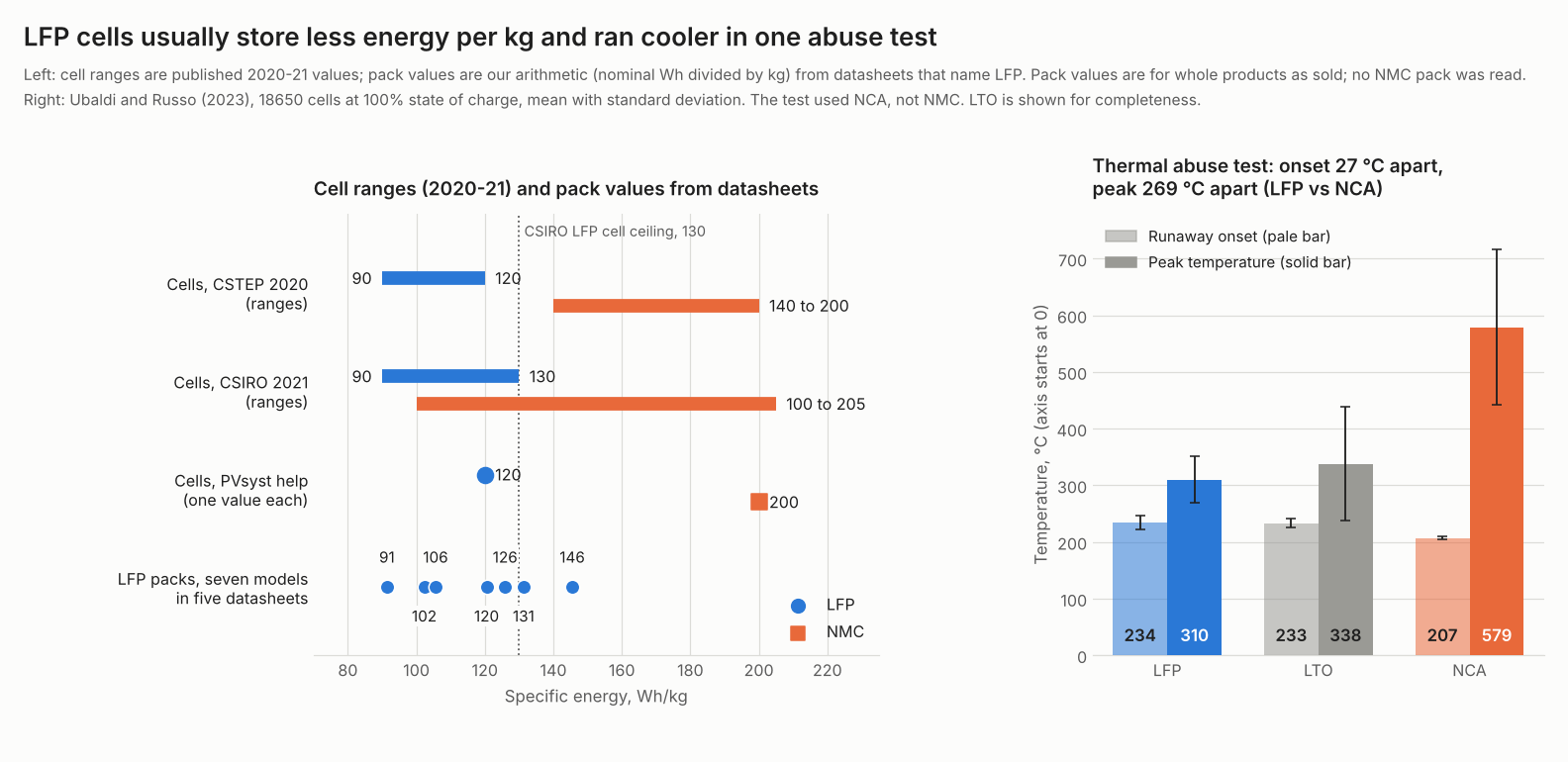
Figure 1. Published ranges usually put LFP cells below NMC on energy per kg, though CSIRO’s ranges overlap (LFP 90 to 130, NMC 100 to 205 Wh/kg). In one abuse test LFP cells peaked 269 °C cooler than NCA cells, though runaway began only 27 °C later.
The sheets read include no NMC pack sheet that names its chemistry, so Figure 1 makes no pack-weight comparison across chemistries. Two LFP packs exceed CSIRO’s 130 Wh/kg cell ceiling. Pack and cell figures are not like for like, so use the maker’s current datasheet.
Does LFP remove the fire risk?
No. In the test below, LFP cells still reached runaway and vented gas. They did so later and less violently than NCA cells.
Ubaldi and Russo (Chemical Engineering Transactions, 2023) heated 18650 cells at 100% state of charge. Peak pressure was 0.108 barg for LFP and 5.071 for NCA, about 47 times higher. Per the paper, the 30-minute mean hydrogen fluoride was 200 ppm for LFP and 100 ppm for NCA. LFP was higher on that gas, so it is not safer on toxic fumes in this test. The test used NCA, not NMC. It used one cell format, so it does not cover packs.
A trade article by Aspen Aerogels, a thermal-barrier maker, reports 160 °C onset for NMC. For LFP prismatic cells it reports 230 °C. CSIRO says lithium-ion batteries in general can release toxic hydrogen fluoride fumes. They can also cause fires if punctured or short-circuited.
Why is LFP charge hard to read from voltage?
The LFP voltage curve is nearly flat across the middle of the charge range. So a small voltage error maps to a large charge error.
Gerschler and Sauer (EVS24, 2009) measured an iron-phosphate cell at 23 °C. Its open-circuit voltage changed by 46 mV between 10% and 70% depth of discharge. That is about -0.8 mV per 1%. They call that about one order of magnitude flatter than NMC and NCA cells. They warn that voltage alone can give an error above 40% in the worst case. Shi and others (Energy and AI, 2026) put the flat zone at roughly 20% to 95% charge.
| Input | Value |
|---|---|
| Voltage change, 10% to 70% depth of discharge (paper) | 46 mV |
| Gradient (46 mV ÷ 60 points) | 0.77 mV per 1% |
| Voltage error on one cell (example) | 10 mV |
| Charge error from voltage alone | 10 ÷ 0.77 = 13.0% |
| If the curve were ten times steeper (illustrative) | 1.3% |
The paper gives only an order of magnitude. The last row shows scale. Systems add current counting. See state of charge for the methods.
Calculator: pack voltage and charge error
With 3.2 V cells, a 51.2 V target is exactly 16 cells. With 3.7 V cells it is 13.84. So you choose 13 cells (48.1 V) or 14 (51.8 V), our arithmetic.
How solar software handles LFP batteries
Only PVsyst names LFP in its battery dialog, and SAM lists an LFPGraphite default. The pages read for the other four tools name no chemistry. Yes means the company’s page names LFP or a chemistry setting. Partly means it names a default but not a user setting.
| Software | Names LFP or a chemistry setting? | Method |
|---|---|---|
| PVsyst | Yes | Modelled, hourly |
| SAM | Partly | Modelled |
| HOMER Pro | Not stated | Modelled |
| OpenSolar | Not stated | Modelled |
| Aurora Solar | Not stated | Modelled |
| Energy Toolbase | Not stated | Modelled |
- PVsyst: Li-ion battery dialog: "Most PV systems use Lithium Iron Phosphate (LiFePo4 or LFP), which is best suited for steady systems". "Technology specifies the chemistry of the battery." The Technologies page lists LFP at 3.2 V and 120 Wh/kg (column headed "power density"). Notes: PVsyst help, undated. The pages read do not say whether the choice changes the simulation.
- SAM: PySAM 8.0.0 docs list "LFPGraphite" among default configurations. The Battery Life help page names NMC and LMO/LTO life models, not LFP. Notes: SAM help undated. PySAM 8.0.0 page. The desktop menu was not checked.
- HOMER Pro: The Storage page names idealised, kinetic and modified kinetic battery models, not chemistries. Notes: HOMER Pro 3.16 manual, no date.
- OpenSolar: "How OpenSolar Models Battery Energy Storage" and "Battery Design Assistant" name no chemistry. Notes: Two support pages, no update date in the text read.
- Aurora Solar: Backup Duration Calculations lists usable capacity and round-trip efficiency as inputs and names no chemistry. Notes: Aurora help, undated.
- Energy Toolbase: Storage Capacity Optimizer lists general storage inputs and names no chemistry. Notes: ETB help, undated.
For ranked tools that model batteries, see the best solar battery storage design software.
Common mistakes with LFP batteries
FAQs
Is LFP the same as LiFePO4?
Yes, the two names describe the same iron-phosphate cathode, and sheets use either spelling. Sunsynk’s sheet prints "Lithium Ferro Phosphate (LifePO4 or LFP)" and Victron’s says "lithium iron phosphate".
Does LFP last longer than NMC?
Not reliably: published figures overlap, so compare each datasheet’s cycles at a stated depth of discharge. CSTEP lists 2,000 cycles for LFP and 1,000 to 2,000 for NMC. CSIRO lists 3,000 to 6,000 for both. Sheet claims run from 2,500 to 6,000 or more under different conditions. See battery cycle life.
Can an LFP battery catch fire?
Yes, an LFP battery can catch fire. In the Ubaldi and Russo test, LFP cells reached runaway and vented, though later and less violently than NCA cells. Pack behaviour depends on design and certification.
Can you charge an LFP battery below freezing?
Not by default: the five sheets that name LFP print a charge range that starts at 0 °C or +5 °C. Sunsynk offers an optional heater to -20 °C, and EPEVER lists a "heating" function. Check the maker’s charge range for your site before you charge in the cold.
Related terms
- Battery management system: the electronics that protect cells and set limits.
- State of charge: stored energy as a percentage of a stated capacity.
Next step: record the chemistry on your next battery quote, then see which tools in the best solar battery storage design software list model it.
Sources
All pages were checked in October 2026. Re-read 30 October 2026. Dates as printed.
- CSTEP, Existing and Emerging Lithium-ion Battery Technologies for India, Technical Brief CSTEP-TB-2020-01, September 2020.
- CSIRO, Batteries for Homes, 2021.
- Ubaldi and Russo, Comparison Between 18650 Lithium-ion Cells of Different Composition Subjected to Thermal Abuse, Chemical Engineering Transactions 104, 2023, pp. 49 to 54.
- Aspen Aerogels, LFP vs NMC thermal runaway, Electric & Hybrid Vehicle Technology International, 18 March 2025.
- Gerschler and Sauer, Investigation of Open-Circuit-Voltage Behaviour of Lithium-Ion Batteries with Various Cathode Materials, EVS24, May 2009.
- Shi and others, a paper on SOC estimation in LFP batteries, Energy and AI 24, 100693, 2026.
- PVsyst help: Technologies and Batteries, basic data (Li-ion), both undated.
- NLR (formerly NREL): PySAM 8.0.0, BatteryStateful and SAM help, Battery Life, undated.
- HOMER Pro 3.16 manual, Storage, no date.
- OpenSolar support: How OpenSolar Models Battery Energy Storage and Battery Design Assistant, no date in the text.
- Aurora help, Backup Duration Calculations, and Energy Toolbase help, Storage Capacity Optimizer, both undated.
- Sunsynk, L3.0 datasheet v.7, 10/24/23 as printed. Distributor copy.
- BSL ECO 10.0 Plus datasheet, undated.
- EPEVER LFP3.84KWH25.6V-P65L2 datasheet, undated.
- Victron Energy, LFP Smart batteries datasheet, undated.
- RoyPow PowerHome 5.1 kWh sheet, undated.
- Pylontech US5000 datasheet, PY21SDRE01-12-3, undated. Retailer copy.
- Tesla, Powerwall 3 datasheet, North America, 2024.
- Enphase, IQ Battery 5P owner’s guide USG-00018-4.0, July 2025.
Last updated 30 October 2026. Next scheduled review: 30 January 2027.