Key takeaways
- Nominal voltage is only a name. The Sunsynk 51.2 V pack runs 43.2 V to 57.6 V, or -15.6% to +12.5%.
- The Victron 12.8 V sheet gives an end-of-discharge voltage of 11.2 V. Its charge range tops out at 14.4 V. That is -12.5% and +12.5% of the label.
- Nominal energy is the label voltage times amp-hours. At 51.2 V and 60 Ah that is 3,072 Wh, and the sheet prints 3.07 kWh.
- Current follows the real voltage. For an example 5,000 W load, the 51.2 V pack draws 97.7 A at nominal but 115.7 A at 43.2 V, which is 18.5% more.
- A range check can fail when the label fits. An example 44 V to 58 V inverter window passes 51.2 V. It misses the Sunsynk pack’s 43.2 V low end by 0.8 V.
To find battery design tools that take a pack voltage and range, see the best solar battery storage design software list.
Nominal voltage at a glance
Nominal voltage puts equipment into a class, so you can match parts by name. It is a label. It is not a measurement. It is not a limit.
| Item | Detail |
|---|---|
| Formula | Pack nominal V = cells in series × cell nominal V. Nominal energy (Wh) = nominal V × capacity (Ah). |
| Unit / typical range | Volts. batterydesign.net lists cell values of about 3.6 V (NMC and NCA), 3.2 V (LFP), 2.3 V (LTO) and 2.0 V (lead acid). |
| Where it matters | Pairing batteries with inverters and controllers, cable and fuse current, energy labels and simulation inputs. |
| Standard or rule | IEC Electropedia entries 482-03-31 (battery) and 826-11-01 (electrical installation). |
| In software | Battery models take a nominal voltage input. Some tools build a bus voltage from it. See the software table. |
Why does nominal voltage matter for installers?
The label tells you which products belong together. Only the real voltage range tells you if they work together. Two errors follow when you treat the label as a measurement.
First, you understate the current. A cable, fuse or breaker sized on the label sees more amps at the low end of the range. Second, a pairing looks safe by name but fails on range. Both are quick to check on paper. For the cable side, see voltage drop calculation and wire and conductor sizing.
How is nominal voltage set for a cell and a battery?
IEC Electropedia entry 482-03-31 defines nominal voltage for batteries. Its wording is "suitable approximate value of the voltage used to designate or identify a cell, a battery or an electrochemical system". Entry 826-11-01 is for installations. It reads "value of the voltage by which the electrical installation or part of the electrical installation is designated and identified".
batterydesign.net says you get it from nominal energy and nominal capacity: V = Wh ÷ Ah. It calls it "a calculated average rather than a directly measured value". The average covers the full discharge curve, from 100% to 0% state of charge, under standard conditions. So label energy is label voltage times amp-hours by design.
The sheets agree. The Sunsynk L3.0 prints 51.2 V, 60 Ah and 3.07 kWh, and 51.2 × 60 is 3,072 Wh. Five of the six Victron 12.8 V models print an energy equal to 12.8 × Ah. The 330 Ah model prints 4,220 Wh, while the product gives 4,224 Wh.
The series count builds the pack label. The Victron sheet says "A 12.8 V battery consists of 4 cells connected in series", and 4 × 3.2 V is 12.8 V. The Sunsynk sheet gives no cell count. Divide 51.2 V by 3.2 V and you get 16 cells. That is our inference. For usable energy against nominal, see depth of discharge. For the chemistry, see LFP battery.
How far does the real voltage move from the label?
On the two sheets read, the limits sit 12.5% above and 12.5% to 15.6% below the label. The Sunsynk 51.2 V pack, for example, runs from 43.2 V to 57.6 V. The label sits inside the range, not at either end.
| Pack | Nominal (V) | Low / high (V) | Low / high vs nominal | What the numbers are |
|---|---|---|---|---|
| Victron 12.8 V, 4 cells in series | 12.8 | 11.2 / 14.4 | -12.5% / +12.5% | Low: end of discharge voltage. High: top of the charge voltage range. |
| Sunsynk L3.0, 51.2 V | 51.2 | 43.2 / 57.6 | -15.6% / +12.5% | Both: the sheet’s operating voltage row. |
| Four Victron 12.8 V in series (our sums) | 51.2 | 44.8 / 57.6 | -12.5% / +12.5% | Our sums: 4 × 11.2 V and 4 × 14.4 V. Not a sheet limit. |
The rows use different bases, so compare them with care. Victron’s charge range is "Between 14 V/28 V and 14,4 V/28,8 V", with end of discharge at 11.2 V. Sunsynk prints one operating row. The Victron sheet also says the 12.8 V packs "can be connected in series, parallel and series/parallel".
The Victron sheet has a footnote: "48 V systems are best built using two 24 V batteries in series". It says four 12 V batteries in series "will work, it will require more periodic balancing time". See battery management system for balancing. See state of charge for what a percentage reading means.
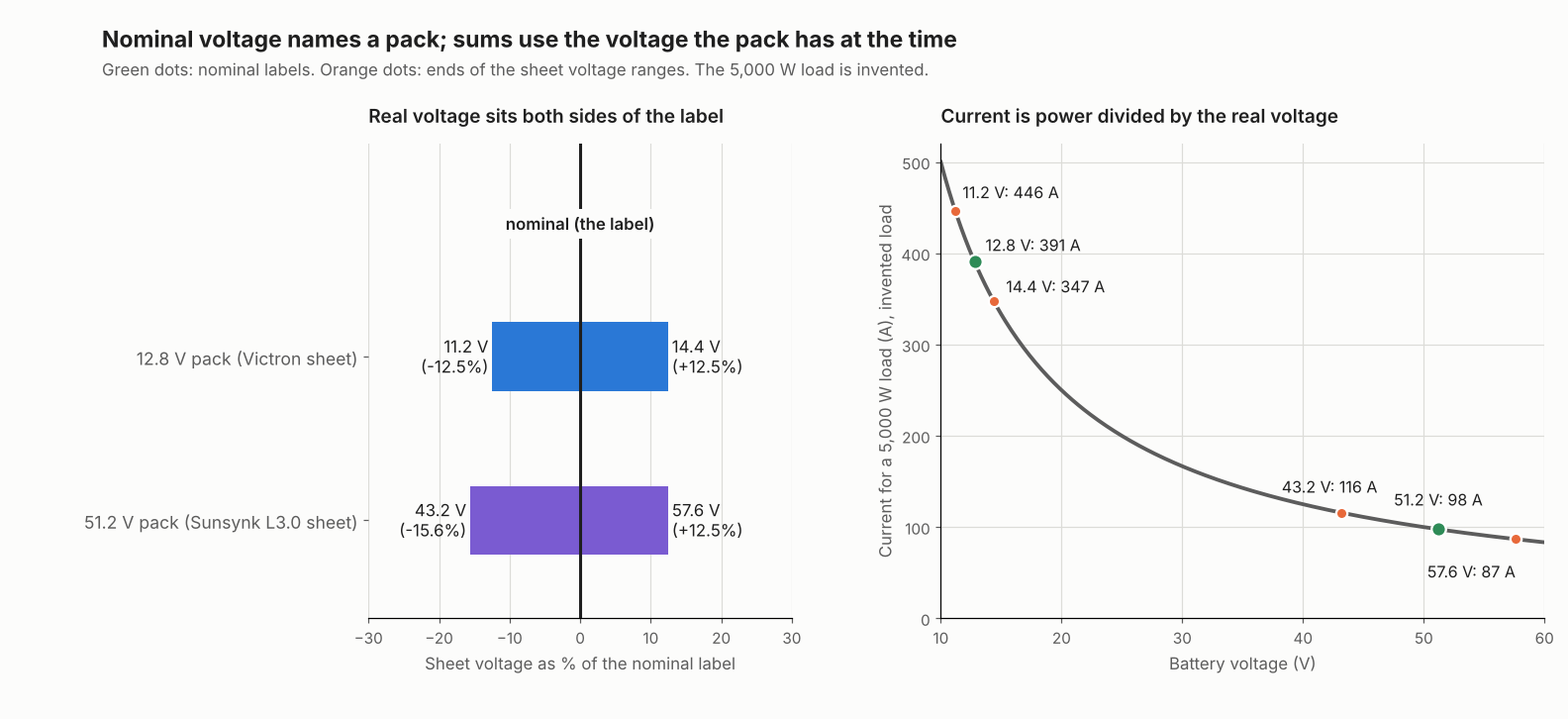
Figure 1. Both sheets put real voltage on each side of the nominal label. A 5,000 W load draws 446 A at 11.2 V against 391 A at the 12.8 V label.
Do modules, controllers and inverters have a nominal voltage?
Sometimes, as a name. A "12V" module, a "12 / 24 /48 V" controller and a 380 V inverter input each carry a label. That label is not the design voltage on the sheet.
The Victron BlueSolar panel sheet has no row called nominal voltage. It names models with 12V, 20V and 24V. It lists the voltage at maximum power. It lists the open-circuit voltage too.
| Victron BlueSolar model | Name label (V) | Vmp (V) | Voc (V) |
|---|---|---|---|
| 130W-12V | 12 | 18.64 | 22.83 |
| 360W-24V | 24 | 38.4 | 47.4 |
| 305W-20V | 20 | 32.5 | 39.7 |
The sheet marks all three models above as discontinued (footnote: "Discontinued, see current models datasheet"). It does not explain the labels. Use the Vmp and Voc rows only. Vmp and Imp covers the hot end of a string. Voc and Isc covers the cold end. See string sizing for the full limits.
The Victron MPPT 150/35 sheet lists battery voltage as "12 / 24 /48 V Auto Select". It says PV voltage must be above Vbat + 5 V for the controller to start. That test uses the real battery voltage. See charge controller and MPPT. The SolarEdge Home Hub datasheet (SE9600H-US, Canada, 18 May 2025) prints a nominal DC input of 380 Vdc and a maximum of 480 Vdc. The sheet does not say how it uses the nominal figure.
Worked example: what changes when you use the real voltage?
These steps check a battery against a load and an inverter. The 5,000 W load and the two windows are example.
- Read the nominal voltage and voltage range rows.
- Turn the range into a percentage of the label.
- Divide the biggest load in watts by the lowest voltage. That gives the worst current.
- Test the lowest and highest voltage against the inverter or controller window.
| Pack | At low (V / A) | At nominal (V / A) | At high (V / A) |
|---|---|---|---|
| Victron 12.8 V | 11.2 / 446.4 | 12.8 / 390.6 | 14.4 / 347.2 |
| Sunsynk 51.2 V | 43.2 / 115.7 | 51.2 / 97.7 | 57.6 / 86.8 |
The 12.8 V pack needs 4.0 times the current of the 51.2 V pack at the same power. At the low end the 51.2 V pack draws 18.5% more than the label suggests. Start your cable and fuse sums from 115.7 A, not 97.7 A. Then apply the maker’s current limits and your code’s conductor and overcurrent rules.
| Inverter window check (windows example) | Numbers | Result |
|---|---|---|
| Sunsynk pack, 40 to 60 V window | 43.2 V to 57.6 V | Fits, with 3.2 V and 2.4 V of margin. |
| Sunsynk pack, 44 to 58 V window | 51.2 V is inside. 43.2 V is 0.8 V under. 57.6 V is inside | Fails at the low end. |
| Four Victron 12.8 V in series, 44 to 58 V window | 44.8 V to 57.6 V (our sums) | Fits, with 0.8 V and 0.4 V of margin. |
The controller start test uses the real battery voltage too.
| Controller start check | Numbers | Result |
|---|---|---|
| Vbat + 5 V (Victron 150/35 sheet) | Battery at 43.2, 51.2 and 57.6 V | PV must exceed 48.2, 56.2 and 62.6 V. |
The label gave both packs the same 51.2 V. Only the range split them. One fails the 44 to 58 V window (43.2 V low end). The other fits (44.8 V). The four-battery sums use the sheet limits per battery and ignore balancing. Check the maker’s own series rules.
Nominal voltage calculator
Enter cells, cell voltages, capacity, a load and an inverter window.
How solar software handles nominal voltage
SAM and HOMER Pro document a nominal voltage input, and HOMER Pro builds its bus voltage from it. The Sol-Ark page does not mention battery voltage. "Yes" means the company’s own page says so.
| Software | Does it use nominal voltage? |
|---|---|
| SAM (PySAM docs) | Yes |
| HOMER Pro | Yes |
| Sol-Ark battery sizing tool | Not stated |
Not stated means the page read does not mention it.
- SAM (PySAM docs): the BatteryStateful module lists an input "Nominal DC voltage" (volts) for the pack and "Default nominal cell voltage" (volts) for a cell. Source: NLR-PySAM 8.0.0 documentation, BatteryStateful page.
- HOMER Pro: "The bus voltage is the storage’s nominal voltage multiplied by the number of storage items per string." Source: HOMER Pro 3.16 manual, Storage page.
- Sol-Ark battery sizing tool: the page says inputs are sunlight hours and the devices to power. It does not mention battery voltage. Source: Sol-Ark tool page, metadata modified 17 February 2026. Read October 2026.
For ranked options, see the best solar battery storage design software list and the best off-grid solar design software list.
Common mistakes with nominal voltage
FAQs
Is nominal voltage the same as actual voltage?
No. IEC calls it an approximate value used to designate or identify. The Sunsynk 51.2 V pack runs from 43.2 V to 57.6 V on its sheet. The Victron 12.8 V pack runs from 11.2 V at end of discharge to 14.4 V at the top of its charge range.
What is the nominal voltage of an LFP cell?
About 3.2 V. batterydesign.net lists that value for LFP. The Victron sheet matches it: its 12.8 V battery is 4 cells in series. NMC and NCA are about 3.6 V on the same page.
Can I connect four 12 V batteries in series for a 48 V system?
Victron says 48 V systems are best built with two 24 V batteries in series. Four 12 V batteries in series "will work, it will require more periodic balancing time". Follow the maker’s instructions for the model.
Does a 12V solar panel produce 12 V?
Not at its design point. The Victron 130W-12V panel prints 18.64 V at maximum power and 22.83 V open circuit. Use Vmp for operating checks. Use Voc for the cold ceiling.
Related terms
- Voc and Isc: open-circuit voltage and short-circuit current, the cold ceiling of a string.
- Vmp and Imp: voltage and current at maximum power, the hot floor of a string.
- State of charge: stored energy as a percentage of a stated capacity.
- Battery management system: the electronics that set a pack’s live limits.
- Watt, volt and amp: the three units that describe a circuit.
Next step: enter your pack’s low and high voltage and your inverter window in the calculator above. Then see which tools accept them in the best solar battery storage design software list.
Sources
- IEC Electropedia, nominal voltage (IEV 482-03-31). Page prints no date. Checked Oct 2026.
- IEC Electropedia, nominal voltage of an electrical installation (IEV 826-11-01). Page prints no date. Checked Oct 2026.
- batterydesign.net, Nominal voltage. Page metadata last modified 11 September 2026. Checked Oct 2026.
- Victron Energy, 12,8 Volt lithium iron phosphate batteries Smart datasheet. No date printed. Checked Oct 2026.
- Sunsynk L3.0 datasheet v.7 (10/24/23), distributor copy. Checked Oct 2026.
- Victron Energy, BlueSolar Monocrystalline Panels datasheet. No date printed. Several models marked discontinued, including the three used here. Checked 30 October 2026.
- Victron BlueSolar charge controller MPPT 150/35 datasheet, distributor copy. No date printed. Checked Oct 2026.
- SolarEdge Home Hub inverter datasheet, Canada, DS-000276-CAN, 18 May 2025. Checked Oct 2026.
- NLR-PySAM 8.0.0, BatteryStateful module. Checked Oct 2026.
- HOMER Pro 3.16 manual, Storage. Checked Oct 2026.
- Sol-Ark, Battery Storage and Hybrid Inverter Sizing Tool. Metadata modified 17 February 2026. Checked Oct 2026.
- Victron Energy, MPPT calculator page. Checked Oct 2026.
Last updated 30 October 2026. Next scheduled review: 30 January 2027.