Key takeaways
- Thin film is a family, not one product. One current CdTe datasheet prints a Pmax coefficient of -0.32 %/°C. The a-Si and CIS figures here come from a 2007 brochure survey.
- A CdTe module has high voltage and low current. The Series 7 TR1 540 W class prints Voc 227.7 V and Isc 3.06 A. A 430 W HJT module prints 59.7 V and 8.91 A.
- With an invented -10 °C cold cell, temperature-only arithmetic gives a 1,500 V CdTe string 5 or 6 modules, by power class. The 1,000 V HJT string holds 15.
- First Solar’s guide gives six modules as the typical 1,500 VDC string. Six 540 W-class modules reach 1,502.8 V with its 1.1 factor, so design that class at five unless First Solar confirms six.
- PVsyst documents thin-film model changes for a-Si, CIS and CdTe. SAM and pvlib list the cell types. The pages read do not say how far they go.
To see which tools model thin-film modules and strings, see the best solar simulation software.
Thin-film solar at a glance
A CdTe module is built as one sheet. A silicon module is a set of wired cells. DOE draws that contrast in its January 2025 paper.
| Item | Detail |
|---|---|
| Formula | No formula for the term. For design: cold Voc = STC Voc × (1 + Voc coefficient × (cold temperature - 25 °C)). Modules per string = system voltage ÷ cold Voc, rounded down. |
| Main types | CdTe and CIGS (DOE cell basics page, no date shown). Amorphous silicon (a-Si) appears in NREL’s 2008 overview and DOE’s page archived in January 2009. |
| Where it matters | The module library record, string length, temperature and spectral models, and mismatch defaults. |
| Standard or rule | No standard for the term. Ratings are quoted at standard test conditions. |
| In software | PVsyst, PVWatts, SAM and pvlib. See the software table. |
Why thin-film solar matters for installers and developers
A module record copied from a silicon module gives the wrong string length and coefficients. That matters when a bid, a supplier list or a module library includes thin film. DOE links CdTe to utility-scale projects.
DOE’s paper says CdTe held about 34% of the US utility-scale PV market and about 3% of the world market in 2022. It also names First Solar as a CdTe maker at gigawatt scale. For a developer, that makes thin film a module option to price on utility-scale bids. The DOE sources give no rooftop share, so this page makes no rooftop claim.
The technology setting also changes the yield estimate. String voltage must fit the module’s own limits. For module anatomy, see solar panel (module).
What are the main types of thin-film solar?
CdTe (cadmium telluride) and CIGS (copper indium gallium diselenide) are the two types DOE names today. Amorphous silicon (a-Si) is an older third type.
The table sets build notes beside the one Pmax coefficient each source prints.
| Type | What the sources say about build and use | Printed Pmax coefficient (%/°C) |
|---|---|---|
| CdTe | DOE (January 2025): CdTe modules are "monolithically integrated and directly deposited on single flat sheets of glass". It names First Solar as a gigawatt-scale maker. | -0.32 (Series 7 TR1 datasheet, April 2026). |
| CIGS | DOE’s page archived in January 2009 says CIGS is deposited on glass or stainless steel. A DOE slide deck (no date) says CIGS modules "face significant challenges in high quality, large area absorber fabrication". | Not stated |
| a-Si | DOE’s 2009 page says amorphous silicon cells are deposited on stainless-steel ribbon. PVsyst’s help says a-Si needs photons of at least 1.7 eV (730 nm). See photovoltaic for silicon’s cutoff. | -0.20 (average of four a-Si modules in the same 2007 brochure survey). |
Not stated: the sources we cite list no CIGS module. The nearest figure is -0.60, from one CIS module in HOMER’s November 2007 brochure survey.
These coefficients come from three sources and three dates. The a-Si and CIS figures are from an old survey. Each is one product or a small-sample average. None is a rule for the type. The HOMER manual calls its survey "non-exhaustive, non-scientific".
How does a thin-film module record change string design?
A CdTe module has a high Voc and a low Isc. So its strings are short, and each string carries little power.
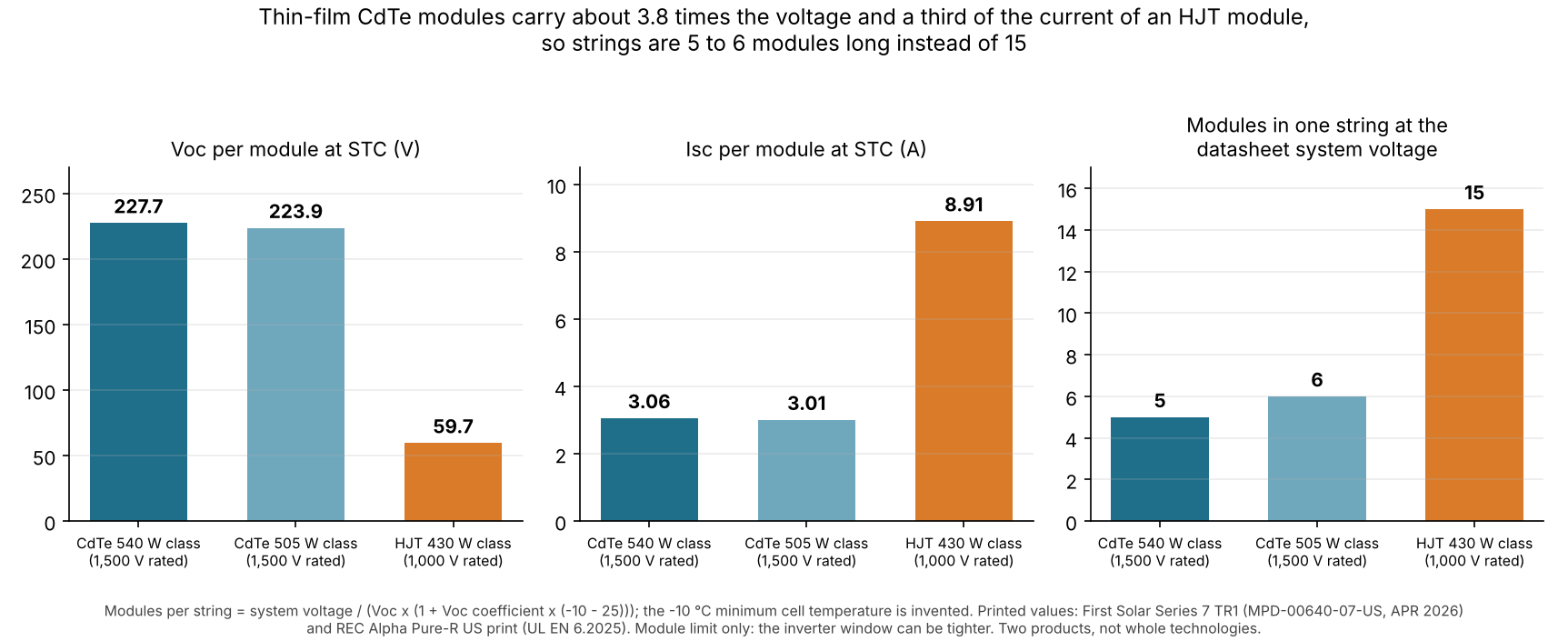
Figure 1. A CdTe module’s Voc is about 3.8 times an HJT module’s and its Isc about a third, so a 1,500 V CdTe string holds 5 or 6 modules where a 1,000 V HJT string holds 15 (example -10 °C cold cell, two products, not whole technologies).
- Read the STC Voc, the Voc coefficient and the maximum system voltage from the datasheet.
- Find the cold Voc at your site’s lowest cell temperature. See cold temperature voltage correction.
- Divide the system voltage by the cold Voc and round down.
- Check the maker’s guide. First Solar’s Series 7 TR1 guide (revision 1.7) says to multiply STC Voc by 1.1. That gives Voc at -10 °C and 1,250 W/m². It also says to limit series strings to four modules at 1,000 VDC or six at 1,500 VDC.
The guide’s 1.1 factor also covers 1,250 W/m², which the table’s temperature-only factor (1.098) does not. That changes the six-module result.
| Case | Guide typical limit | Our arithmetic | String Voc with 1.1 | Verdict |
|---|---|---|---|---|
| 540 W class, 1,500 V | 6 modules | 5 modules | 1,502.8 V for six | Six is over 1,500 V. |
| 505 W class, 1,500 V | 6 modules | 6 modules | 1,477.7 V for six | Six fits. |
| 540 W class, 1,000 V | 4 modules | Not calculated | 1,001.9 V for four | Four is just over 1,000 V. |
Confirm each limit with First Solar for your power class. Its guide calls the counts typical and says not to exceed system design voltage. The guide also says to "Maintain equivalent voltage in parallel strings by installing an equal number of modules per string". For limits that depend on the inverter, see string sizing.
Worked example: three datasheets at one example cold site
Strings are sized to each module’s own system voltage, with an example -10 °C cold cell. This is a module limit only. The inverter window can allow fewer. The HJT module is a heterojunction product. See n-type TOPCon and HJT.
| Item | CdTe 540 W class | CdTe 505 W class | HJT 430 W class |
|---|---|---|---|
| Pmax at STC (W) | 540 | 505 | 430 |
| Voc (V) | 227.7 | 223.9 | 59.7 |
| Voc coefficient (%/°C) | -0.28 | -0.28 | -0.24 |
| Isc (A) | 3.06 | 3.01 | 8.91 |
| Maximum system voltage (V) | 1,500 | 1,500 | 1,000 |
| Cold factor at -10 °C | 1.098 | 1.098 | 1.084 |
| Cold Voc per module (V) | 250.0 | 245.8 | 64.7 |
| System voltage ÷ cold Voc | 5.9996 | 6.1015 | 15.4524 |
| Modules per string (temperature-only arithmetic) | 5 | 6 | 15 |
| String cold Voc (V) | 1,250.1 | 1,475.1 | 970.7 |
| One more module would reach (V) | 1,500.1 | 1,720.9 | 1,035.4 |
| String power at STC (kW) | 2.70 | 3.03 | 6.45 |
| Strings for a 100 kWp array (example target) | 38 | 34 | 16 |
By temperature-only arithmetic the 540 W class gets 5 modules, because the ratio is 5.9996 against a limit of 6. The sixth would reach 1,500.1 V. First Solar’s guide gives 6 as typical. Printed values are rounded, so confirm with the maker. The 505 W class takes six, so the two power classes give different string lengths. Shorter strings mean more strings: 38 against 16 for the same 100 kWp. Sources: First Solar Series 7 TR1 datasheet (April 2026) and REC Alpha Pure-R US print (code UL EN 6.2025). Use the calculator below with your own sheet values.
How solar software handles thin-film solar
Only PVsyst and PVWatts document thin-film handling in detail. SAM and pvlib name the cell types only. Thin film needs its own temperature and spectral treatment and its own mismatch default. Every page below was read in October 2026.
| Software | Documents thin-film handling? | What the page says | Page read |
|---|---|---|---|
| PVsyst | Yes, modelled | Help lists model changes for a-Si, CIS and CdTe modules. | Four PVsyst help pages, no date shown. |
| PVWatts (NLR, formerly NREL) | Yes (v5), modelled | The "Thin film" module type assumes about 10% efficiency in its table (about 11% in its text), a glass cover and -0.20 %/°C, against -0.47 for "standard" and -0.35 for "premium". | PVWatts Version 5 Manual, September 2014, archived copy. |
| SAM | Partly, modelled | A staff reply says the cell type sets starting values in the CEC model. | SAM forum reply, 30 December 2014. A forum reply, not the help manual. |
| pvlib | Partly, modelled | The celltype input of fit_cec_sam accepts thin-film cell types. | pvlib 0.16.1 reference page for fit_cec_sam, no date shown. |
Partly: the page names the cell types but not what the model does with them.
- PVsyst: help lists model changes for "a-Si:H (amorphous, including tandem and triple junction), CIS and CdTe modules", including recombination losses in amorphous junctions. Its amorphous spectral correction is for a-Si. The module form says the spectral field is "Not suited for CdTe technology". It lists separate thin-film mismatch defaults. See mismatch loss.
- SAM: the types are Mono-Si, Multi-Si, Amorphous, CdTe, CIGS and CIS. The source is a forum reply, not the help manual.
- pvlib: the input accepts ‘cis’, ‘cigs’, ‘cdte’ and ‘amorphous’ among others. The page does not say what the function does with it.
For module libraries and files, see PAN and OND files.
Common mistakes with thin-film solar
FAQs
How is a thin-film module built differently from a silicon module?
DOE says silicon modules are made of discrete cells arranged in strings. CdTe modules are monolithically integrated and deposited on glass. The Series 7 TR1 sheet still prints a cell count (up to 268). PVsyst’s module form asks for the number of cells in series. See monocrystalline vs polycrystalline for the wafer side.
Does thin film make more energy per kW than silicon?
Sometimes. DOE’s 2025 paper says modern CdTe modules can yield well per nameplate watt. It adds "due in part to their temperature coefficient and blue-light spectral response". A DOE slide, "CdTe Fielded Energy Yield Compared to Silicon", shows -4% to +7.5%, credited to Reese and Haegel et al., 2018. Yield also depends on site, design and the tool’s model, so run an energy yield simulation.
Is perovskite thin film?
Yes. DOE’s cell basics page says perovskite solar cells are a type of thin-film cell. This page covers CdTe, CIGS and a-Si only, so it gives no perovskite figures.
Is thin film the same as flexible solar?
No. DOE lists glass, plastic or metal as bases for thin-film layers. Its 2025 paper puts CdTe on glass. Flexibility depends on the base and the product.
Related terms
- Photovoltaic (PV): how light becomes direct current in a semiconductor.
- Solar cell: the single device that converts light to current.
- Monocrystalline vs polycrystalline: the wafer-based alternatives.
- Solar farm: the utility-scale setting where DOE places CdTe.
- Temperature coefficient: how power and voltage move with cell temperature.
- String sizing: choosing modules per string within inverter limits.
Next step: run your own module sheet through the calculator above, then check that your design tool takes the same Voc coefficient. See the best solar simulation software.
Sources
- DOE SETO, Cadmium Telluride Photovoltaics Perspective Paper, January 2025.
- DOE, Solar Photovoltaic Cell Basics, no date shown.
- DOE, Photovoltaic Basics, archived 18 January 2009.
- NREL, Overview and Challenges of Thin Film Solar Electric Technologies, 2008.
- DOE SETO, Commercial Thin Film Research Overview slides, no date shown.
- First Solar, Series 7 TR1 datasheet, MPD-00640-07-US, April 2026.
- First Solar, Series 7 TR1 user guide, MPD-00752-07-US, revision 1.7.
- REC Alpha Pure-R datasheet, US print, UL EN 6.2025.
- PVsyst help, model for thin film and other new technologies, no date shown. Also the amorphous spectral correction, PV modules main interface and array mismatch losses pages, checked 30 October 2026.
- Dobos, PVWatts Version 5 Manual, NREL/TP-6A20-62641, September 2014.
- HOMER Grid manual, PV temperature coefficient of power, survey November 2007.
- SAM forum, thin film modules, staff reply 30 December 2014.
- pvlib, fit_cec_sam, version 0.16.1.
Sources re-opened and checked 30 October 2026, except where a source line says otherwise.
Last updated 30 October 2026. Next scheduled review: 30 January 2027.