Key takeaways
- N-type and p-type name the wafer. PERC, TOPCon and HJT name the cell structure. Fraunhofer ISE’s 14 July 2026 edition says n-type TOPCon "has become dominant".
- At STC, three sheets give 215.1 W/m² (PERC), 222.7 (TOPCon) and 222.3 (HJT). At an example 65 °C cell they give 185.8, 196.9 and 201.0.
- On these three sheets, the hot-cell and warranty numbers separate the products more than the cell name does. Compare the two modules you quote.
- The first-year warranty step is 2% on the PERC and HJT sheets and 1% on the TOPCon sheet.
- PVsyst’s help ties LID to p-type boron-doped wafers. Makers’ no-LID claims are their own.
To find tools that model module technology and LID, see the best solar simulation software list.
N-type, TOPCon and HJT at a glance
Two questions sit under these labels: which wafer, and which cell structure. A sheet answers them in different words, so the printed numbers are the safer comparison.
| Item | Detail |
|---|---|
| Formula | Efficiency = Pmax ÷ (module area × 1,000 W/m²). Watts per m² = Pmax ÷ area. |
| Unit / typical range | % or W/m². Fraunhofer ISE: weighted average 22.7% for wafer-based c-Si modules in Q4-2024, range 18.9% to 24.8% (data as of 09/2025). |
| Where it matters | Module choice, roof area, hot-day output, warranty terms and the module record in a design tool. |
| Standard or rule | No standard defines these terms on this page. Fraunhofer ISE lists them in its abbreviations. |
| In software | PVsyst has a module Technology field and a LID loss line. See the software table. |
Why these terms matter for installers
They decide how many modules fit a roof. They decide how much power survives heat. They also set the warranty floor. A wrong assumption shows up in the quote.
- Area: an example 10 kWp target needs 46.5 m² of module area with the PERC sheet. It needs 44.9 m² with the TOPCon sheet and 45.0 m² with the HJT sheet.
- Heat and age: Figure 1 shows the gaps widen.
- Library: a design tool needs the right record.
See solar panel (module) and equipment datasheets.
What is the difference between n-type, p-type, TOPCon, HJT and PERC?
N-type and p-type describe the wafer. PERC, TOPCon and HJT describe how the cell is passivated and contacted. TOPCon and HJT sit on n-type wafers.
| Term | What it names | What the sources say |
|---|---|---|
| p-type | Wafer doping | Fraunhofer ISE: "Positively doped wafer (with boron or gallium)." |
| n-type | Wafer doping | Fraunhofer ISE: "Negatively doped wafer (with phosphorous)." |
| PERC | Cell structure, on p-type | DOE diagram text: p-type crystalline silicon, n-type diffused junction, alumina and silicon nitride, local back surface field, aluminium. |
| TOPCon | Cell structure, on n-type | Fraunhofer ISE: "Tunnel Oxide Passivated Contact". DOE diagram: n-type crystalline silicon, n-type polysilicon, silicon nitride, tunnel oxide. |
| HJT (SHJ) | Cell structure, on n-type | Fraunhofer ISE: "Heterojunction with Intrinsic Thin-Layer". DOE diagram: n-type crystalline silicon, intrinsic amorphous silicon, transparent conductive oxide, p-type amorphous silicon. |
DOE says Al-BSF cells dominated the global market until about 2018, when PERC overtook them. It adds that a move from PERC to n-type technologies is under way. Those include silicon heterojunctions and tunnel-oxide passivated contacts. Fraunhofer ISE’s module chart (from company datasheets, data as of 09/2025) carries the note "n-type TopCon and Heterojunction replaces p-type PERC technology."
Fraunhofer ISE’s report, citing ITRPV, gives n-type an 86% share of 2025 wafer production. N-type is not tied to TOPCon and HJT alone. PVsyst’s help gives SunPower mono-facial cells as an n-type example. For the PERC cell, see PERC and half-cut cells. For the single device, see solar cell.
Does an n-type wafer avoid light-induced degradation?
Tool documentation and an NLR paper tie LID to boron-doped wafers. Makers say their n-type cells avoid it. The sheets still carry a first-year warranty step.
The PVsyst 7 help says "The LID effect only arises with conventional p-type boron-doped wafers." It says n-type wafers are "not affected". An NLR conference paper (July 2019) describes a regeneration step. That step allowed "reversal of light induced degradation (LID) of boron-doped Cz Si". The same paper says "phosphorous-doped, n-type Si does not exhibit a high sensitivity to impurities".
Makers go further. REC’s technology document says its cells "do not contain boron and are not affected by LID". Jinko’s whitepaper says "no LID and LeTID effects". Both are maker statements. This page cites no independent source on LeTID.
The first-year lines do not show an n-type advantage on every sheet. REC (HJT) prints 98%, Jinko (TOPCon) 99%. The Canadian Solar PERC sheet allows a loss of at most 2% in year 1. A warranty floor is a contract term, not a measured LID figure. For how warranties and field data differ, see degradation rate.
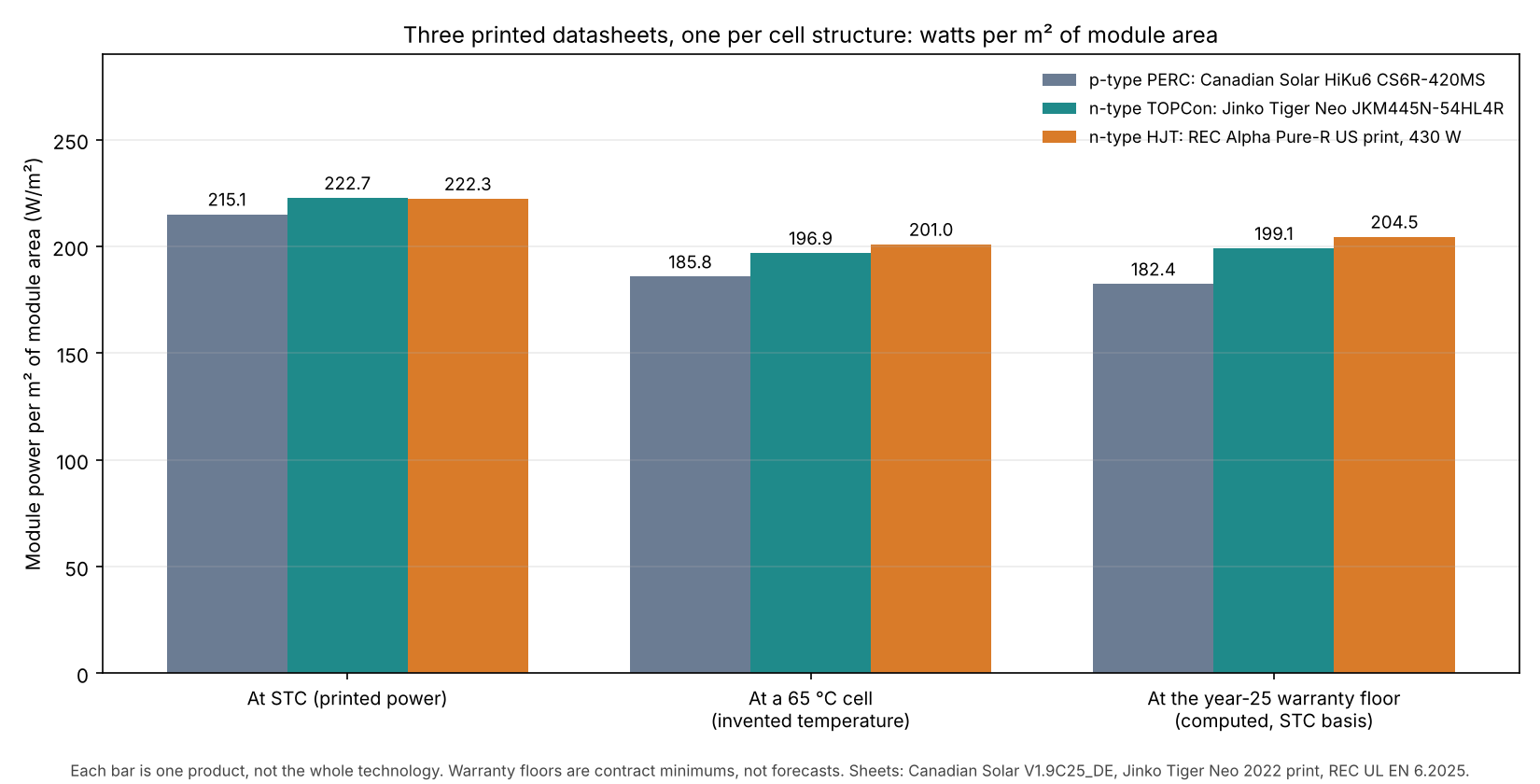
Figure 1. The three sheets sit within 7.6 W/m² at STC, but the gap grows to 15.1 W/m² at an example 65 °C cell and 22.1 W/m² at the year-25 warranty floor (Canadian Solar term assumed).
TOPCon vs HJT: what do three printed datasheets show?
One sheet per structure shows the pattern, not the rule. Each column below is one product, at the top power class on its sheet. The TOPCon and HJT sheets print more watts per m² than the PERC sheet. At the example hot cell the HJT sheet is ahead of both.
| Item | p-type PERC | n-type TOPCon | n-type HJT |
|---|---|---|---|
| Sheet | Canadian Solar HiKu6 CS6R-420MS | Jinko Tiger Neo JKM445N-54HL4R | REC Alpha Pure-R US print |
| Cell wording on the sheet | "Monokristallin". The product name reads "HiKu6 Mono PERC" | "N type Mono-crystalline" | "80 half-cut bifacial REC heterojunction cells" |
| Size, mm | 1722 × 1134 | 1762 × 1134 | 1730 × 1118 |
| Pmax at STC | 420 W | 445 W | 430 W |
| Efficiency: printed (computed) | 21.5% (21.51%) | 22.27% (22.27%) | 22.3% (22.23%) |
Temperature and warranty lines are in a second table.
| Item | p-type PERC | n-type TOPCon | n-type HJT |
|---|---|---|---|
| Pmax coefficient | -0.34 %/°C | -0.29 %/°C | -0.24 %/°C |
| Year-1 loss, then yearly | at most 2%, then at most 0.55% | 99% in year 1 (chart), then 0.40% over 30 years | 98% in year 1, then 0.25% |
| Year-25 floor (computed) | 84.8% (term assumed) | 89.4% | 92.0% |
| W/m² at STC | 215.1 | 222.7 | 222.3 |
| W/m² at a 65 °C cell (example) | 185.8 (-13.6%) | 196.9 (-11.6%) | 201.0 (-9.6%) |
| W/m² at the year-25 floor | 182.4 | 199.1 | 204.5 |
Print codes: the REC print is marked "UL EN 6.2025", the Canadian Solar sheet carries code "V1.9C25_DE", and the Jinko sheet has a © 2022 footer.
Method: hot power is Pmax × (1 + coefficient × 40 K). The temperature coefficient page sets this out. Gaps in the text and Figure 1 use unrounded values. The floor is year-1 power less 24 yearly steps, on an STC basis. It is a minimum that a claim is judged against. It is not a forecast. See standard test conditions.
At STC the TOPCon sheet leads the HJT sheet by 0.4 W/m². At the hot cell the HJT sheet leads by 4.1. At the year-25 floor it leads by 5.4. The coefficient and the yearly step drive that, not the cell name alone.
Limits: the three sheets differ in print year, maker, size and power class. The Canadian Solar copy is a German-language print, and the Jinko sheet is an Australian variant. The REC cell is bifacial, but its sheet prints no bifaciality factor. See bifacial module.
The Canadian Solar year-25 figure uses the 25-year term in its footnote. The Jinko sheet says "N type", and its TOPCon label comes from Jinko’s Tiger Neo whitepaper. The Canadian Solar sheet does not print "p-type", and the REC sheet does not print "n-type".
Printed efficiency can be tested against power and size. The REC print gives 22.3% where 430 W on 1730 × 1118 mm gives 22.23%. The gap is 0.07 points. The sheet does not say why.
Datasheet normaliser calculator
Enter any three modules to compare watts per m², hot-cell power and the year-N floor. The starting values are the three sheets above.
What should you check on a sheet before choosing?
These lines matter more than the cell name, so read them in this order.
- The Pmax coefficient and its unit.
- The year-1 loss and the yearly step, and the term of each.
- Efficiency against power and size.
- Any bifacial rating, kept apart from front-side power.
- The print code or date, since prints change.
How solar software handles cell technology and LID
Only PVsyst documents both a module technology field and a LID setting. HelioScope documents a workaround through its soiling loss. Aurora documents neither on the pages read.
| Software | Documents cell technology or LID handling? |
|---|---|
| PVsyst | Yes |
| HelioScope | Partly |
| Aurora Solar | Not stated |
Spelling: this page writes n-type and TOPCon. Quoted sources print "N type" (Jinko) and "TopCon" (Fraunhofer ISE chart note). Not stated: the page read does not say. Partly: the page documents a workaround, not a LID setting. Notes and sources for each tool follow.
- PVsyst: the module form’s Technology field "Gives choice for the main technologies of PV modules available on the market. Acts on the model." The LID loss page says LID "only arises with conventional p-type boron-doped wafers". If you specify LID, the page proposes 2%, and it says LID is not proposed as a default. Source: PVsyst help, module main interface and the PVsyst 7 LID loss page, no dates shown, checked October 2026. The technology options are not listed on the page read.
- HelioScope: source is the HelioScope vs PVsyst page, no date shown, checked October 2026. The degradation page read names no cell technology. The page says "HelioScope does not specifically adjust for light-induced degradation (LID)."
- HelioScope, LID workaround: the HelioScope vs PVsyst page offers one: "Instead, the soiling losses can be adjusted to account for the losses or gains from LID."
- Aurora Solar: it names no cell technology on the Bifacial modules help page (no date shown, checked October 2026) or on any other page read. That page says "Aurora simulations currently do not model rear side power gain for bifacial modules."
The pvlib python retrieve_sam page (0.16.1) says "CECMod" returns the CEC module database and names no technology field. Ranked tools that model module records are in the best solar simulation software list. The best PVsyst alternatives list covers other options. To see where hot-day loss and yearly loss enter a model, see system losses.
Common mistakes with n-type, TOPCon and HJT
FAQs
Is TOPCon better than HJT?
These three sheets do not settle it. The TOPCon sheet leads by 0.4 W/m² at STC. The HJT sheet leads by 4.1 at a 65 °C cell. Different makers, sizes and prints sit behind each column. So compare the two products you are quoting.
Is TOPCon an n-type technology?
Yes. DOE names tunnel-oxide passivated contacts as an n-type technology. Its TOPCon diagram text includes n-type crystalline silicon. Fraunhofer ISE says n-type TOPCon has become dominant.
Is PERC obsolete?
No. PERC is still on sheets, such as the Canadian Solar print above. DOE says a move from PERC to n-type designs is taking place. Fraunhofer ISE’s chart note says n-type TOPCon and heterojunction replace p-type PERC.
Why does my sheet not say n-type?
Sheets use their own words. The three here print "N type Mono-crystalline", "Mono PERC" and "heterojunction". The maker or distributor can say which wafer a model uses, and the reply belongs with the sheet.
Related terms
- Solar cell: the single device that modules chain together.
- PERC and half-cut cells: the p-type structure and the half-cell format.
- Bifacial module: a module that also collects light on its rear side.
Next step: enter the two modules you are quoting into the calculator above, then see which tools model their LID in the best solar simulation software list.
Sources
- Fraunhofer ISE, Photovoltaics Report, edition of 14 July 2026, pages 5, 34 and 56 (checked 30 October 2026). The n-type wafer share is the report’s citation of ITRPV.
- DOE, Crystalline Silicon Photovoltaics Research (published 24 January 2014, modified 17 December 2025, checked October 2026).
- NLR (formerly NREL), Mitigating Process Induced Degradation in p- and n-Czochralski Silicon Wafers with Tabula Rasa, NREL/CP-5900-74027 (July 2019, checked October 2026).
- PVsyst help (no dates shown, checked October 2026): LID loss, PVsyst 7 and PV modules main interface.
- REC, Alpha series technology (date only in the file name, checked October 2026).
- Jinko, Tiger Neo N-Type TOPCon whitepaper (no date in the file, checked October 2026).
- Datasheets, distributor copies (checked October 2026): Canadian Solar HiKu6 CS6R-MS, Jinko JKM425-445N-54HL4R and REC Alpha Pure-R US print.
- Company pages (no dates shown, checked October 2026): HelioScope vs PVsyst, HelioScope module degradation, Aurora, Bifacial modules and pvlib 0.16.1, retrieve_sam.
Last updated 30 October 2026. Next scheduled review: 30 January 2027.