Key takeaways
- Mono is one crystal from a pulled ingot. Poly has many grains in a cast ingot. Research papers and Fraunhofer ISE call poly multi. Sheets say "poly-crystalline" or "mono-crystalline".
- Fraunhofer ISE’s 14 July 2026 edition says multi-crystalline silicon technology "has disappeared from the market". Its 2025 table lists 690 of 706 GWp as mono-Si, or 97.7% by our arithmetic.
- A 2017 chapter says mc-Si was over 60% of modules produced in 2014, so older roofs may hold poly modules.
- On two Jinko sheets with 2017 revision codes, poly tops out at 280 W and mono PERC at 300 W at the same 1,650 × 992 mm size. That is 7.1% more power per module. The mono sheet is also PERC, so wafer type is not the whole gap.
- Of five tools, only PV*SOL documents mono and poly cell type options. PVsyst documents a Technology field without listing them.
Only PV*SOL of five tools documents mono and poly cell-type options. Compare module libraries in the best solar design software list.
Monocrystalline vs polycrystalline at a glance
The two words name the crystal structure of the wafer. They do not name the cell design. A mono module can be PERC, TOPCon or HJT, so the sheet needs reading for both.
| Item | Detail |
|---|---|
| Formula | Efficiency = Pmax ÷ (module area × 1,000 W/m²). Watts per m² = Pmax ÷ area. |
| What differs | One crystal (mono) or many grains (poly or multi) in the silicon. |
| Words on sheets | Jinko: "Poly-crystalline" and "Mono-crystalline PERC". ET Solar: "Polycrystalline Module". Fraunhofer ISE: "Multi-Si" and "Mono-Si". |
| Where it matters | Old arrays, replacement matches, survey records and old design files. |
| In software | PV*SOL documents "Si monocrystalline" and "Si polycrystalline" cell types. See the software table. |
Why does wafer type matter for installers?
For new designs it rarely does, because Fraunhofer ISE says poly has left the market. It still matters when you survey, extend, repair or re-model an old roof.
Three jobs need the cell type. A survey record should name it from the label or sheet. A replacement module needs a library match. See equipment datasheets. An old design file may have a cell type field that a new one lacks. For the unit itself see solar panel (module).
How is each kind of ingot made?
Mono silicon is grown as a single crystal by the Czochralski method. Poly silicon is cast and cooled in one direction. That leaves many grains. The table uses two journal and book sources.
| Item | Monocrystalline | Polycrystalline (multicrystalline) |
|---|---|---|
| Growth | Czochralski. Di Sabatino and others (Crystals, 7 February 2024) describe "the growth of cylindrical, single-crystal Si ingots measuring about 1.5–2 m in length". | Directional solidification. The same review says the ingots are "distinguished by columnar grains that extend over height". |
| Quality | The review links mono efficiency to "a high-purity and defect-free microstructure". | A 2017 chapter by Gaspar and others says mc-Si has much higher densities of crystalline defects than single crystals. |
| Market effect | The review says Czochralski’s mass production and size gains caused "a decline in the use of the directional solidification method in the industrial market". | Same sentence. The review gives no share figure. |
Cell structure is a separate choice. See PERC and half-cut cells and n-type, TOPCon and HJT. For the effect itself see photovoltaic.
What does production data show?
Worldwide production is now almost all mono. Fraunhofer ISE’s 2025 table lists 0 GWp of multi-Si. The two sources below use different bases. Do not subtract one from the other.
| Source | Year and basis | What it prints |
|---|---|---|
| Gaspar, Autruffe and Pó, IntechOpen chapter, 31 May 2017 | 2014, share of all modules produced | "mc-Si technologies accounted over 60% of all module produced in 2014". It gives Cz-Si as about 34% without naming the base. |
| Fraunhofer ISE, Photovoltaics Report, updated 14 July 2026, page 30 | 2025, production in GWp, total 706 (ITRPV) | Thin film 16, Multi-Si 0, Mono-Si 690. Mono is 97.7% of 706 by our arithmetic. Only First Solar is counted as thin film. |
Page 28 of the same report says "In practice, multi-crystalline silicon technology has disappeared from the market." These are production figures, not roof counts. They say nothing about what is on existing roofs.
What do mono and poly datasheets print?
On the Jinko prints, the two sheets share the 280 W class, and the mono sheet runs 20 W higher. Each column is one product family on one old print, and the hot row assumes a 65 °C cell. These values describe those products, not whole technologies.
| Item | Jinko Eagle 60P | Jinko Eagle PERC 60 | ET Solar ET-P660 |
|---|---|---|---|
| Cell wording | "Poly-crystalline 156×156mm (6 inch)" | "Mono-crystalline PERC 156×156mm (6 inch)" | "Polycrystalline Module". 156.75 mm cells |
| Revision code | EN-JKM-280PP-60_rev2017 | EN-JKM-300M-60-PERC_1.0_rev2017 | M/ET-PD-EN-EU2017V4 |
| Cells and size | 60. 1650×992×35 mm | 60. 1650×992×40 mm | 60. 1640×992×35 mm |
The second table gives the power, efficiency and heat figures from the same three sheets.
| Item | Jinko Eagle 60P | Jinko Eagle PERC 60 | ET Solar ET-P660 |
|---|---|---|---|
| Power classes | 260 to 280 W | 280 to 300 W | 265 to 280 W |
| Printed efficiency | 15.88% to 17.11% | 17.11% to 18.33% | 16.29% to 17.21% |
| Top class, W/m² (computed) | 171.1 | 183.3 | 172.1 |
| Pmax coefficient | -0.40 %/°C | -0.39 %/°C | -0.41 %/°C |
| Hot top class, W/m² (65 °C cell) | 143.7 | 154.7 | 143.9 |
| Weight | 19.0 kg | 19.0 kg | 18.5 kg |
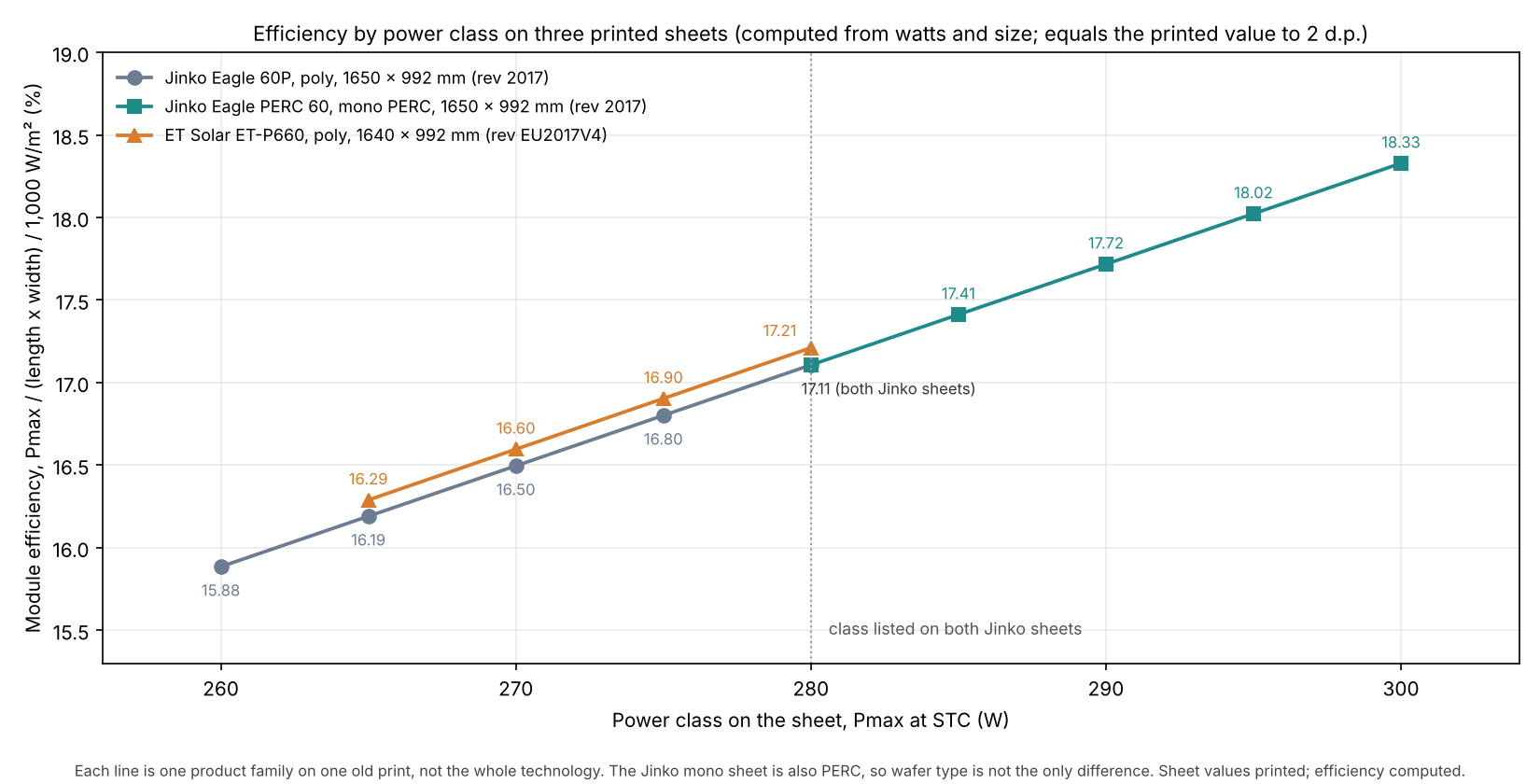
Figure 1. At 280 W both Jinko sheets print 17.11%. The poly line stops there, and the mono PERC line runs on to 300 W and 18.33%.
Method: efficiency is Pmax ÷ area ÷ 1,000 W/m². It matches every printed value to two decimals. Hot power is Pmax × (1 + coefficient × 40 K), as set out on temperature coefficient. The coefficients differ by 0.01 points between the Jinko sheets. So the 11.0 W/m² hot gap comes mainly from the power class.
Limits: three sheets, 2017 revision codes, distributor or blog copies, and no other printed date. The mono sheet is also PERC. The poly sheets name no rear structure. So do not credit the wafer for the whole gap. For newer n-type values see n-type, TOPCon and HJT. For the test basis see standard test conditions.
Worked example: 10 kWp on the same footprint
A higher class on the same footprint cuts module count and area. The 10 kWp target is invented. Both rows use the 1,650 × 992 mm Jinko size.
| Module and class | Watts per m² | Modules for 10 kWp | Module area |
|---|---|---|---|
| Jinko Eagle 60P, poly, 280 W | 171.1 | 36 | 58.9 m² |
| Jinko Eagle PERC 60, mono PERC, 300 W | 183.3 | 34 | 55.7 m² |
The count is the target ÷ Pmax, rounded up. The 300 W class saves two modules and 3.3 m² (3.27 m² before rounding). Area counts modules only, not rails or gaps. Check the real roof fit in solar panel layout.
Same-footprint sheet check
Enter up to three modules and a target size. The starting values reproduce the two rows above. Module 3 is a 280 W mono PERC of the same size, for comparison.
If the calculator does not load, open it on its own page.
How solar software handles mono and poly cell type
Of the five help pages we read, only PV*SOL lists mono and poly cell type options, and PVsyst shows a Technology field with no options listed. The ratings do not say how well a tool models either type.
| Software | Names a mono or poly cell type? | Page read (October 2026) |
|---|---|---|
| PV*SOL | Yes | PV modules (Databases), PV*SOL help. © 2026 shown, no version. |
| PVsyst | Partly | PV modules Main interface (quote) and Basic data. No date or version shown. |
| OpenSolar | Not stated | How to add your hardware components. No date shown. |
| HelioScope | Not stated | Upload New Modules/Inverters. No date shown. |
| Aurora Solar | Not stated | Enabling Solar Components. No date shown. |
Not stated: the company page we read does not say. Partly: a field exists but lists no mono or poly option. What each page says:
- PV*SOL: Cell type options include "Si monocrystalline", "Si polycrystalline", "Si amorphous" and "Other", plus others such as CdTe.
- PVsyst: A Technology field "Gives choice for the main technologies of PV modules available on the market. Acts on the model." The page lists no mono or poly option.
- OpenSolar: The page names no module cell type field.
- HelioScope: The page says "Users can manually upload Modules via PAN Files". It names no cell type field.
- Aurora Solar: The page names no cell type field or filter.
PVsyst is rated Partly because no page read lists a mono or poly option. The n-type, TOPCon and HJT page covers newer cell types. Other pages of these companies are not covered.
Common mistakes with mono and poly
FAQs
Is monocrystalline better than polycrystalline?
On the two Jinko sheets read, mono PERC reached 300 W and poly 280 W at 1,650 × 992 mm, but that gap mixes wafer type and PERC. For new modules the choice is mostly made for you: Fraunhofer ISE’s 2025 table shows 690 of 706 GWp as mono-Si and 0 as multi-Si.
Is polycrystalline the same as multicrystalline?
Yes, in these sources. Both words mean the same cast, many-grain silicon. Jinko and ET Solar print "poly", PV*SOL says "polycrystalline", and Fraunhofer ISE and Gaspar write "multi" or "mc-Si".
Are polycrystalline panels still made?
Fraunhofer ISE’s 2025 production table lists no multi-Si. Its text says the technology has disappeared from the market. That is a worldwide production statement. It does not count modules already installed.
How do I tell which one a module is?
Read the cell wording on the sheet, not the look. The Jinko model codes differ too. They are JKM280PP-60 for poly and JKM300M-60 for mono PERC. Codes are maker-specific, so ask the maker if a label is unclear.
Related terms
- Photovoltaic: the effect that turns light into direct current.
- N-type, TOPCon and HJT: the wafer doping and the newer cell structures.
- Solar panel (module): cells sealed in one weather-tight unit.
- Thin-film solar: modules made without silicon wafers.
Next step: find the cell wording on the sheet of the module you are matching, then see n-type, TOPCon and HJT for newer modules.
Sources
- Fraunhofer ISE, Photovoltaics Report, updated 14 July 2026, printed pages 28 and 30. Checked October 2026.
- Gaspar, Autruffe and Pó, Silicon Growth Technologies for PV Applications, IntechOpen, published 31 May 2017. Checked October 2026.
- Di Sabatino, Hendawi and Sanchez Garcia, Silicon Solar Cells: Trends, Manufacturing Challenges, and AI Perspectives, Crystals 2024, 14(2), 167, published 7 February 2024. Checked October 2026.
- Datasheet copies, checked October 2026: Jinko Eagle 60P (EN-JKM-280PP-60_rev2017), Jinko Eagle PERC 60 (EN-JKM-300M-60-PERC_1.0_rev2017) and ET Solar ET-P660 (M/ET-PD-EN-EU2017V4). No other printed dates.
- PV*SOL help, PV modules (Databases). © 2026 shown. Checked October 2026.
- PVsyst, PV modules Main interface and Basic data. No date shown. Checked October 2026.
- OpenSolar, How to add your hardware components, HelioScope, Upload New Modules/Inverters and Aurora, Enabling Solar Components. No dates shown in the text read. Checked October 2026.
Last updated 30 October 2026. Next scheduled review: 30 January 2027.