Key takeaways
- EIA calls the PV cell "the basic building block of a PV system". DOE says cells are connected "in chains" to form modules or panels.
- PVEducation gives about 0.5 V for one silicon cell at its maximum power point. It gives around 690 mV open circuit for commercial silicon.
- The Jinko Eagle PERC 60 sheet (300 W class) has 60 cells at 32.6 V. That is 0.543 V and 5.00 W per cell if they form one series string.
- Series adds voltage and parallel adds current. The same 60 cells wired 30 in series by 2 in parallel give 16.3 V and 18.42 A, still about 300 W (idealised).
- On the nominal 156 x 156 mm cell area, the 300 W class is 20.5%, a derived figure. The printed module figure is 18.33%.
To see which tools shade by cell string, see the best solar shading analysis software.
Solar cell at a glance
A solar cell is the smallest part that makes power. It is a low-voltage device, so a module wires cells together. The numbers below come from the worked example on this page.
| Item | Detail |
|---|---|
| Formula | Cell Vmp = module Vmp ÷ cells in series. Cell current = module current ÷ parallel blocks. Cell power = Vmp × Imp ÷ cells. |
| Unit | V, A and W per cell. A silicon cell is about 0.5 V at maximum power (PVEducation). |
| Where it matters | Datasheet checks, string design, shade models and the cell count in a module record. |
| Standard or rule | Module sheets rate the module, not the cell. Ratings use standard test conditions. |
| In software | Tools store a cell count and some model shade by cell string. See the software table. |
Why does the solar cell matter for installers?
You rarely buy a cell, but its numbers explain the module sheet.
- Sanity check: module Voc divided by series cells should look like one cell’s Voc.
- Shading: tools that model by cell string need the cell layout.
- Wording: "cell efficiency" and "module efficiency" are not the same number.
See equipment datasheets and Voc and Isc.
How does one solar cell work?
Light frees charge carriers in a semiconductor. A junction field separates them, and metal contacts carry the current out. For the photon arithmetic, see photovoltaic.
- Absorb. DOE says the semiconductor "absorbs the light’s energy and transfers it to negatively charged particles". PVEducation says a pair forms when the photon energy is greater than the band gap.
- Separate. The pairs are short-lived and recombine if left alone. The electric field of the p-n junction separates carriers that reach it, so they can flow as current.
- Build voltage. At short circuit no charge builds up and no voltage forms. If carriers cannot leave, charge piles up until the voltage balances the light current. Open-circuit voltage is "the maximum voltage available from a solar cell, and this occurs at zero current".
- Collect. Metal contacts carry the current out. In EIA’s words, "PV cells generate direct current (DC) electricity."
| Part | What it does (source) |
|---|---|
| Textured, coated front surface | Prepares the front surface. DOE’s cell-basics page said in an earlier version: "The first step is chemical texturing of the wafer surface." The current DOE page (checked November 2026) no longer gives this detail, so treat it as general industry practice rather than a live DOE quote. See anti-reflection coating. |
| Emitter (the thin layer light enters first) | Sits near where light is absorbed (PVEducation: "The emitter is usually thin to keep the depletion region near where the light is strongly absorbed"). |
| Base (the thick layer below) | Absorbs most of the light (PVEducation: "the base is usually made thick enough to absorb most of the light." It calls emitter and base historical terms). |
| p-n junction between them | Separates the carriers (PVEducation: "in practice nearly all photovoltaic energy conversion uses semiconductor materials in the form of a p-n junction."). |
| Metal contacts on the cell faces | Carry the current out. DOE’s current page (checked November 2026) says current is "extracted through conductive metal contacts, the grid-like lines on a solar cell." Its earlier wording named screen-printed silver metallization specifically, a detail the live page no longer gives. |
Cell designs differ in how they treat the rear and the wafer doping. See PERC and half-cut cells, n-type, TOPCon and HJT and monocrystalline vs polycrystalline. Thin-film cells are made differently. See thin-film solar.
Worked example: what does one cell give?
On one printed sheet, a 60-cell module at 32.6 V gives 0.543 V per cell. So a cell is about a half-volt part. The sheet is the Jinko Eagle PERC 60 (revision code EN-JKM-300M-60-PERC_1.0_rev2017), a distributor copy. It is not a current manufacturer sheet, so read the figures as an illustration.
It prints "Mono-crystalline PERC 156×156mm (6 inch)" cells and 60 cells (6×10). It does not print the wiring. The table assumes one series string of 60. Under that assumption, cell current equals module current. DOE’s cell-basics page once said an individual cell is "typically producing about 1 or 2 watts of power." The current page (checked November 2026) does not repeat that figure, so check DOE’s site before citing it again. A full-size 156 mm cell here gives about 5 W. Read the 5 W as an illustration from one 2017 sheet, not DOE’s current position.
| Class | Module Vmp, Imp | Module Voc, Isc | Cell Vmp / Voc | Cell power |
|---|---|---|---|---|
| 280 W | 31.8 V, 8.81 A | 38.6 V, 9.49 A | 0.530 V / 0.643 V | 4.67 W |
| 285 W | 32.0 V, 8.90 A | 38.7 V, 9.51 A | 0.533 V / 0.645 V | 4.75 W |
| 290 W | 32.2 V, 9.02 A | 39.5 V, 9.55 A | 0.537 V / 0.658 V | 4.84 W |
| 295 W | 32.4 V, 9.10 A | 39.7 V, 9.61 A | 0.540 V / 0.662 V | 4.91 W |
| 300 W | 32.6 V, 9.21 A | 40.1 V, 9.72 A | 0.543 V / 0.668 V | 5.00 W |
Cell power is Vmp × Imp ÷ 60. Vmp × Imp can differ from the printed class by under 0.5 W (300.2 W against 300 W) because the sheet rounds. From the 280 W to the 300 W class, cell power (Vmp × Imp) rises by 7.2%. Vmp rises 2.5% and Imp 4.5%. The cell Voc values sit near PVEducation’s 690 mV for commercial silicon. That supports the one-string reading but does not prove it.
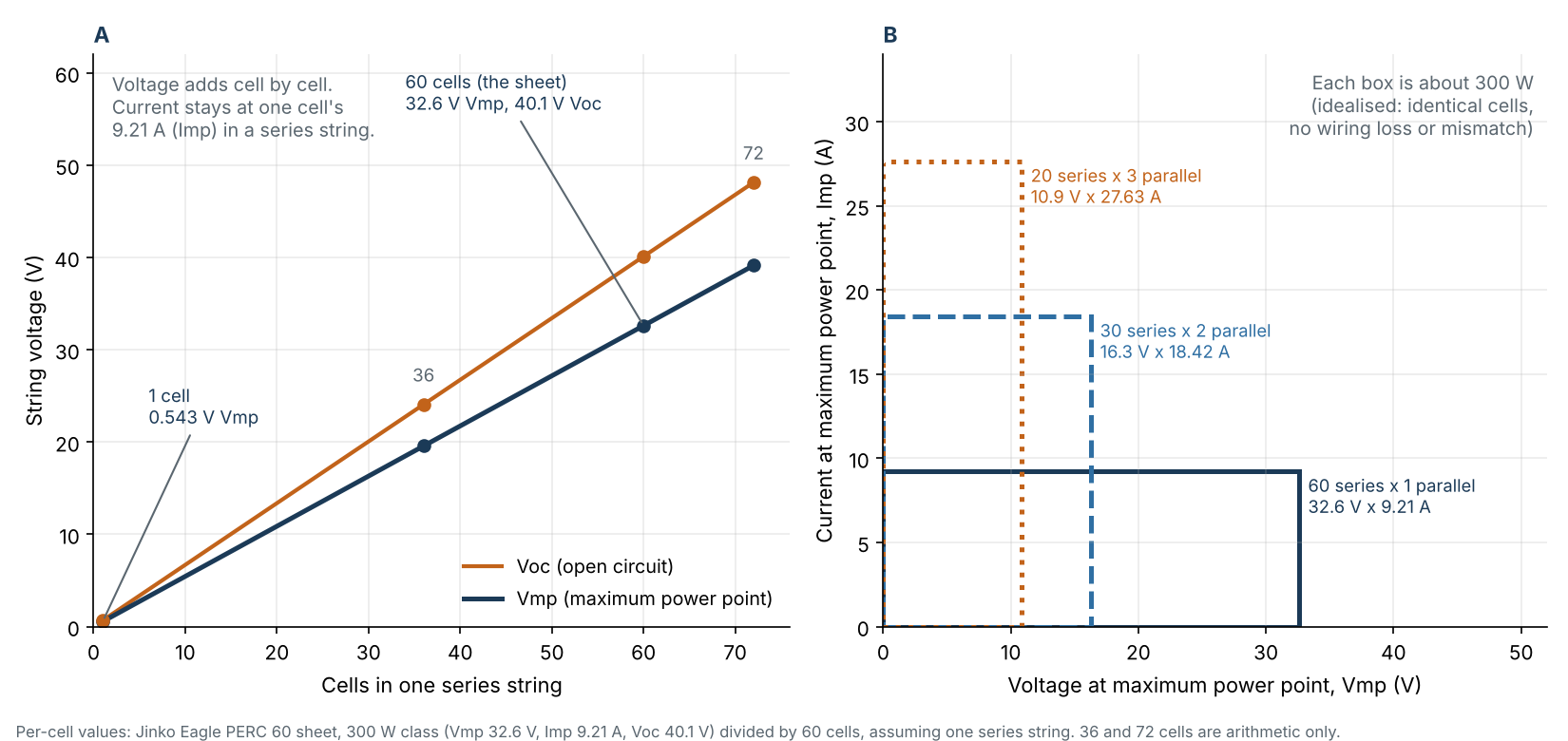
Figure 1. Voltage adds cell by cell: 60 cells at 0.543 V each give 32.6 V. Rewiring the same 60 cells as 30 by 2 or 20 by 3 keeps about 300 W (idealised, assumed one-string sheet, 36 and 72 cells are arithmetic only).
Solar cell vs module: what changes?
A module is many cells wired, sealed and framed. DOE says cells are connected "in chains to form larger units known as modules or panels". PVEducation says they are "nearly always in series".
| Item | One cell | Module (Jinko sheet, 300 W class) |
|---|---|---|
| Voltage at maximum power | About 0.5 V (PVEducation). Derived here: 0.543 V. | 32.6 V, from 60 cells in series (assumed). |
| Open-circuit voltage | Around 690 mV for commercial silicon (PVEducation). Derived here: 0.668 V. | 40.1 V. |
| Current | 9.21 A at Imp (derived). | 9.21 A. A series string carries one cell’s current. |
| Power | 5.00 W (derived). | 300 W class. |
| Area | 243.4 cm2 nominal (156 x 156 mm). | 1,650 x 992 mm, 1.637 m2. The 60 nominal cells fill 89.2% of it. |
| Efficiency | 20.5% on nominal cell area (derived). | 18.33% printed, on the whole module area. |
| Packaging | No frame or junction box. | DOE: the stack is "laminated in an oven to make the module waterproof", then framed with a junction box. |
| Faults | A single cell has no string and no bypass diode. | In a series string, current is limited to that of one cell. TU Delft says "PV modules have so-called bypass diodes integrated". |
Here the gap is entirely the area ratio (89.2%). The nominal cell area ignores the clipped corners of mono cells. So 20.5% is not a measured cell efficiency. Do not quote either figure as the other.
Cell counts vary. TU Delft says modern modules often contain 60, 72 or even 96 cells. PVEducation says residential or large-field modules usually contain 60 or 72, and also names 36 cells in series. Half-cut sheets print bigger counts. See PERC and half-cut cells. For the unit itself, see solar panel (module).
Wiring changes the shape, not the power. The same 60 cells keep about 300 W in each layout below. Losses and mismatch are ignored.
| Layout of the same 60 cells | Voc / Isc | Vmp / Imp | Power |
|---|---|---|---|
| 60 series x 1 parallel | 40.1 V / 9.72 A | 32.6 V / 9.21 A | 300.2 W |
| 30 series x 2 parallel | 20.1 V / 19.44 A | 16.3 V / 18.42 A | 300.2 W |
| 20 series x 3 parallel | 13.4 V / 29.16 A | 10.9 V / 27.63 A | 300.2 W |
For what shade and mismatch do to a real string, see mismatch loss and bypass diode failure. For how many modules fit a string, see string sizing.
Cell-to-module calculator
Enter module values from a datasheet and the cell layout. The starting values reproduce the 300 W row above.
If the calculator does not load, open it on its own page.
How solar software handles the solar cell
Four of the five tools document a cell count or a shade model built on the cell layout. pvlib documents a fitting input only.
| Software | Documents a cell count or cell-layout model? |
|---|---|
| PVsyst | Yes |
| PV*SOL | Yes |
| Aurora Solar | Yes |
| HelioScope | Yes |
| pvlib python | Partly |
Here is what each page says, as checked in October 2026.
- PVsyst: it has a series-cell input. "NCell serie: Number of cells in series, necessary for the determination of the model, for one cell." It also notes diodes. "Normally 3 diodes for 60 and 72 cells, 4 diodes for 96 cells in series." Page: PV modules Main interface. No date or version shown.
- PV*SOL: the Electrical data section says "Specify number of cells". It does not say if that is series or parallel. It also lists cell types such as Si monocrystalline, Si polycrystalline and CdTe. Page: PV modules (Databases). Footer "© 2026 PV*SOL Help", no other date.
- Aurora Solar: it uses the module’s cell string and bypass diode layout. "Aurora is capable of running performance simulations at the submodule, or cell string level for silicon crystalline modules." Page: Submodule (Cell String)-Level Simulation. No date shown.
- HelioScope: "HelioScope checks for shading on each cell string." It factors in the cell structure and bypass diodes. Page: Shade Modeling. No date in the text read.
- pvlib python: the CEC single-diode fitting function takes a
cells_in_seriesinput, "Number of cells in series". It is a fitting input, not a cell model. Page: fit_cec_sam, docs version 0.16.1 (stable). No date shown.
To compare tools that store cell and module data, see the best solar simulation software.
Common mistakes with the solar cell
FAQs
What is the difference between a solar cell and a solar panel?
A cell is one PV device. A panel, or module, is many cells sealed with a frame and junction box. Here, 60 cells at about 5.00 W each make a 300 W class module.
How much voltage does one solar cell make?
About 0.5 V at the maximum power point (PVEducation). Open circuit, commercial silicon is around 690 mV and a high-quality single-crystal cell reaches 764 mV.
How many cells are in a solar panel?
TU Delft says modern modules often contain 60, 72 or even 96. PVEducation also names 36 cells in series. The printed count may differ from the series count.
Is a PV cell the same as a solar cell?
Yes. EIA writes "A photovoltaic (PV) cell, commonly called a solar cell". Both terms name the single device, while a module is the sealed unit of many cells. See photovoltaic.
Related terms
- Photovoltaic: the effect that makes a cell work.
- Solar panel (module): cells sealed in one weather-tight unit.
- Fill factor: why Vmp × Imp is below Voc × Isc.
Next step: divide a datasheet Voc by its series cell count, then test cell-string shade in the best solar shading analysis software.
Sources
- DOE, Solar Photovoltaic Cell Basics. No page date. The URL moved from energy.gov/eere/solar to energy.gov/cmei/systems after DOE’s reorganisation. Rechecked 3 November 2026, when the page kept the light-absorption quote used above but no longer gave the per-cell wattage, texturing or screen-printing detail.
- DOE, Solar Photovoltaic Technology Basics. Published 22 October 2020. Metadata modified 2 September 2026. Checked October 2026.
- DOE, Photovoltaic Cell and Module Design. Metadata: published 12 February 2021, modified 10 December 2025. Checked October 2026.
- DOE, Solar Photovoltaic Manufacturing Basics. Published 17 May 2021, last modified 7 April 2025. Checked October 2026.
- PVEducation. No page dates. Checked October 2026. Solar cell structure, Light-generated current, The photovoltaic effect, Open-circuit voltage and Module circuit design.
- TU Delft OpenCourseWare, Solar Energy, chapter 15 PV modules. No date or edition shown. Checked October 2026.
- EIA, Photovoltaics and electricity. No page date. Checked October 2026.
- Jinko Eagle PERC 60 datasheet, distributor copy, footer EN-JKM-300M-60-PERC_1.0_rev2017. Not a current manufacturer sheet. Checked October 2026.
- PVsyst, PV modules Main interface. No date shown. Checked October 2026.
- PV*SOL help, PV modules (Databases). Footer "© 2026 PV*SOL Help". Checked October 2026.
- Aurora help, Submodule (Cell String)-Level Simulation. No date shown. Checked October 2026.
- HelioScope help, Shade Modeling. No date in the text read. Checked October 2026.
- pvlib, ivtools.sdm.fit_cec_sam. Docs version 0.16.1. No date shown. Checked October 2026.
Last updated 3 November 2026. Next scheduled review: 30 January 2027.