Key takeaways
- PV makes DC electricity from light. A solar thermal collector makes heat. Both can be called a "solar panel".
- The effect has three steps. A photon frees an electron, a junction field separates the charges, and DC current flows out.
- Silicon’s gap is 1.12 eV at 300 K, which puts the cutoff near 1,107 nm. A 1,200 nm photon carries 1.03 eV, so it cannot free an electron.
- Becquerel first saw the effect in 1839. Alfred Smee used "photo-voltaic" in 1849, and Etymonline dates its entry to 1923.
- Design tools turn the effect into a module model. pvlib and PVsyst both document a single-diode model.
To see which tools build a PV module model from datasheet values, see the best solar design software.
Photovoltaic at a glance
Photovoltaic names how a solar cell works. Light goes in. Direct current comes out. The photon math below uses 1.12 eV for silicon. The Ioffe silicon database gives that value at 300 K. The gap shrinks as the cell warms, so 1,107 nm is a room-temperature cutoff.
| Item | Detail |
|---|---|
| Formula | Photon energy in eV = 1.24 ÷ wavelength in micrometres. Silicon cutoff = 1.24 ÷ 1.12 = 1.107 micrometres, or 1,107 nm. |
| Unit | eV and nm for photons. W, kW and kWp for what you design. See kW and kWp. |
| Where it matters | Quotes, proposals, datasheets and the module model inside a design tool. |
| In software | Tools turn the effect into a module model. See the software table. |
Why does photovoltaic matter for installers?
The word keeps heat and electricity apart. A thermal collector and a PV module can both be sold as a "solar panel". They make heat and DC electricity. So their outputs do not share a line on a quote.
In a permit set, "panel" can also mean an electrical panel. Write "PV module" for the unit that makes electricity. See solar panel (module).
Where does the word photovoltaic come from?
It joins the Greek word for light with volt, a unit named for Alessandro Volta. The pvresources introduction says the term comes from the Greek "phōs meaning light" plus the word volt.
The Etymonline entry for "voltaic" gives 1813, "designating electricity produced by chemical action", formed in recognition of Volta. So the second half first described battery electricity. "Photo" added light to it.
The dates are not in conflict. Alfred Smee wrote "photo-voltaic" in 1849: an 1849 review of his book quotes "a very slight deflection of the galvanometer declares the presence of a photo-voltaic current". Etymonline dates its entry for the one-word "photovoltaic" to 1923.
Two dates anchor the history. A DOE solar timeline says that in 1839 Edmond Becquerel "discovers the photovoltaic effect". He was experimenting with "an electrolytic cell made up of two metal electrodes placed in an electricity-conducting solution". So his first device was not a semiconductor cell. APS says "In April, 1954, researchers at Bell Laboratories demonstrated the first practical silicon solar cell."
"PV" is mostly an adjective, and a short noun for photovoltaics. EIA writes "A photovoltaic (PV) cell, commonly called a solar cell". The same page then says PV panel, PV array and PV system. For the cell, see solar cell.
How does the photovoltaic effect work?
Light frees charge carriers in a semiconductor. An electric field at a junction separates them. Current can then flow in an outside circuit. The field pushes the charges one way, so the current is DC.
- Absorb. PVEducation defines the band gap as "the minimum amount of energy required for an electron to break free of its bound state". DOE says the bandgap shows which wavelengths the material can absorb. EIA says "Only the photons that are absorbed provide energy to generate electricity."
- Separate. PVEducation: "The carriers are separated by the action of the electric field existing at the p-n junction."
- Deliver. EIA says "PV cells generate direct current (DC) electricity." Inverters then convert it to AC. See inverter.
The gap sets which photons can work. A silicon cell review by Hossain, Sun and Davis says "Si has a bandgap of 1.12 eV". It gives the band edge as "1.12 eV or 1107 nm". Photons below the gap, it says, "either don’t get absorbed at all or get absorbed and converted into heat."
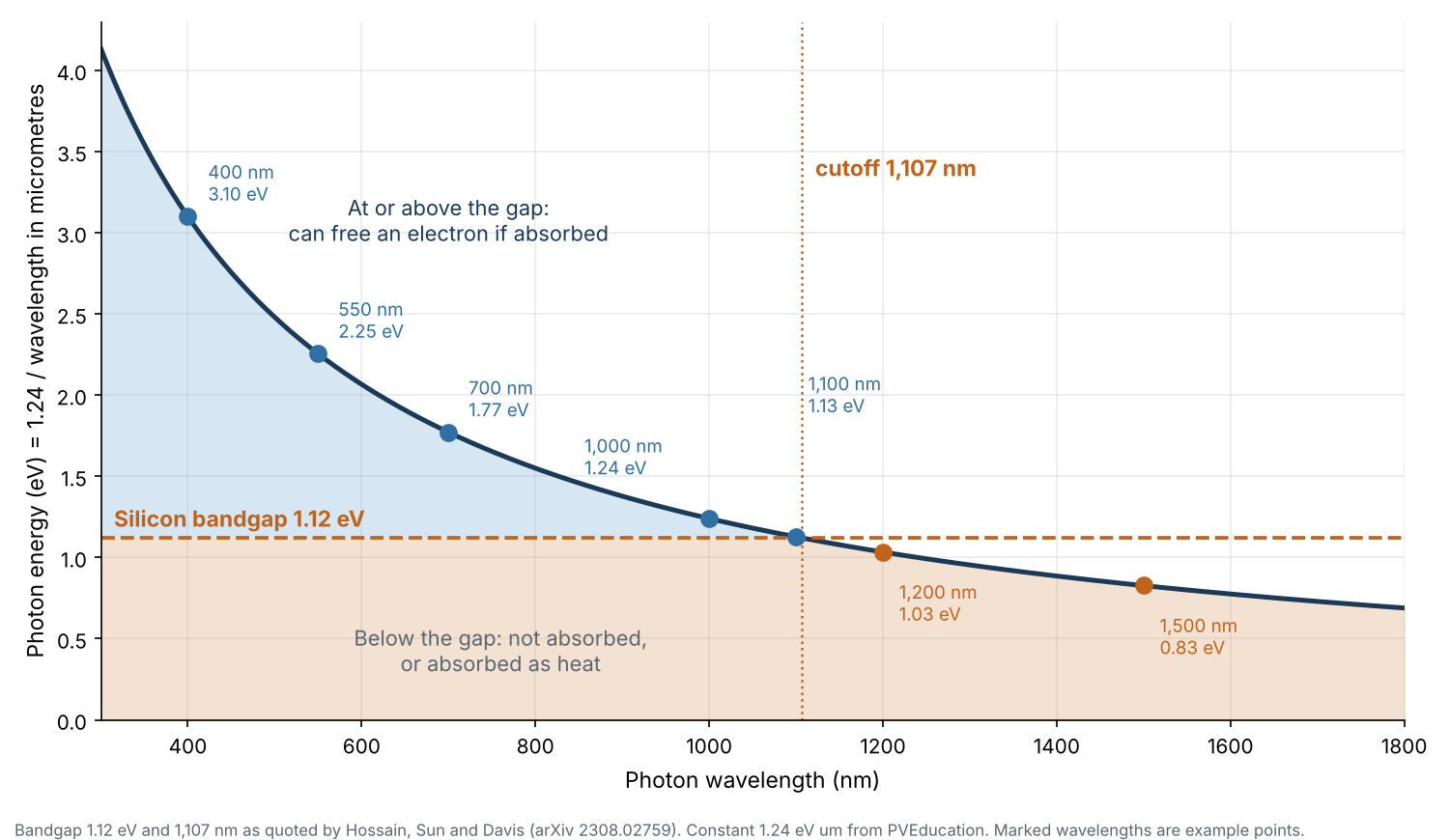
Figure 1. A 1.12 eV gap puts silicon’s cutoff at 1,107 nm: a 400 nm photon carries 3.10 eV, a 1,500 nm photon only 0.83 eV.
Worked example: which photons can a silicon cell use?
A photon can free an electron in silicon only if its energy is at least 1.12 eV. That means a wavelength of 1,107 nm or shorter. The wavelengths below are example points. They are not measurements.
| Wavelength | Photon energy | Against the 1.12 eV gap | Energy above the gap |
|---|---|---|---|
| 400 nm | 3.10 eV | At or above | 1.98 eV (63.9% of the photon) |
| 550 nm | 2.25 eV | At or above | 1.13 eV (50.3%) |
| 700 nm | 1.77 eV | At or above | 0.65 eV (36.8%) |
| 1,000 nm | 1.24 eV | At or above | 0.12 eV (9.7%) |
| 1,100 nm | 1.13 eV | At or above | 0.01 eV (0.6%) |
| 1,200 nm | 1.03 eV | Below | None. 0.09 eV short |
| 1,500 nm | 0.83 eV | Below | None. 0.29 eV short |
Energy is 1.24 ÷ wavelength in micrometres. The constant 1.24 eV·µm is PVEducation’s shortcut. The Hossain review and the Ioffe database both give 1.12 eV for silicon, the database at 300 K. At the cutoff, 1.24 ÷ 1.12 gives 1,107 nm. That matches the review.
The table is math only, and an installer’s tool does not trace photons. It uses the single-diode module model in the software section. The table does not say what happens to the energy above the gap. It also treats the gap as a sharp edge. The review notes that "not all will get absorbed and generate an electron-hole pair". The gap sets what is possible. It does not set what a cell yields. For yield, see energy yield simulation.
Photon energy and bandgap calculator
Enter a wavelength and a bandgap. The starting values match the 1,200 nm row above.
If the calculator does not load, open the photon energy and bandgap calculator on its own page.
How does PV differ from solar thermal?
PV turns light straight into electricity in a semiconductor. Solar thermal collects the sun’s heat. A thermal system can also make electricity. It can do so only through heat, steam and a generator.
| Question | Photovoltaic | Solar thermal |
|---|---|---|
| What it makes | EIA: a PV cell "converts sunlight directly into electricity". | EIA glossary: a collector is "A device designed to receive solar radiation and convert it to thermal energy." |
| Usual use | EIA: "PV cells generate direct current (DC) electricity". | EIA glossary: "The energy is usually used for space heating, for water heating, and for heating swimming pools." |
| Route to electricity | Direct, in the cell. EIA calls the cell "a nonmechanical device". | EIA: "In most types of systems, a heat-transfer fluid is heated and circulated in the receiver and used to produce steam", and a turbine "powers a generator to produce electricity." |
| Use of "panel" | EIA: "PV panel (sometimes called a module)". | EIA glossary: "Solar thermal panels" is a system that "actively concentrates thermal energy from the sun by means of solar collector panels." |
So "solar panel" alone does not say which one you mean. Say "PV module" when you mean the electricity unit. See solar panel (module).
How far does "PV" stretch from cell to system?
It names every level. These are PV cell, PV panel or module, PV array and PV system. Each level has its own page. This one only shows the words.
| Word | What the pages say | Detail page |
|---|---|---|
| PV cell | EIA: "The PV cell is the basic building block of a PV system." | Solar cell |
| PV panel or module | EIA: "PV cells are electrically connected in a packaged, weather-tight PV panel (sometimes called a module)." | Solar panel (module) |
| PV array | EIA: "PV panels can be connected in groups to form a PV array." | Solar array |
| PV system | pvresources glossary: "an installation of PV modules and other components designed to produce power from sunlight." | Inverter |
Cell structure is its own topic. See n-type TOPCon and HJT and PERC and half-cut cells. DOE lists crystalline silicon, thin-film cadmium telluride and CIGS, perovskite, organic, quantum dot and multijunction cells. Each material has its own bandgap.
How solar software handles the photovoltaic effect
Both tools we checked document a single-diode module model rather than tracing photons. To compare simulators that use such models, see the best solar simulation software.
| Software | Documents a single-diode module model? |
|---|---|
| pvlib python | Yes |
| PVsyst | Yes |
What each page says is listed here, with the page we read.
- pvlib python: Page read: Single diode models, docs version 0.16.1 (current stable as of November 2026). No date shown. It lists calcparams_cec, calcparams_pvsyst and calcparams_desoto. The page says "Single-diode models are a popular means of simulating the electrical output of a PV module under any given irradiance and temperature conditions."
- PVsyst: The page title is "Standard one-diode-model". It describes a "one diode" equivalent circuit "for describing a PV cell". It assumes the photocurrent is "perfectly proportional" to irradiance. Page read: PV Module - Standard one-diode-model. No date shown, October 2026
The table asks only whether the page names a single-diode model. It does not rate accuracy. See pvlib and standard test conditions. They cover the datasheet values these models use.
Common mistakes with photovoltaic
FAQs
What does PV stand for in solar?
PV stands for photovoltaic. It is mostly an adjective. Examples are PV cell, PV module, PV array and PV system. It is also a short noun for photovoltaics.
Is photovoltaic the same as a solar panel?
Not always. "Solar panel" can mean a PV module or a solar thermal collector panel. Photovoltaic names the electricity route, so "PV module" is the exact wording.
Why does a PV cell make DC, not AC?
The junction field separates the charges in one direction, so the current flows one way and is DC. EIA says "PV cells generate direct current (DC) electricity." An inverter converts it to AC. See inverter.
Is every PV cell made of silicon?
No. DOE’s cell basics page names crystalline silicon, cadmium telluride, CIGS, perovskite, organic, quantum dot and multijunction cells. The 1.12 eV gap on this page is for silicon only.
Related terms
- Solar cell: the single PV device that converts light to current.
- Solar panel (module): cells sealed in one weather-tight unit.
- Solar array: modules wired to work as one generator.
Next step: find the cell type and the module model on your next datasheet, then try the best free solar design software on a real roof.
Sources
- EIA, Photovoltaics and electricity. No page date. Checked October 2026.
- EIA glossary, entries starting "Solar". No page date. Checked October 2026.
- EIA, Solar thermal power plants. No page date. Checked October 2026.
- DOE, Solar Photovoltaic Cell Basics. No page date. Checked October 2026.
- DOE, Solar Photovoltaic Technology Basics. Metadata: published 2020-10-22, modified 2026-09-02. Checked October 2026.
- PVEducation. No page dates. Checked October 2026. Energy of a photon, Band gap, Light-generated current and The photovoltaic effect.
- Hossain, Sun and Davis, Photon Management in Silicon Photovoltaic Cells, arXiv 2308.02759. No date shown. Checked October 2026.
- pvresources, Photovoltaics introduction and glossary. Both state "last time updated on 17th April, 2022". Checked October 2026.
- Online Etymology Dictionary, photovoltaic. No page date. Checked October 2026.
- Smee on Electro-Biology, Journal of Psychological Medicine and Mental Pathology, 1849 (text read in a mirror of the PMC record). The pvresources introduction also gives Smee’s 1849 book as the first known use. Checked 30 October 2026.
- Ioffe Institute, Silicon band structure. Energy gap 1.12 eV at 300 K. Checked 30 October 2026.
- Online Etymology Dictionary, voltaic. No page date. Checked October 2026.
- DOE, The History of Solar. No date shown. Checked October 2026.
- APS News, First Practical Silicon Solar Cell. Published 1 April 2009. Checked October 2026.
- pvlib, Single diode models. Version 0.16.1. No date shown. Checked 3 November 2026.
- PVsyst, PV Module standard one-diode model. No date shown. Checked October 2026.
Last updated 3 November 2026. Next scheduled review: 30 January 2027.