A solar CRM is software that tracks each lead, quote and job for a solar company. In Australia it must also carry STCs (small-scale technology certificates, a federal solar rebate) and state scheme figures through the quote. Pylon ranks first on this list, at 77.8/100.
The field is thin. We scored 11 tools: 5 ranked (2 of them general CRMs) and 6 also considered. Only three solar-specific CRMs reached our minimum match score (4 out of 10), so two general CRMs complete the list of five. We could only check Pylon’s UK prices, and SolarHub CRM is documented only from third-party listings.
Quick picks
Rank | Product | Best for | Starting price (checked October 2026) | Pricing model | Free plan / trial | Score /100 |
|---|---|---|---|---|---|---|
1 | Design, STC quoting and CRM from one Australian company | ✓ AUD not confirmed. UK page GBP 4 per project, CRM from GBP 49 per user per month | Per project, plus per-user CRM | 5 free project credits | 77.8 | |
2 | Teams already on HubSpot marketing | ✓ Free. Starter USD 7 or USD 20 per seat per month | Per seat | Free for up to 2 users | 65.1 | |
3 | Free design, proposals and lead capture | ✓ Free core platform | Free. Paid API and accounting connectors | Free core platform | 62.7 | |
4 | Configurable pipelines on a budget | ✓ Free. AUD price not captured | Per user | Free for up to 3 users. Trial offered | 60.2 | |
5 | Low-cost lead and proposal CRM for small teams | ? Free. Paid tiers from USD 29 per month (Capterra. Company may bill in AUD) | Monthly tiers by designs and users | Free plan (limits unconfirmed) | 49.2 |
✓ Verified on the company’s own pricing page. ◐ Published by the company outside its pricing page (help centre, store or press release). ? We could not read the company’s pricing page, so the figure is not confirmed. Prices checked October 2026.
How the 5 tools scored
- Use-case fit 35%
- User reviews 20%
- Pricing 15%
- Ease of use 10%
- Support 10%
- Momentum 10%
Tool | Score chart | Score |
|---|---|---|
77.8 out of 100 | 77.8 | |
65.1 out of 100 | 65.1 | |
62.7 out of 100 | 62.7 | |
60.2 out of 100 | 60.2 | |
49.2 out of 100 | 49.2 |
Each bar shows the weighted score out of 100. Tools marked (general) are general tools that are not solar-specific.
Sub-scores at a glance (0-10)
Product | Use-case fit | User reviews | Pricing | Ease of use | Support | Momentum | Total /100 |
|---|---|---|---|---|---|---|---|
7.1 | 6.7 | 8.0 | 7.5 | 10.0 | 10.0 | 77.8 | |
5.7 | 7.4 | 7.0 | 7.5 | 7.5 | 5.0 | 65.1 | |
4.8 | 5.0 | 9.0 | 7.5 | 5.0 | 10.0 | 62.7 | |
5.7 | 6.2 | 7.0 | 7.5 | 5.0 | 5.0 | 60.2 | |
6.2 | 5.0 | 3.0 | 5.0 | 5.0 | 3.0 | 49.2 |
A 5.0 on reviews, ease, support or momentum is our neutral score. We use it when public evidence is thin. It is not a judgement.
Why do so few solar CRMs qualify in Australia?
An Australian home quote is shaped by incentives and consumer rules. These include STCs and the Cheaper Home Batteries rebate. State schemes such as PDRS (the NSW Peak Demand Reduction Scheme) and VEECs (Victorian energy efficiency certificates) add more.
Retailers also carry NETCC (New Energy Tech Consumer Code) obligations. A CRM that cannot carry those figures through the quote leaves your office re-keying numbers between tools.
In our research, those workflows mostly live in Australian design and quoting tools, not in CRMs. Solar Proof calculates STCs, Cheaper Home Batteries rebates and VEECs. SolarPlus is built around Australian design and quoting.
Both are proposal platforms with light or no CRM, so they fell below the minimum score. For the Australian-built job-management tools ServiceM8, AroFlo and Simpro, we found no STC workflow documented at all.
That leaves three solar-specific CRMs, and only Pylon combines Australian incentive handling, a real CRM and a review record. HubSpot Sales Hub and Zoho CRM, both general CRMs, complete the list. HubSpot ranks above OpenSolar on its large review base and published prices, though it has no solar features.
Comparing outside Australia? See our best solar CRM guide and the UK and India versions. For design and STC quoting tools, see our best solar design software Australia page.
How did we rank solar CRMs for Australia?
How the score is weighted
- Use-case fit 35%
- User reviews 20%
- Pricing 15%
- Ease of use 10%
- Support 10%
- Momentum 10%
We did our desk research from 22 to 25 October 2026 and checked prices and ratings on 22 October. We used company pages and public user reviews. We did not run a sales pipeline in any tool.
- Use-case fit (35%): How well the tool does this page’s job. CRM counts most, then lead management, then workflow automation and proposals. Tools with no named Australian presence score lower, and tools with no Australian presence at all score much lower.
- User reviews (20%): G2, Capterra and similar ratings. Ratings based on only a few reviews count for less, and tools with no reviews get a middle score.
- Pricing transparency (15%): Prices published on the company’s own page score higher than prices you must ask for or prices from a third party.
- Ease of use, support and product momentum (10% each): We take these from review sub-scores and dated release notes. Without evidence, a tool gets a middle score here. Momentum is cut when we could not confirm core facts on the company’s site.
Scores are specific to this page’s job, so the same tool can score differently elsewhere.
Every page ranks at least five products, so general tools that reach the minimum score join in score order until there are five. Third-party ratings are context only and never used in rating markup. SurgePV is not part of this ranking.
Read the full method: how we score software.
1. Pylon: best for design, STC quoting and CRM from one Australian company
Best for: Small and mid-sized Australian installers who want incentives handled in the quote and a CRM they switch on per user. Score: 77.8/100.
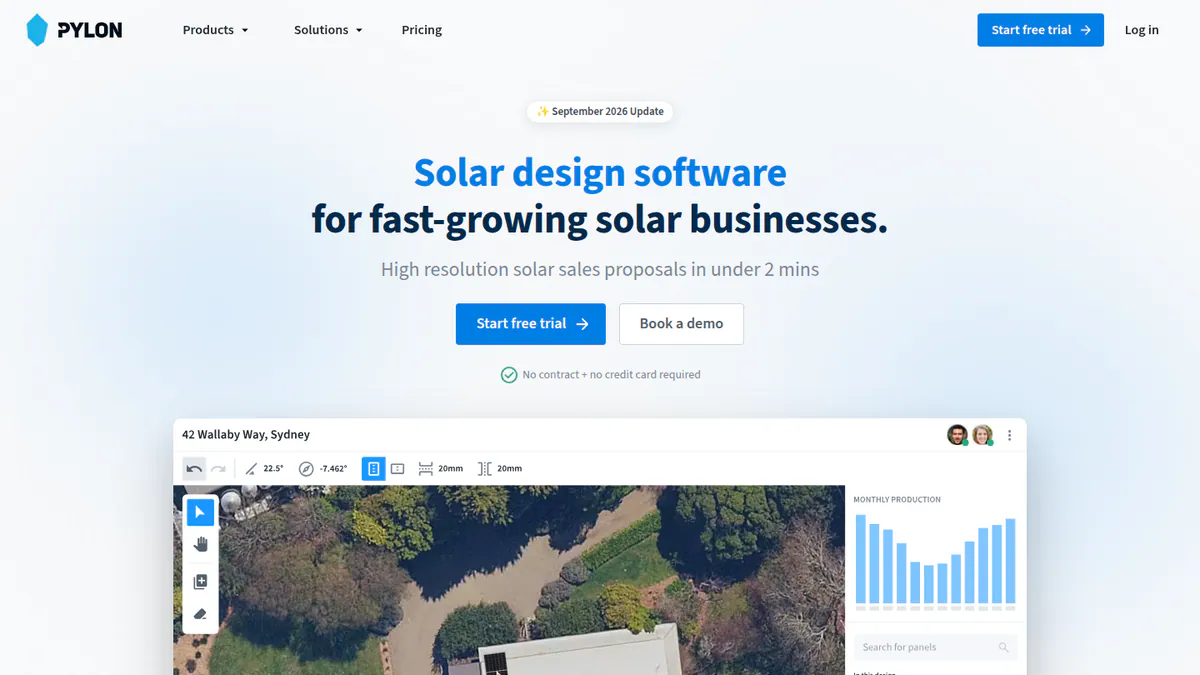
What it is: Pylon is a solar design and proposal tool from Sydney, with an optional solar CRM add-on. It is sold per project, with unlimited users. It is the only ranked tool that documents Australian STC and PDRS incentives.
Why we picked it: Australian quotes live or die on incentive figures, and Pylon carries them from design through to the proposal and CRM. It also scored top marks for support and recent product updates.
Key features:
- STC and PDRS incentives in Australian quotes.
- Optional solar CRM with automations, web forms and SMS.
- Solar and battery design on aerial imagery.
- Web and PDF proposals with eSignature.
- Connections to Xero, ServiceM8, Amber VPP (virtual power plant), Mailchimp and Facebook.
- Editable single-line diagrams (SLDs, simple drawings of how the wires connect) and an API with webhooks (ways for other apps to connect). Dated updates run through July 2026.
Pricing: We could not confirm Pylon’s AUD prices. Its UK page lists Standard at GBP 4 per project (up to 30 kW DC) and Pro at GBP 10 per project. Enterprise is quote only. The Solar CRM add-on starts at GBP 49 per user per month, with email sync, a lead processor, SMS, web forms and AI assistance. New accounts get five free Standard projects, with no card needed. Checked October 2026 on the Pylon UK pricing page. Ask Pylon for the Australian price list.
Pros (from user reviews on Capterra and G2):
- Paying per project keeps costs low for small operators.
- Beginners learn it quickly with the manual, though one reviewer says the interface takes time to pick up.
- Quotes and proposals come out detailed and thorough.
Cons (from reviews and our research):
- Aerial imagery varies by location, and the Nearmap link is inconsistent.
- Reviewers find the usage modelling awkward.
- The CRM is a per-user add-on on top of project fees.
Reviews: Capterra 4.6/5 (25 reviews) and G2 4.3/5 (2 reviews), checked October 2026. Most Capterra reviews date from 2021-2023, before the CRM and SLD updates.
Read our full Pylon review or our Pylon alternatives.
Want to see Pylon working? Book a demo with the SolarSoftwares team.
Book a demoYour request goes by email to the SolarSoftwares team. A time is set only after we reply. It does not change any score or ranking.
2. HubSpot Sales Hub (general sales CRM): best for teams already on HubSpot marketing
Best for: Installers whose sales and marketing already run in HubSpot. Score: 65.1/100.
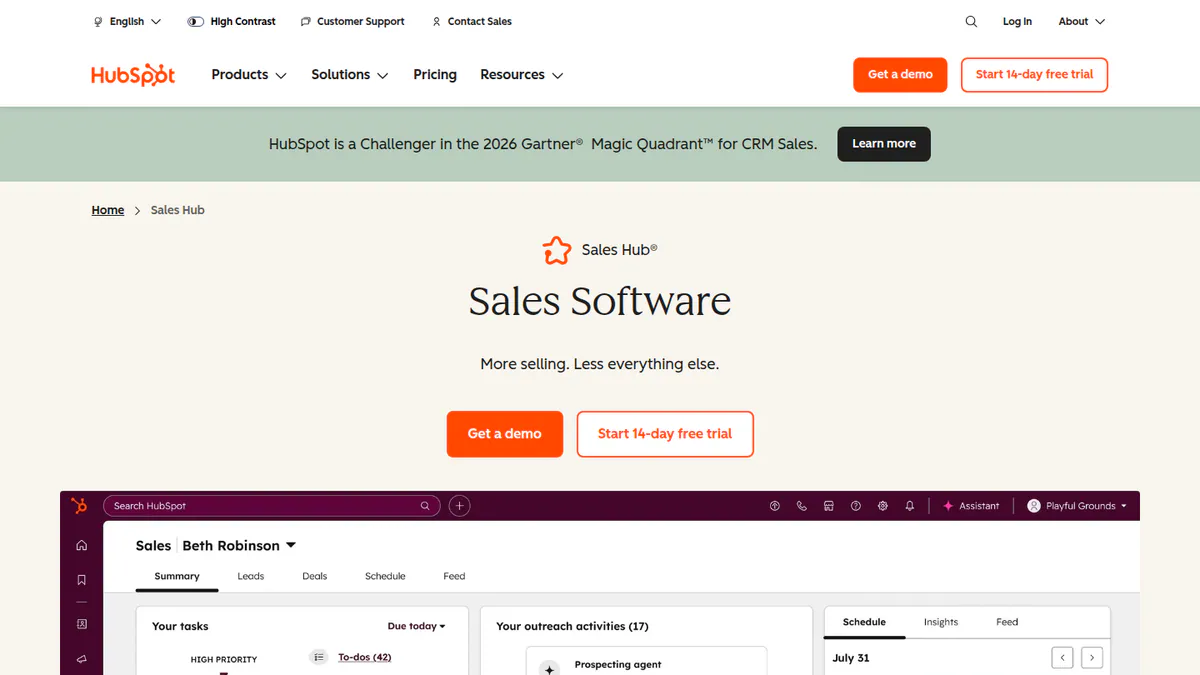
What it is: HubSpot Sales Hub is a general sales CRM from HubSpot, Inc., not a solar tool. Sales teams use it for pipelines, sequences, calling and quotes. A third-party app (Saular) links it to OpenSolar, and SolarPlus and Solar Proof both list HubSpot as a connection.
Why we picked it: It is a proven sales CRM with 506 Capterra reviews and published prices. Australian quoting tools already connect to it, so you can add STC quotes without changing CRM.
Key features:
- Contact, deal and pipeline management.
- Email tracking, templates and meeting links.
- Sequences and sales automation on paid tiers.
- Calling and conversation tools.
- Dashboards and reporting.
- Marketplace apps, including a third-party two-way OpenSolar sync.
Pricing: Free for up to 2 users. Starter is USD 7 or USD 20 per seat per month (the page does not label which is the annual rate). Professional is USD 90 or USD 100 per seat per month, plus a required USD 1,500 onboarding fee. Enterprise starts at USD 150 per seat per month, plus USD 3,500 onboarding. Checked October 2026 on the HubSpot pricing page. Other currencies are selectable there, but we did not record AUD prices.
Pros (from user reviews on Capterra):
- A central pipeline and automation help close deals faster.
- It works closely with HubSpot’s marketing tools, so leads flow straight into sales.
- Prospect tracking is detailed, which helps the whole team follow up.
Cons (from reviews and our research):
- Costs rise quickly as you add seats and tiers.
- Calling tools can be buggy, and some find support hard to reach.
- No STC, rebate or state-scheme fields, so you build them yourself.
Reviews: Capterra 4.5/5 (506 reviews), checked October 2026.
Want to see HubSpot Sales Hub (general sales CRM) working? Book a demo with the SolarSoftwares team.
Book a demoYour request goes by email to the SolarSoftwares team. A time is set only after we reply. It does not change any score or ranking.
3. OpenSolar: best for free design, proposals and lead capture
Best for: Installers who want zero licence cost and can accept a light CRM. Score: 62.7/100.
What it is: OpenSolar is a free design, proposal and sales platform from OpenSolar Inc., funded by hardware and finance partners. Australia is one of its named markets. It is a proposal platform with lead tools, not a full CRM.
Why we picked it: It gives you design, proposals and lead capture with no licence cost. That makes it a free way to start a solar sales pipeline.
Key features:
- AI lead generation and PROfile lead capture (June 2026).
- Sales tools added in August 2026.
- Interactive web proposals with e-signature and payment collection.
- Free 3D and 2D rooftop design with shading.
- Integrated finance options and a hardware shop.
Pricing: The core platform is free, and OpenSolar says it "will always be free". Since 16 April 2026, API access and the Xero and QuickBooks connectors carry fees OpenSolar does not publish. API access has a 30-day free trial, and premium imagery is an optional paid add-on. Checked October 2026 on OpenSolar’s pricing announcement.
Pros (from reviews and our research):
- No licence cost for the core platform, for any number of users.
- Adding, removing and changing panels is very easy, says a G2 reviewer.
- Crews get a user-friendly app with job details on site, says another reviewer.
Cons (from reviews and our research):
- It is "not completely free" once you need add-ons, says a G2 reviewer.
- Panel layouts still need an engineering review, as design lacks automatic customisation.
- We found no STC or state-incentive workflow, so rebate figures come from another tool.
Reviews: G2 4.8/5 (3 reviews), checked October 2026. That is too few to rely on, and we found no Capterra listing.
Read our full OpenSolar review or our OpenSolar alternatives.
Want to see OpenSolar working? Book a demo with the SolarSoftwares team.
Book a demoYour request goes by email to the SolarSoftwares team. A time is set only after we reply. It does not change any score or ranking.
4. Zoho CRM (general sales CRM): best for configurable pipelines on a budget
Best for: Installers with someone who can build solar stages and incentive fields. Score: 60.2/100.
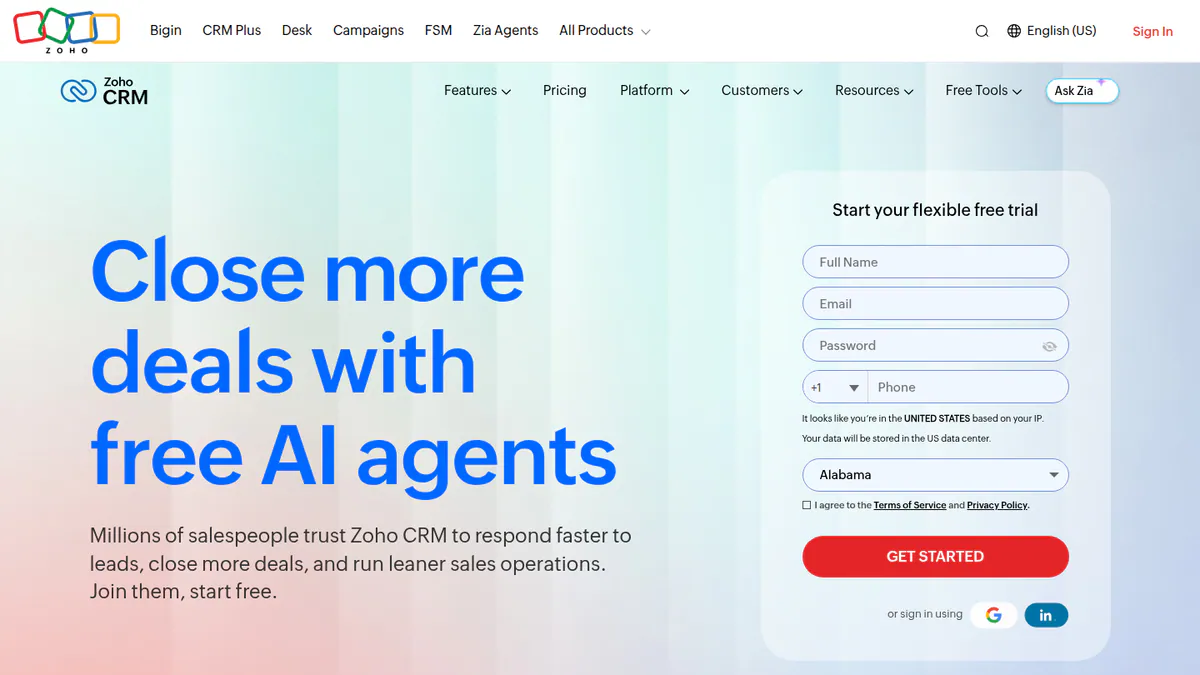
What it is: Zoho Corporation makes Zoho CRM, a low-cost, customisable general CRM with a large review record and a free plan. It is not solar-specific. Solar workflows come from partner customisation or an Aurora Solar API tutorial, not from Zoho itself.
Why we picked it: It has the largest review base on this page and a free plan for 3 users. Someone handy with setup can shape it around your STC and rebate steps.
Key features:
- Leads, contacts, deals and pipelines.
- Workflow automation and blueprints for process steps.
- Custom dashboards and modules.
- Links to Zoho Books, Desk, Sign and Analytics.
- Aurora Solar API tutorial for creating projects.
Pricing: Free for up to 3 users. The only price list we could check was in INR. It runs from Standard at INR 800 per user per month (billed annually) to Ultimate at INR 2,600. Check AUD prices on Zoho’s site. A free trial is offered, but its length is not stated. Checked October 2026 on Zoho’s edition comparison.
Pros (from user reviews on Capterra):
- Most reviewers find it easy to use, though some say the screens feel cluttered.
- You can shape dashboards, workflows and blueprints around your own job steps.
- Good value for money compared with rivals.
Cons (from reviews and our research):
- Setup has a learning curve and may need outside help.
- Support can be slow, reviewers say.
- No STC or rebate fields come built in, and we found no named Australian presence.
Reviews: Capterra 4.3/5 (7,005 reviews) and G2 4.1/5 (2,947 reviews), checked October 2026.
Want to see Zoho CRM (general sales CRM) working? Book a demo with the SolarSoftwares team.
Book a demoYour request goes by email to the SolarSoftwares team. A time is set only after we reply. It does not change any score or ranking.
5. SolarHub CRM: best for a low-cost lead and proposal CRM
Best for: Solo installers and small teams who want a solar CRM with a free tier. Score: 49.2/100.
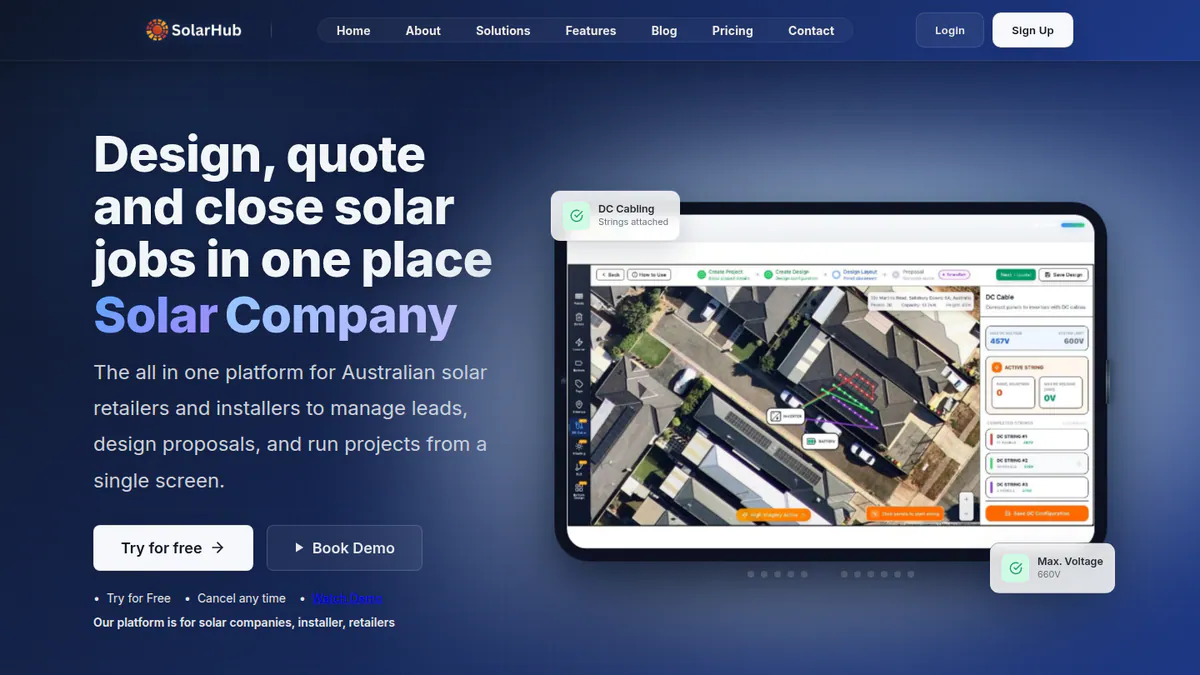
What it is: SolarHub CRM, from Glytrix, is a solar CRM on a .com.au domain. It offers lead capture, proposal templates and simple design sketching. It is not the same business as solarhub.net.au. Note: we could not open SolarHub CRM’s website for this update, so its prices, free-tier limits and currency are unconfirmed. Its facts come mainly from Capterra and an earlier check of the company homepage.
Why we picked it: It is built as a solar CRM for small teams, with a free tier and low-cost paid plans. It made the list because so few solar CRMs qualify in Australia, so treat it as a cautious pick.
Key features:
- Lead capture with automated lead assignment.
- Proposal templates with e-signature.
- Solar design sketching for proposals.
- Lead source integrations, from 3 up to unlimited by tier.
- Workflow automations on Pro, with web, Android and iOS access.
Pricing: Capterra lists these prices in USD. Free covers 5 designs and 50 tokens a month, up to 3 users and 500 leads. Standard is USD 29 per month (30 designs, 300 tokens, 5 users). Premium is USD 49 per month (50 designs, 500 tokens, 7 users), and Pro is USD 199 per month (200 designs, 2,000 tokens, 20 users). Enterprise is on request. On paid plans, extra designs cost USD 1 each and extra users USD 3.99. Capterra lists no free trial. An earlier check of the company homepage recorded the same tier prices with AUD implied. It also showed a free tier of 25 quotes a month and 4.99 per extra user. So confirm the currency and limits with SolarHub CRM. Checked October 2026 on SolarHub CRM’s Capterra listing.
Pros (from our research):
- Built as a solar CRM, not a design tool with a CRM bolted on.
- Leads, proposals with e-signature and design sketches sit in one tool.
- Staff can work on the web, Android or iOS.
Cons (from our research):
- No user reviews to judge it by.
- We found no STC or state-incentive calculation.
- We found no named integrations beyond lead sources, and no release notes.
Reviews: No user reviews on Capterra (0) or G2 as of October 2026.
Read our full SolarHub CRM review.
Want to see SolarHub CRM working? Book a demo with the SolarSoftwares team.
Book a demoYour request goes by email to the SolarSoftwares team. A time is set only after we reply. It does not change any score or ranking.
How do these solar CRMs compare for Australia?
Product | Type | Australian presence (our research) | STC / state incentives documented | Price as published | Reviews (October 2026) |
|---|---|---|---|---|---|
Design and proposals plus CRM add-on | Sydney-based | STC and PDRS | AUD not confirmed (GBP 4/project UK) | Capterra 4.6 (25) | |
HubSpot (general) | General sales CRM | Global only | No | Free. Starter USD 7-20/seat/mo | Capterra 4.5 (506) |
Free proposals with lead tools | Named market | Not documented | Free core | G2 4.8 (3) | |
General sales CRM | Global only | No | Free (3 users). AUD not captured | Capterra 4.3 (7,005) | |
Solar CRM | .com.au, Capterra lists Australia | Not documented | Free. From USD 29/mo (Capterra. Company may bill in AUD) | None |
Also considered
- SolarPlus (just below the minimum score): a Victorian design, quoting and sales platform founded in 2011. It has light CRM features (lead sync, scheduling, sales reporting) and integrates with Xero, HubSpot, Simpro and SolarQuotes. Plans start at USD 135 per month on annual prepay, with AUD 500 or AUD 1,000 onboarding packs (checked October 2026). It does not say whether onboarding is mandatory. It is strong on design but too light on CRM for this list.
- ServiceM8 (strong reviews, but just below the minimum score): a Sydney-built trades job-management app, priced by jobs per month with unlimited users on paid plans. Capterra lists AUD 29 per month for Starter, which we could not confirm on the company’s AU page. It integrates with Pylon, so it makes a sensible job-side partner. But it is a general tool with no solar features.
- Solar Proof (a proposal tool, below the minimum score): an Australian design and proposal tool that calculates STCs, Cheaper Home Batteries rebates and VEECs. It describes its proposals as NETCC-compliant (the company’s own claim), and pay-as-you-go starts at AUD 4 per project (AUD implied). It is not a CRM, but it connects to HubSpot, Zoho, Less Annoying CRM and monday.com.
- AroFlo (a weak match for this job): Melbourne-built trades job management from AUD 80 per user per month, with a minimum of 3 users. Its solar page lists no STC features.
- Simpro (a weak match for this job): Brisbane-built, quote-only field service for mid-sized and larger contractors. Its solar page shows no solar-specific features.
- Tradify (a weak match for this job): a New Zealand trades job-management app. We found no AUD prices or solar features.
- Formbay: an STC compliance tool, next to a CRM but not one, so not scored.
How do you choose a solar CRM in Australia?
- Want STCs, a CRM and design from one Australian company? Pick Pylon, and ask for the AUD price list before committing.
- Teams already running HubSpot or Zoho should keep it and connect a quoting tool that handles STCs, such as Solar Proof.
- When licence cost must be zero, use OpenSolar for proposals and lead capture, and add a CRM later.
- Need only a cheap lead and proposal pipeline for a small team? Trial SolarHub CRM’s free tier and confirm the currency and limits in writing.
- If your pain is scheduling crews and invoicing rather than sales, look at job-management tools. See our solar field service management guide.
- For the global shortlist, read our best solar CRM guide. For no-cost options, see free solar CRM.
Want more choices? Browse every tool we checked in our CRM and lead management category.
Solar CRM Australia FAQs
What is the best solar CRM in Australia?
Pylon is the best solar CRM in Australia in our October 2026 ranking, at 77.8/100. It is Sydney-based, documents STC and PDRS incentives, and adds a CRM to pay-per-project design. Only three solar-specific CRMs qualified, so check Pylon’s AUD pricing directly.
How much does solar CRM software cost in Australia?
OpenSolar’s core platform is free, and HubSpot and Zoho CRM have free plans for 2 and 3 users. SolarHub CRM has a free tier, then USD 29 to USD 199 per month (Capterra). Pylon’s AUD prices are unconfirmed, and its UK CRM add-on is GBP 49 per user per month.
Can a solar CRM calculate Australian STCs?
Among the CRMs we ranked, only Pylon documents STC and PDRS incentives in its quotes (October 2026). Solar Proof calculates STCs, Cheaper Home Batteries rebates and VEECs, but it is a design and proposal tool, not a CRM. Many installers pair it with HubSpot or Zoho.
Is OpenSolar free for Australian solar companies?
Yes, the core design, proposal and sales platform is free, and OpenSolar says it will stay free. Since 16 April 2026, API access and the Xero and QuickBooks connectors carry unpublished fees. Premium imagery is a paid add-on (checked October 2026).
Should an Australian installer use a solar-specific CRM or Zoho?
Use Zoho CRM if someone on your team can build solar stages and incentive fields. It has a free plan for 3 users and 7,005 Capterra reviews (October 2026). Use a solar-specific tool such as Pylon if you want STC handling and solar proposals without that work.
Does using solar CRM software make a retailer CER or NETCC compliant?
No. Compliance obligations sit with the business, not the software. In our October 2026 research, no CRM documented CER (Clean Energy Regulator) or NETCC compliance workflows. Solar Proof, a proposal tool, calls its proposals NETCC-compliant, but that is the company’s own claim.
Sources
All checked 22 October 2026. Pylon, OpenSolar, SolarHub CRM (Capterra) and Solar Proof re-checked 25 October 2026.
- Pylon: UK pricing, July 2026 update, Capterra, G2
- OpenSolar: pricing announcement, news, G2
- SolarHub CRM: Capterra, company homepage (earlier check)
- HubSpot Sales Hub: pricing, Saular OpenSolar app, Capterra
- Zoho CRM: edition comparison, Capterra, G2
- SolarPlus: pricing, features. Solar Proof: pricing, features
- ServiceM8: Capterra. AroFlo: pricing. Simpro: solar industry page. Tradify: Capterra
Last updated 28 October 2026. Next scheduled review: 23 January 2027.